Metanoia Faith

An Invitation · For Our Protestant Friends

I am Catholic — main site

You Already Believe More Than You Think.

You love the Scriptures, you confess the Trinity, you trust the Cross, and you await the risen Lord. So do we. This page is not a debate trap. It is an honest account of what the Catholic Church actually teaches, where the caricatures got it wrong, and where we still disagree — written by people who would count it a joy to have you at our altar.

I. First, What We Hold Together

We Are Not Starting From Nothing.

Much of what is called “the Catholic faith” is simply the faith you already profess. Before a single difference is named, this is the ground we share — and it is far larger than the ground we dispute. If you are a Bible-believing Protestant, you already hold most of what we hold dearest.

The Holy Trinity

One God in three Persons — Father, Son and Holy Spirit. We confess the same Creeds of Nicæa and the Apostles, word for word.

Jesus Christ, God and Man

Truly God and truly man, born of the Virgin Mary, crucified under Pontius Pilate, risen bodily on the third day. Defined at Chalcedon in 451, and held by every Catholic.

Scripture as the Word of God

Inspired, trustworthy, and the Church's daily food. We read it more, not less. It is read at every Mass, and the whole Psalter every four weeks.

Salvation by grace

We do not save ourselves, and we never claim to. Grace is a gift, Christ is the only Saviour, and His blood is the only ransom.

The Cross and the Empty Tomb

His death for our sins, His burial, His resurrection — of first importance, as Paul says (1 Corinthians 15:3–4). Everything we teach hangs on it.

Sin, judgment, heaven and hell

We are all sinners, judgment is real, and eternity depends on Christ. We have not softened His warnings or traded them for comfort.

The moral law

The Ten Commandments, the sanctity of life, chastity, the permanence of marriage. The Catholic moral vision is not the world's.

The Great Commission

Make disciples of all nations (Matthew 28:19). The Church exists for mission, and the unchurched are not our project — they are our family to find.

Prayer, fasting and almsgiving

The disciplines Protestants have long practised are the disciplines we require of ourselves — and multiply in Lent.

We are not asking you to become someone else. We are asking whether the Lord who gave you all of this intends to give you more.

Before You Read Another Claim

What “CCC” Means — and Why We Keep Citing It

Throughout this site you will see references such as CCC 1030–1032 set beside passages of Scripture. CCC stands for Catechism of the Catholic Church: the Church's single reference work, published in 1992, which sets out in numbered paragraphs what Catholics believe, how they worship, how they are to live, and how they pray.

It is not a new revelation, and it adds nothing to the faith once delivered to the saints. It gathers what the Church has always taught — out of Scripture, the Fathers, the Councils and the Creeds — into one place, so that a claim can be checked instead of inherited secondhand.

Read it as a map of how the Church reads the Bible. The Catechism quotes Scripture in nearly every paragraph, and it is arranged in four parts: the Creed (what we believe), the Sacraments (how we are made holy), Life in Christ (how we live), and Prayer (how we speak to God).

How to read a citation

A reference like CCC 1030–1032 means paragraphs 1030 to 1032; the paragraph mark § is used the same way. Every citation on this site can be looked up and read in full — we would far rather you check us than trust us.

CCC 1030–1032= paragraphs 1030 to 1032 of the Catechism

The Holy Trinity

Sacred Scripture · Matthew 28:19

“Go therefore and make disciples of all nations, baptizing them in the name of the Father and of the Son and of the Holy Spirit.”

Catechism · CCC 232–260

One God in three Persons — Father, Son and Holy Spirit — equal in majesty, undivided in being. The Catechism calls this the central mystery of the faith and the light by which every other mystery is read.

Scripture and Sacred Tradition

Sacred Scripture · 2 Thessalonians 2:15

“So then, brethren, stand firm and hold to the traditions which you were taught by us, either by word of mouth or by letter.”

Catechism · CCC 80–83

Scripture and Tradition flow from the same divine source and are honoured together. The Church serves the Word; she does not stand above it, and nothing is added to what the apostles handed on.

Grace and Justification

Sacred Scripture · Ephesians 2:8–10

“For by grace you have been saved through faith; and this is not your own doing, it is the gift of God — not because of works, lest any man should boast.”

Catechism · CCC 1987–1995

Justification is God's free gift, won by the Passion of Christ and received by faith. Works of love are its fruit, never its price. Grace comes first, always.

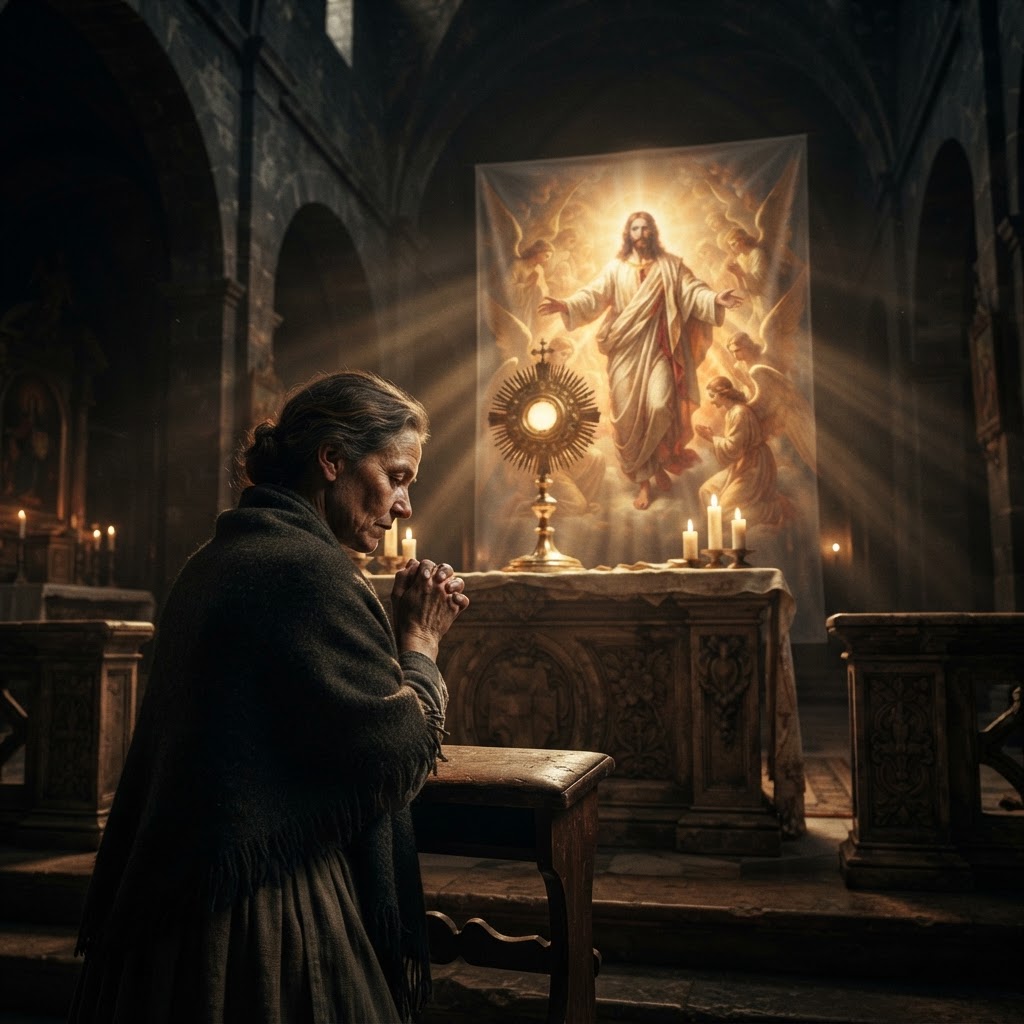
The Holy Eucharist

Sacred Scripture · 1 Corinthians 10:16

“The cup of blessing which we bless, is it not a participation in the blood of Christ? The bread which we break, is it not a participation in the body of Christ?”

Catechism · CCC 1373–1381

The body and blood, soul and divinity of Christ, truly, really and substantially present. The one sacrifice of Calvary is made present, never repeated.

Confession and Absolution

Sacred Scripture · John 20:22–23

“Receive the Holy Spirit. If you forgive the sins of any, they are forgiven; if you retain the sins of any, they are retained.”

Catechism · CCC 1422–1498

The risen Christ gave His apostles authority to forgive and to retain sins. That authority is exercised in the sacrament of Reconciliation, and the absolution spoken is His.

Mary, Mother of God

Sacred Scripture · Luke 1:43

“And why is this granted me, that the mother of my Lord should come to me?”

Catechism · CCC 495 · 963–971

The title defends Christ, not Mary: the child she bore is the eternal Son, so she is rightly called God-bearer. Honoured, never adored — and the first disciple.

Set a belief beside its Scripture and its paragraph, and the argument stops being about what Catholics are supposed to think.


II. What You Have Heard, and What We Actually Teach

Nine Things Catholics Are Supposed to Believe.

Most of what separates us is not the faith — it is a set of claims about the faith that were taught to you in good conscience by men who had themselves been taught them. Open any of these and read what the Church actually says, with the source beside it. Check us. We would rather be corrected than admired.

Worship belongs to God alone. Mary is honoured, not adored — and the Church condemns the worship of any creature as idolatry (CCC 2113). What she is, she is by grace: the woman God chose, who said “all generations will call me blessed” (Luke 1:48). We ask her to pray for us exactly as Paul asked the Romans to pray for him (Romans 15:30). The solemn title “Mother of God” (Theotokos, Ephesus 431) was defined to defend Christ against those who denied His divinity — not to exalt her.

Where to check it · Catechism 963–971 · Luke 1:43–48

III. The Core of the Catholic Faith, Stated Plainly

Six Things We Believe, and Why.

Not six novelties added to the Gospel — six places where we think the Gospel is fuller than we were told, argued from Scripture first and the earliest Christians second. Each one has a page of its own if you want the long case.

01

Scripture and Tradition, Not Scripture Alone

The Bible is not the Church's enemy; it is her book. But the New Testament itself says the Church is “the pillar and bulwark of the truth” (1 Timothy 3:15), commands the keeping of traditions received by word as well as by letter (2 Thessalonians 2:15), and calls no document the sole rule of faith. The practical test is the canon: the table of contents in your Bible was decided by the same Church whose Tradition you are asked to distrust. We hold Scripture as the supreme written authority, read within the living Church that recognised it.

2 Thessalonians 2:15 · 1 Timothy 3:15 · 2 Peter 1:20–21

How the Church reads Scripture
02

Grace and Faith All the Way Down — and Then Fruit

The Catholic doctrine is not “faith plus works” as a price. It is grace, from beginning to end: a real transformation of the soul, not merely a legal verdict. Paul tells us the love of God has been “poured into our hearts through the Holy Spirit” (Romans 5:5) and that “if anyone is in Christ, he is a new creation” (2 Corinthians 5:17). Faith is the hand that receives it. Then good works follow as fruit, and only because the grace is real — which is why we insist that grace changes us, rather than covering a man God still sees as unchanged.

Romans 5:5 · 2 Corinthians 5:17 · Galatians 5:6 · James 2:14–26

Justification by faith — the whole argument
03

The Eucharist Is Not a Symbol

“This is my body” (1 Corinthians 11:24), “unless you eat the flesh of the Son of Man and drink his blood, you have no life in you” (John 6:53), and “the bread which we break, is it not a participation in the body of Christ?” (1 Corinthians 10:16). The early Christians understood it before any medieval development: Ignatius of Antioch wrote in about 107 that some “do not confess the Eucharist to be the flesh of our Saviour”; Justin Martyr explained to the emperor in 155 that the bread and wine are “the flesh and blood of that Jesus who was made flesh.” If a Protestant has never seen the Church's own claim, it is usually this one that stops him.

1 Corinthians 10:16; 11:23–29 · John 6:48–69 · St. Ignatius, Smyrnaeans 7 · St. Justin, First Apology 66

The Eucharist — the full case
04

Sacraments: God Working Through Matter

You do not object to God using matter: He used mud and spittle, a hem, a bronze serpent, and a river called Jordan. The Catholic sacraments are that same pattern of condescension, instituted by Christ, through which the Gospel is not merely announced to a man but applied to him: washed, fed, anointed, absolved, forgiven, united. Grace does not despise the body; the Word became flesh precisely because it does not.

John 9:6–7 · 2 Kings 5:10–14 · James 5:14–15 · CCC 1123–1131

The Sacramental Life
05

Peter, the Keys, and a Visible Church

The strongest argument for the papacy is not Rome's grandeur; it is Isaiah 22. When the king's steward is removed, the prophet promises a new steward whose office is permanent — “I will place on his shoulder the key of the house of David… and he shall be a father to the inhabitants of Jerusalem” (Isaiah 22:22). Now hear Our Lord: “I will give you the keys of the kingdom of heaven… whatever you bind on earth shall be bound in heaven” (Matthew 16:19). Christ is quoting the office of the chief steward and conferring it on Peter. The early Church knew it: Corinth appealed to Rome to settle matters in AD 96, and Irenaeus, in 180, listed the Roman succession as the sure way for every church to find the apostolic faith.

Isaiah 22:20–24 · Matthew 16:16–19 · Luke 22:32 · John 21:15–17 · 1 Clement 63 · Irenaeus, Adversus Haereses III.3.2

The Seat of Peter — The Rock
06

Mary and the Saints: One Family, One Intercession

The Church on earth and the Church in heaven are not two Churches. Christ is “not ashamed to call them brethren” (Hebrews 2:11), and Abraham is called to remember us (Luke 16). The saints in glory are not asleep and not removed from us: Revelation shows them offering golden bowls of incense, “which are the prayers of the saints” (Revelation 5:8; 8:3–4). Asking Mary to pray for you is asking a sister in Christ to intercede — and no one in that family is closer to Him than His own Mother, who is the New Eve and the Ark in which He dwelt (Irenaeus, Adversus Haereses III.22.4; Revelation 11:19–12:1).

Hebrews 2:11 · Revelation 5:8; 8:3–4 · Luke 1:39–56 · St. Irenaeus III.22.4

The Communion of Saints

IV. Where We Still Disagree

Charity Does Not Require Us to Pretend.

A unity built on vagueness is not unity; it is a truce, and it collapses the first time someone reads the text closely. So here is the disagreement set out plainly — your position as you would state it, ours as we would state it, and why it matters. We are not asking you to agree. We are asking you to weigh it.

The rule of faith

As you would put it

Scripture alone is the final authority; the Church's Tradition is human addition.

As we would put it

Scripture is God's Word, read through the Church that recognised it. The canon itself is Tradition's fruit.

This is the hinge. Every other difference below follows from it.

Justification

As you would put it

Christ's righteousness is imputed; a believing man remains in himself unchanged and is covered.

As we would put it

Justification is real — the soul is truly made righteous by grace, and works of love are its fruit, not its price.

If grace transforms, the sacraments matter. If it only covers, they do not.

The Lord's Supper

As you would put it

A memorial, an ordinance, received by faith; the bread remains bread.

As we would put it

The body and blood of Christ, truly present; the memorial makes present what it remembers.

This is why we will not treat the disagreements as a matter of taste.

Sacraments

As you would put it

Ordinances showing obedience and confessing a faith already given.

As we would put it

Channels of real grace — visible words through which God acts.

The difference is whether God is present at the font, or only in the ear.

The visible Church

As you would put it

The true Church is invisible, and it can exist under many roofs.

As we would put it

One visible Body, one Head, and one steward with the keys among the apostles.

Where do you take a dispute? The New Testament's answer is a Council, not a parted congregation.

Purgatory and purgation

As you would put it

Dismissed as a second chance, or as payment squeezed from the fearful.

As we would put it

The forgiven being made ready for the vision of God, as nothing unclean can enter heaven.

Only matters if you think love persists across death — which the Church insists it does.

Assurance

As you would put it

Once saved, one's own perseverance need not be a live question.

As we would put it

Truly saved, yet warned to persevere; a gift cannot be taken from you, but a man can walk away.

Both of us quote Paul, and both of us must quote all of him.

The Catholic Way of Life

“You follow the traditions of men.” Have you counted yours?

The Catholic faith is not a rulebook. It is a way of reading Scripture and a way of walking it out — and the practices in your own Sunday that no verse commands are the very argument. A hermeneutic, a rhythm of life, and an honest comparison.

Read the case

VI. What To Do Next

Come and See. There Is Room for You Here.

We are not asking you to unlearn everything you love, or to abandon the Scriptures that formed you. We are asking you to follow them wherever they lead — and to do it slowly, honestly, and with the whole Church for a guide.

1

Pray before you read

Ask the Holy Spirit to lead you, and ask for the honesty we owe each other. Christ prayed that we would be one (John 17:21). That prayer is not answered by politeness, and not by silence.

2

Read the primary sources

You have likely heard what Catholics teach from those who left us. Read what we wrote: the Catechism, the Councils, the Fathers. Even now, they are more surprising than the caricature.

3

Come and see

Attend a Mass. Nobody will ask you to do anything embarrassing, and you are welcome to come forward for a blessing with your arms crossed if you cannot yet receive. Watch what we do with the Scriptures and with the Body of Christ. It is the oldest Christian service in the world, and it is still being said here every day.

4

Talk to a priest

Write to a parish and ask your hardest question. Ask why we baptise infants, why we confess, why the Mass. Any priest who cannot answer your question should know it, and most will thank you for asking it.

5

If God is moving, do not wait

The Church has a place for the hesitant and a process for the curious — every parish runs classes for adults seeking full communion. There is no pressure and no deadline. There is only the question: if this is His Body, what else matters?

“That they may all be one.”

Our Lord prayed it on the night He was betrayed, and He has never stopped praying it. If anything on this page has disturbed you, do not let it fester in silence: bring it to us. Ask the difficult question, and let the Church answer for herself.

Share this page

Share this page with anyone who needs to hear it.