
My Formation · Theology & Scripture
Justification by Faith and the Obedience of Faith
A Catholic adult catechesis on the Letter to the Romans — how the Church reads St Paul, what living faith actually is, and how the shape of the letter itself guards the doctrine.
“Through whom we have received grace and apostleship to bring about the obedience of faith among all the nations.” — Romans 1:5
To Begin
One Gospel, Not Two Systems
This formation is for Catholics who have heard two incomplete slogans: that Paul teaches “faith alone” in the Protestant sense, or that Catholics earn heaven by works. Neither is the faith of the Apostles.
Romans does not set faith against obedience. It names faith as obedience — the obedientia fidei.
The Rule of Faith
What We Are Asking the Letter to Do
Adult catechesis begins with the rule of faith. Scripture is read in the living Tradition of the Church (Dei Verbum 12). Structure may serve that reading. It may not replace it.
- 1What does Paul’s immediate argument require?
- 2How did the Fathers and the councils read this kind of text?
- 3Does this reading make faith into obedience — or into a substitute for obedience?
- 4Does a chiastic parallel confirm that reading, or only decorate it?
Chiasm is ancient Hebrew patterning. A whole-letter machine with a pair for every paragraph is a modern reconstruction and must stay a servant.
The Church’s Definition
What Faith Actually Is
“By faith, man completely submits his intellect and his will to God. With his whole being man gives his assent to God the revealer. Sacred Scripture calls this human response to God… ‘the obedience of faith.’”
— CCC 143; Romans 1:5; 16:26; Dei Verbum 5
Faith is the beginning, foundation and root of all justification. Nothing that precedes justifying grace merits that grace.
— Trent, Session 6
The faith that justifies is not idle. With justifying grace are infused faith, hope, and charity. Justification increases as the justified cooperate with grace in good works.
— Trent, Session 6
Origen teaches that faith is the root and works the fruit; Chrysostom, that the font is not enough without a life worthy of the gift. James 2 and Hebrews 11 both read Abraham this way — the faith that reckoned him righteous is the same faith by which he obeyed.
Walking the Letter
How the Fathers Walked the Letter
- 11:18–3:20 — Jew and Gentile under sin
- 23:21–4:25 — Righteousness through faith; Abraham before circumcision
- 35–8 — Adam and Christ, baptism, the Spirit, no condemnation
- 49–11 — God’s fidelity to Israel; mercy on all
- 512–15 — Living sacrifice; love fulfills the Law
The Organic Overlay
The Shape That Guards the Doctrine
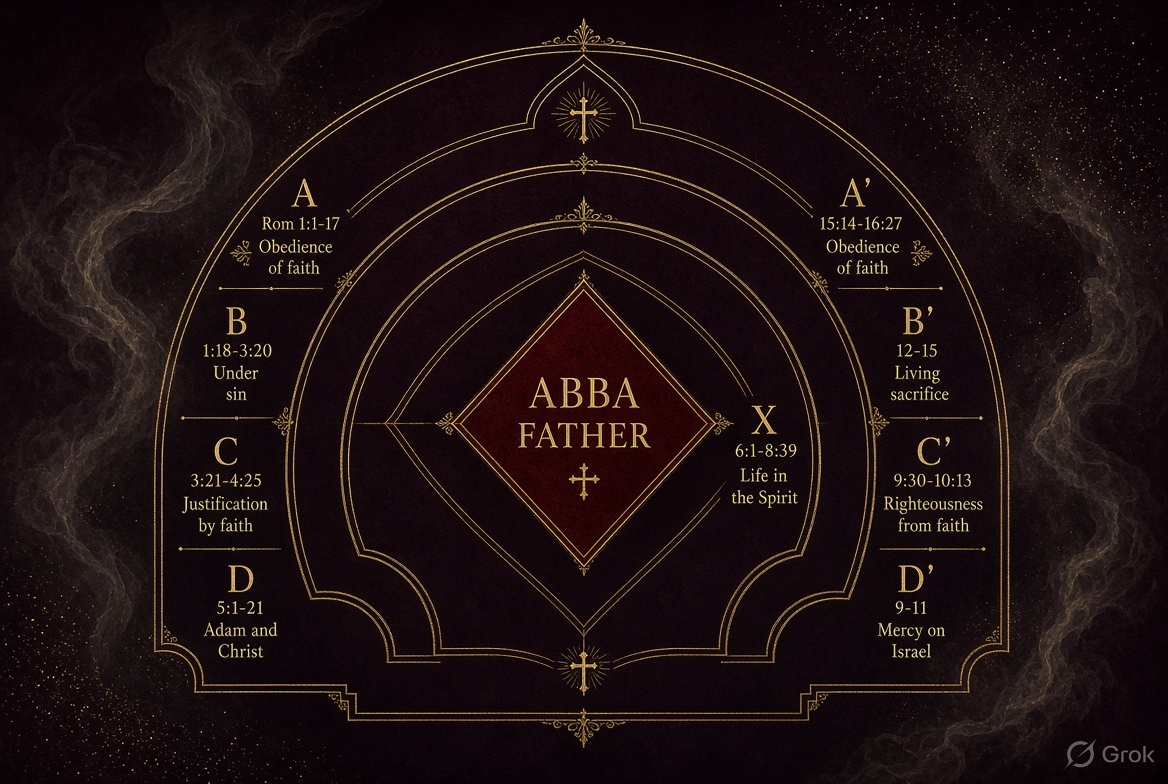
Paul frames the letter. The middle is new life in Christ and the Spirit. The two justification panels interpret each other.
The Doctrinal Chiasm
The Main Doctrinal Chiasm C / C′
C · Romans 3:21–4:25
Righteousness of God manifested apart from the law, through faith in Jesus Christ for all who believe (3:21–22). Justified by his grace as a gift (3:24). A man is justified by faith apart from works of the law (3:28). Abraham believed before circumcision (4:3–12).
C′ · Romans 9:30–10:13
Gentiles attained righteousness by faith. Israel pursued it as if by works and stumbled. Christ is the end of the law for righteousness to everyone who believes (10:4). Confess with the mouth, believe in the heart (10:9).
“Works of the law” are Mosaic badges and any boast that precedes grace. They are not the good works living faith produces after grace. That is why Romans 2:6–13 can stand beside 3:28.
Adam and Christ
One Man’s Disobedience, One Man’s Obedience
“For as by one man’s disobedience many were made sinners, so by one man’s obedience many will be made righteous.”
— Romans 5:19
Chrysostom: God not only is righteous; He makes those full of sores righteous. Justification is remission of sin and interior renewal together (Trent Session 6, ch. 7).
The Heart of the Letter
Romans 6–8 · The Letter’s Living Center
Baptism and obedience from the heart (6:1–23). “But thanks be to God, that you who were once slaves of sin have become obedient from the heart to the standard of teaching to which you were committed.” — Romans 6:17
The Law cannot give the life it commands (7). The commandment that promised life proves death to the sinner, exposing the wound only Christ can heal.
No condemnation; the Spirit of life (8:1–4, 11, 38–39). What the Law could not do, God did by sending His Son in the likeness of sinful flesh.
The X Inside the X
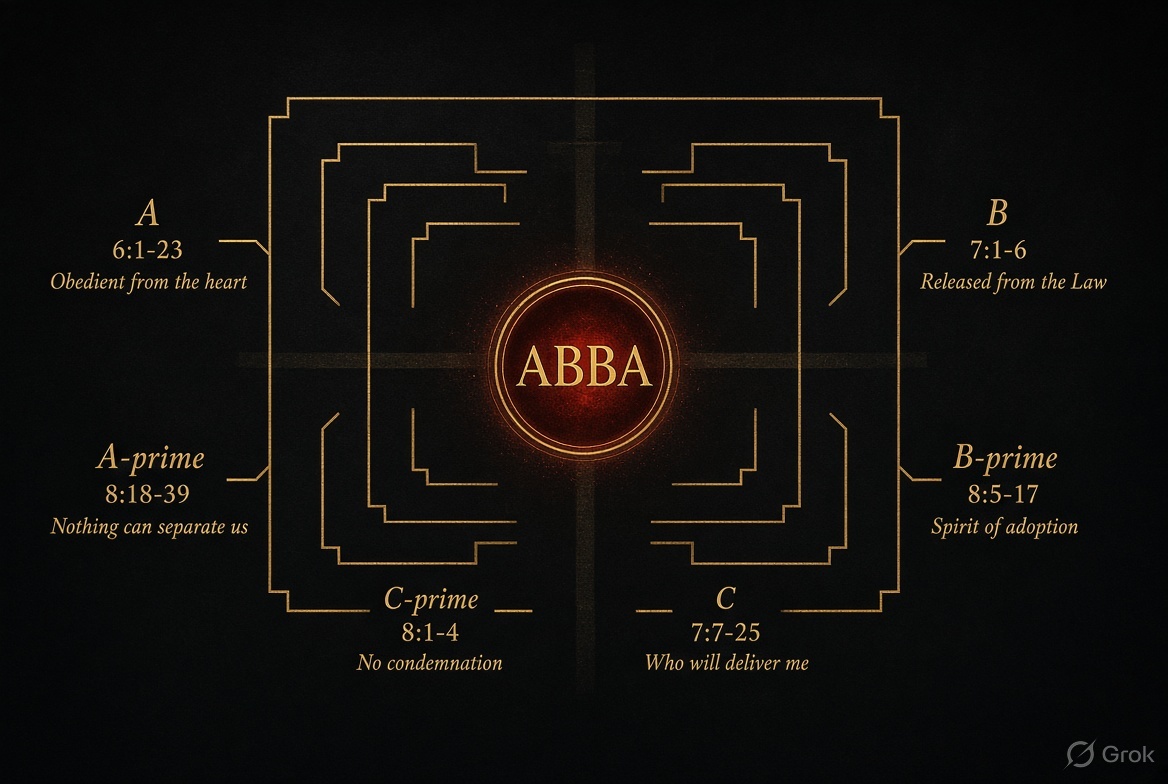
“For all who are led by the Spirit of God are sons of God. For you did not receive the spirit of slavery to fall back into fear, but you have received the Spirit of sonship. When we cry, ‘Abba! Father!’ it is the Spirit himself bearing witness with our spirit that we are children of God, and if children, then heirs, heirs of God and fellow heirs with Christ, provided we suffer with him in order that we may also be glorified with him.”
— Romans 8:14–17
Chapter 6 said you became obedient from the heart. Chapter 8 says what that heart is: not a slave under fear, but a son who names God Father. Divine filiation is what the justified man is (CCC 1996–1997).
Israel and the Common Life
Not a Parenthesis — the Whole Story
D′. Chapters 9–11 are not a parenthesis. God’s gifts to Israel are irrevocable. C′ sits inside D′ because justification by faith explains both Israel’s stumble and the nations’ inclusion.
B′. Romans 12:1 — a living sacrifice; 13:10 — love fulfills the law; 15:7 — welcome one another. This is not optional ethics after doctrine.
What Catholic Teaching Refuses
Four Errors the Church Has Always Refused
Pelagius
No work before grace merits justification. The initiative is always God’s.
A merely external verdict
God remakes the ungodly; charity is poured into the heart (5:5).
Faith that remains alone
Benedict XVI — Luther’s phrase is true only if faith is not opposed to charity.
Flattening “works”
Works of the Law are not faith working through love (Gal 5:6).
Abraham: One Man, One Economy
From the Going-Out to the Altar
Clement of Rome: Abraham was blessed because of deeds of justice wrought in faith. One Abraham, one faith, one obedience — from the going-out to the altar.
Formation Examen
A Changed Mind That Becomes a Changed Life
Metanoia means a changed mind that becomes a changed life.
- ☐Is my faith submission of intellect and will, or only an opinion?
- ☐Have I treated baptism as a finished label, or as a death I must keep living?
- ☐Where am I still seeking a righteousness of my own?
- ☐Can I cry Abba, or do I live under a spirit of slavery?
- ☐Does my body look like a living sacrifice this week?
- ☐Do I welcome those in the Church who are not like me?
Closing Prayer
Let Our Faith Never Remain Alone
Lord Jesus Christ, You are the righteousness of God revealed apart from the Law, and You are the One who writes the Law upon the heart by Your Spirit. Give us the obedience of faith. Root us in the grace that justifies the ungodly. Make us sons who cry Abba, and heirs who suffer with You in order to be glorified with You. Let our faith never remain alone. Let it work through love, until Jew and Gentile, weak and strong, glorify the Father together. Amen.
References
- Sacred Scripture: Romans 1–16
- Council of Trent, Session 6 (Decree on Justification)
- Vatican II, Dei Verbum 5
- Catechism of the Catholic Church, nn. 143–149 and 1987–2029
- St. John Chrysostom, Homilies on Romans
- St. Augustine, On the Spirit and the Letter
- Hahn & Mitch, Romans (Catholic Commentary on Sacred Scripture)
Metanoia Faith · Personal Formation · Theology & Scripture · metanoiafaith.com