
“I am the bread of life; he who comes to me shall not hunger, and he who believes in me shall never thirst.” — John 6:35
THE BODY
& THE BLOOD OF CHRIST
The True Presence of Christ in the Eucharist: its Jewish roots, the plain words of Scripture, the witness of the early Church, and the definition of the Council of Trent.
Why the bread and wine become the Body and Blood of Christ, why the earliest Christians believed it without argument, what Trent had to define in answer to the Reformation, and how to answer the claims still made against it.
The Core Statements
What the Church Actually Believes
Here is the whole doctrine in one screen for quick reference: what the Eucharist is, what happens at the words of consecration, what the sacrament does, and what is owed to it.
This Is My Body
The Lord took bread, gave thanks, broke it and said of it: this is my body. The Church has never read those words as a figure of speech, and the men who heard them did not take them as one.
Matthew 26:26 · John 6:51
This Is My Blood
The chalice is not a reminder of blood shed long ago. It is the new covenant in His blood, poured out for many for the forgiveness of sins, the covenant Jeremiah promised and Sinai prefigured.
Matthew 26:28 · Jeremiah 31:31-34
Transubstantiation
At the words of consecration the whole substance of the bread is changed into the substance of His body, and of the wine into His blood. The appearances remain: what looks and tastes like bread is no longer bread in its deepest reality.
Council of Trent, Session XIII, ch. 4
Body, Blood, Soul and Divinity
What is present is not a fragment or a power or a memory. The whole Christ is present — His body, His blood, His human soul and His divinity — under either kind, and in every part of the host.
Catechism of the Catholic Church, n. 1374
One Sacrifice, Made Present
The Mass does not repeat Calvary and does not add to it. It makes present the one offering of Christ, the same victim and the same priest, differing only in the manner of the offering — unbloody now, as it was in blood on the cross.
Council of Trent, Session XXII · Hebrews 9-10
Communion
To receive is to be joined to Christ and to one another: because there is one bread, we who are many are one body, for we all partake of the one bread. The Eucharist is the sacrament of the Church's unity, and it creates what it signifies.
1 Corinthians 10:16-17
Worship Due to God Alone
Because the same God is present who is adored by the angels, the sacrament is adored with the worship of latria. Hence the reservation of the Blessed Sacrament, Benediction and Corpus Christi — the Church has never treated this as an option.
Council of Trent, Session XIII, ch. 5 · Hebrews 1:6
The Priest Acts in the Person of Christ
The ordained priest does not offer something of his own; he lends his voice and hands to Christ. It is not the man who causes what is on the altar to become the Body and Blood of Christ, but Christ Himself.
St John Chrysostom · Catechism, nn. 1548-1553
The Fruits of the Sacrament
Union with Christ, food for the journey, forgiveness of venial sin, preservation from mortal sin, and the pledge of the resurrection and glory to come. It is the antidote by which we are freed from daily faults and preserved from grave ones.
Council of Trent, Session XIII, ch. 2 · John 6:54
Source and Summit
The Eucharist is the source and summit of the whole Christian life. Everything the Church does — her teaching, her prayer, her works of mercy — is ordered to it and flows from it.
Lumen Gentium, n. 11 · Catechism, n. 1324
The Fulfilment of the Passover
Christ our paschal lamb has been sacrificed. What Israel ate in haste on the night of its deliverance, the Church eats on the night of hers; and the pure offering promised for every place is now made from the rising of the sun to its setting.
1 Corinthians 5:7 · Malachi 1:11
The Jewish Roots
Nothing Here Was Invented in a Vacuum
The Eucharist is often treated as a Christian innovation, a ceremony invented centuries later and dressed in old images. The opposite is true. Every element of it is the fulfilment of something Israel already practised: a lamb, unleavened bread, a table of presence, a thanksgiving sacrifice, a priest who brings bread and wine, and a banquet promised by the prophets. What the Church does at the altar is what the Messiah was expected to do.
That is why the New Testament speaks of the Eucharist in sacrificial and Paschal language from its earliest pages. It is not an illustration appended to the gospel. It is the gospel's own appointed form of worship, given on the night He was betrayed, into the hands of men formed by the rituals below.
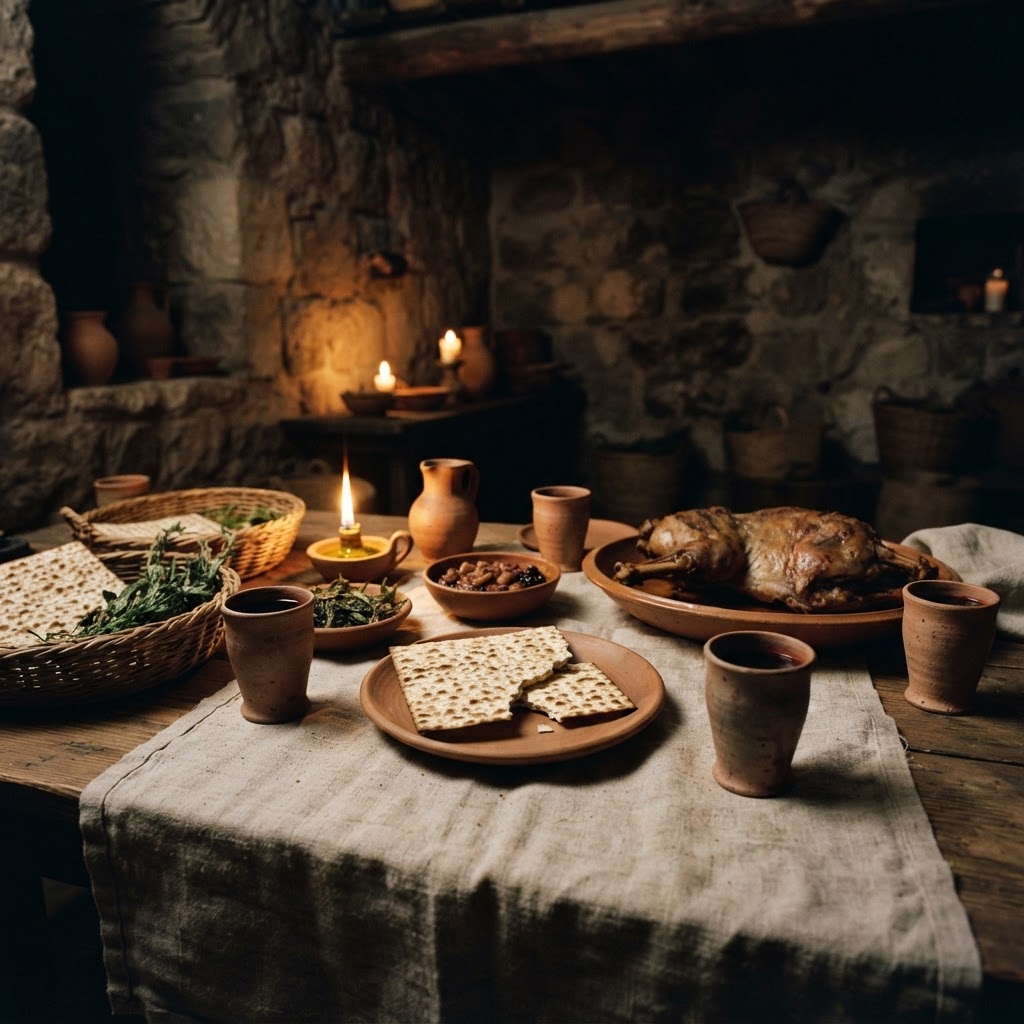
The Eight Foundations That Pointed Forward
The Passover and the Paschal Lamb
Israel's first liturgy was a meal: a lamb slain, its blood on the doorposts, its flesh eaten in haste the night before deliverance (Exodus 12). The meal was never a mere commemoration. The Mishnah records the rule that in every generation a man must regard himself as though he personally came out of Egypt (Pesahim 10:5). Paul states the fulfilment in a single clause: Christ our paschal lamb has been sacrificed (1 Corinthians 5:7). The Eucharist is that Passover, eaten again, by those who have passed through the water.
Unleavened Bread
For seven days Israel ate matzah, called the bread of affliction (Deuteronomy 16:3), the bread of a people leaving in haste. Leaven stood for corruption and the old life, which is why Paul tells the Corinthians to celebrate the feast with the unleavened bread of sincerity and truth (1 Corinthians 5:6-8). The Latin Church has kept unleavened bread for the Eucharist for exactly this reason: what is offered is the bread of the passage, not of the old order.
The Todah, the Sacrifice of Thanksgiving
Leviticus describes a fourth offering among the sacrifices: the todah, the thanksgiving sacrifice of a man who had been delivered, who brought bread and a peace offering and ate it before the Lord (Leviticus 7:12-15; Psalm 116:17). The rabbis taught that in the messianic age every sacrifice would cease except the todah. The Greek word for this thanksgiving is eucharistia, and it is the word the Church has used for the Bread and the Cup since the first century.
The Bread of the Presence
Every Sabbath, twelve loaves called the bread of the Presence were set on a golden table before the Lord in the sanctuary (Leviticus 24:5-9). Bread was offered to God, and then eaten by the priests in the holy place. This is the shape of the Eucharist: bread consecrated to God and given back to be consumed by His people, and it is why the ancient liturgies call the Eucharistic bread the bread of the Presence.
The Manna in the Wilderness
Israel ate bread from heaven in the desert, and the Psalms call it the bread of angels (Psalm 78:24-25; Wisdom 16:20-21). When the crowd in Capernaum asked Jesus for this bread, they were asking for something they already knew by tradition. He answered that the manna killed those who ate it, and that the true bread from heaven is a Person: unless a man eats His flesh, He said, he has no life in him (John 6:32-35, 49-51).
Melchizedek, Priest of the Most High
Long before Levi, a priest-king named Melchizedek met Abraham and brought out bread and wine (Genesis 14:18-20). Psalm 110 makes the Messiah a priest forever 'after the order of Melchizedek', and Hebrews argues at length that this older priesthood with its bread and wine supersedes the Levitical order (Hebrews 7). The Church has always read the offering of the Mass in that order.
The Banquet of the Messiah
The prophets described salvation as a feast: the Lord of hosts will make for all peoples a banquet of rich food on His mountain (Isaiah 25:6-9); come, buy wine and milk without money (Isaiah 55:1-2); Wisdom has set her table (Proverbs 9:1-5). The Messiah's own parables of the wedding feast and the wedding supper of the Lamb (Revelation 19:9) assume the same picture. The Eucharist is the foretaste of that table.
The Berakah and the Cup of Blessing
Every Jewish meal was framed by blessings, berakoth, and the head of the table presided over them. At the Last Supper Jesus gave thanks, eucharistesas, over the bread and the cup. Paul, writing only some twenty years later, calls it the cup of blessing which we bless, and asks whether it is not a participation in the blood of Christ (1 Corinthians 10:16). The vocabulary is Jewish table ritual; the claim is something far greater.
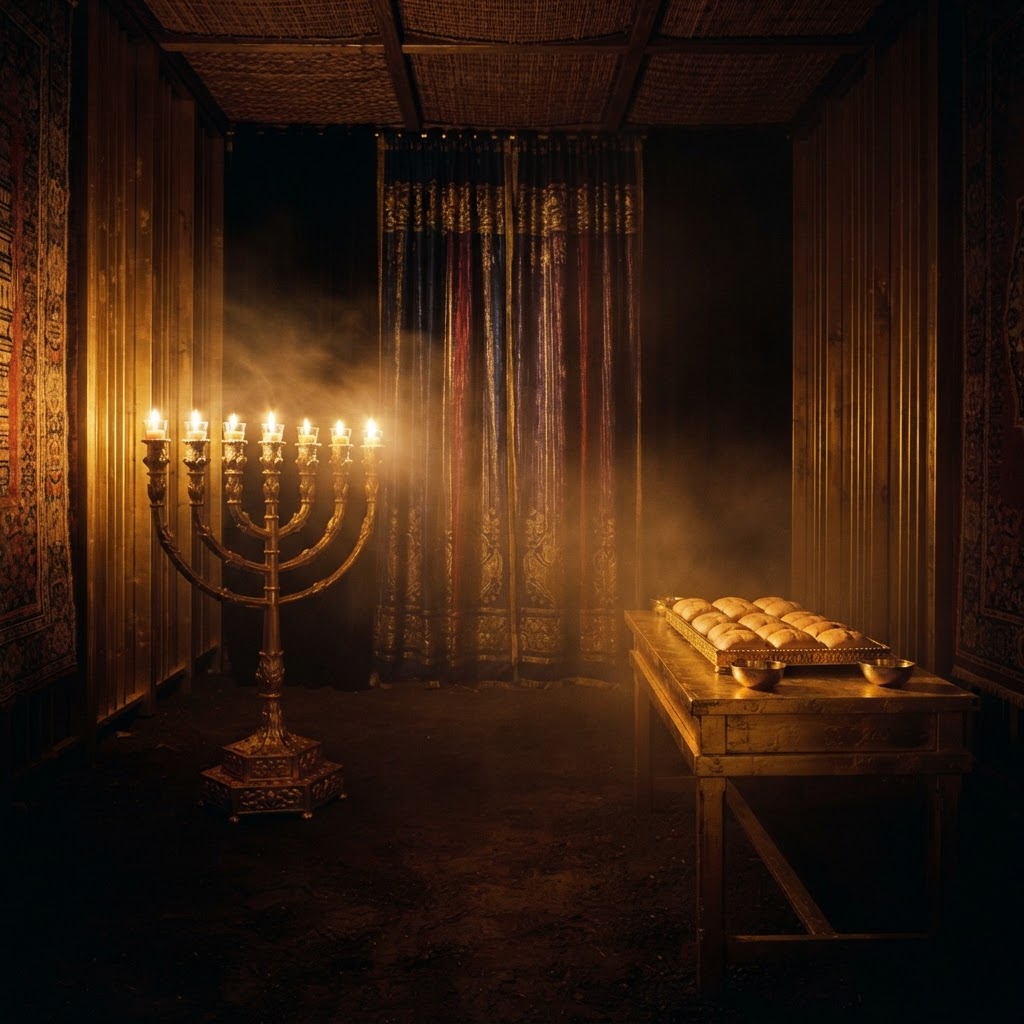
From Temple to Altar
Israel's worship was one of blood and bread offered in one place. The last of the prophets announced its transformation: from the rising of the sun to its setting, a pure offering would be offered to the Lord's name in every place (Malachi 1:11). That is precisely what the Church has done since the apostles — the one sacrifice of Christ made present on ten thousand altars, from the rising of the sun to its setting, in a pure offering of bread and wine.
The Temple was destroyed in AD 70. Its sacrifices ended, as the prophets said they would. The offering of the Church did not end, because it was never a second sacrifice: it is the same offering which the Messiah instituted, and He told His apostles to do it until He comes.
For from the rising of the sun to its setting my name is great among the nations, and in every place incense is offered to my name, and a pure offering.
Malachi 1:11
Scripture citations follow the Revised Standard Version, Catholic Edition. The Mishnah and the Jewish liturgical customs are cited here as background to the New Testament, not as authority for Christian doctrine.
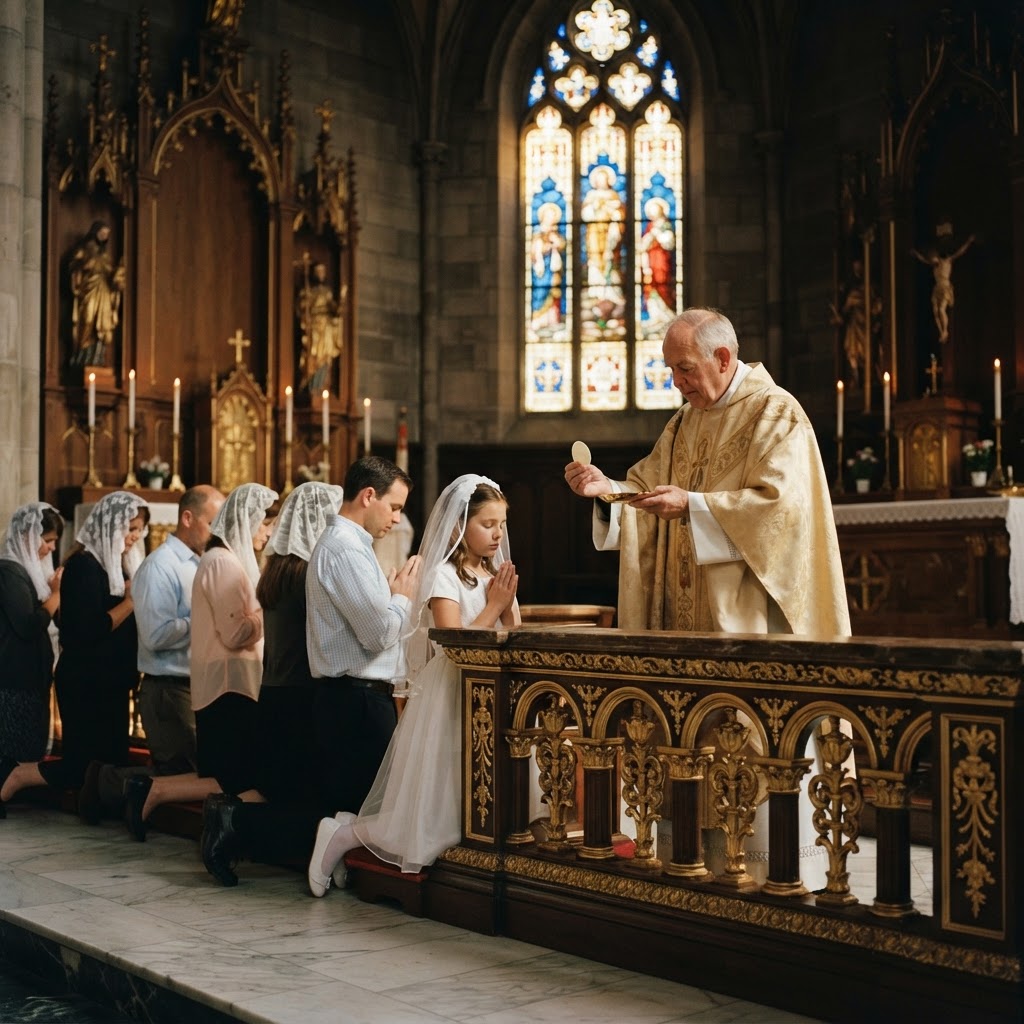
Since then He Himself has declared and said of the bread, 'This is My Body', who shall dare doubt any longer?
St Cyril of Jerusalem, Mystagogical Catechesis 4.2 (c. AD 350)
The Biblical Exegesis
What the Text Actually Says
The Catholic reading of the Eucharist does not rest on a single verse read in isolation. It rests on four independent accounts of the institution, on the longest sustained discourse in the fourth Gospel, and on Paul's own theology of the Cup and the Body. Read as a whole, the evidence is not ambiguous. It is the alternatives to it that require special pleading.
The Four Witnesses to the Institution
Two things are worth noticing before the words themselves. First, the earliest written account is Paul's, written within about twenty-five years of the event, citing a tradition he had received and handed on — so the claim that the Eucharist was a later legend has no room to grow. Second, all four accounts use the same verb: Jesus took bread, gave thanks, broke it, and said of it, this is my body. The covenant language deliberately evokes Sinai, where Moses took the blood and said, behold the blood of the covenant (Exodus 24:8), and Jeremiah's promise of a new covenant (Jeremiah 31:31-34).
1 Corinthians 11:23-26
Written c. AD 55, the earliest witness of the four
“I received from the Lord what I also delivered to you, that the Lord Jesus on the night when he was betrayed took bread, and when he had given thanks, he broke it, and said, This is my body which is for you. Do this in remembrance of me. In the same way also the cup, after supper, saying, This cup is the new covenant in my blood.”
Matthew 26:26-28
The covenant formula of Sinai
“Take, eat; this is my body.” And he took a cup, and when he had given thanks he gave it to them, saying, “Drink of it, all of you; for this is my blood of the covenant, which is poured out for many for the forgiveness of sins.”
Mark 14:22-24
The same words, an independent stream
“Take; this is my body.” And he took a cup, and when he had given thanks he gave it to them, and they all drank of it. And he said to them, “This is my blood of the covenant, which is poured out for many.”
Luke 22:19-20
The command to repeat it
“This is my body which is given for you. Do this in remembrance of me.” And likewise the cup after supper, saying, “This cup which is poured out for you is the new covenant in my blood.”
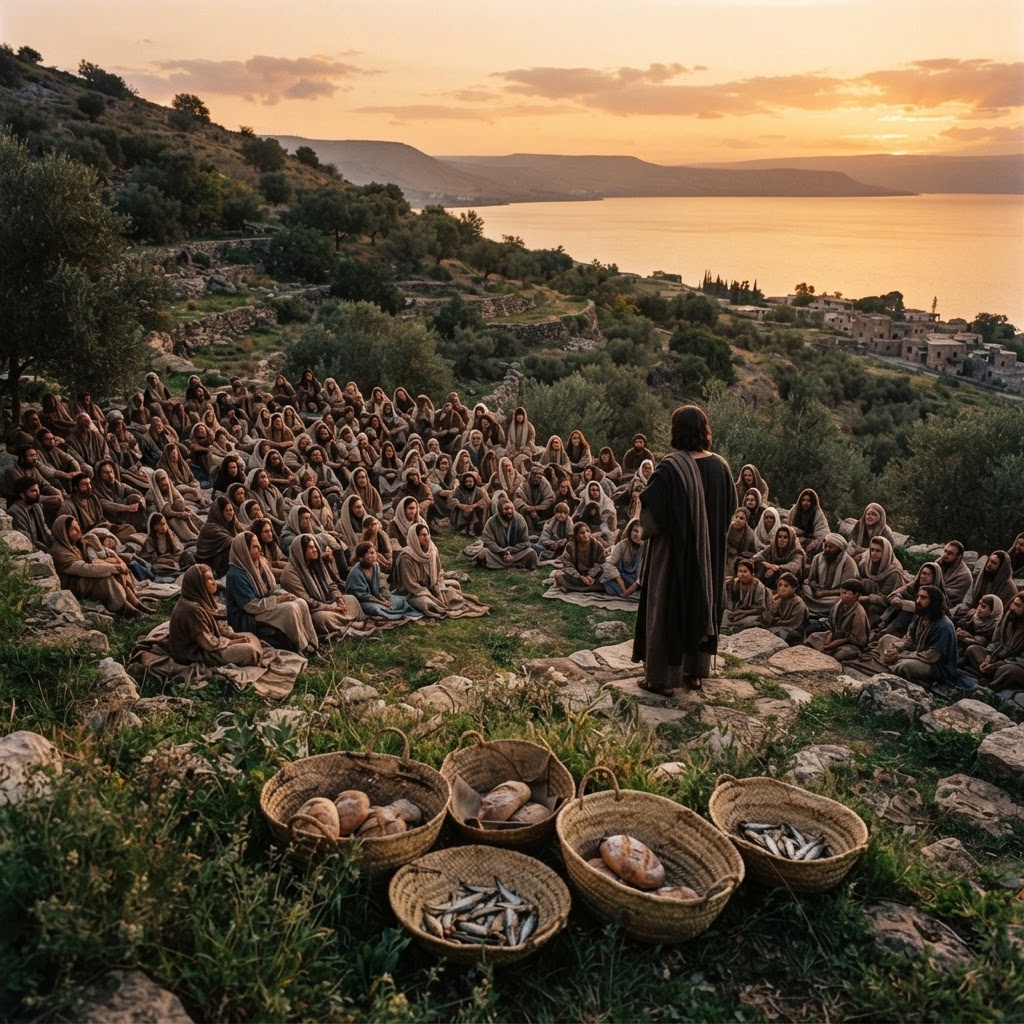
The Bread of Life: John 6:22-71
The discourse begins where the miracle ended. The crowd wants more bread; He tells them to labour for the food which endures to eternal life (v.27), contrasts the manna that their fathers ate and died with the bread that comes down from heaven (vv.31-35, 49-51), and then says something no teacher of Israel had ever said: the bread which I shall give for the life of the world is my flesh (v.51).
The reaction is immediate and hostile. The Jews then disputed among themselves, saying, How can this man give us his flesh to eat? (v.52). This is the pivot of the whole chapter, and it is decisive, because of what He does next and what He does not do.
What He does is intensify. Everywhere else in this Gospel, when a hearer misunderstands Him, He corrects the misunderstanding: Nicodemus thinks of a second physical birth and is told of water and the Spirit (John 3:3-8); the Samaritan woman thinks of well water and is told of living water (John 4:10-14); the disciples think Lazarus is merely sleeping and are told plainly that he is dead (John 11:11-14). Here He does the opposite. He does not say, you have misunderstood me; I spoke of faith. He says, truly, truly, I say to you, unless you eat the flesh of the Son of man and drink his blood, you have no life in you (v.53), and He shifts from the ordinary verb for eating to a blunt word meaning to chew or gnaw (trogein, vv.54, 56, 57, 58).
The scandal of this is not the cannibalism of a metaphor. It is the blood. The Law forbade the drinking of blood absolutely (Leviticus 17:10-14), and every Jew in that crowd knew it. If He had meant a figure of speech, the offence would have been His poor phrasing, not His doctrine. Instead, many of His disciples said, this is a hard saying; who can listen to it? (v.60), and many of them drew back and no longer went about with him (v.66).
At that point He turns to the Twelve with the question on which the whole passage turns: will you also go away? (v.67). A teacher whose hearers had taken a metaphor literally would have cleared it up in a sentence to keep them. He did not. Peter answered with the confession of the Church: Lord, to whom shall we go? You have the words of eternal life (v.68).
He who eats my flesh and drinks my blood has eternal life, and I will raise him up at the last day. For my flesh is food indeed, and my blood is drink indeed. He who eats my flesh and drinks my blood abides in me, and I in him.
John 6:54-56
“The Flesh Is of No Avail” — the Objection Answered from the Text
One verse is usually produced against all of this: it is the Spirit that gives life, the flesh is of no avail; the words that I have spoken to you are spirit and life (John 6:63). Read against the two verses immediately before it, the objection collapses. Jesus has just said that His flesh is food indeed and that whoever eats it has eternal life. He cannot mean six verses later that His flesh is worthless — nor could He mean that flesh as such is worthless, since the whole Gospel opens with the Word made flesh (John 1:14) and He has promised to raise the body up on the last day.
What He means is that it is the Spirit who gives life to that flesh, and that His words are not inert description but spirit and life: they accomplish what they announce. That is the Catholic reading, and it is the reading the Church had from the beginning. The alternative asks us to believe that He permitted His disciples to walk away over a misunderstanding He chose not to correct.
Paul: Participation, Not Recollection
Paul never argues for the Real Presence; he assumes it as a fact his readers already accept. The cup of blessing which we bless, is it not a participation (koinonia) in the blood of Christ? The bread which we break, is it not a participation in the body of Christ? (1 Corinthians 10:16). The word is not memory and not symbol. It is communion in the reality itself — which is why he can say in the same breath that we who are many are one body, for we all partake of the one bread (10:17).
Then the warning. Whoever eats the bread or drinks the cup of the Lord in an unworthy manner will be guilty of profaning the body and blood of the Lord (11:27), and again: any one who eats and drinks without discerning the body eats and drinks judgment upon himself (11:29). Paul adds that this is why many of you are weak and ill, and some have died (11:30). A man cannot be guilty of profaning a symbol; he cannot be sickened by failing to discern a picture. The realism of 1 Corinthians 11 is the realism of John 6, written earlier and without controversy.
The remaining witnesses confirm the pattern. On the road to Emmaus the risen Christ is known in the breaking of the bread (Luke 24:30-35) — a scene with the shape of the Mass, word first and then sacrament. The first believers devote themselves to the apostles' teaching and the fellowship, to the breaking of bread and the prayers (Acts 2:42). Hebrews insists that the sacrifice of Christ was offered once for all, and that no further sacrifice for sin remains (Hebrews 9:26-28; 10:10-14) — which is precisely why the Church calls the Mass the same sacrifice, not a new one: it makes present the one offering, it does not repeat it.
Scripture quotations follow the Revised Standard Version, Catholic Edition.
The Evidence of the Early Church
Every Apostolic Church Read Him Literally
If the Eucharist were a fourth-century invention, the record would show an argument. It shows none. The writings of the first four centuries affirm the Real Presence in Syria, Asia Minor, Rome, North Africa, Egypt and Palestine, in Greek and in Latin, from men taught by the apostles and their immediate disciples. No Father writing before the sixteenth century teaches that the bread and wine are only a sign.
This is the historical difficulty the Reformation had to answer and could not. The witness below is arranged in the order it was written, so the reader can see how soon it begins, and how unbroken it is.
The Didache
c. AD 70 — Syria · Didache 9:5; 14:1
“Let no one eat or drink of your Eucharist except those who have been baptised into the name of the Lord.” On the Lord's own day, the earliest Christian manual says, assemble and “break bread and give thanks”. Within a generation of the Resurrection, the Eucharist is already the Church's fixed weekly act, fenced off from the unbaptised.
St Ignatius of Antioch
c. AD 107 — a disciple of the apostles, on his way to martyrdom in Rome · Letter to the Smyrnaeans 7:1; Letter to the Ephesians 20:2
Of those who held aloof he writes: “They abstain from the Eucharist and from prayer, because they do not confess that the Eucharist is the flesh of our Saviour Jesus Christ, which flesh suffered for our sins and which the Father, of His goodness, raised up again.” Of the sacrament itself he says it is “the medicine of immortality... the antidote that we should not die, but live for ever in Jesus Christ.”
St Justin Martyr
c. AD 155 — Rome, in an apology addressed to the emperor · First Apology 66
“For not as common bread and common drink do we receive these; but in like manner as Jesus Christ our Saviour, having been made flesh by the Word of God, had both flesh and blood for our salvation, so likewise have we been taught that the food which is blessed by the prayer of His word... is the flesh and blood of that Jesus who was made flesh.” He then describes the Sunday assembly: the memoirs of the apostles are read, and the Eucharist is distributed.
St Irenaeus of Lyons
c. AD 180 — a hearer of Polycarp, who had known the apostle John · Against Heresies IV.18.5; V.2.2
“He has declared the cup, a part of creation, to be His own blood, from which He causes our blood to flow; and the bread, a part of creation, He has established as His own body, from which He gives increase to our bodies.” And again: the bread, “when it receives the invocation of God, is no longer common bread, but the Eucharist, consisting of two realities, earthly and heavenly.”
Tertullian
c. AD 200 — Carthage · On the Crown 3
“We take also in assemblies before daybreak... the sacrament of the Eucharist,” received from the hands of the appointed presidents. The sacrament is assumed, named, and treated as the ordinary furniture of Christian life across the empire — with no argument, because there was no dispute.
St Cyprian of Carthage
c. AD 250 — North Africa · Letter 63 to Caecilius
Cyprian argues at length that the chalice must be wine mixed with water, and gives a reason that only makes sense if the elements are what Christ said they are: the priest who offers must imitate what Christ did, and the cup must be the Lord's own blood, so that what is offered is the same offering the Lord handed to His apostles.
St Cyril of Jerusalem
c. AD 350 — instructing candidates for baptism · Mystagogical Catechesis 4.2-4
“Since then He Himself has declared and said of the bread, This is My Body, who shall dare doubt any longer? And since He has affirmed and said, This is My Blood, who shall ever hesitate, saying that it is not His blood?” He adds the argument from Cana: He who once changed water into wine at a wedding shall not be thought unable to change wine into blood.
St Ambrose of Milan
c. AD 390 — the man who baptised Augustine · On the Mysteries 9.50, 9.54
“Let us prove that this is not what nature formed, but what the blessing has consecrated; and that the power of the blessing is greater than that of nature, because by the blessing nature itself is changed.” And: “Before the blessing of the heavenly words another species is named; after the consecration the body of Christ is signified.”
St John Chrysostom
c. AD 400 — Constantinople · Homily on the Betrayal of Judas 1.6
“It is not man who causes what is present to become the Body and Blood of Christ, but Christ Himself who was crucified for us. The priest stands fulfilling a figure, but the power and grace are of God. This is My Body, he says; this word transforms the things offered.”
St Augustine of Hippo
c. AD 400 — North Africa · Sermon 272
Preaching to the newly baptised, Augustine tells them plainly that “it is your own mystery that is placed on the Lord's table; what you receive is your own mystery,” and warns them against the sin of Judas by asking what they have received and from Whose hand. Throughout his sermons he speaks of the bread as the body of Christ without a trace of the memorialism later attributed to him.
What the Stones Say
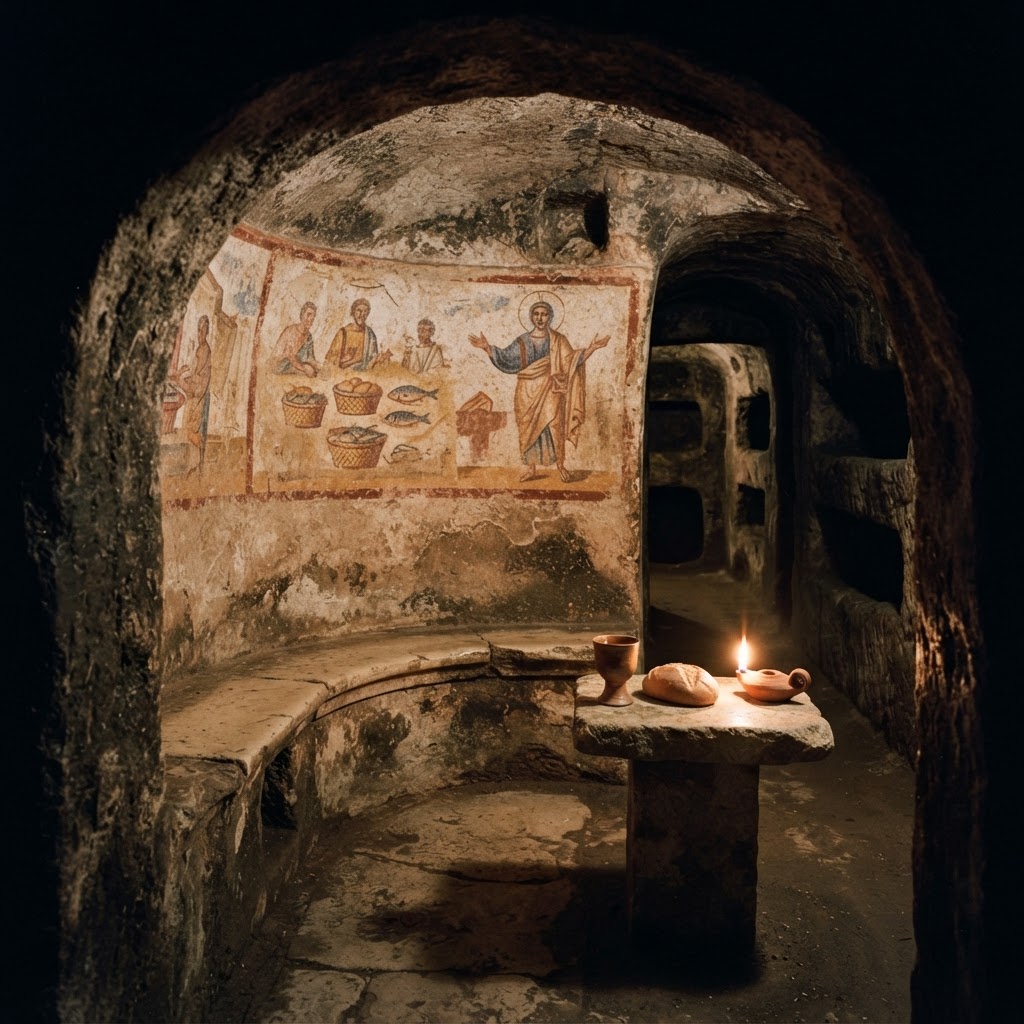
The earliest Christian art agrees with the earliest Christian writing. In the Catacomb of Priscilla in Rome, a second-century fresco known as the Fractio Panis shows a bishop or priest breaking a single large loaf before a chalice at a table of seven — the Eucharist as it was actually performed underground, drawn centuries before any council defined its terminology. Other catacombs paint baskets of loaves and fish, and chalices, beside the tombs of the martyrs.
Rome was a city of house churches, not of written theology, and what survives from its walls is not an argument about symbols. It is a meal.
The Liturgy and the Later Councils
The prayers of the earliest liturgies are equally explicit. The ancient anaphoras ask the Father to send the Holy Spirit upon the offering so that the bread may be shown to be the body of Christ; the Roman Canon speaks of the offering of a holy, spotless sacrifice. By the twelfth century the Church had settled on a word to protect the doctrine: the Fourth Lateran Council (1215) teaches that the bread is transubstantiated into the body and the wine into the blood. The word was new, because a new kind of denial had appeared; the faith it protects is the faith of Ignatius and Justin.
He has declared the cup, a part of creation, to be His own blood, from which He causes our blood to flow; and the bread, a part of creation, He has established as His own body.
St Irenaeus of Lyons, Against Heresies IV.18.5 (c. AD 180)
The Reformation and the Council of Trent
What Trent Had to Define, and Why
The sixteenth-century attack on the Eucharist was not a disagreement about ceremony. It denied that the bread and wine become the Body and Blood of Christ, and it denied that the Mass is a sacrifice. Because those two denials struck at the centre of Christian worship, the Church answered them not with an opinion but with a definition, and that definition remains the Catholic position today.
The Claims That Were Made
Luther — Real Presence, but no change, and no sacrifice
Luther believed Christ is present in the Supper, but denied that the bread and wine are changed, and rejected with the greatest vehemence the teaching that the Mass is a sacrifice offered to God. He kept the presence and cut away its altar.
Zwingli — a sign, and nothing more
Zwingli read “this is my body” as “this signifies my body”, so that the Supper becomes a memorial act of the congregation and a confession of faith. At the Colloquy of Marburg in 1529 he faced Luther, who wrote on the table in chalk: Hoc est corpus meum — this is my body — and underlined the word is.
Calvin — truth in the Spirit, but not in the bread
Calvin taught a true spiritual feeding on Christ, received by faith, while denying that Christ's body is present in or with the elements. The Supper communicates grace, but the bread is not the Body; the two are held together without being identified.
The common premise
All three denied that the Mass is the sacrifice of the New Covenant, and all three therefore had to reinterpret the plain sense of Christ's words. Everything the Council of Trent defined follows from that one move.
Session XIII, 1551 — The Doctrine, Chapter by Chapter
The decree opens by rejecting the reinterpretation of the words as metaphor, and it says so in terms of deliberate force. Chapter I teaches that after the consecration our Lord Jesus Christ, true God and man, is truly, really and substantially contained under the appearances of bread and wine, and it calls it a crime most unworthy that His own words, recorded by the evangelists and repeated by Paul, should be wrested to fictitious and imaginary tropes contrary to the universal sense of the Church.
Chapter II names the fruits of the sacrament: spiritual food, the antidote by which we are freed from daily faults and preserved from mortal sins, and the pledge of our glory to come. Chapter III makes the distinction that answers the Reformers' picture of a mere remembrance — in the other sacraments the power to sanctify is present when they are used, but in the Eucharist the Author of holiness Himself is present before it is received. Chapter IV defines the change: by the consecration of the bread and of the wine, a conversion is made of the whole substance of the bread into the substance of the body of Christ our Lord, and of the whole substance of the wine into the substance of His blood, which conversion the Catholic Church suitably and properly calls transubstantiation.
Chapter V is the chapter most often forgotten. Because the same God is present who is adored by the angels, the faithful may and must render to the sacrament the worship of latria, the worship due to God alone. From this follows the reservation of the Blessed Sacrament, the feast of Corpus Christi and the processions through the streets, all of which the Council commends as pious and religious customs.
If any one denieth that in the sacrament of the most holy Eucharist are contained truly, really and substantially the body and blood together with the soul and divinity of our Lord Jesus Christ, and therefore the whole Christ, but saith that He is only therein as in a sign, or in figure, or by His power: let him be anathema.
Council of Trent, Session XIII (1551), canon 1
The canons attached to the decree name each position in turn: that the substance of bread and wine remains (canon 2, against consubstantiation); that the Eucharist contains nothing more than a sign or figure (canon 3); that it is not to be adored with latria (canon 4); that it is not to be reserved or carried in procession (canon 5); that the change is not real (canon 2, again). Each canon answers a claim that people were actually making, and each ends with the same formula, because the Church was not inventing doctrine but protecting the faith she had received.
Session XXII, 1562 — The Sacrifice of the Mass
Eleven years later the Council turned to the second denial. Its doctrine is one sentence long and it has been misquoted ever since: the sacrifice of the Mass is one and the same sacrifice as the sacrifice of the cross, because the victim is the same, Christ our Lord, and the priest who offers is the same, differing only in the manner of the offering. What was offered once in blood on the cross is offered now unbloodily under the signs. The Mass does not repeat Calvary; it makes present what happened once. That is why the Council could anathematise the claim that the Mass is a blasphemy or an idolatry: what is on the altar is not a new victim, but the one Victim, truly present.
The Council also defined the sacrificial priesthood as instituted by Christ at the Last Supper when He said, do this in remembrance of me, and it spoke of the fruits of the Mass, applied both for the living and for those who have died in Christ.
What the Church Has Said Since
Trent was not the end of the argument. Paul VI's encyclical Mysterium Fidei (1965) defended the reality of the change against new theories that reduced the words to symbols and the presence to a significance, and the Catechism of the Catholic Church gathers the whole doctrine in numbers 1322 to 1419: the mode of Christ's presence is unique, it surpasses understanding, and the celebration makes present the one sacrifice of the cross. John Paul II's Ecclesia de Eucharistia (2003) and Benedict XVI's Sacramentum Caritatis (2007) draw out its consequences for a Church that lives from the Eucharist — and warns that liturgical practice must never be separated from the truth of what is on the altar.
In the most blessed sacrament of the Eucharist the body and blood, together with the soul and divinity, of our Lord Jesus Christ, and therefore the whole Christ, is truly, really and substantially contained.
Catechism of the Catholic Church, n. 1374
Quotations from the Council of Trent follow the standard English translation of the session decrees; the sentence structure has been adapted for readability, the substance has not. The Council's own words are linked in full in the sources below.
The Contradiction
Sola Scriptura Against the Clear Words of Jesus
The Reformation's principle was that Scripture alone is the authority for faith, and that in what is necessary for salvation it is clear enough to be understood by any careful reader. The Eucharist is the place where that principle is tested against itself, and where it fails.
1
The plain sense is not obscure
This is my body; this is my blood of the covenant. There is no ambiguity about what the words claim. The crowd understood them, disputed them, and left over them. A principle that says Scripture is clear in what is necessary must begin by taking those words at their face value.
2
To deny it, something outside the text must be added
The memorialist reading does not come from the sentence. It comes from a rule brought to the sentence: that a sacrament cannot be a reality, only a sign. That rule is not written anywhere in Scripture, and no apostle taught it. It is an unwritten tradition of interpretation.
3
So the principle contradicts itself
Sola scriptura is invoked to reject the Church's reading, but the replacement reading is itself an authority outside the text. It is a private magisterium: a system of theology deciding what the words are allowed to mean. The choice is not between Scripture and tradition. It is between the tradition of the apostles and the tradition of the sixteenth century.
The words themselves sit in the middle of a discourse that refuses every escape. When the hearers murmur, He does not explain a metaphor; He repeats the claim in stronger terms and tells them that unless they eat His flesh and drink His blood they have no life in them. When they leave, He does not call them back. The only person who speaks for the doctrine in the whole chapter is Peter, and he speaks for the Church.
There is a further problem for the principle, and it is historical rather than textual. The Church was celebrating the Eucharist long before she had a settled list of the books of the New Testament. The writings of the apostles were read at the Eucharist and recognised by the same communities that already believed in the Real Presence. The doctrine did not depend on the canon; the canon was handed on by the Church that held the doctrine, and by the men who had known the apostles.
Scripture itself never claims to be the Church's only authority. Paul commands the Thessalonians to hold to the traditions he taught them by word and by letter (2 Thessalonians 2:15), tells Timothy to entrust what he heard to faithful men (2 Timothy 2:2), and calls the Church the pillar and bulwark of the truth (1 Timothy 3:15). Peter warns that the ignorant and unstable twist Paul's letters to their own destruction (2 Peter 3:16) — a warning about private interpretation written inside Scripture itself.
None of this is an argument against reading the Bible. It is an argument that the Bible, read plainly, is on the Catholic side of this question, and that what turns the bread into a picture is a theological system standing outside the text and over it.
The cup of blessing which we bless, is it not a participation in the blood of Christ? The bread which we break, is it not a participation in the body of Christ?
1 Corinthians 10:16
This is not a slogan aimed at brothers and sisters who love Christ and honour His word. It is an invitation to take the word at its word. The one thing the passage will not permit is to say that the words are clear in principle but must be read against themselves in fact.
Answering the Objections
How to Answer the Claims Made Against It
These are the arguments a Catholic will actually meet, set out as they are made, with the answer and the texts the answer stands on. They are arranged so the section can be used as it stands: read the claim, read the reply, and look up the passage.
Three Things to Do in Every Conversation
First, take the claim seriously and state it in its strongest form — a caricature is easy to knock down and persuades no one. Second, put the burden of proof where it belongs: the words are there, plainly, and those who deny them must explain how a symbol produces the guilt, the sickness and the judgment of 1 Corinthians 11. Third, stay in the texts. John 6 and 1 Corinthians 10 and 11 are enough for the whole argument, and the Fathers show that the early Church read them the Catholic way.
The claim
“This is my body” is a metaphor, like “I am the door” or “I am the vine.”
The answer
The metaphors of this Gospel are self-evident and no one takes them literally. Here the hearers take it literally, argue about it, and walk away — and He does not correct them, which He does everywhere else a misunderstanding occurs. He escalates instead: from bread, to flesh, to a word meaning to chew, and then to a condition of salvation. A metaphor spoken over a real loaf at a real meal, with the command “do this”, cannot bear that weight.
John 6:52-58, 60, 66-67 · compare John 3:4-8; 4:11-15; 11:11-14
The claim
“The flesh profits nothing” (John 6:63) proves He was speaking only of faith.
The answer
The verse comes six verses after He says His flesh is food indeed and drink indeed, so it cannot mean His flesh is worthless — that would make Him contradict Himself, and it would contradict John 1:14, where the Word becomes flesh for our salvation. He is saying that it is the Spirit who gives life to that flesh and that His words are efficacious. The words “are spirit and life” are the opposite of “these words are a figure of speech”.
John 6:54-55, 63 · John 1:14; 6:68
The claim
“This do in remembrance of me” means a memorial meal, so the bread only represents His body.
The answer
In Scripture the word behind “remembrance” is not a mental recall; it is a making-present of a past act of God. The same word describes the yearly remembrance of sins under the Law, in which the sacrifice was offered again and the guilt was actually dealt with. Paul uses the command to remember and in the same breath warns that whoever eats unworthily is guilty of profaning the body and blood of the Lord.
Luke 22:19 · 1 Corinthians 11:26-29 · Hebrews 10:3
The claim
The Mass crucifies Christ again and repeats His sacrifice.
The answer
The Church has never taught a repetition. There is one victim, Christ, and one offering, His on the cross; the Mass makes that same offering present, unbloodily, and applies its fruits, which is why the priest is Christ acting in His Church. Hebrews insists that Christ suffered once and needs no further sacrifice for sin, and the Church affirms exactly that: what is on the altar is the once-for-all sacrifice, not a new one.
Hebrews 9:26-28; 10:10-14 · Malachi 1:11 · 1 Corinthians 11:26
The claim
The Law forbids drinking blood (Leviticus 17:10-14), so the words must be figurative.
The answer
That prohibition is precisely why the crowd was scandalised and why many disciples left. If He were speaking of faith in a figure of speech, no Jew would have been offended, and no one would have walked away. The New Covenant displaces the old prohibition because the blood offered is His own, and the first covenant was itself sealed in blood sprinkled on the people and the altar.
Leviticus 17:10-14 · Exodus 24:8 · Jeremiah 31:31-34
The claim
The Fathers called the Eucharist a “figure” or a “symbol”, so they did not believe this.
The answer
The same writers who use the language of types and figures say in the next sentence that the bread is the flesh of Christ. For the ancients a symbol was not an empty sign but a sign that contains and conveys the reality. What no Father says — anywhere, in any language, before the sixteenth century — is that the bread and wine remain merely bread and wine.
1 Corinthians 10:16-17
Ignatius, Smyrnaeans 7:1 · Irenaeus, Against Heresies IV.18.5
The claim
Christ's body is seated at the right hand of the Father, so it cannot also be on a thousand altars.
The answer
In the risen Christ there is no conflict between the two: He sits at the Father's right hand in His natural mode of existing, and He is sacramentally present in many places in His own substance, by a mode of being that words struggle to express but that God can accomplish. He who entered a locked room in His risen body is not confined by our geometry.
John 20:19, 26 · Matthew 28:20
The claim
Adoration is idolatry — we are worshipping a piece of bread.
The answer
Idolatry would be the sin only if the doctrine were false, so the objection assumes the point at issue. If the words of Christ are true, then what is in the monstrance is the Son of God and worship is not only permitted but owed; the Church calls it exactly what Scripture calls it when the Father brings the Son into the world: let all God's angels worship Him.
Hebrews 1:6 · Matthew 14:33; 28:9, 17
Council of Trent, Session XIII, chapter V (the worship of latria)
The claim
The bread is only a proclamation of His death, as 1 Corinthians 11:26 says.
The answer
That verse is not the end of the paragraph. Paul goes on to say that an unworthy communicant is guilty of profaning the body and blood of the Lord, that he must discern the body, and that because this was neglected many in Corinth were weak, ill and had died. You cannot be guilty of profaning a symbol, and you cannot be judged for failing to discern a picture.
1 Corinthians 11:27-30
The claim
This turns grace into magic — salvation by eating.
The answer
The Eucharist is received by faith and is a gift, not a work. Christ says both: whoever believes in me has eternal life, and unless you eat the flesh of the Son of man you have no life in you. Faith and communion are not rivals; the second is how the first is fed. The objection would also have to explain why the Lord made eating a condition of life if eating were of no consequence.
John 6:35, 40, 47, 53-54
The decisive question. Ask, in charity: if the bread is only a symbol, what was it that the Lord commanded the apostles to do when He said do this; why did He allow His disciples to leave over a misunderstanding; and how does a picture make a man guilty of profaning the body and blood of the Lord? Every objection above is an attempt to avoid one of those three questions. The answers are not complicated. They are simply unwelcome.
Sources & Further Reading
The Sources, Listed Plainly
Everything claimed on this page can be checked. The Scripture references are given in full, the Fathers are linked in translation, and the conciliar texts are linked to the decrees themselves.
The Scriptural texts
The Fathers and the early Church
The definitions and the modern Magisterium
Daily Reflection · The Eucharist
One Bread, One Body, One Lord
"Because there is one bread, we who are many are one body, for we all partake of the one bread."
1 Corinthians 10:17
Everything on this page ends in a single act of worship. The doctrine is not a theory to be admired from a distance; it is a Person to be received. If the words of Christ are true, then the altar is the centre of the world, and the Church's whole life is a preparation for the next Communion. Approach Him with reverence, receive Him with faith, and stay with Him afterwards — He has asked nothing more difficult than to be believed.