
Dogma · The Central Mystery of the Faith
The Triune God
One God in Three Persons — Father, Son and Holy Spirit. Not a riddle to solve, but the living God whom the Church is baptised into, worships, and proclaims. The deepest truth of who God is in Himself, revealed by the Son and the Spirit, and received by the Church in her living Tradition.
“The grace of the Lord Jesus Christ and the love of God and the fellowship of the Holy Spirit be with you all.” — 2 Corinthians 13:13
To Begin — A Vision of the Uncreated Light
Imagine, in the prophetic light of contemplative vision, a vast celestial expanse of pure radiance. At its heart burns an uncreated Light of infinite intensity — neither divided nor diminished — yet within that single blazing glory three distinct yet inseparable modes of personal presence shine forth: each fully the Light, each distinct in relation, none subordinate in essence. This is the vision the Church has contemplated from the beginning: one God in three Persons.
The Most Holy Trinity stands as the central mystery of the Catholic Faith — the ineffable reality of the one true God who is Father, Son, and Holy Spirit. This is not a philosophical construct imposed upon revelation, but the deepest truth of who God is in Himself, revealed by the Son and the Spirit, and received by the Church in her living Tradition.
Section I — The Core Dogma
One Divine Essence · Three Really Distinct Persons
The Catechism of the Catholic Church, drawing upon the Fourth Lateran Council (1215), states with precision:
“We do not confess three Gods, but one God in three persons, the ‘consubstantial Trinity.’ The divine persons do not share the one divinity among themselves but each of them is God whole and entire… Each of the persons is that supreme reality, viz., the divine substance, essence or nature.”
— CCC 253
There is one divine essence (ousia, substance, nature) — utterly simple, infinite, uncreated. There are three distinct Persons (hypostases): the Father, the Son, and the Holy Spirit. Their distinction lies solely in the relations of origin:
The Father
Unbegotten · Principle without principle
The unbegotten origin of the Godhead. He is not from another, but is the eternal source of the Son by generation and of the Spirit by spiration. He is pure origin, yet He is wholly in the Son and the Spirit.
The Son
Eternally begotten of the Father
The eternal Logos, begotten not made — the perfect Image and Word of the Father, of one substance (homoousios) with Him. He proceeds from no one but the Father, and is wholly in the Father and the Spirit.
The Holy Spirit
Proceeds from the Father and the Son (Filioque)
The Lord and Giver of life, who proceeds from the Father and the Son — the mutual Love and Gift of Father and Son. Not begotten, but spirated; wholly God and wholly in the Father and the Son.
“We worship one God in Trinity, and Trinity in Unity; neither confounding the Persons, nor dividing the Substance… The Father is made of none… The Son is of the Father alone… The Holy Spirit is of the Father and of the Son… And in this Trinity none is afore or after another; none is greater or less than another; but the whole three Persons are co-eternal together, and co-equal.”
— Athanasian Creed
The divine Persons are really distinct, yet “everything (in them) is one where there is no opposition of relationship.” The Father is wholly in the Son and the Spirit; the Son wholly in the Father and the Spirit; the Spirit wholly in the Father and the Son — perichoresis, circumincession: the Three indwelling one another in the unity of one undivided life.
The Shield of the Trinity · Scutum Fidei
One in Three, Three in One
The classic medieval diagram known as the Shield of the Trinity (Scutum Fidei) visualises this dogma with luminous clarity. Three outer circles bear the names Pater, Filius, Spiritus Sanctus. A central circle is marked Deus. Lines connecting each Person to the centre are labelled est (“is”); lines connecting the Persons to one another are labelled non est (“is not”). Below, the same truth is rendered in a modern English counterpart — one substance, three distinct Persons.
Classical · Latin
Modern · English
Thus: the Father is God; the Son is God; the Holy Spirit is God. Yet the Father is not the Son; the Son is not the Holy Spirit; the Holy Spirit is not the Father. One substance, three distinct relations. The diagram is not a full explanation of the mystery, but a faithful summary of the Athanasian confession that guards against both tritheism and modalism.
Section II — Scriptural Foundations
Revealed in the Word
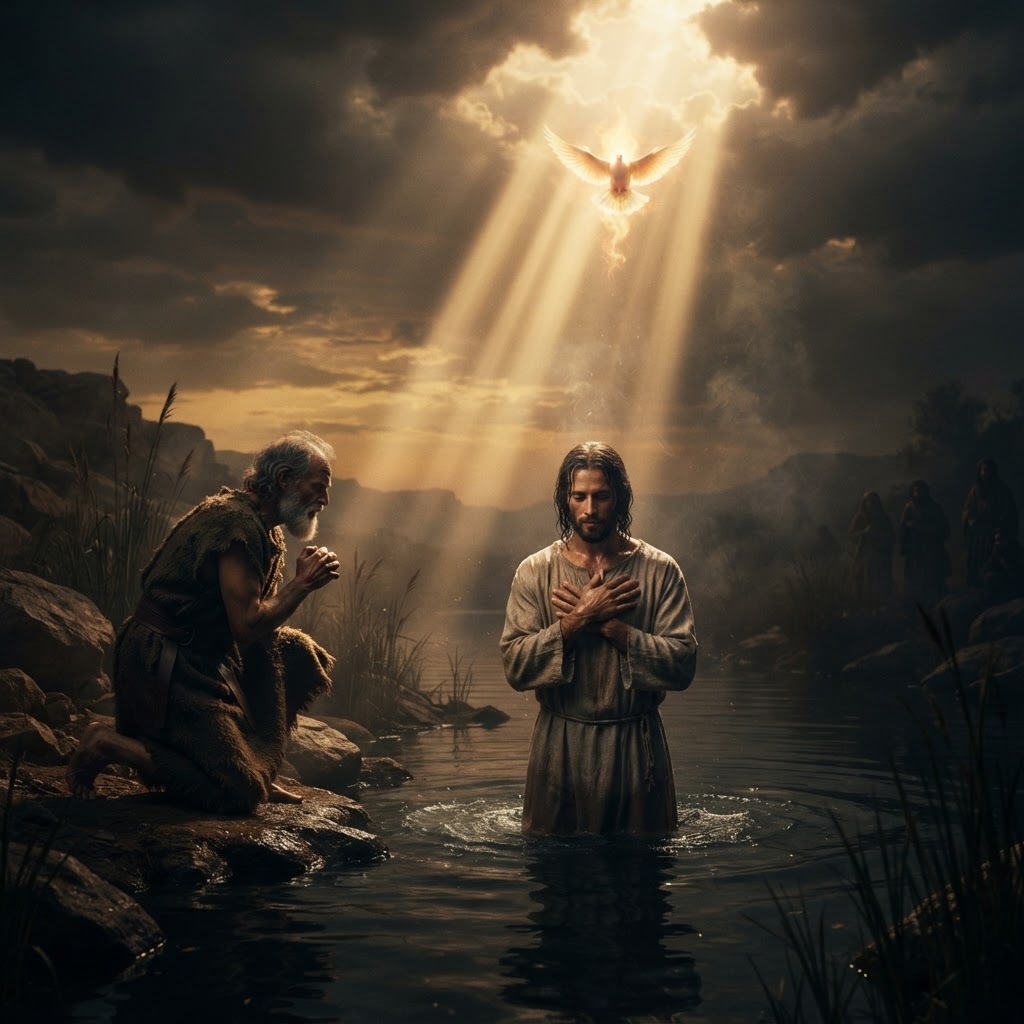
Sacred Scripture does not present a systematic treatise, yet the reality is woven throughout. The singular Name is invoked over three. The grace of the Lord Jesus Christ, the love of God, and the fellowship of the Holy Spirit are invoked as one. The Word who was with God and was God in the beginning is sent by the Father and sends the Spirit. The baptismal theophany at the Jordan reveals the Three together: the Father's voice, the Son in the waters, the Spirit descending as a dove.
1. Genesis 1:26
Then God said: “Let us make man in our image, after our likeness.”
The plural at the dawn of creation seeds the Trinitarian revelation the Fathers loved to ponder — one God speaking in the plural, the eternal counsel of Father, Son and Spirit.
2. Matthew 3:16–17
The heavens were opened and he saw the Spirit of God descending like a dove and coming to rest on him; and behold, a voice from heaven said, “This is my beloved Son, with whom I am well pleased.”
The Baptism of Christ: the Son in the Jordan, the Spirit descending, the Father speaking — all Three present together in one moment. The theophany upon which the Church's Trinitarian faith stands.
3. Matthew 28:19
Go therefore and make disciples of all nations, baptizing them in the name of the Father and of the Son and of the Holy Spirit.
The singular Name is invoked over three — not three names, but one Name. Christ entrusts the Triune God to the Church as her baptismal formula and her deepest confession.
4. John 1:1
In the beginning was the Word, and the Word was with God, and the Word was God.
The Word who was with God and was God — distinct from the Father in relation, yet fully divine in essence — is sent by the Father and in turn sends the Spirit.
5. John 15:26
When the Advocate comes, whom I shall send to you from the Father, the Spirit of truth who proceeds from the Father, he will bear witness to me.
The Spirit proceeds from the Father and is the Spirit of the Son — the eternal procession made known in the economy of salvation.
6. 2 Corinthians 13:13
The grace of the Lord Jesus Christ and the love of God and the fellowship of the Holy Spirit be with you all.
The apostolic blessing invokes the three together — grace of the Son, love of the Father, fellowship of the Spirit — in the daily greeting of the Church.
Section III — The Witness of the Fathers and the Councils
“Three men” at the Oak of Mamre
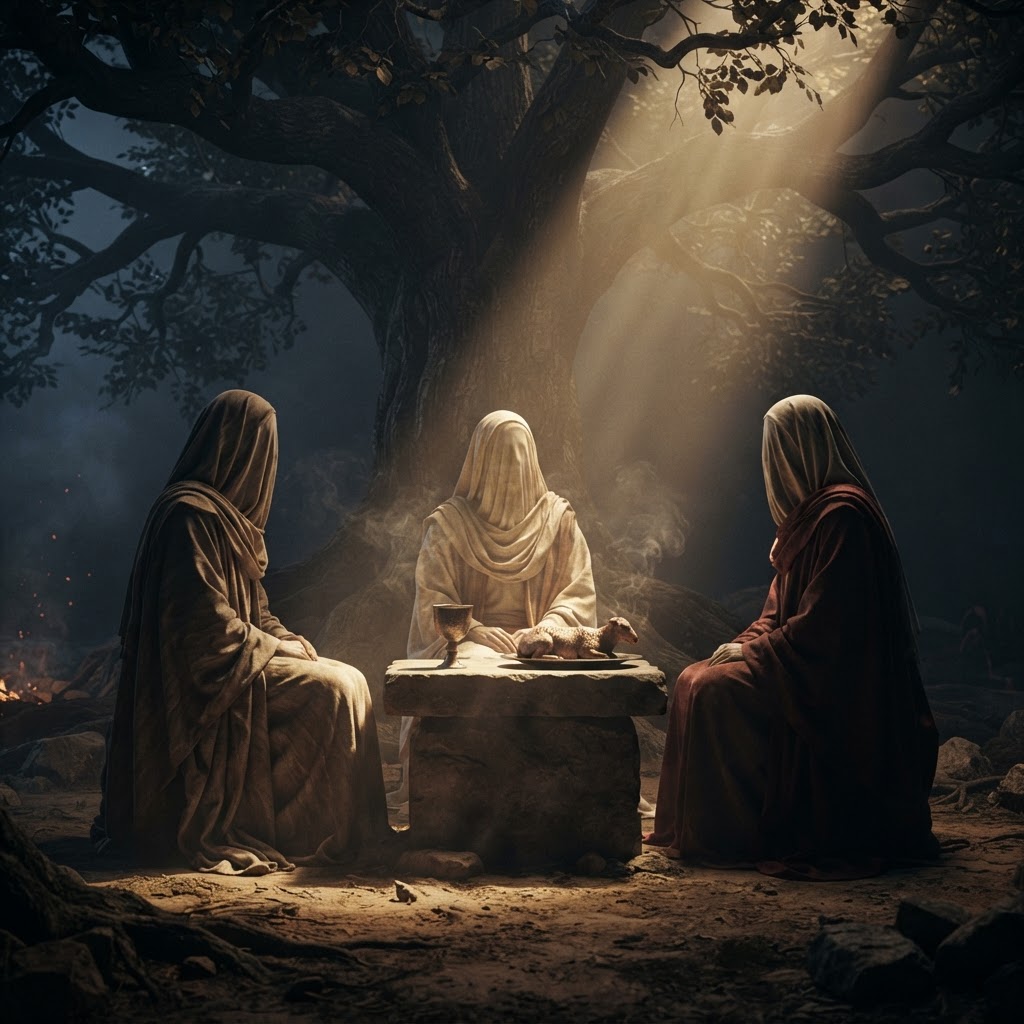
Genesis 18 records Abraham bowing before three yet addressing one Lord. The Fathers — and Andrei Rublev in his famous icon — read this as the first veiled icon of the Trinity: one God visited Abraham in the likeness of three angelic guests, seated together around a single altar.
The early Church clarified this mystery against heresies that would either divide the substance (Arianism) or confound the Persons (Modalism / Sabellianism). St. Athanasius fought for the full divinity of the Son. The Cappadocian Fathers — St. Basil the Great, St. Gregory of Nazianzus, and St. Gregory of Nyssa — secured the language of one ousia and three hypostases, grounding distinction in relations of origin while affirming absolute equality of nature and glory.
St. Athanasius of Alexandria
c. 296–373
Defended the full divinity of the Son against Arianism: “The Father is that which the Son is… by nature one God.” The Word is homoousios, consubstantial, one being with the Father, not a creature.
St. Basil the Great
c. 330–379
In De Spiritu Sancto confirmed the full divinity of the Holy Spirit and secured the grammar of one ousia (essence) and three hypostases (Persons), grounding the Trinity in relations of origin.
St. Gregory of Nazianzus
c. 329–390
Taught that the names Father, Son and Spirit are given by the relations of being unbegotten, begotten, and proceeding — preserving distinction in the one nature and equal dignity of the Godhead.
St. Gregory of Nyssa
c. 335–395
Together with Basil and Gregory of Nazianzus (the Cappadocian Fathers) articulated the one divine nature in three really distinct hypostases, affirming absolute equality of glory and the inseparable operation of the Three.
St. Augustine of Hippo
354–430
In De Trinitate explored the vestiges of the Trinity in the human soul made in God's image — memory, understanding and will; mind, word and love — opening the Western psychological analogy.
Forged in the Councils
The Church's Definitive Confession
Under the guidance of the Holy Spirit, the Councils did not invent the Trinity — they guarded what had been received. The First Council of Nicæa (325) confessed the Son as consubstantial with the Father. The First Council of Constantinople (381) completed the Creed by affirming the Holy Spirit as the Lord and Giver of life. Lateran IV and the Council of Florence further refined the Western expression of the processions and the absolute simplicity of the divine essence.
325
Nicæa I
Against Arius: the Son is “consubstantial (homoousios) with the Father — true God from true God, begotten, not made, of one being with the Father.”
381
Constantinople I
Completed the Creed by affirming the Holy Spirit as “the Lord and Giver of life, who proceeds from the Father, who with the Father and the Son is adored and glorified.”
675
Toledo XI
“We confess one God in a Trinity of Persons… the Father is not the Son, the Son is not the Father, the Holy Spirit is not the Father or the Son; yet each is God, and one God.”
1215
Lateran IV
Dogmatic definition of the Trinity: three Persons, one essence, the Father begetting, the Son begotten, the Spirit proceeding; and the absolute simplicity of the divine essence.
1439
Council of Florence
Affirmed the Filioque and the eternal processions of the Persons for the union of East and West, refining the Western expression of the processions.
Section IV — Physical Analogy · The Triple Point
One Substance, Three States, in Perfect Equilibrium
Consider the thermodynamic triple point of water — the precise temperature and pressure (approximately 0.01 °C and 611.657 pascals) at which pure water exists simultaneously and in stable equilibrium as solid ice, liquid water, and water vapour. One and the same substance (H₂O) is present at once in three distinct physical states: each fully water, none reduced to a mere phase transition of the others, coexisting without mixture or succession in that unique equilibrium.
This is a limited but striking natural vestige. Just as the one substance of water is fully present in each of the three states at the triple point, so the one divine essence is fully possessed by each of the three Persons. The states remain distinct yet inseparable in their equilibrium; the Persons remain distinct in relation yet inseparable in the unity of the Godhead. If water, a created thing, can stand unified in three states at one point, we need not stumble at the uncreated God standing one in essence and three in Person from eternity.

A necessary caution: the analogy fails, as all do, because the states of water are not personal and can exist separately under other conditions; the divine Persons exist only in their eternal relations and can never be apart from one another or from the one essence. Yet it points beyond sequential or modal conceptions toward simultaneous, coequal distinction within unity.
Section V — Metaphysical Analogy · The Spoken Word
Of Mind, Word and Breath
St. Augustine, in De Trinitate, offers the profound psychological analogy drawn from the image of God in the human soul. The mind (the memory of itself) generates an interior word — the understanding or knowledge of itself. From this knowledge proceeds the will or love that binds them. In a higher register closer to the biblical language of Word and Spirit: the Mind (Father) eternally generates the Word (Son) that perfectly articulates its own being; the Breath (Holy Spirit) is the spiration of love by which the Word is uttered and the mutual communion is completed.
The Word is not less than the Mind that speaks it; the Breath is not a lesser force but the very love that proceeds. In God this is perfect, eternal, and consubstantial: the Father is pure origin, the Son is the perfect Image and Word begotten, the Spirit is the Gift and Love proceeding. The human mind is a distant, created reflection — fallen and sequential — yet it remains the clearest vestige of the uncreated Trinity that Scripture and the Fathers have contemplated.
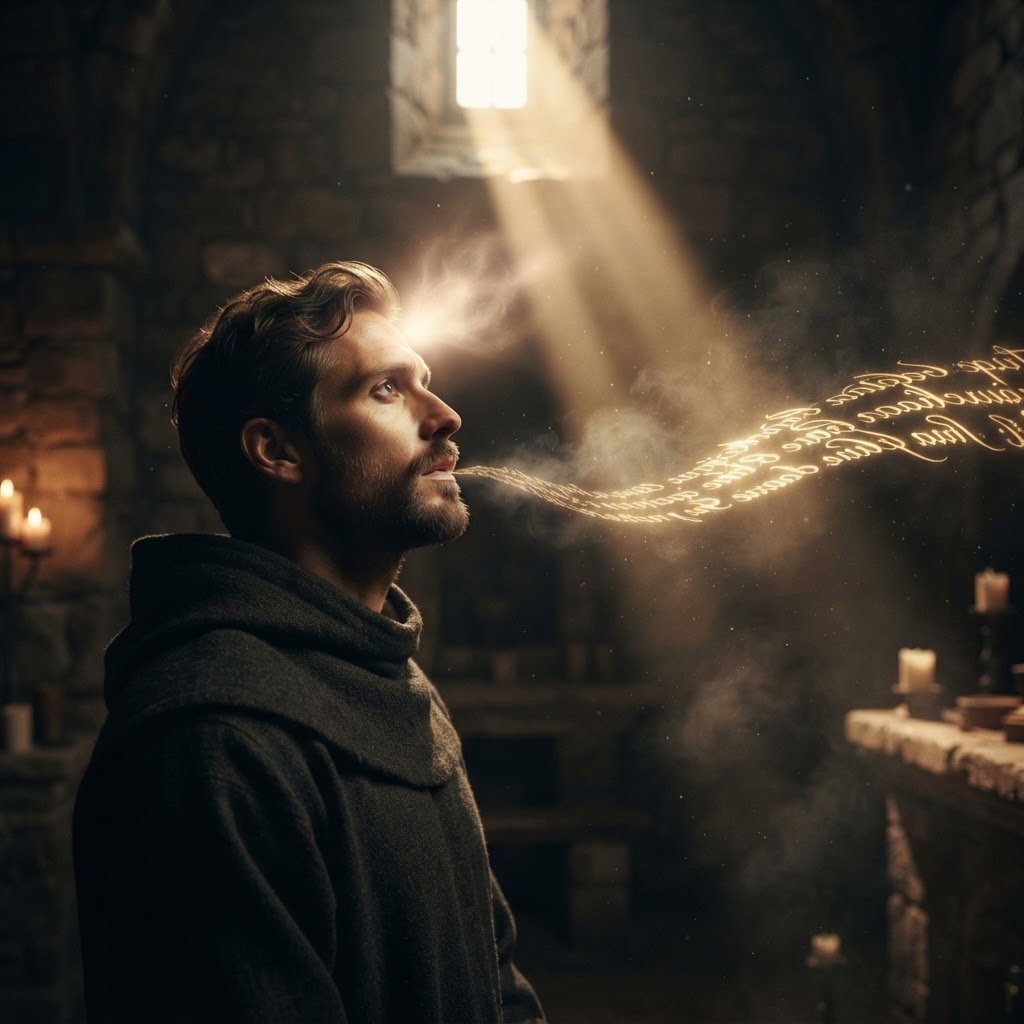
The Mind (Father)
Pure origin — conceives the thought, the unbegotten source of all. The memory that holds all in unity.
The Word (Son)
The eternal Logos, begotten not made — articulates the thought exactly: the perfect Image and Word of the Father.
The Breath (Spirit)
The spiration of love — carries the Word forth: the Gift and Love proceeding from Father and Son.
The caution: the Spirit is a divine Person, not merely a breath, and the Son is a Person, not merely a thought. Yet this analogy, which Augustine treasured, shows how one nature can give rise to a truly distinct Word and a truly distinct Love — without ever multiplying into more than one mind, one speaker, one life.
Section VI — What the Dogma Is Not
Four Errors the Church Has Always Refused
Arianism
Error: The Son is a creature — the first and greatest of created things, but not God.
Truth: Refuted at Nicæa: the Son is homoousios, of the same substance as the Father. “In the beginning was the Word, and the Word was God” (John 1:1).
Modalism (Sabellianism)
Error: Father, Son and Spirit are only three modes or names of one Person acting in different ways.
Truth: Refuted by the Baptism: all Three are simultaneously present. The Father is not the Son; Christ prays to the Father, the Father speaks of the Son.
Tritheism
Error: There are three Gods who happen to cooperate.
Truth: Refuted at Toledo and Lateran IV: there are not three Gods but one God. Each Person is the one undivided divine essence, not a third of it.
Partialism
Error: The Father is a third of God, the Son a third, the Spirit a third — three pieces adding up to one.
Truth: Each Person is wholly God. The Father is all of God, the Son is all of God, the Spirit is all of God — and there is but one God.
Section VII — The Mystery That Calls Us to Worship
Not a Puzzle to Solve · A Reality to Adore
All analogies remain shadows. The Trinity is not a puzzle to be solved but a reality to be adored. As the Church has always taught, this mystery is the source of every other mystery of the Faith: Creation, Incarnation, Redemption, the Church, and the final consummation all flow from and return to the inner life of the Triune God.
In the prophetic light of faith we are invited not merely to understand but to enter by grace into that same communion. Baptised into the Name of the Father and of the Son and of the Holy Spirit, we are drawn into the eternal exchange of love that is the life of God. There the soul finds its true metanoia — the turning of the whole being toward the radiant, consubstantial, coeternal Trinity.
Glory be to the Father, and to the Son, and to the Holy Spirit:
as it was in the beginning, is now, and ever shall be, world without end.
Amen.
Formation Companion
The Image Bears the Original
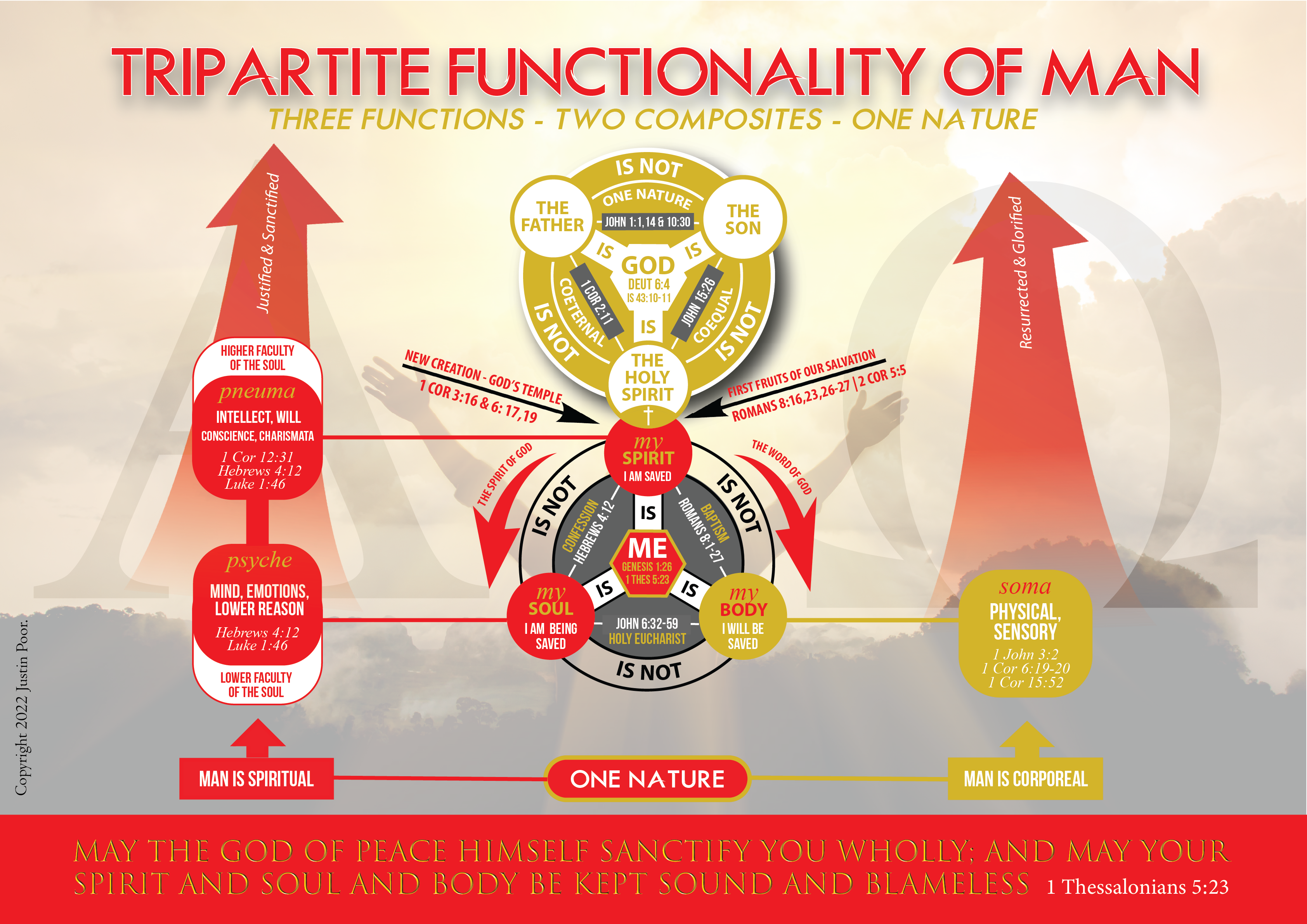
Having contemplated the Triune God, turn now to the creature made in His image — spirit, soul, and body, three functions in one nature, wholly kept and sanctified.
The Tripartite Functionality of ManReferences
- Catechism of the Catholic Church, nn. 232–267 (esp. 253 on the consubstantial Trinity)
- Lateran IV (1215), cap. 1 — dogmatic definition of the Trinity and divine simplicity
- The Nicene-Constantinopolitan Creed; the Athanasian Creed (Quicunque Vult)
- St. Athanasius, Contra Arianos (Orations Against the Arians); De Synodis
- St. Basil the Great, De Spiritu Sancto (On the Holy Spirit)
- St. Gregory of Nazianzus, Oration 31 (On the Holy Spirit); Theological Orations
- St. Gregory of Nyssa, Ad Ablabium (On “Not Three Gods”)
- St. Augustine, De Trinitate (On the Trinity)
- Council of Nicæa I (325) · Constantinople I (381) · Toledo XI (675) · Lateran IV (1215) · Florence (1439)
- Scripture: Genesis 1:26; 18:1–15; Matthew 3:16–17; 28:19; John 1:1; 15:26; 2 Corinthians 13:13–14
Interpretations follow the hermeneutic of continuity with the perennial Magisterium.