Metanoia Faith
← Personal Formation/Personal Formation · Doctrine
Metanoia Faith · The Papacy

“You are Peter, and on this rock I will build my Church, and the gates of hell shall not prevail against it.” — Matthew 16:18

THE SEAT OF PETER
THE ROCK

The office of Peter from the Old Testament to the New: the seat of Moses, the steward and the keys of the house of David, and the Church's witness that Rome holds the see of the Rock.

How Christ anointed Peter chief apostle and gave him the keys of the Davidic kingdom, how the early Church appealed to the see of Peter before any council had met, what the archaeology of Rome and Bethsaida shows, and precisely what the Church does and does not claim when she speaks of the pope.

The Rock · The Keys · The Steward · The Chair of Unity

The Core Statements

What the Church Actually Claims

Before the arguments, the claim itself — stated precisely, so that what is defended is the Catholic doctrine rather than a caricature of it.

Peter holds the Keys

Christ gave the keys of the kingdom of heaven to Peter alone, with the power to open and shut — the exact language Isaiah used of the steward of the house of David.

Matthew 16:19 · Isaiah 22:22

Peter is the Rock

Simon was renamed Cephas, Rock, and on him Christ said He would build His Church — a building that the gates of hell would not overcome.

John 1:42 · Matthew 16:18

Binding and Loosing

What Peter binds on earth is bound in heaven. This is juridical authority, the steward's authority in the king's household, not a personal opinion that others may disregard.

Matthew 16:19; 18:18

The Chief Apostle

Peter is named first in every list of the apostles, is called the first, speaks for the Twelve, leads the election of Matthias and opens the Church's mission at Pentecost.

Matthew 10:2 · Acts 1-2

The Office of Unity

Christ prayed for Peter by name that his faith would not fail, and told him to strengthen his brothers, and three times charged him to feed and tend the flock.

Luke 22:31-32 · John 21:15-17

An Office, Not a Man

The steward of Isaiah 22 held an office which outlived him and passed to another when he failed. The papacy is that office: the see of Peter, not the merits of the man who holds it.

Isaiah 22:19-24

The See of Peter in Rome

Peter and Paul were martyred in Rome, and from the first century the Church of Rome acted as the Church that settles disputes — before any council of the empire had met.

1 Clement (c. AD 96) · Irenaeus III.3.2

Guardian of the Faith Once Delivered

The office exists to keep the deposit of faith unchanged: the pope is its guardian, never its author, and he may not invent doctrine or add to revelation.

Jude 3 · 1 Timothy 6:20

Infallibility in Defined Doctrine

When the Roman Pontiff teaches ex cathedra, defining a doctrine of faith or morals to be held by the whole Church, he is preserved from error by the divine assistance promised to Peter. It is not impeccability, and not every word he speaks.

Vatican I, Pastor Aeternus, ch. 4

The Kingdom Has a Structure

David's kingdom had a king, a queen mother and a steward over the household. Christ, the Son of David, established the same shape in His Church — and the steward is not the king.

2 Samuel 7 · Isaiah 22 · Luke 1:32-33

The Old Testament Foundations

The Kingdom Christ Restored

The papacy is often described as a medieval political invention, a structure of power that grew up around the bishop of Rome long after the apostles. The claim of the Catholic Church is different, and it is much older than the Church herself: the office given to Peter is the office of the steward of the house of David, described in the Old Testament seven centuries before Christ, and the Lord who gave it is the Son of David who came to restore that kingdom.

Israel's kingdom was not a vague monarchy. It had a defined shape: a king, a mother of the king, elders and household officers — and over the king's household, a steward who held the keys. When the prophets promised that the throne of David would be established for ever (2 Samuel 7:12-16; Psalm 89:3-4; Isaiah 9:6-7), they were promising a kingdom, and a kingdom comes with its offices.

The Steward of the House of David

Isaiah 22 records a transfer of that office. The steward Shebna has failed, and the Lord says that his authority will be taken from him and given to another. The words of the transfer are the words Christ uses of Peter — and this is not a coincidence of vocabulary, because the Gospel writers, writing in Greek, chose the very terms the Greek Old Testament uses here.

In that day I will call my servant Eliakim the son of Hilkiah, and I will clothe him with your robe, and will bind your girdle on him, and will commit your authority to his hand... And I will place on his shoulder the key of the house of David; he shall open, and none shall shut; and he shall shut, and none shall open... and he shall be a father to the inhabitants of Jerusalem and to the house of Judah.

Isaiah 22:20-24

Every element of that investiture reappears in Matthew 16. The steward is given the robe — the outward sign that he acts with the king's authority. He is given the key of the house of David, which is authority over the king's household. He opens and shuts, which is what binding and loosing meant in the juridical language of Israel. He becomes a father to the people, which is why the pope is still called father. And the office is transferable: when Shebna failed, the office did not disappear; it passed to Eliakim, and Isaiah adds that it would be fastened as a peg in a sure place, and the honour of his father's house would hang upon it (22:23-24). An office outlives its holder. That is what a see is.

One thing must be said at once, because it guards the whole doctrine: the steward was not the king. He did not rule in his own right, he did not own the household, and he could do nothing that was not the king's. The papacy is exactly this. The pope is not Christ, and the Church is not his; he is a servant of the household, holding the keys of Another.

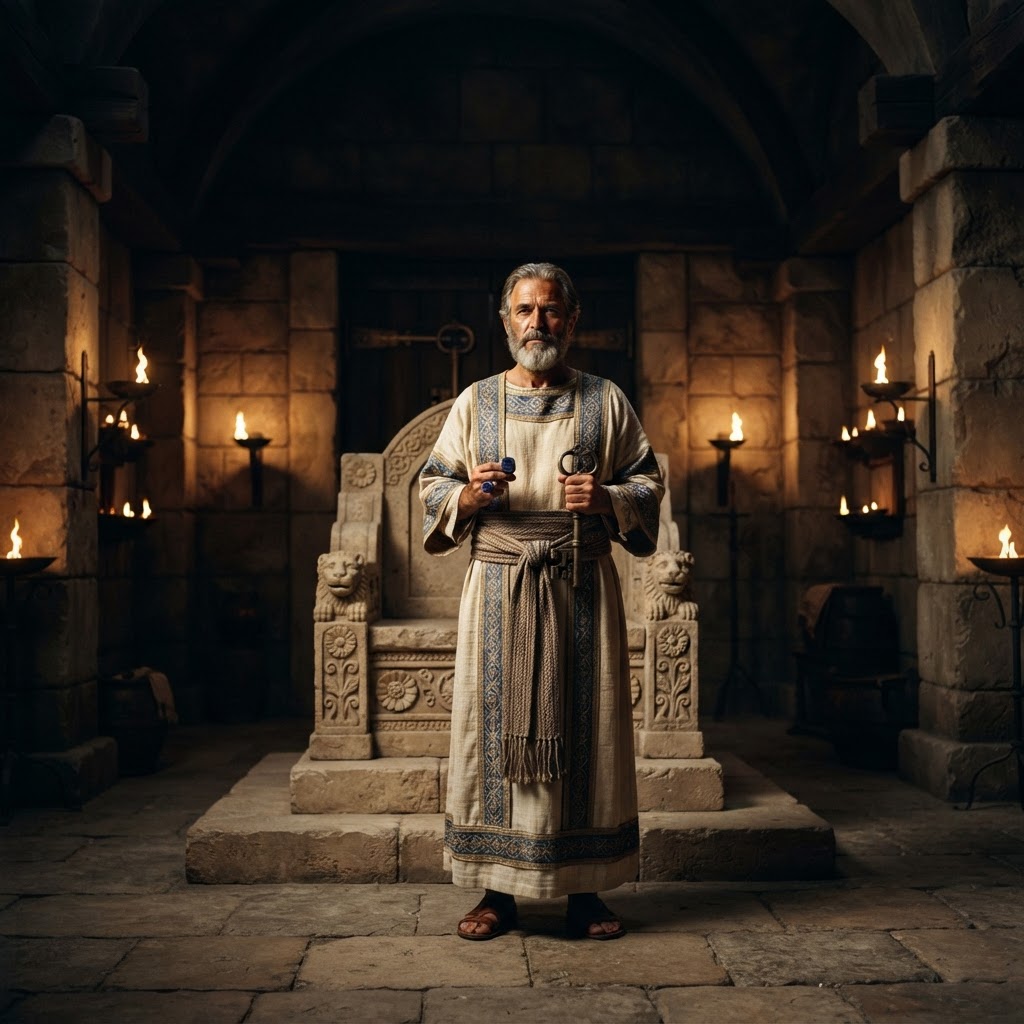
A royal steward in fine linen robes holding a great bronze key and a seal ring before a stone throne in an ancient Judean palace hall.
An artist's reconstruction of the master of the palace: the king's steward, who carried the key of the house of David, opened and shut, and acted with delegated authority — never his own.

The Seat of Moses

There is a second Old Testament structure Christ Himself treats as still standing during His own ministry: the teaching seat.

The scribes and the Pharisees sit on Moses' seat; so practise and observe whatever they tell you, but not what they do; for they preach, but do not practise.

Matthew 23:2-3

This is the Lord's own instruction, and it is devastating to a whole family of arguments against the papacy. He tells His disciples to obey the men who sit on Moses' seat even though those men were corrupt, self-seeking and soon to arrange His death. The authority belonged to the seat, not to the sitter. If the seat of Moses could bind consciences while occupied by murderous hypocrites, then the corruption of popes — and there have been corrupt popes — proves nothing at all about the see of Peter. Christ's promise was never that the office would be held by saints. It was that the gates of hell would not prevail against what He built.

Christ did not abolish the seat of Moses; He took it. He warned that the scribes had made the teaching seat a place of pride and had taken away the key of knowledge (Luke 11:52). He then gave a key to a fisherman, and told him to feed the sheep.

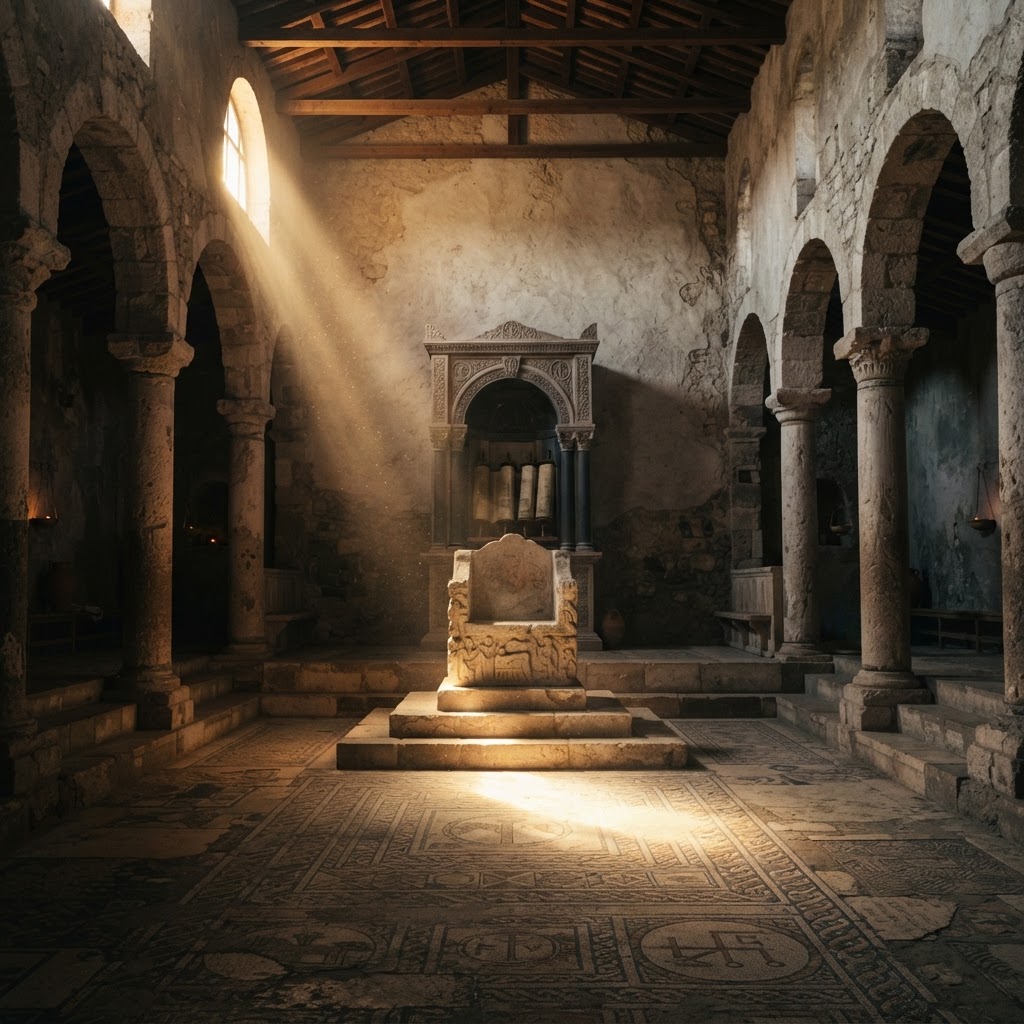
A carved stone chair of Moses at the centre of a mosaic floor in an ancient Galilean synagogue, with a stone ark holding Torah scrolls behind it.
An artist's reconstruction of a Galilean synagogue. The stone seat of Moses was a real object, cut from stone, on which the teacher sat to expound the Law. To occupy it was to teach with authority — which is precisely the claim made of the pope's ordinary magisterium.

The Promise to David, and the Key in the Hand of Christ

The whole structure rests on the promise that David's throne would never end. Nathan told David that God would raise up his offspring and establish his kingdom for ever (2 Samuel 7:12-13); the Psalmist repeats it as an oath (Psalm 89:3-4, 35-37; 132:11-12); Isaiah names the child on whose shoulder government rests, and says of the increase of his government there will be no end, upon the throne of David (Isaiah 9:6-7); Daniel sees a kingdom given to one like a son of man which shall not be destroyed (Daniel 7:13-14).

The angel announces to Mary that her Son will be given the throne of His father David, and of His kingdom there will be no end (Luke 1:32-33). This is the kingdom into which the keys are given. And the Risen Christ says of Himself what Isaiah said of the steward: He is holy and true, He holds the key of David, He opens and none shall shut (Revelation 3:7). He holds the key of the house of David — and in Matthew 16 He hands the keys to Peter. The delegated authority is the point. The King never surrenders His own.

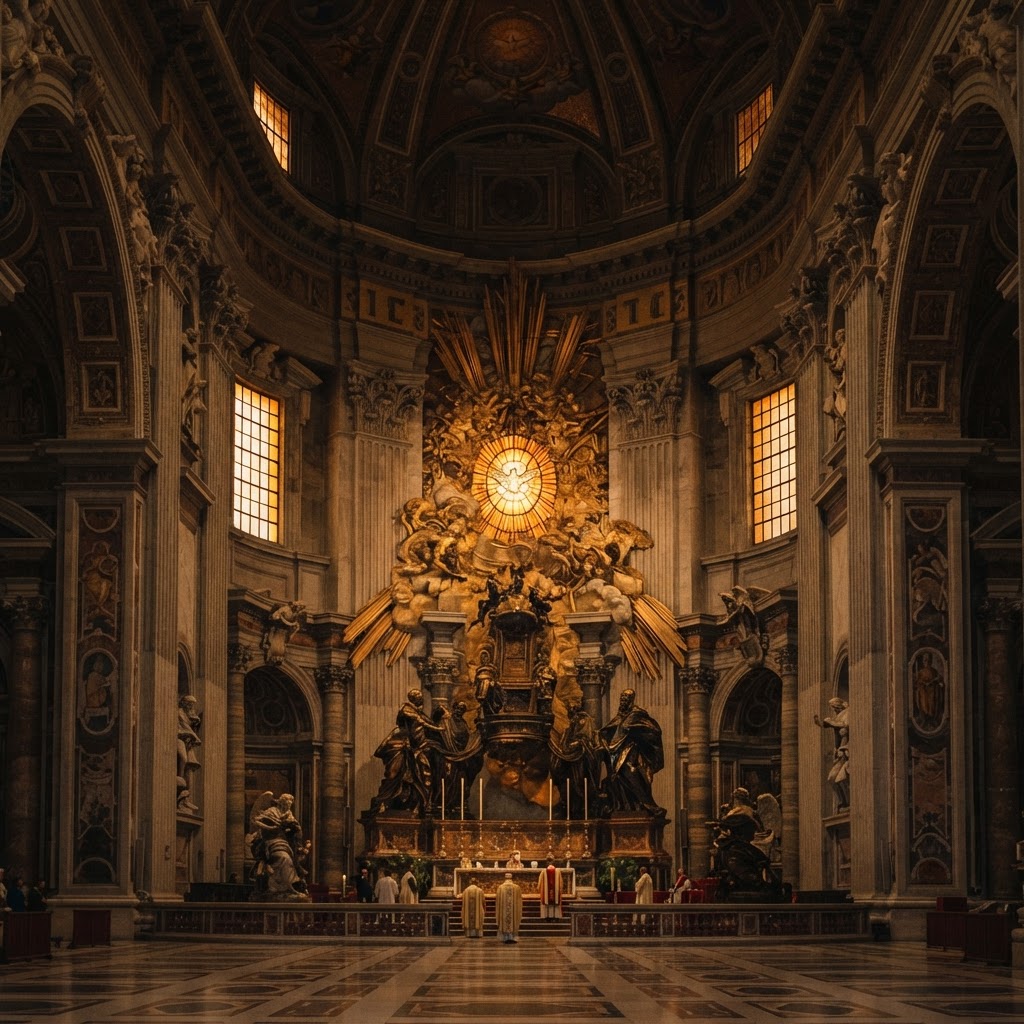
The gilded Cathedra Petri in the apse of Saint Peter's Basilica beneath the glowing alabaster window of the Holy Spirit.

Peter has spoken through Leo.

The bishops of the Council of Chalcedon, AD 451

The New Testament Grant

Christ Anoints Peter Chief Apostle

The Old Testament gives the shape of the office. The Gospels record the moment it is conferred, and they do so with the vocabulary of Isaiah 22 deliberately in place. What follows is the whole scriptural case, gathered in one place and in the order the New Testament itself gives it.

The Promise at Caesarea Philippi

And I tell you, you are Peter, and on this rock I will build my Church, and the gates of hell shall not prevail against it. I will give you the keys of the kingdom of heaven, and whatever you bind on earth shall be bound in heaven, and whatever you loose on earth shall be loosed in heaven.

Matthew 16:18-19

The setting matters. Christ had asked what men said about Him, and then asked the Twelve directly. Simon answered for them all: You are the Christ, the Son of the living God. The Lord replied that this had been revealed by the Father — and then renamed the man who had said it.

One technical point is decisive here, and it is often obscured. It is sometimes argued that the wordplay fails because petros means a small stone while petra means a rock, so the Church is built on the confession and not on Peter. That argument does not survive the language Christ actually spoke. He spoke Aramaic, in which there is one word, kepha, and He said: you are Kepha, and on this kepha I will build my Church. The Greek distinction is an artefact of translation, not a clue about the meaning. The demonstrative points straight at the man: you are Rock, and on this rock.

1

A new name

Simon becomes Cephas, Rock (John 1:42). God gives new names when He gives a new vocation: Abram became Abraham, Sarai became Sarah, Jacob became Israel. Throughout the Old Testament the rock is God Himself — the Lord is my rock and my fortress (Psalm 18:2). The name is a claim, and only Christ could make it of a man.

2

The build on the rock

You are Peter, and on this rock I will build my Church, and the gates of hell shall not prevail against it (Matthew 16:18). The Church is built on a person; that is why the promise of indefectibility is attached to this verse and not to a doctrine or a book.

3

The keys and the binding

I will give you the keys of the kingdom of heaven, and whatever you bind on earth shall be bound in heaven, and whatever you loose on earth shall be loosed in heaven (Matthew 16:19). This is the steward of Isaiah 22, in the kingdom of the Son of David, with jurisdiction over the household of God.

4

The prayer that guards the faith

Simon, Simon, behold, Satan demanded to have you, that he might sift you like wheat, but I have prayed for you that your faith may not fail; and when you have turned again, strengthen your brethren (Luke 22:31-32). Christ prays for one man, promises that his faith will not fail, and gives that man the task of strengthening the rest.

5

Feed my sheep

Three times the risen Christ asks Peter whether he loves Him, and three times He answers the answer with a commission: feed my lambs, tend my sheep, feed my sheep (John 21:15-17). The threefold denial is undone by a threefold pastoral office over the whole flock.

6

The mouth of the apostolic college

Peter is first in every list of the apostles (Matthew 10:2; Mark 3:16; Luke 6:14; Acts 1:13), he opens the Church's preaching at Pentecost (Acts 2), receives the Gentiles into the Church (Acts 10-11), and speaks the decisive word at the Council of Jerusalem while the assembly keeps silence (Acts 15:7-12).

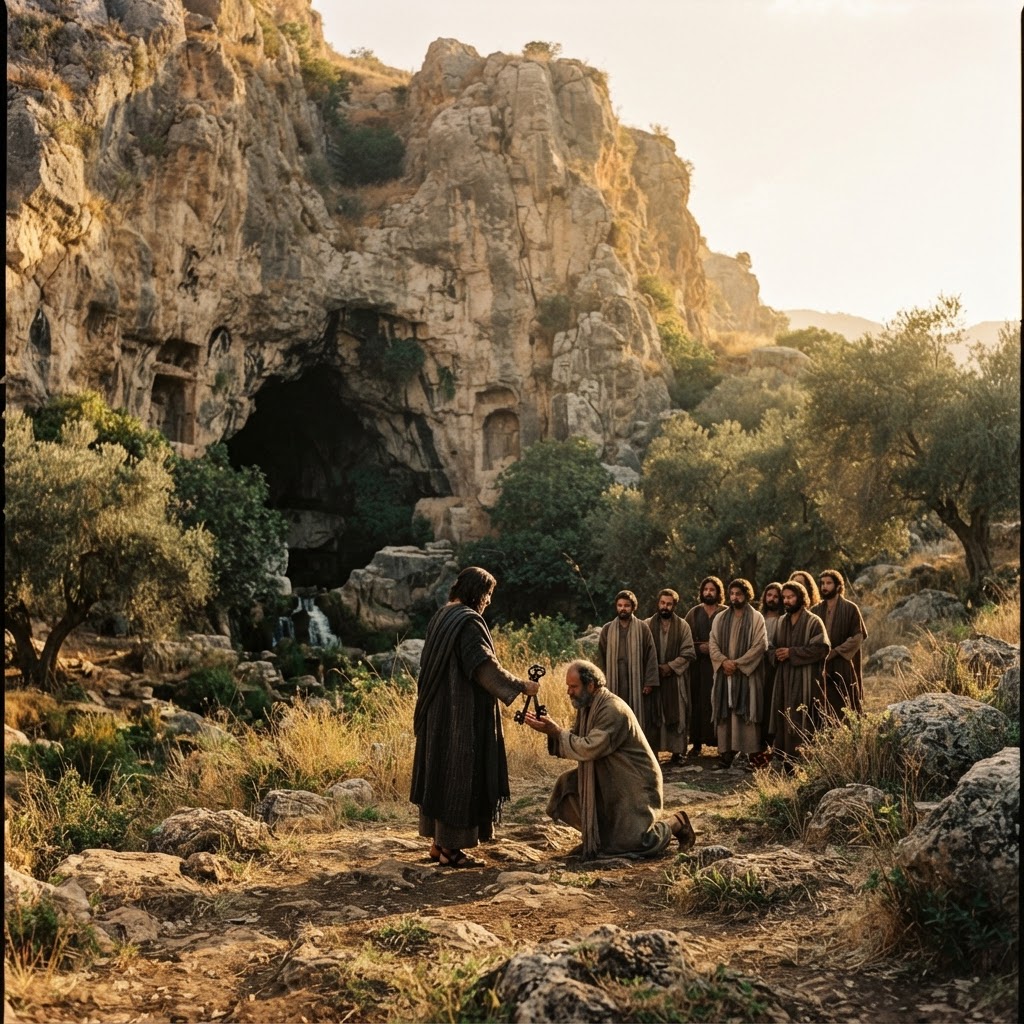
A robed first-century teacher handing large iron keys to a kneeling bearded fisherman at the rock face of Caesarea Philippi at golden hour.
An artist's reconstruction of the grant at Caesarea Philippi. The keys are not a metaphor for insight; they are the steward's keys of the house of David, and Christ said He would give them.

Binding and Loosing: Who Holds the Keys

An objection is often drawn from Matthew 18:18, where Christ gives the power to bind and loose to the apostles as a body. But this confirms the Catholic reading rather than undermining it. In the household of David, the steward held the key and the elders shared in the governance of the house; both are true, and they are ordered. Matthew 16 gives the keys to one man; Matthew 18 gives the household its share of authority. What the Church has never done is read Matthew 18 as cancelling Matthew 16, because that is not how Scripture works: a later grant broadens responsibility, it does not revoke an earlier commission.

The practice of the apostolic Church shows how this worked. At the Council of Jerusalem there was much debate, and then Peter stood up and gave the doctrinal judgement that decided the question: God made no distinction between us and them, and we shall be saved through the grace of the Lord Jesus, just as they will (Acts 15:7-11). The assembly fell silent. James, the bishop of Jerusalem, then proposed the practical settlement that followed from Peter's judgement. The steward speaks, the household acts.

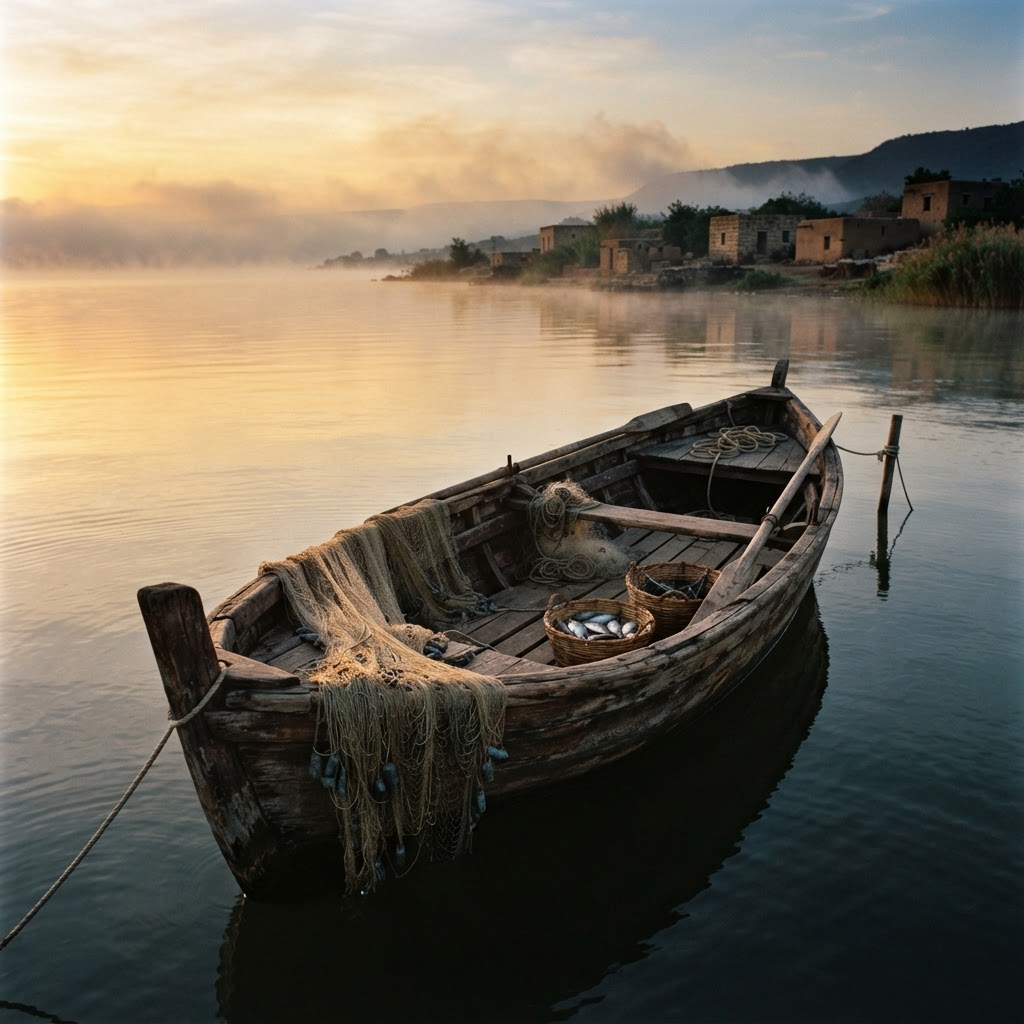
A wooden first-century fishing boat on the Sea of Galilee at dawn with nets drying over the gunwale and the shoreline of Bethsaida beyond.
The Sea of Galilee at Bethsaida, the home town of Peter, Andrew and Philip. The man given the keys of the kingdom was a fisherman from a village on this shore.

One Flock, One Shepherd, One Faith

Why a chief apostle at all? Because Christ asked for it in the prayer He prayed the night before He died: that they may all be one, as you, Father, are in me and I in you, so that the world may believe that you have sent me (John 17:21). Unity of faith is not a sentiment; it is an institution, and institutions need a visible centre. He had said already that there would be one flock and one shepherd (John 10:16), and He charged the man He renamed Rock to strengthen the brothers and to feed the sheep.

This is why the office is not a career but a service, and why the Church has always described it as the bond of communion: the see of Peter exists so that the Church may speak with one voice about what she has received. Peter himself understood both sides of it. He calls himself a fellow elder, exhorts the shepherds not to lord it over those in their charge, and points them to the chief Shepherd who is coming (1 Peter 5:1-4).

And it is worth noticing what Christ did not promise. He did not promise that Peter would never fail — Peter denied Him three times, and Paul later opposed him to his face when he acted inconsistently at Antioch (Galatians 2:11). He promised something narrower and more important: that Peter's faith would not fail, and that the gates of hell would not prevail against the Church built on him. The office is a guarantee about the faith, not about the man.

Simon, Simon, behold, Satan demanded to have you, that he might sift you like wheat, but I have prayed for you that your faith may not fail; and when you have turned again, strengthen your brethren.

Luke 22:31-32

Scripture quotations follow the Revised Standard Version, Catholic Edition. The Aramaic reading of Matthew 16:18 is common ground among commentators of every tradition: kepha is used for both halves of the sentence.

The Early Church Speaks of Rome

Not a Theory, but a Practice

The strongest thing that can be said about the Roman primacy is not that Christian writers praised it, but that they used it. Before any general council had met, churches in Greece, Asia Minor, Syria, Egypt, Gaul and North Africa were appealing to the Church of Rome to settle their disputes, and Rome was answering as though she had the right to be obeyed. Men who had no interest in Rome's claims cited the chair of Peter as the reason they stayed in communion.

The evidence below runs from the generation of the apostles to the Council of Chalcedon. Every witness is writing before the papacy is supposed to have existed.

I

1 Clement — the Church of Rome writes to Corinth

c. AD 96, while the apostle John was still alive · 1 Clement 42-44, 59

✠

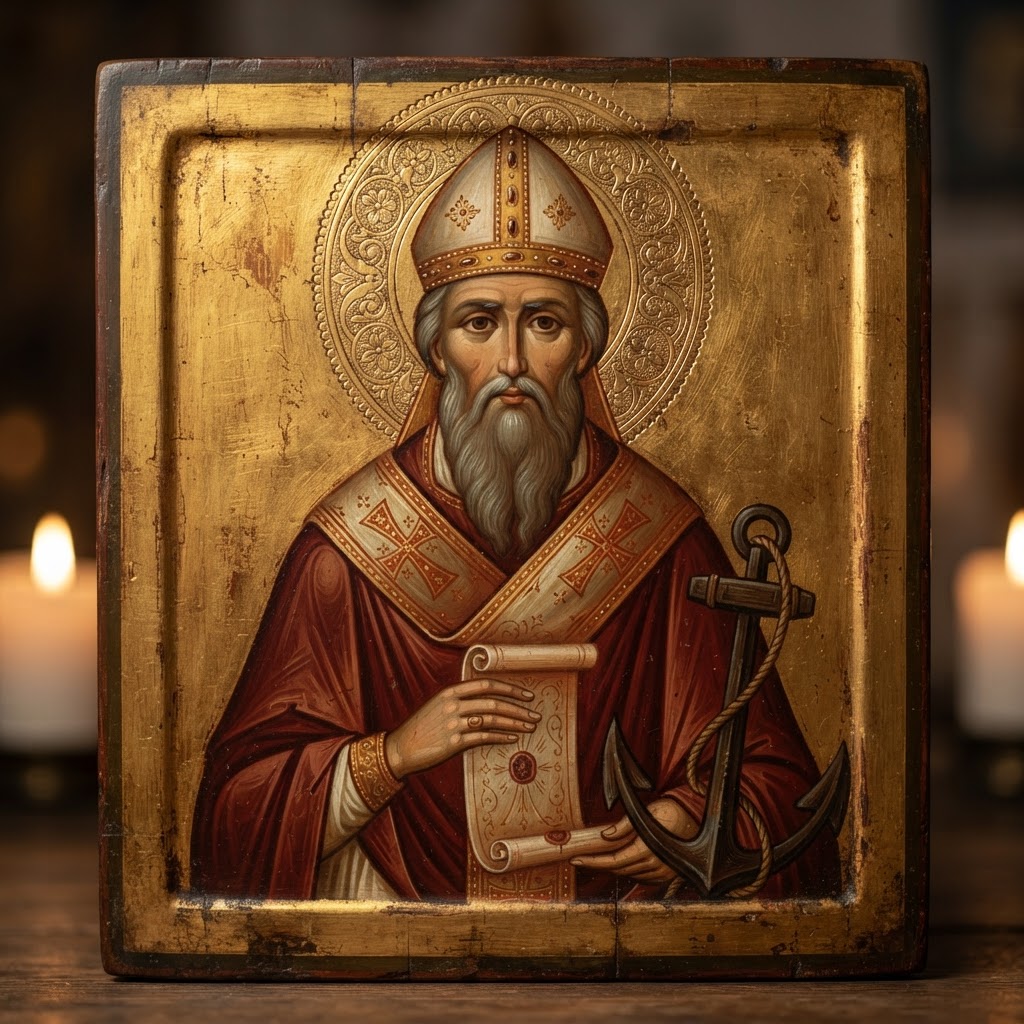
A dispute in Corinth had led to the deposition of the local presbyters. Without being asked, the Church of Rome wrote and instructed the Corinthians to restore them, grounding the appeal in the order the apostles had established. It ends with a warning: if any disobey the words spoken by Him through us, let them know that they will involve themselves in transgression and no small danger. Here is Rome intervening authoritatively in a church it did not found, within living memory of the apostles. The Corinthians kept the letter and read it in their assemblies decades later.

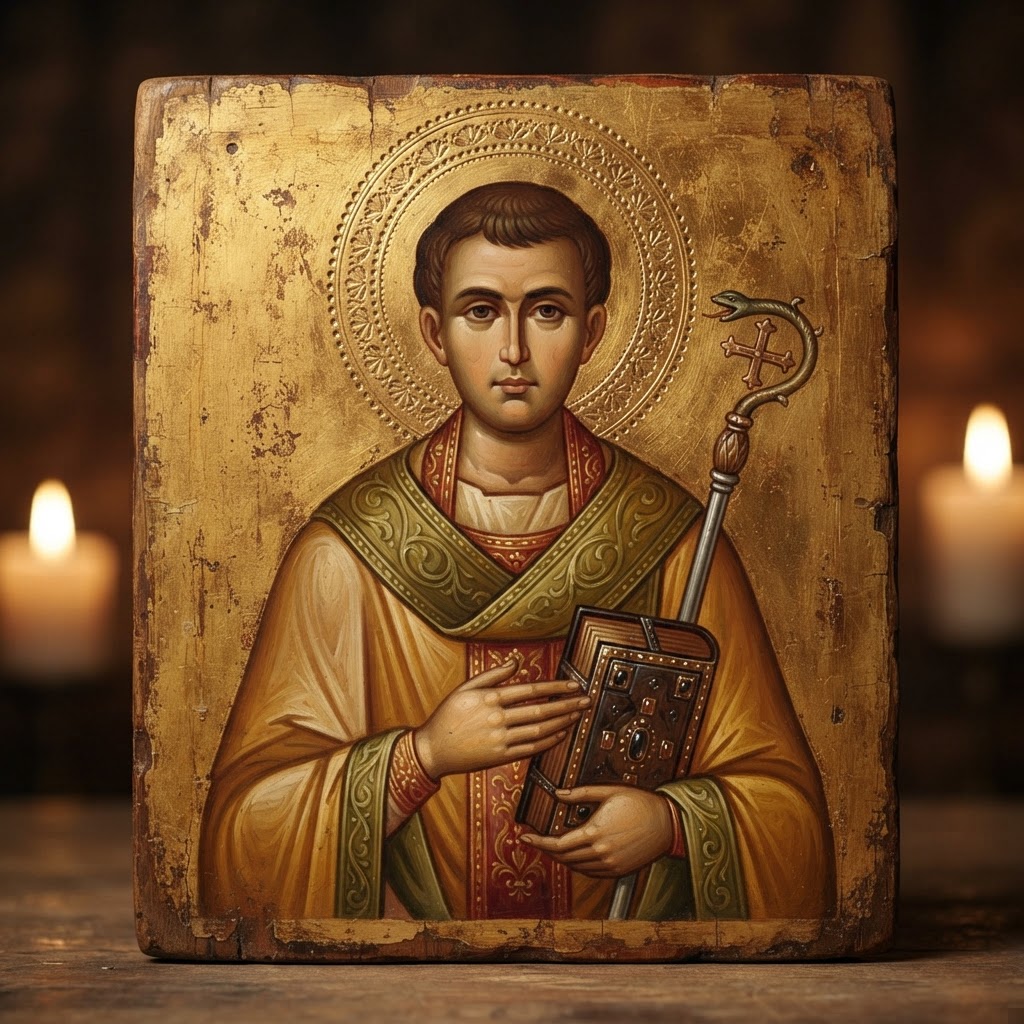
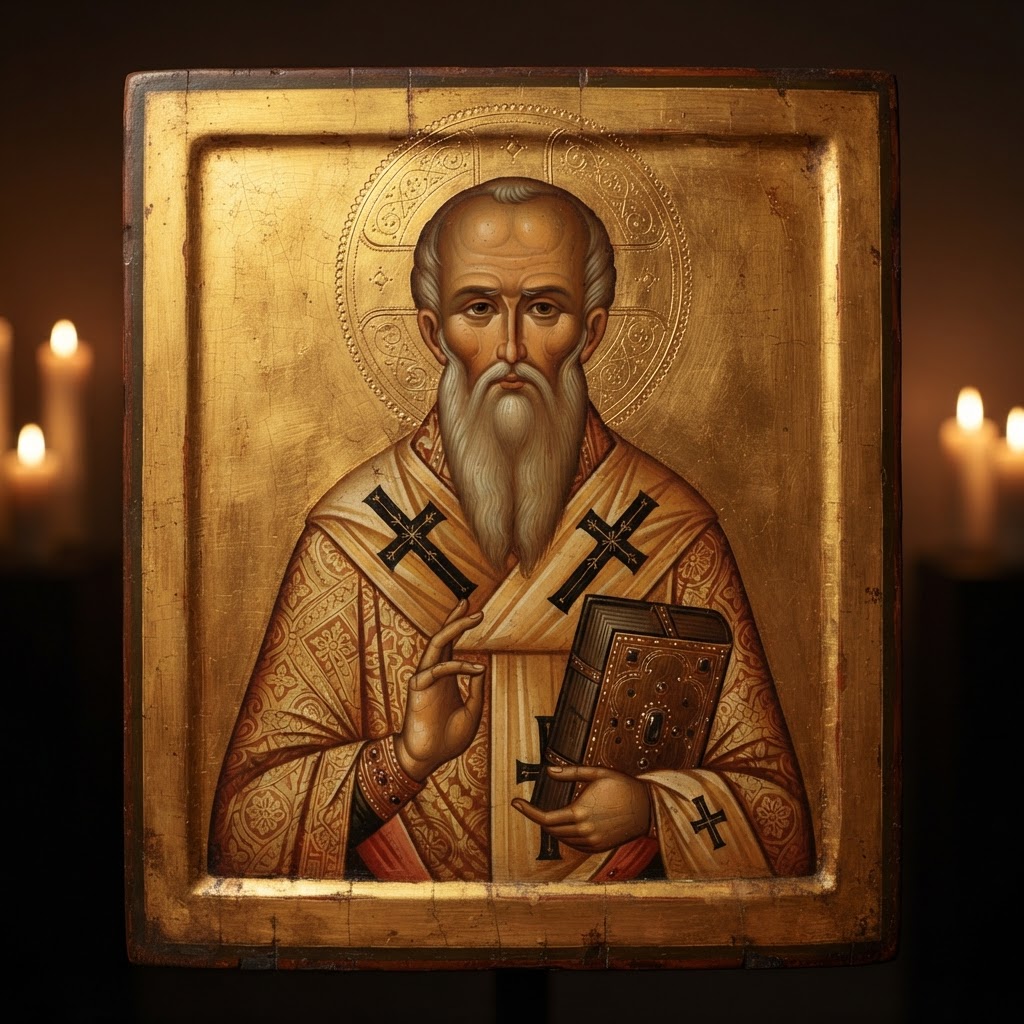
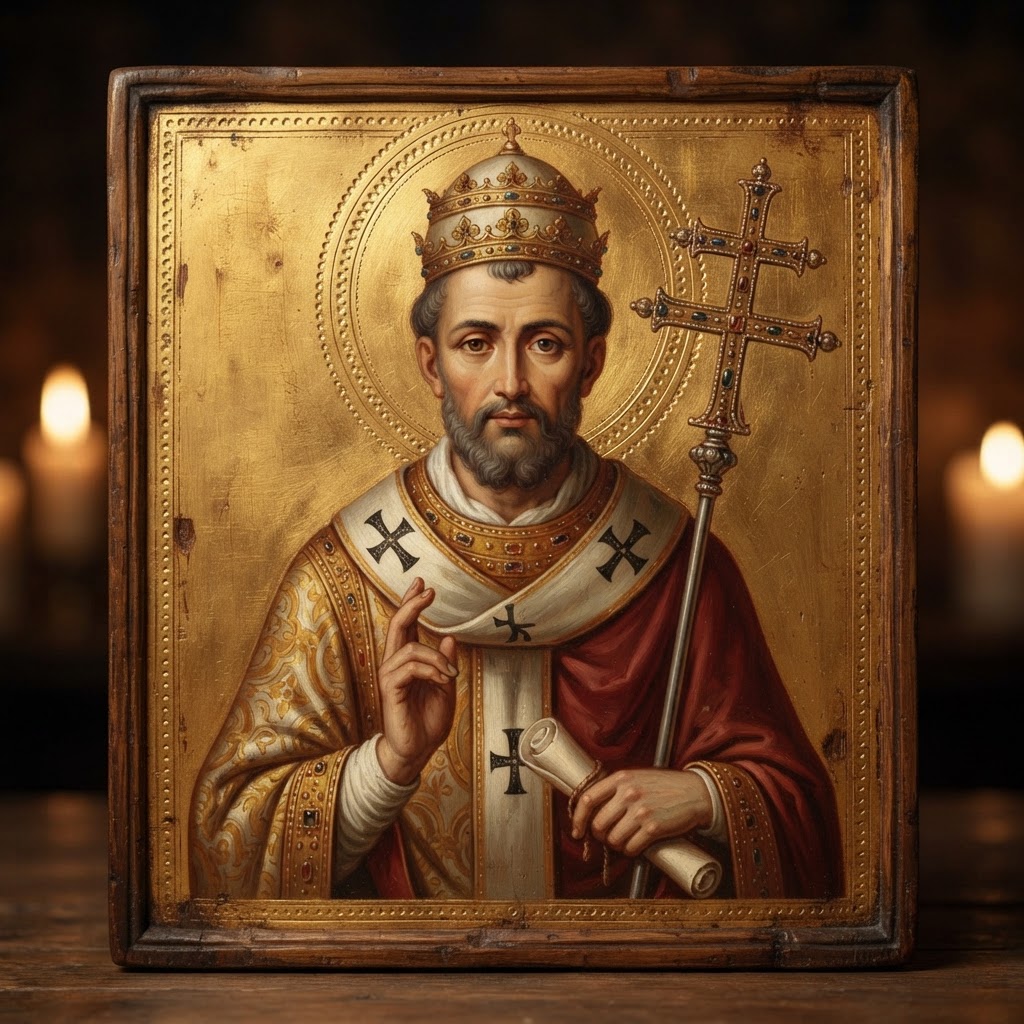
Icon of St Clement of Rome holding a scroll beside a ship's anchor
II

St Ignatius of Antioch

c. AD 107, on his way to be martyred in Rome · Letter to the Romans, prologue; Letter to the Smyrnaeans 8:1

✠

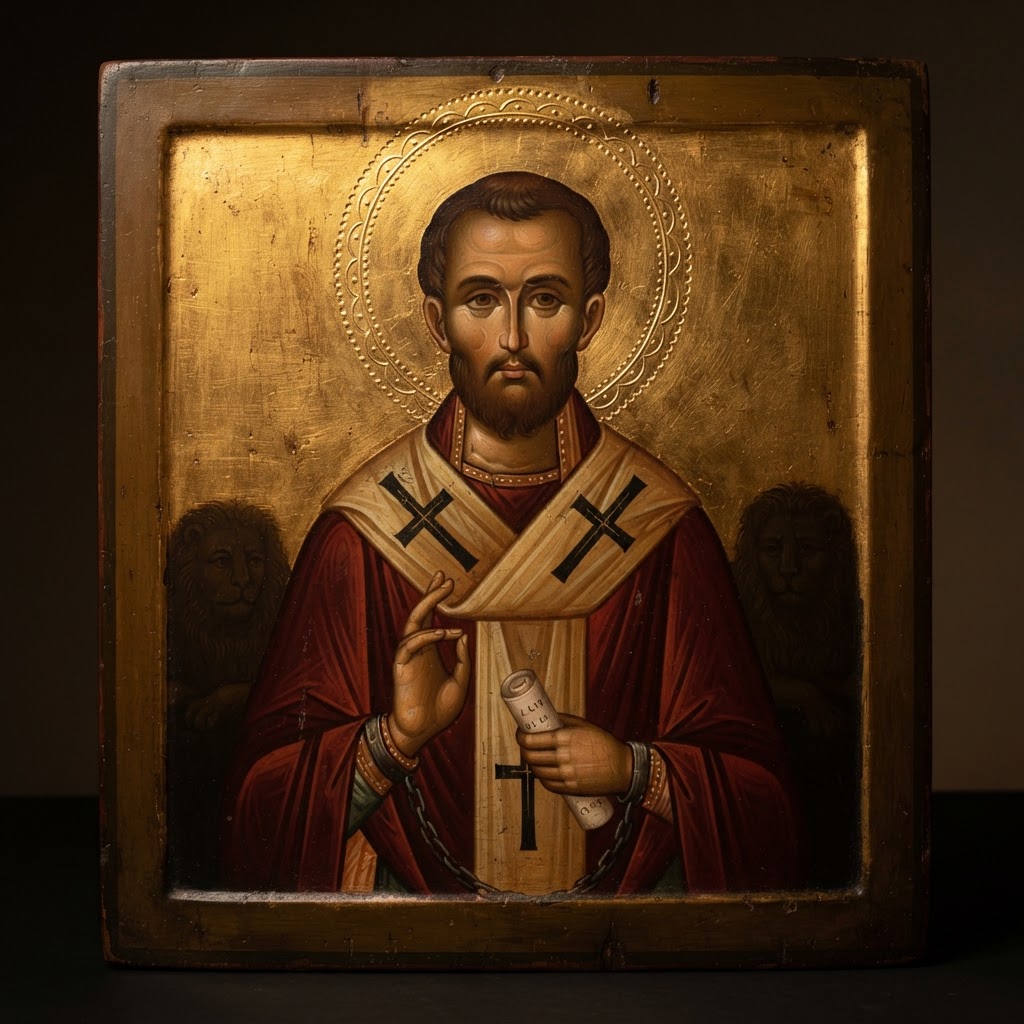
Ignatius greets the Roman church as the one which presides in love, and writes with a reverence for it that he gives to no other see. To the Smyrnaeans he lays down the principle of communion: where the bishop is, there let the multitude be, just as where Jesus Christ is, there is the Catholic Church. Unity has a visible structure, and Rome is treated as its centre.

Icon of St Ignatius of Antioch in chains holding his letters
III

St Irenaeus of Lyons

c. AD 180 — a disciple of Polycarp, who had known the apostle John · Against Heresies III.3.1-3

✠

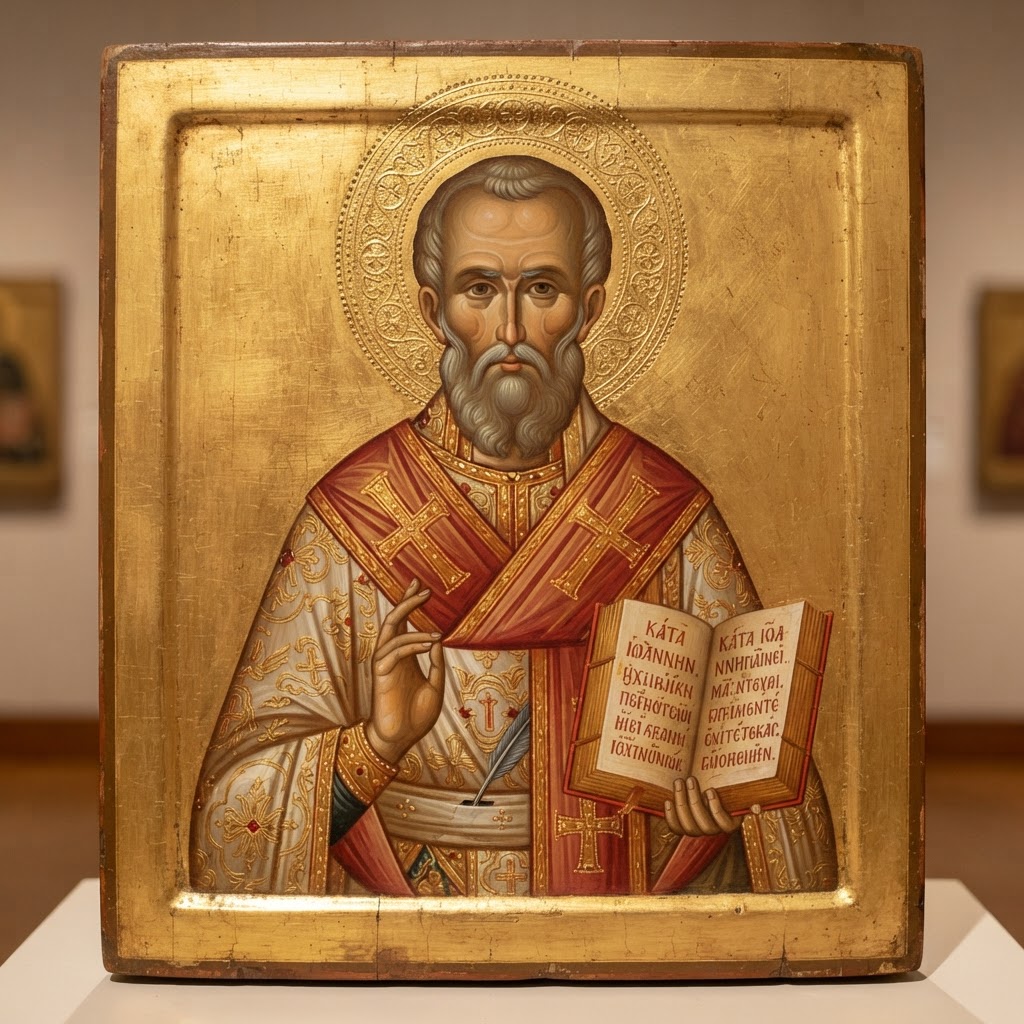
Irenaeus gives the apostolic succession of the Church of Rome — Peter and Paul, then Linus, Anacletus, Clement and onward — and states why he does it: with this Church, because of its pre-eminent authority, it is a matter of necessity that every Church should agree. This is the argument of a bishop of Gaul, writing in Greek, against Gnostic teachers, and it treats Rome as the Church by which the apostolic faith is tested.

Icon of St Irenaeus of Lyons holding an open book with a quill at his belt
IV

Tertullian

c. AD 200 — Carthage · On the Prescription of Heretics 32, 36

✠

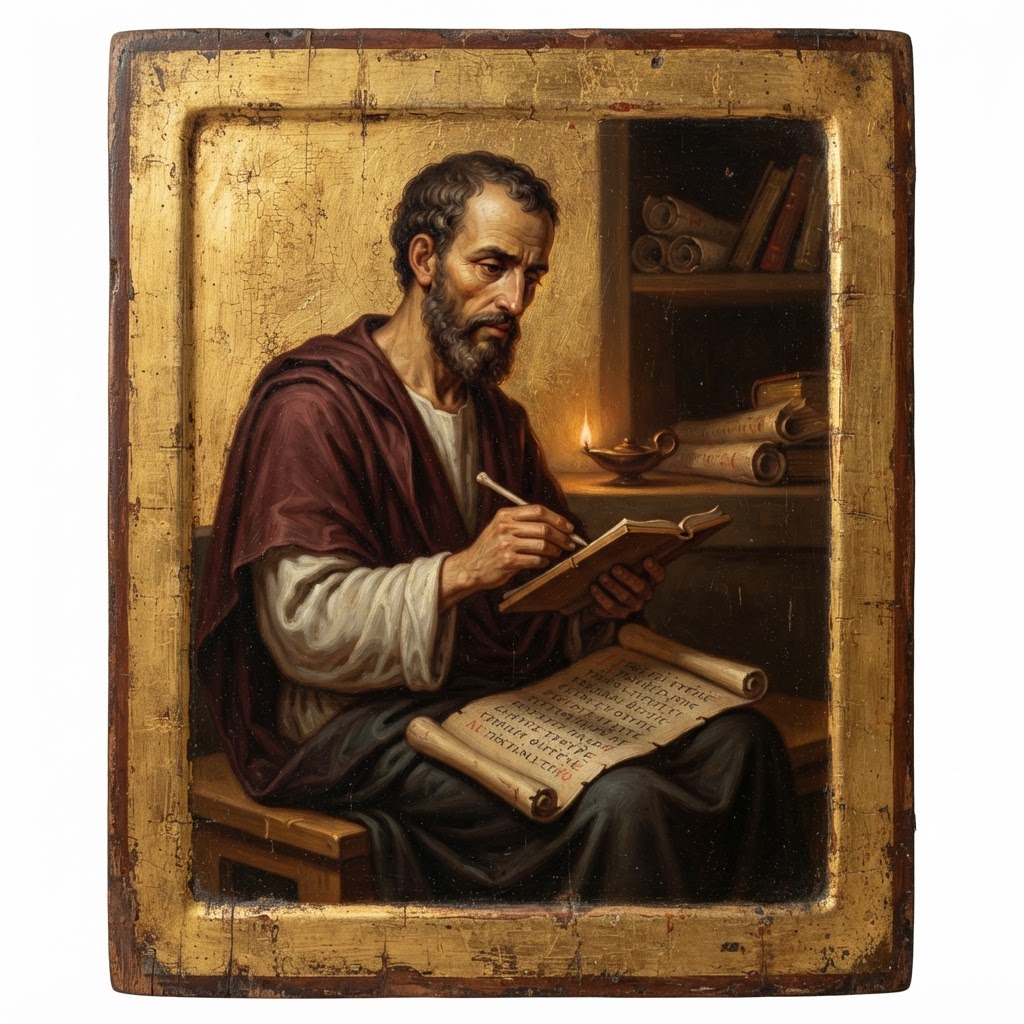
He calls the Church of Rome a happy church to which the apostles poured forth all their doctrine along with their blood, and points the heretics to it as the place where apostolic teaching is preserved. Tertullian later broke with the Church — which is why his testimony is so telling: he was not writing to flatter Rome, and by the end of his life he was her critic.

Icon of Tertullian of Carthage writing with a stylus on a wax tablet
V

St Cyprian of Carthage

c. AD 250 — the great bishop of North Africa · On the Unity of the Church 4; Letter 55.8

✠

Cyprian teaches that Christ founded a single Chair and established a source and an origin of that one unity, and that the primacy was given to Peter. He uses that very fact as an argument against schism: if the Church is one, and her unity begins in the chair of Peter, then whoever separates himself from that communion has separated himself from the Church.

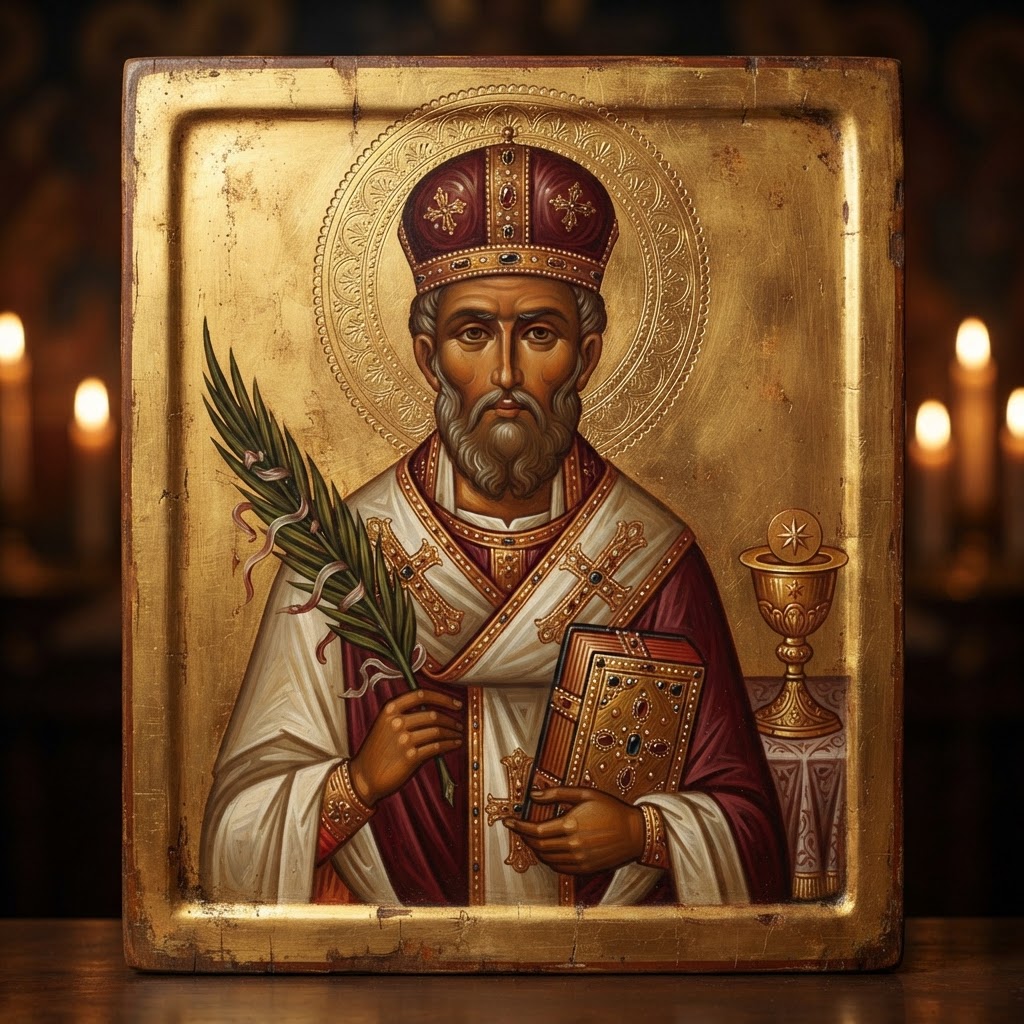
Icon of St Cyprian of Carthage holding a book and a martyr's palm
VI

Optatus of Milevis

c. AD 370 — arguing with the Donatists in North Africa · Against the Donatists II.2

✠

To settle a schism, Optatus takes his opponent to the point of origin: you cannot deny that you know that in the city of Rome the episcopal chair was first conferred on Peter, in which the head of all the apostles, Peter, sat. He then lists the Roman bishops down to his own day. For a fourth-century African bishop, the test of communion was the see of Peter.

Icon of St Optatus of Milevis holding a codex and a bishop's staff
VII

St Jerome

c. AD 376 — writing from the desert to Pope Damasus · Letter 15.2

✠

I am with you, that is, with the chair of Peter. I know that the Church is built upon that rock. Jerome, the greatest scholar of his age and a man with no talent for deference, wrote to Rome for a doctrinal decision and said plainly why: the Church is built on that rock.

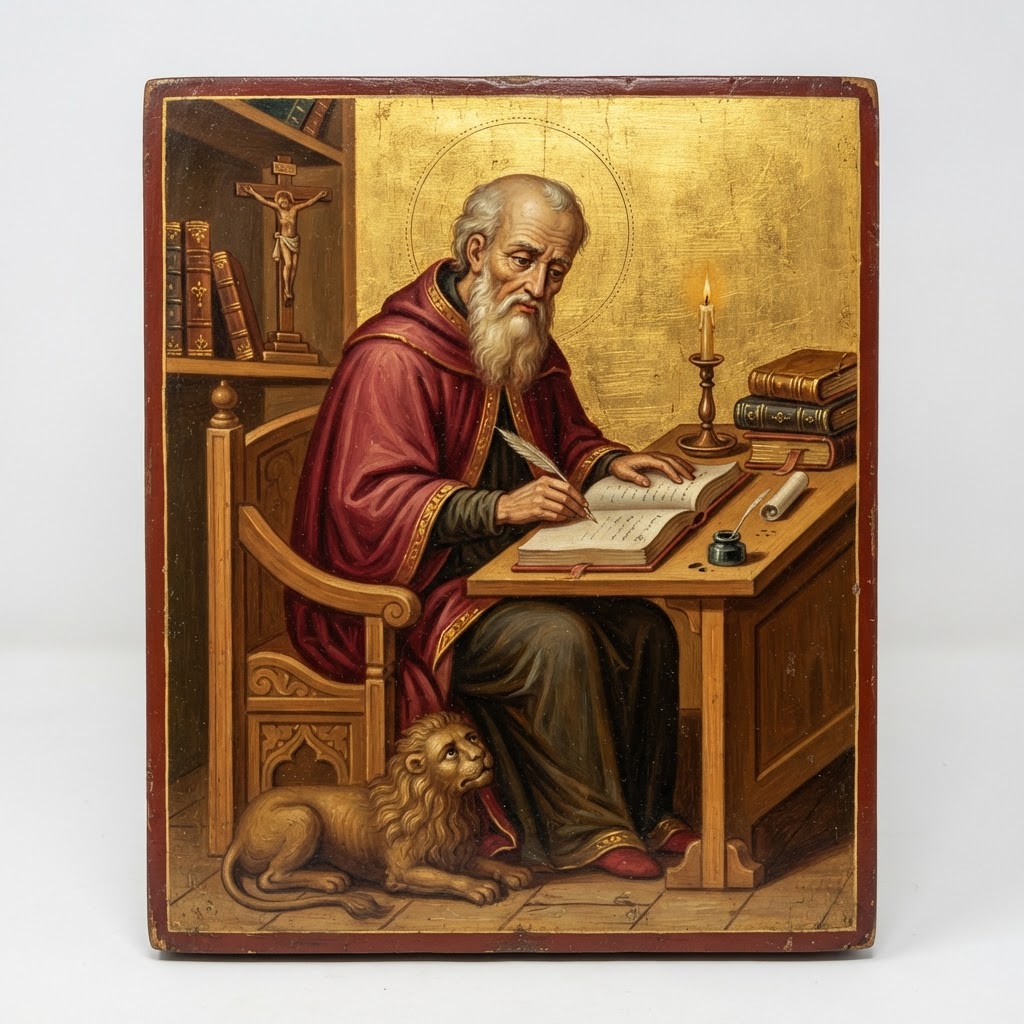
Icon of St Jerome at his desk with a quill, a scroll and a lion at his feet
VIII

St Augustine of Hippo

c. AD 400 — North Africa · Against the Letter of Mani 4; Sermon 131.10

✠

Augustine lists the succession of priests from the very see of Peter the apostle, to whom the Lord committed the feeding of his sheep, up to the present day, as one of the reasons he believes the gospel. And when Rome had judged a doctrinal dispute, he preached: two councils have been sent to the Apostolic See and answers have come back; the case is closed. His sermon, incidentally, was on John 6.

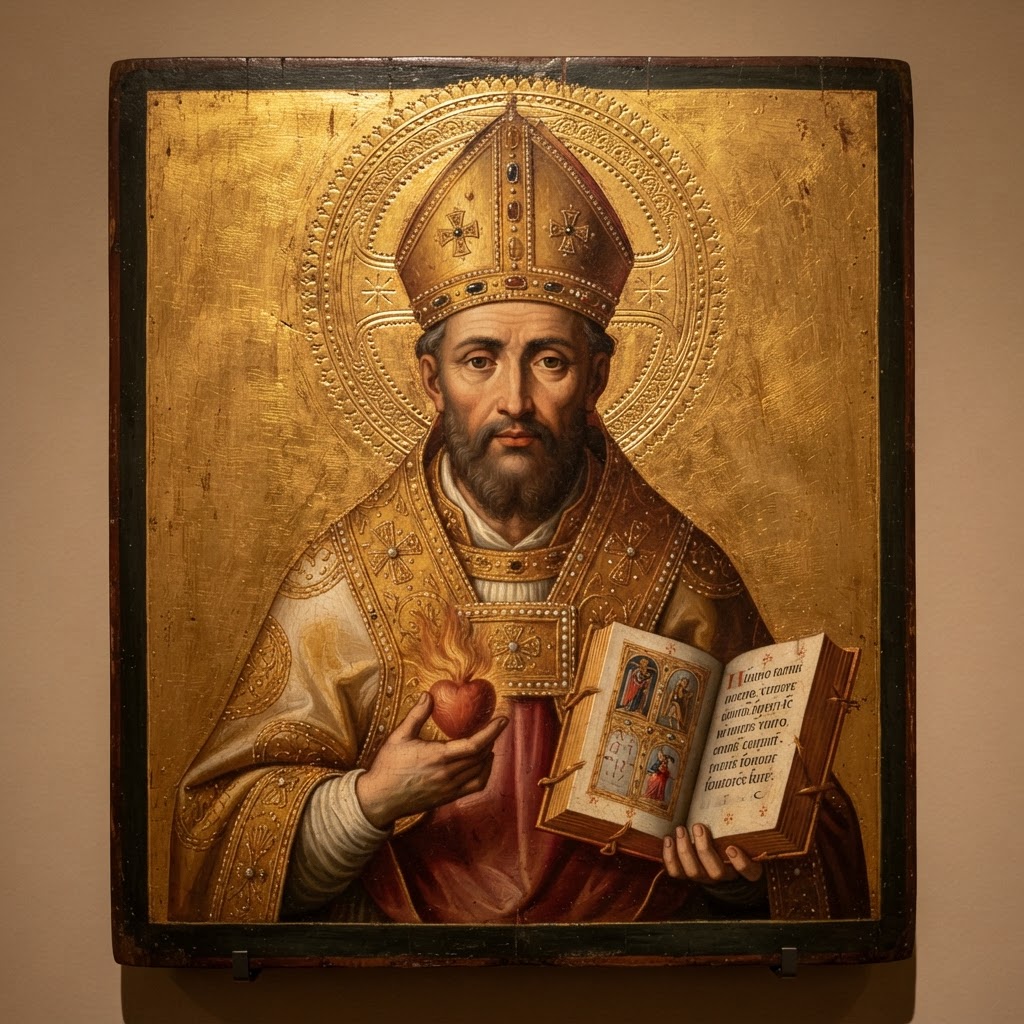
Icon of St Augustine of Hippo holding an open book and a flaming heart
IX

St John Chrysostom and St Leo the Great

AD 404 and AD 451 — the East and the West · Chrysostom's appeal to Pope Innocent I; the acclamation of Chalcedon

✠

Chrysostom, patriarch of Constantinople and the greatest preacher of the East, was deposed by a hostile court and appealed directly to Pope Innocent I of Rome, who received him into communion. Half a century later, when Leo the Great's letter on the two natures was read at the Council of Chalcedon, the assembled bishops cried out: Peter has spoken through Leo.

Icon of St John Chrysostom holding a book of his homiliesIcon of Pope St Leo the Great holding his rolled scroll
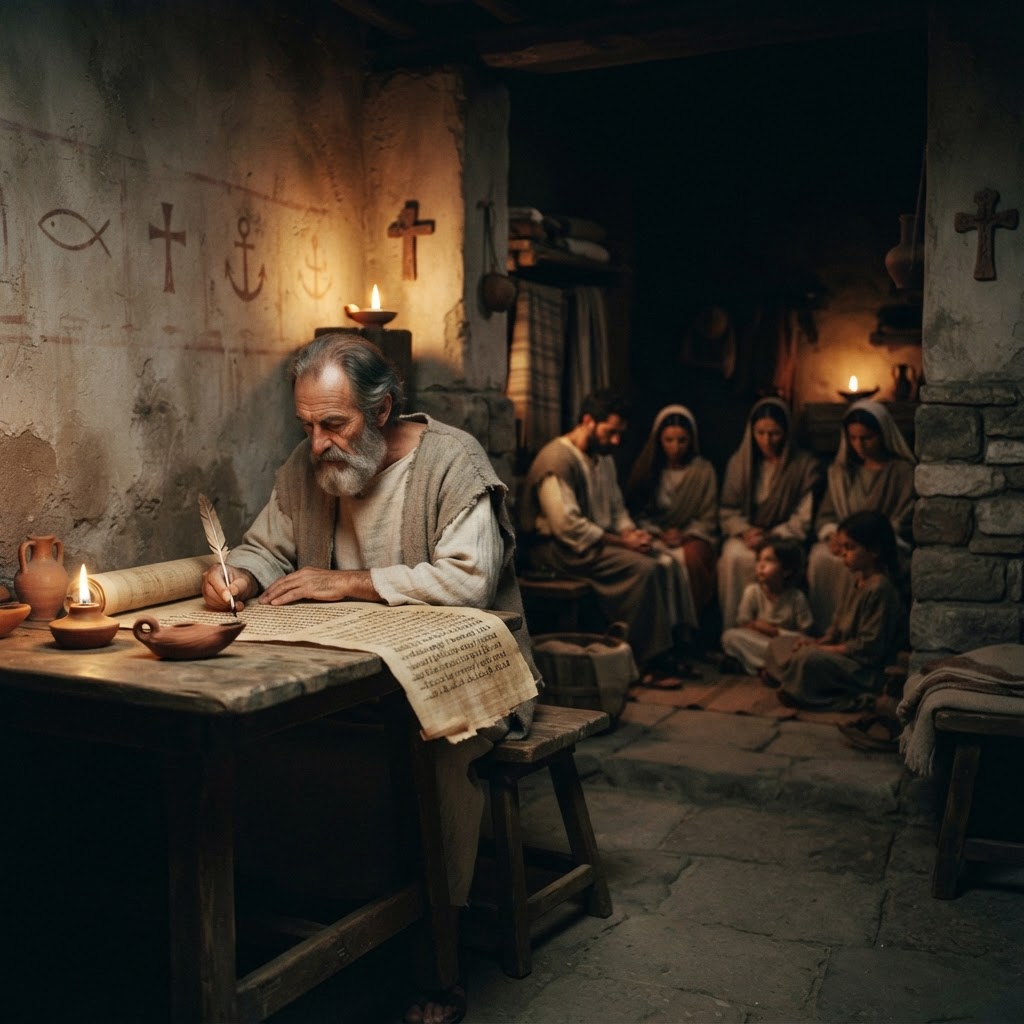
A second-century bishop writing a letter by oil lamplight on a papyrus scroll in a Roman house-church, with Christians praying in the shadows behind him.
An artist's reconstruction of a Roman house-church. From rooms like this the Church of Rome wrote to Corinth in the first century, appealing to the order the apostles had established.

The Witness of the Councils and of Constantinople

The evidence is not only Western. The Council of Constantinople in 381 — an entirely Eastern council — gave the bishop of its own city the primacy of honour after the bishop of Rome, and gave as its reason that Constantinople was the new Rome. The canon presupposes what it does not argue: that Rome stood first. In the same way, the bishops of the East appealed to Rome when they were oppressed, and the popes intervened in the East's doctrinal disputes. When the Church later tried to heal the rupture of the eleventh century, the reunion formula of AD 519 was a confession that in the Apostolic See the Catholic religion has always been kept undefiled.

With this Church, on account of its pre-eminent authority, it is a matter of necessity that every Church should agree.

St Irenaeus, Against Heresies III.3.2 (c. AD 180)

It is worth asking why this evidence is so rarely heard. Part of the answer is that the papacy of the first four centuries did not look like the papacy of later centuries, when the collapse of the empire and the disputes of the Middle Ages made the bishop of Rome a temporal as well as a spiritual figure. But an office which is invoked in AD 96, 107, 180, 200, 250, 370, 376, 400, 404 and 451 did not come into being in the year 1075, or in 1870, or in the reign of Constantine. What changed was the scale of the disputes, not the existence of the see.

What the Ground Has Held

The Stones Under the Claim

A doctrine is not proved by archaeology, and the Church's faith does not rest on a trench. But the physical record matters, because the central anti-Catholic claim of the last five hundred years has been that the see of Peter was invented and that Peter himself was never in Rome. The ground under Saint Peter's, and the ground under a village on the Sea of Galilee, say otherwise.

The Trophy of the Apostles, AD 200

Recorded c. AD 200 · Monument uncovered 1939–1949

Around the year 200 a Roman presbyter named Gaius was disputing with a Montanist named Proclus. His argument was not theological but local, and that is exactly why it is useful: he offered the monuments. In the early fourth century Eusebius recorded his words, and they describe a Rome in which the burial places of Peter and Paul were already public knowledge and already visited.

But I can point out the trophies of the apostles. For if you will go to the Vatican or to the Ostian Way, you will find the trophies of those who founded this church.

Gaius the presbyter, quoted in Eusebius, Church History II.25 (c. AD 200)

The Excavations Beneath Saint Peter's

Excavated 1939–1949 · Relics announced 1968

In 1939, under the floor of the basilica, work began on the necropolis that the Emperor Constantine had filled in and built over. Archaeologists uncovered a Roman cemetery of tombs and mausoleums, and in it a small monument — an aedicula, cut into a red plaster wall — that had been venerated by Christians from at least the second century, in a place no Christian would have chosen to venerate unless something was there. The wall carries graffiti invoking Peter and Paul, and among them the Greek words that have been read as PETROS ENI: Peter is here.

Bones were found in a niche in that wall. In 1968 Pope Paul VI announced that they had been identified as those of a robust man of about sixty to seventy years of age, wrapped in costly purple cloth, and he spoke of the identification as convincing. Two things should be said plainly. First, the identification is a judgement of historians and anatomists, and the evidence has been debated since; it is not a matter of faith. Second, the doctrine does not need it. The catacombs show Christians venerating Peter's burial place in Rome in the second century, which is the point the argument actually turns on.

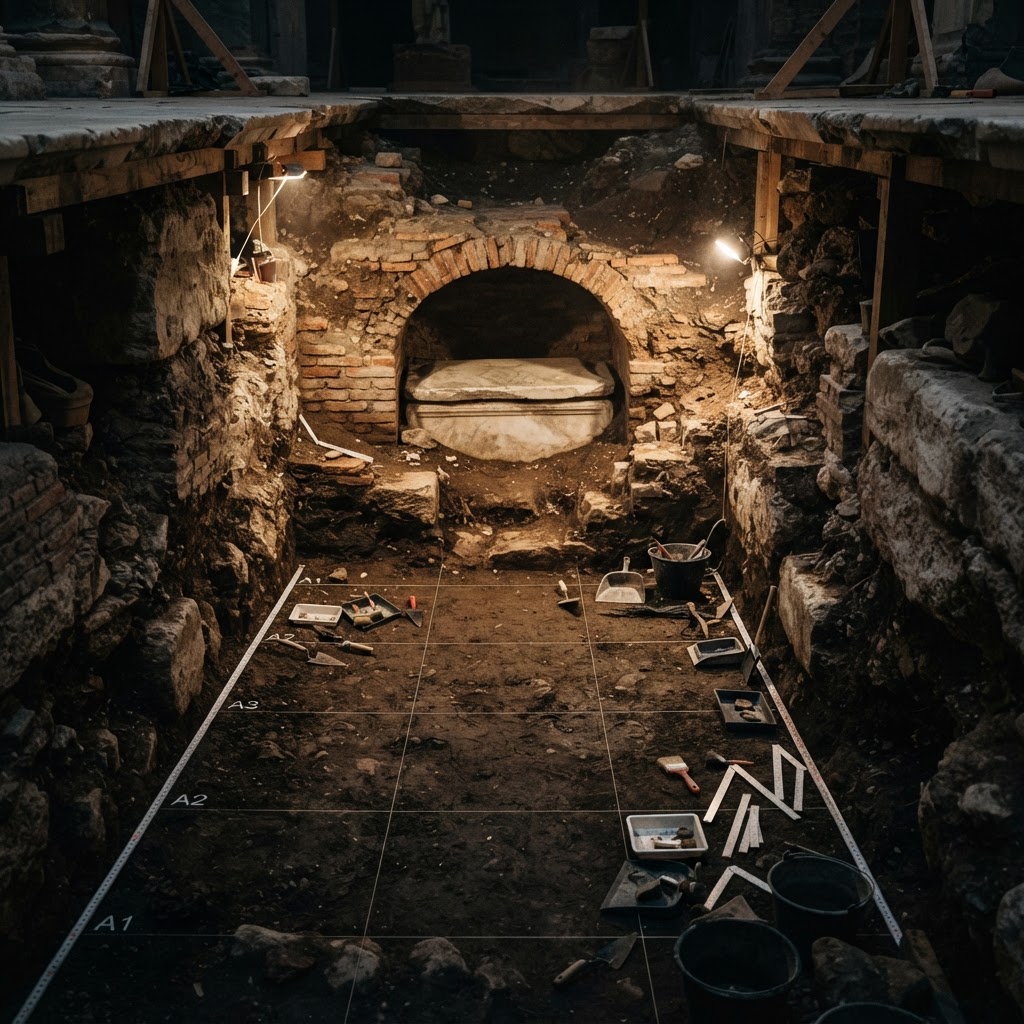
An excavation trench beneath a marble floor with trowels and grid strings, revealing an ancient Roman tomb niche with a marble slab.
An artist's reconstruction of work beneath the floor of Saint Peter's. From 1939 the Roman necropolis was excavated under the basilica, revealing the second-century monument to the apostle and the graffiti invoking Peter and Paul.

The Mosaic at Bethsaida

Basilica excavated from 2016 · Mosaic reported 2022

The other end of the story lies on the northern shore of the Sea of Galilee. The pilgrim Willibald, writing in AD 724, described a church at Bethsaida built over the house of Peter and Andrew. Excavators working at el-Araj have uncovered a Byzantine basilica that matches his description, and in its floor a mosaic with Greek inscriptions.

One of them names the donor: Constantinos, the servant of the Messiah. Another honours the apostle in the language Byzantine Christians used of Peter — the head and leader of the heavenly messengers, the chief and commander of the heavenly apostles. The phrasing echoes the promise of the keys of the kingdom of heaven from Matthew 16:19, and it has been described in recent reporting as a mosaic honouring Peter as the keeper of the keys — a title rarely found in any inscription in the eastern Mediterranean. In a church standing, as its excavators argue, over the house of the fisherman who was given that name.

A word of honesty is owed here. The identification of el-Araj with biblical Bethsaida is contested by scholars who favour the neighbouring site of et-Tell, and the argument will continue. But the mosaic does not depend on that debate in order to be relevant: on the floor of a sixth-century church by the Galilean shore, an ancient community called Peter the chief of the heavenly apostles and the keeper of the keys. That is not a medieval invention, and it is not a Roman one. It is a Greek inscription, in a Galilean church, in the land where he fished.

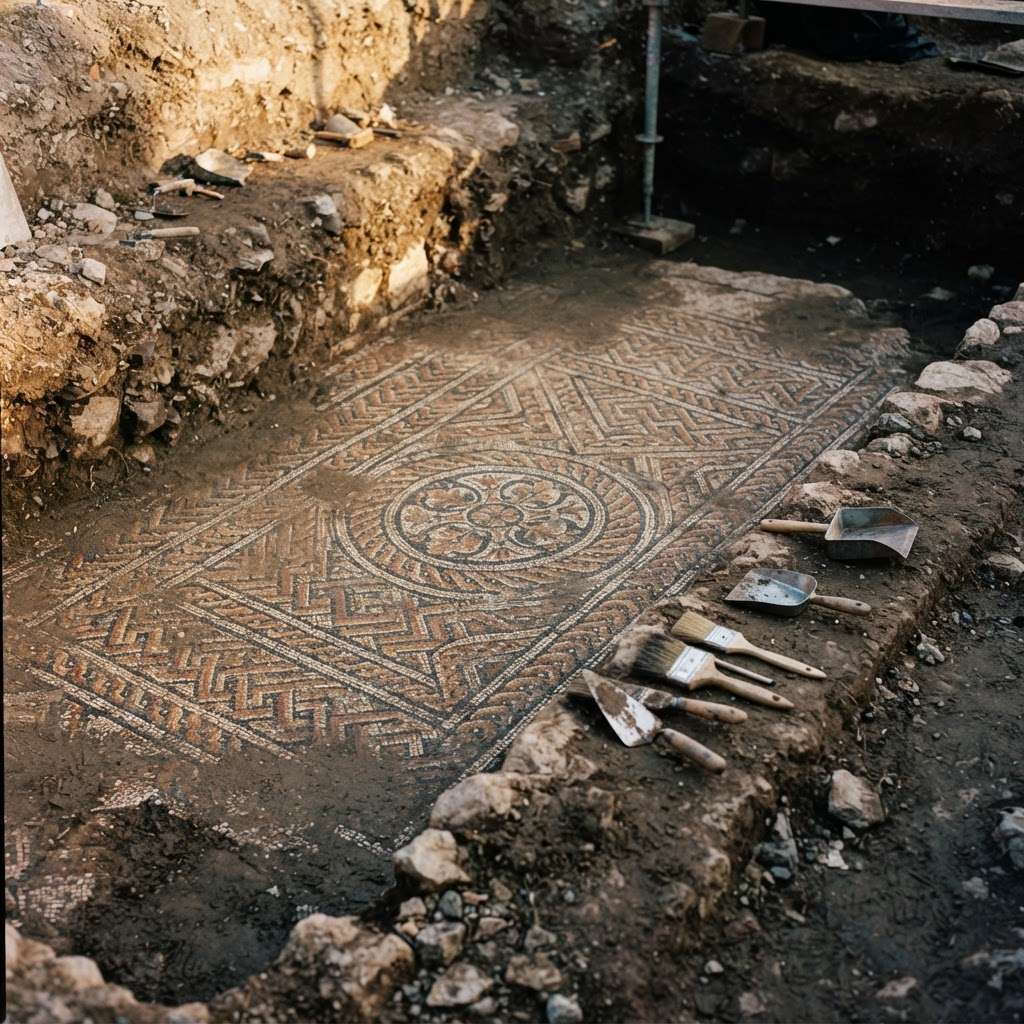
An artist's reconstruction of an excavated Byzantine church floor with a geometric stone mosaic and a circular medallion, trowels and brushes beside it.
An artist's reconstruction of an excavated Byzantine church floor of the kind found at el-Araj. The mosaic inscriptions there honour Peter as the head and leader of the heavenly apostles — and echo the promise of the keys.

The Chair of Moses, Cut From Stone

Chorazin synagogue excavated 1905–1926

There is a physical witness to the earlier section of this page as well. When Jesus said that the scribes and Pharisees sat on Moses' seat, He was describing an object. Carved stone seats of Moses have survived from the synagogues of Galilee, including the one recovered at Chorazin — a chair of stone, on which the teacher sat to expound the Law. The shape of the doctrine is sitting in museums and on excavated synagogue floors: authority belongs to a seat, and a seat outlives the man who occupies it.

The scribes and the Pharisees sit on Moses' seat; so practise and observe whatever they tell you, but not what they do.

Matthew 23:2-3

The Doctrinal Development

How the Office Was Defined, and Its Limits

Two different questions are usually collapsed into one. The first is whether the office of Peter exists in the Church — settled by Scripture and by the practice of the first centuries. The second is exactly how that office teaches, and precisely when its teaching is guaranteed. That second question took the Church eighteen centuries to define with precision, and the delay is not evidence of invention. It is evidence that precision comes when error forces it.

Development, Not Invention

Christology itself was defined in stages: Nicaea said who the Son is; Chalcedon said what His two natures mean. The Church did not invent the Incarnation in AD 451. She said with precision what she had always believed, in answer to men who said it otherwise. Saint Vincent of Lérins set out the rule in the fifth century: the understanding of the faith must grow, but in the same meaning and the same sense. The deposit does not change; the Church's articulation of it deepens.

The papacy followed the same pattern. The first centuries exercised the primacy without defining its boundaries: appeals came to Rome and Rome answered. When the doctrine was later denied outright, the Church was forced to say exactly what she meant, and the definition of 1870 is the result.

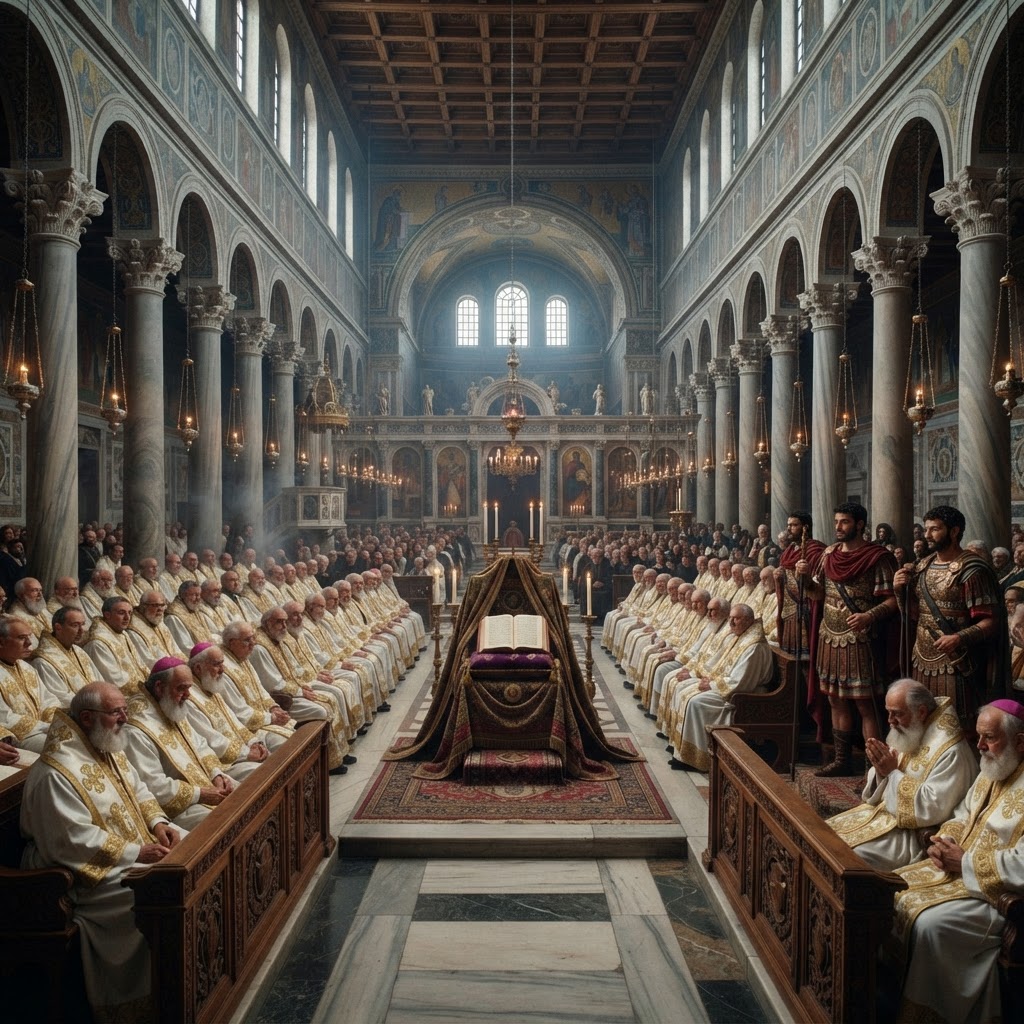
Bishops seated in two facing rows in a great basilica around an enthroned Gospel book, with lamplight and marble columns.
An artist's reconstruction of the Council of Chalcedon, AD 451, where the bishops acclaimed the letter of Pope Leo with the cry 'Peter has spoken through Leo'. The infallibility defined at Vatican I in 1870 was already the practice of the Church in the fifth century.

What Vatican I Actually Defined

The constitution Pastor Aeternus (18 July 1870) has four chapters. The first teaches that the primacy was instituted in Peter by Christ Himself. The second, that what Christ gave to Peter remains in the Church, and is therefore held by whoever succeeds Peter in the Roman see. The third defines the nature of that power: a true, ordinary and immediate jurisdiction over the whole Church — pastoral, not military, and one that does not abolish the authority of bishops in their own churches but confirms it. The fourth is the chapter everyone quotes, and it is worth reading precisely, because almost every popular caricature of it dies on its wording.

When the Roman Pontiff speaks ex cathedra — that is, when in the exercise of his office as shepherd and teacher of all Christians, in virtue of his supreme apostolic authority, he defines a doctrine concerning faith or morals to be held by the whole Church — he possesses, by the divine assistance promised to him in blessed Peter, that infallibility with which the divine Redeemer willed his Church to be endowed in defining doctrine concerning faith and morals.

Vatican I, Pastor Aeternus, chapter 4 (1870)

Read that sentence slowly and almost the whole anti-papal folklore evaporates. The conditions are narrow, the subject matter is limited to faith and morals, the act is a formal definition, the audience is the whole Church, and the guarantee is the divine assistance promised to Peter — not a personal gift of the man, and not the Church's substitute for study, prayer or argument. Saint John Henry Newman, who agonised over the definition before it was made, wrote afterwards that he had feared a doctrine broader than this and found instead a doctrine he already held.

The Five Limits, Stated Plainly

1

It is not new revelation

No pope can add to the deposit of faith. The charism exists to keep the Church from losing what she has received, not to give her something she never had. Public revelation ended with the apostles.

2

It is not impeccability

Infallibility concerns teaching, not the moral life. A pope may be a great sinner, as some have been, and the charism is untouched; it is Christ's promise about the faith, not a personal reward.

3

It is not every statement

Homilies, letters, books, interviews, private opinions and prudential judgements are not infallible and may be wrong. The definition names the narrow case: a formal definition of faith or morals to be held by the whole Church.

4

It is not governance or policy

Decisions about discipline, liturgy in its details, appointments or politics are not definitions of faith and morals. Catholics may and do disagree about such matters, and have always done so.

5

It is not the pope alone against the Church

The definition speaks of the infallibility with which Christ willed His Church to be endowed. The pope's charism serves the Church's faith; it is not a separate, private oracle. And the whole body of the faithful shares in the certainty of the faith.

Vatican II Locates the Charism in the Church

Lumen Gentium, the Second Vatican Council's constitution on the Church, teaches in its eighteenth paragraph that the Roman Pontiff is the perpetual and visible principle and foundation of the unity both of the bishops and of the whole company of the faithful; in its twenty-second, that the college of bishops has no authority apart from its head; and in its twenty-fifth, that the faithful owe religious assent of will and intellect to the authentic teaching of the pope even when he does not speak infallibly, but that this teaching is to be distinguished from a formal definition.

The same paragraph insists that the pope's charism is exercised within the faith of the whole Church, and that the whole body of the faithful cannot err in believing — the Church, not merely its head, is preserved in the truth. And Unitatis Redintegratio acknowledged in the same Council that the Eastern churches possess true sacraments and true apostolic succession, and that they are not to be treated as though the papacy were the only reality the Church contains. The office is real, and it is not the whole Church.

The Difficult Cases

Two cases are raised in every serious discussion, and both deserve an honest answer. Pope Honorius I was condemned by a council in the seventh century for failing to resist the heresy of monotheletism. This was put directly to the fathers of Vatican I, and the answer stands: his letters to Sergius were private correspondence; he did not define anything for the Church, and his offence was negligence in not condemning error rather than an ex cathedra teaching of error. The second case is the long history of papal moral and political failure, which is real and cannot be denied. It touches the holiness of the Church's members, not the guarantee attached to her teaching; and the Church herself publishes the record.

The charism exists for one purpose, and it is the purpose the Lord gave it: that the faith once delivered to the saints should not be lost (Jude 3), and that against the Church built on the rock the gates of hell should not prevail (Matthew 16:18). What the doctrine claims is that this promise is attached to a visible office. What it does not claim is that the men who hold it deserve it.

Quotations from Pastor Aeternus follow the standard English translation, lightly adapted for sentence flow; the conditions named in the definition are reproduced in full.

Answering the Objections

The Ten Claims Most Often Made

These are the arguments a Catholic will meet in practice, stated as they are made, with the answer and the ground it stands on. Two habits make the conversation worthwhile: put the claim in its strongest form before answering it, and keep the argument in the texts and the historical record rather than in personalities.

The Objections and the Answers

The claim

“On this rock” means Peter's confession of faith, not Peter. Augustine says so.

The answer

Augustine says both at different times, and in the same years he describes the see of Peter as the rock and appeals to it. But the decisive point is not Augustine; it is the language Christ spoke. In Aramaic there is one word, kepha, so He said: you are Kepha, and on this kepha. And the grant that follows in the very next verse is personal — the keys, and the power to bind and loose. It would be strange for Christ to build His Church on a confession and then hand the government of it to the man who made it.

Matthew 16:17-19 · John 1:42

St Jerome, Letter 15.2: the Church is built on that rock

The claim

The power to bind and loose was given to all the apostles (Matthew 18:18; John 20:23), so Peter had no primacy.

The answer

Both are true and they are ordered. In the household of David the steward held the keys and the elders shared in the governance of the house. Matthew 16 gives the keys of the kingdom to one man; Matthew 18 gives the household its share of authority. Scripture does not set these against each other, and the apostolic practice of Acts 15 shows the structure working: the college debates, Peter pronounces, silence follows, and James then settles the practical terms.

Matthew 16:19; 18:18 · Acts 15:6-11

The claim

Constantine invented the papacy in the fourth century.

The answer

The Church of Rome wrote to Corinth and instructed it how to settle its dispute around AD 96, when the emperor Constantine was not yet born. Ignatius, Irenaeus, Tertullian, Cyprian and Optatus describe the Roman see's authority in the second and third centuries. Constantine convened the Council of Nicaea; he did not create the see of Peter, and he died a catechumen — the bishop he was to have been baptised by was an Arian.

1 Clement 42-44 (c. AD 96)

Irenaeus III.3.2 · Cyprian, On the Unity 4

The claim

Paul rebuked Peter to his face at Antioch, so Peter was not the chief.

The answer

Paul rebuked Peter for a failure of conduct, not of teaching, and the rebuke was about the truth of the gospel in practice — which is why Paul could write that he had laid his gospel before Peter and the other leaders (Galatians 2:2) and could speak of Peter's apostolate to the circumcised as equal to his own to the Gentiles (Galatians 2:7-8). The Church has never claimed that popes are sinless or beyond correction. What Christ promised Peter was that his faith would not fail, not that his behaviour would always be consistent.

Galatians 2:2, 7-11 · Luke 22:32

The claim

Nobody called the bishop of Rome “pope” in the early Church.

The answer

Vocabulary is not the office. The title 'papa' comes into Christian usage in the third and fourth centuries, and Tertullian was already mocking the Roman bishop as pontifex maximus around AD 220. What matters is that the function is documented under other names from the first century onward — Rome's intervention in Corinth, Irenaeus' pre-eminent authority, Cyprian's chair of Peter, Optatus' episcopal chair first conferred on Peter in Rome. Titles arrive late because they arrive when controversy makes precision necessary.

2 Thessalonians 2:15

Optatus, Against the Donatists II.2 (c. AD 370)

The claim

Vatican I created the doctrine of infallibility in 1870.

The answer

The practice is fifteen hundred years older than the definition. In AD 451 the bishops of Chalcedon acclaimed the letter of Pope Leo with the cry that Peter had spoken through Leo; Augustine said of a Roman judgement that the case was closed, in a sermon preached about AD 400; the reunion formula of AD 519 confessed that the Catholic religion had always been kept undefiled in the Apostolic See. What 1870 did was define the conditions of a guarantee the Church already trusted.

Matthew 16:18-19 · 1 Timothy 3:15

Council of Chalcedon, AD 451

The claim

The Donation of Constantine was a forgery, so Rome's claims rest on forgeries.

The answer

The Donation was indeed exposed as a forgery, and it was exposed by Catholic scholars: Lorenzo Valla in the fifteenth century, with Nicholas of Cusa pressing the case. The episode is a credit to the Church's willingness to be corrected by evidence, not a stain on the doctrine — because the Donation plays no part in the argument for the primacy, which rests on Scripture and on the first-century record. A forged document pretending to give the papacy land cannot create or destroy an office attested in AD 96.

1 Peter 5:1-4

The claim

Honorius I was a heretic pope, so popes can teach error.

The answer

This objection was argued at Vatican I itself, and the answer given then still holds. Honorius wrote private letters to Sergius in which he failed to condemn the heresy of monotheletism; he was condemned by a council for negligence, not for a formal definition. He taught nothing ex cathedra to the whole Church, which is the only case the charism covers. The episode actually shows the narrowness of the claim: if infallibility meant what its critics say it means, Honorius would destroy it.

Matthew 16:18

Vatican I, Pastor Aeternus, ch. 4

The claim

The Renaissance popes were corrupt, so this cannot be the Church of Christ.

The answer

The Lord Himself answered this in advance. He told His disciples to obey those who sat on Moses' seat, while warning them not to imitate what those men did (Matthew 23:2-3). The authority belonged to the seat, not the sitter. The same objection, applied consistently, would falsify the apostles themselves: one betrayed Him, one denied Him three times, and all but one fled. Christ promised indefectibility in faith, not personal holiness in office.

Matthew 23:2-3; 16:18

The claim

The East never accepted the papacy; Rome imposed it.

The answer

The East appealed to Rome repeatedly — Athanasius in the fourth century, John Chrysostom when he was deposed in 404, Flavian of Constantinople when he was condemned in 449. The entirely Eastern Council of Constantinople in 381 gave its own bishop the primacy of honour after the bishop of Rome, a canon that presupposes Rome stands first. What the East resisted in the eleventh century was a particular claim about the manner of jurisdiction, not the fact that Rome held the first see.

Acts 15:7-11

Council of Constantinople I, canon 3 (AD 381)

The question underneath. Strip away the history and one question remains: did Christ leave His Church a visible centre of unity, or did He leave it a book and a disagreement? He prayed that they might be one so that the world would believe, He renamed a man Rock, gave him the keys of the house of David, prayed that his faith would not fail, and told him to feed His sheep. The Catholic claim is that He meant it.

Sources & Further Reading

The Sources, Listed Plainly

The Scripture references are given in full, the Fathers and the early witnesses are linked in English translation, and the archaeological reports are linked to the original announcements so that they can be weighed rather than taken on trust.

✝

Daily Reflection · The Papacy

The Rock, the Keys, and the Prayer of Christ

"I have prayed for you that your faith may not fail; and when you have turned again, strengthen your brethren."

Luke 22:32

The papacy is not first a claim about a man. It is a claim about a prayer Christ prayed and a promise He kept: that His Church would be given a visible centre, a steward with the keys, and a voice that keeps the faith once delivered. Nothing on this page asks anyone to trust in the sanctity of popes. It asks whether the words of Christ are true, and whether a Church built on a rock may quietly become a Church built on nothing at all.

Share this page

Share this page with anyone who needs to hear it.