
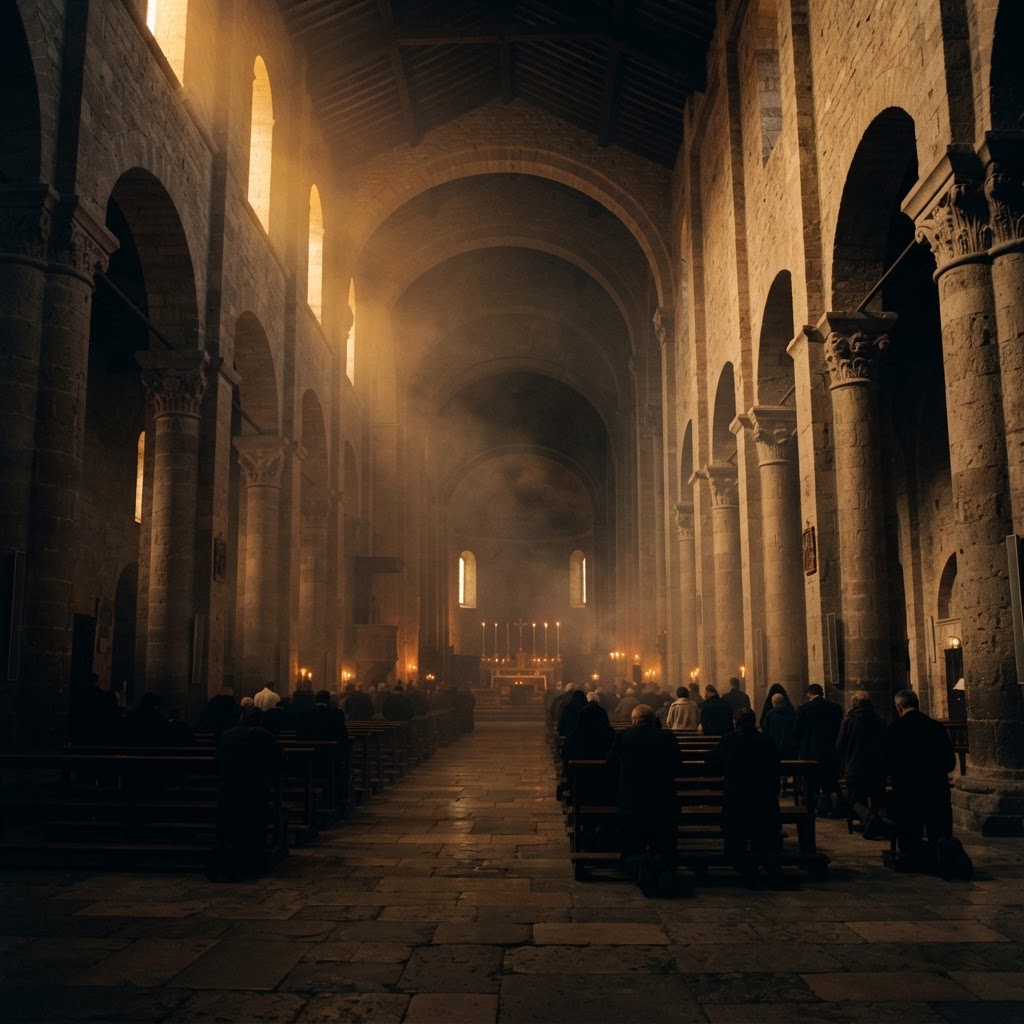
Dogma · Ecclesiology · The Creed's Last Article
The Communion of Saints
One Body · One Family · One Prayer — and Why Protestants Should Read It Slowly
The Church is not a society of individuals who happen to believe the same things. She is a Body, and a body's members do not resign when they die. This is a study of what the Church is, what the Creed means when it confesses the communion of saints, and how to answer the honest Protestant objections without caricature.
“Therefore, since we are surrounded by so great a cloud of witnesses…” — Hebrews 12:1
A Guide for ProtestantsTo Begin — The Question Behind the Question
Ask most Catholics what the communion of saints is and you will get a warm but slightly vague answer about heaven being crowded with friends. Ask most Protestants and you will get a sharper one: a medieval addition, a distraction from Christ, perhaps a little dangerous. Both answers miss the real subject — because the doctrine of the saints is not first a doctrine about Mary or the martyrs. It is a doctrine about the Church.
Everything turns on one question: is the Church a body, or a gathering? If she is a gathering, then death removes people from the gathering, and to speak of the dead as still among us is pious imagination. If she is a body — Paul's own image, “the Body of Christ” — then her members are joined by something stronger than proximity, and the grave is a change of address, not a severing of the limb.
So this page is built in two halves, and it will not work unless you hold them together. The first half is ecclesiology: what the Church actually is. The second is the communion of saints: what follows from it, biblically, historically, and in the Church's own boundaries. And because the honest interlocutor for this doctrine is almost always a Protestant, one whole section is given to answering their objections in their own terms — not with slogans, but with the passages they will actually raise.
A word to the reader
If you are Catholic, this is meant to give you the grammar for what you already do when you ask a saint to pray for you. If you are Protestant, nothing here asks you to stop loving Christ; it asks you to consider whether the Church you love is smaller than the one He founded.
Section I — Ecclesiology: What the Church Is
A Body, Not a Voluntary Society
The New Testament never describes the Church as an association of like-minded believers. It calls her a body with a head, a bride with a husband, a temple with a cornerstone, a household with a father, a vine with branches, a flock with a shepherd. Every one of those images has the same property: you do not join it the way you join a club, on your own terms, and you do not leave it without being wounded.
“For just as the body is one and has many members, and all the members of the body, though many, are one body, so it is with Christ. For by one Spirit we were all baptised into one body” (1 Cor 12:12–13). Notice Paul's logic: the unity is not a goal the Corinthians must achieve, it is a fact they must stop denying. Baptism did not merely register a private conviction; it grafted a person into a living organism.
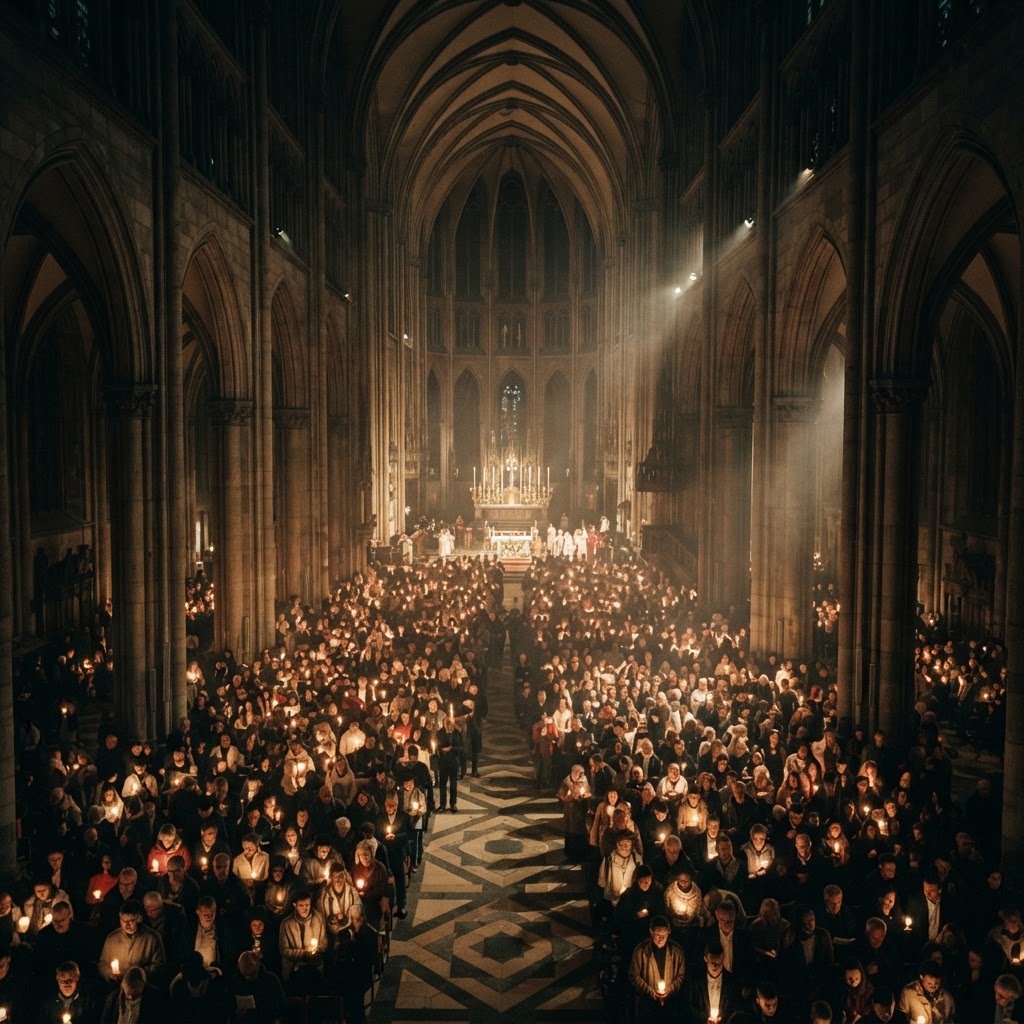
The Creed then names four marks of that one Body — and each one matters for the saints:
One
One Lord, one faith, one baptism, one Body. Schism is not a different opinion; it is a wound in a body that cannot stop being one.
Holy
Holy not because every member is holy, but because her Head is holy and the Spirit who dwells in her is holy — and He will not rest until the members are.
Catholic
Universal, not tribal: the Church is the family of every nation, and therefore the family of the dead of every century as much as the living.
Apostolic
She is not a society founded by enthusiasts but a body founded on the apostles, and handed down — which means she has a past, and her past is still her own.
Two consequences follow, and they are the whole foundation of this page. First: if the Church is Christ's Body, then her Head is not merely an example to be imitated but a life to be shared — and no member of a body is dispensable. Second: if her unity is a real participation (koinōnia) in one life, then it is not created by our agreement and it is not destroyed by our absence. A body remains one body even when some of its members are asleep in another room.
In plain words
The Church is the Body of Christ: one life, many members, joined by baptism and the Spirit rather than by preference. That is why the Creed can speak of a communion of saints — because in a body, what one member has, the others share, and death does not remove a limb.
Section II — One Church in Three States
Militant · Suffering · Triumphant
The Church is one, but she is not yet in one condition. Catholic teaching speaks of three states of the one Church — not three churches — distinguished by where her members are in the journey of purification and glory. Lumen Gentium 49 puts it plainly: some are pilgrims on earth, some are being purified, some are in glory; and all of them are caught up in one love.
The Church Militant
On earth · still fightingWe who are still in the body, battling sin, praying, interceding for one another and for the world. Our membership in this state is the one that still costs us something.
The Church Suffering
Being purified · still being healedThose who have died in God's friendship but not yet in full maturity — purified of the last attachments that cannot enter the wedding feast. They are still members: we pray for them, because love does not stop at the grave and because nothing unclean enters heaven (Rev 21:27).
The Church Triumphant
In glory · already homeThe saints in glory, who see God face to face and are therefore more alive, more awake, and more aware of us than they have ever been. They are not distant; they are the near ones. Their prayer is the prayer of the heavenly sanctuary, and it does not stop.
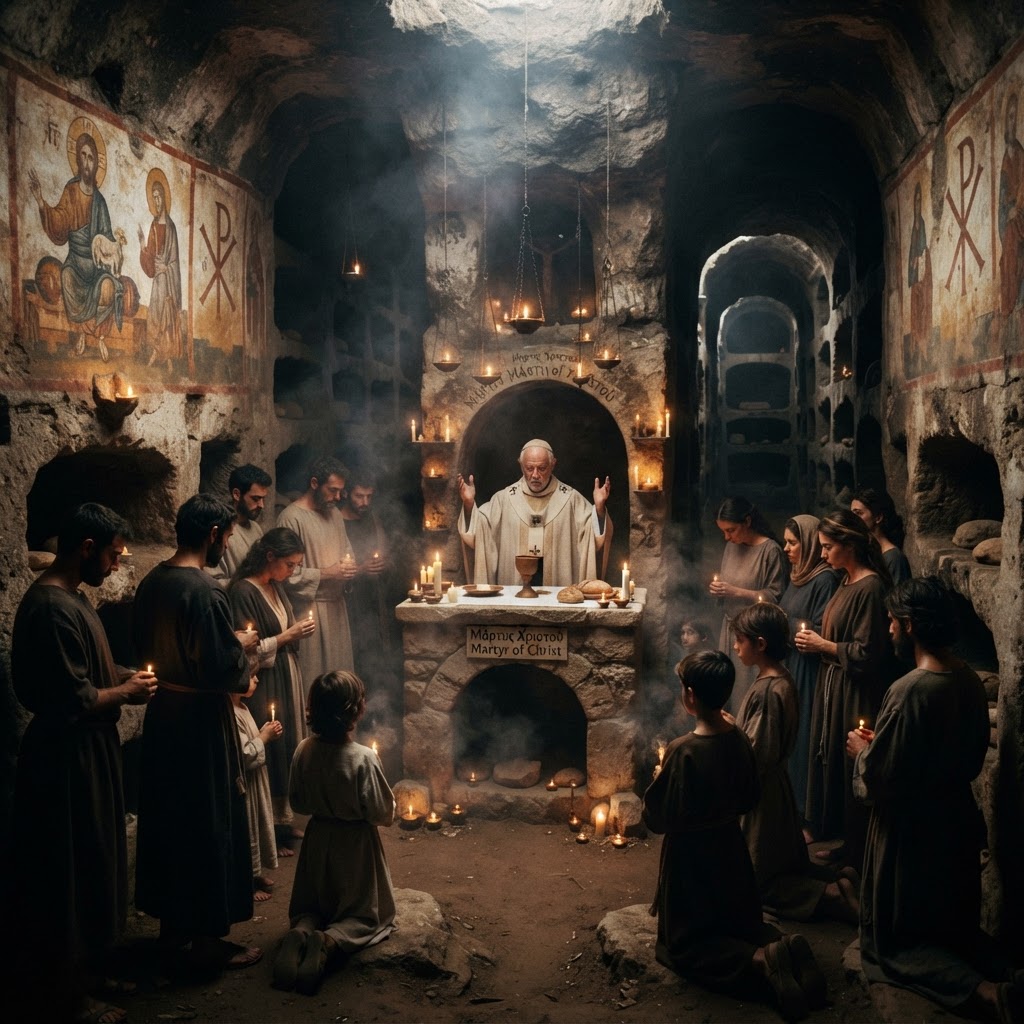
This is why the Church has always prayed for the dead and with the saints: both are acts of the same faith. To pray for the faithful departed is to say the Body is not severed by death; to ask the saints to pray for us is to say the Body is not silent beyond it. The difference between the two is only which direction the love is travelling.
In plain words
There is one Church, and she is in three places at once: still fighting here, still being healed there, already home with Christ. Death does not remove anyone from her membership roll — it only changes their location. That is the doctrine. Everything practical follows from it.
Section III — Biblical Foundations
The Cloud of Witnesses
The doctrine is not argued from a single proof-text but from the whole shape of Scripture's picture of God's people: one body, one worship, one family that death does not divide. Read these passages in order — narrative, then vision, then practice — and notice how consistently they assume that the faithful dead are neither absent nor asleep.
1. Hebrews 12:1–2
“Therefore, since we are surrounded by so great a cloud of witnesses, let us also lay aside every weight… looking to Jesus.”
The image is a stadium: those who have finished the race are watching those still running. The author is not being sentimental — he assumes an audience of the faithful dead. The same word, martyrēs, became the Church's word for those who died for the faith.
2. 1 Corinthians 12:26
“If one member suffers, all suffer together; if one member is honoured, all rejoice together.”
Koinōnia is participation, not sentiment. If the members of the Body share a real common life, then death — which the Church calls the last enemy, not a wall — cannot amputate a member from the Body of Christ.
3. Revelation 5:8
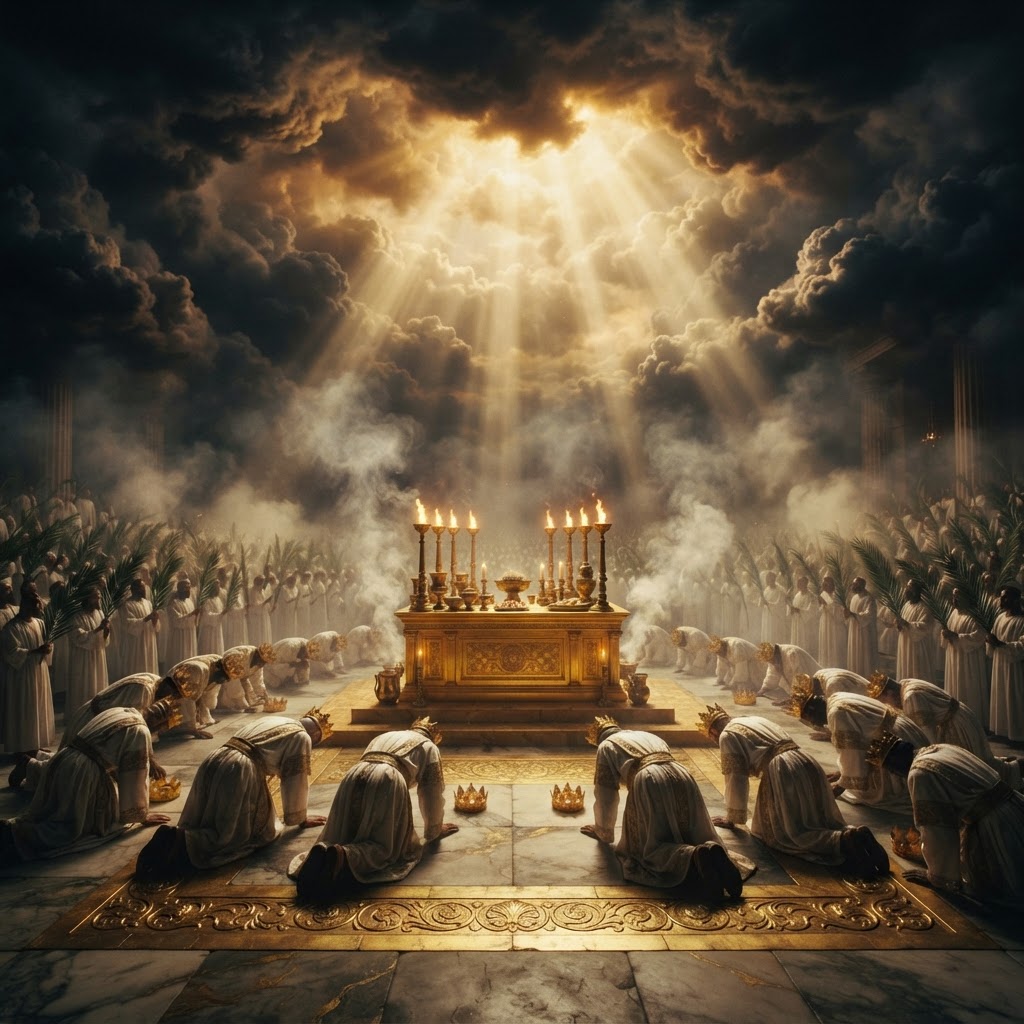
“The twenty-four elders fell down before the Lamb, each holding a harp, and with golden bowls full of incense, which are the prayers of the saints.”
In the heavenly sanctuary, the prayers of God's holy ones are gathered, held and offered. Revelation is not a vision of idle spirits; it is a liturgy, and prayer is its activity.
4. Revelation 8:3–4
“Another angel came and stood at the altar with a golden censer… and the smoke of the incense rose with the prayers of the saints from the hand of the angel before God.”
Heavenly prayer is priestly, ascending, and bound to an altar. What happens at the altar on earth is a participation in what is happening at the altar in heaven.
5. Matthew 17:1–3
“And behold, there appeared to them Moses and Elijah, talking with him.”
Two men who had died centuries earlier appear, are recognisable, and speak about Christ's coming passion. This is the Church's clearest picture of the blessed dead: conscious, present, and concerned with the work of salvation.
6. 1 Timothy 2:1–5
“I urge that supplications, prayers, intercessions, and thanksgivings be made for all men… For there is one God, and there is one mediator between God and men, the man Christ Jesus.”
Paul commands creaturely intercession and names the one mediator in the same paragraph — which means the two are not rivals. Christ is the mediator who reconciles; every other intercession is a participation in His, not a supplement to it.
7. 2 Maccabees 15:12–16
“Onias… with hands outstretched, was praying for the whole body of the Jews… ‘This is a lover of the brethren, who prays much for the people and for the holy city — Jeremiah, the prophet of God.’”
Judah sees the departed prophet and high priest interceding for the living. If you do not receive this book as canonical, the case does not collapse — it rests on the New Testament evidence above. But the Church that canonised the New Testament read this book as her own Scripture.
8. James 5:16
“Therefore confess your sins to one another, and pray for one another, that you may be healed.”
Intercession between creatures is commanded, not merely permitted. The question is never whether one Christian may ask another to pray — it is whether death ends the family.
What emerges is not a doctrine bolted onto the gospel but the gospel's own ecology: a God who is not the God of the dead but of the living, a worship that is joined to a heavenly liturgy, and a family in which asking one another for prayer is the ordinary grammar of love.
Section IV — The Witness of the Early Church
Not an Accretion, an Inheritance
The claim that devotion to the saints was invented in the Middle Ages has to survive the documentary record. It does not. Follow the chain from Lyons to Carthage to Jerusalem to Bethlehem to Hippo: the practice is assumed everywhere we look, taught to catechumens, and defended against its first critics in exactly the terms the Church still uses.
St. Irenaeus of Lyons
c. 180 · Against Heresies 3.24
The Church is one body spread across the world, held together by one faith and one Lord, in whom every member lives and grows. The unity of the Body is not an aspiration the Church is working toward; it is a fact she is learning to live out of.
St. Cyprian of Carthage
c. 250 · Letters & On the Lapsed
In the Eucharist, the names of the martyrs and the departed were read aloud from the diptychs — the living and the dead named together at one altar. Cyprian insists that no one can have God for a Father who will not have the Church for a mother.
St. Cyril of Jerusalem
c. 350 · Mystagogical Catechesis 5.9
After the consecration, the Church commemorates “the patriarchs, prophets, apostles and martyrs, that at their prayers and intercessions God would receive our petition.” This is a catechism lesson for the newly baptised, not a medieval innovation: invocation was simply how Christians prayed.
St. Jerome
c. 406 · Against Vigilantius
Jerome defends the honour given to the martyrs and their prayers against a critic who called it superstition. His answer is the Church's answer ever since: the saints are not dead — the God of Abraham, Isaac and Jacob is not the God of the dead but of the living.
St. Augustine of Hippo
c. 420 · City of God
The martyrs' shrines were crowded with the sick and the praying; Augustine reports the healings and explains the theology: we honour the martyrs as members of the one Christ, and ask their prayers, while reserving worship for God alone.
The Sub Tuum Præsidium
Egypt, 3rd–4th century · papyrus, Rylands 470
“Beneath your compassion we take refuge, O Theotokos…” The oldest surviving Christian prayer to any saint is not a later ornament; it was written on papyrus in the age of the martyrs and is still prayed today.
In plain words
Cyril of Jerusalem is the decisive witness for the ordinary believer: he is not writing a theology of the saints, he is explaining the Mass to the newly baptised, and the intercession of the martyrs is simply part of it. A doctrine that is already embedded in the liturgy before anyone argues about it is not an invention — it is the faith that was handed over.
Section V — A Guide for Protestants
Eight Objections, Answered Without Caricature
These are the arguments a serious Protestant will actually make — and they deserve better than the answer they usually get. Each entry begins with what to concede or ask first, because most of these objections contain something true that has been misapplied.
Ask or concede first
Ask a Protestant friend to recite the Apostles' Creed. It is there — “I believe in the Holy Spirit, the holy catholic Church, the communion of saints” — and they confess it Sunday after Sunday.
The Catholic answer
The phrase is the Church's one-word summary of Hebrews 12:1, 1 Corinthians 12:26 and Revelation 5:8. You do not have to find the doctrine in a proof-text when you can find it in the shape of the New Testament's own worship.
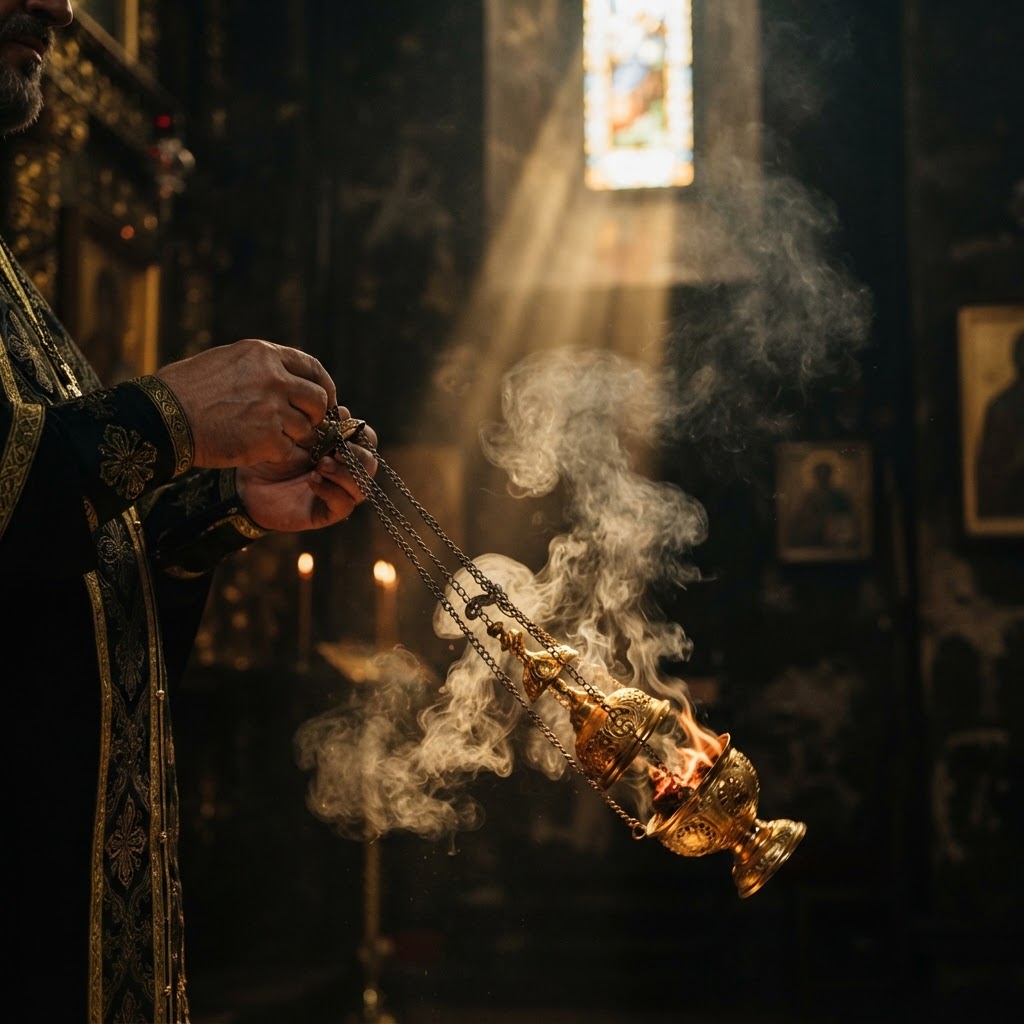
Underneath all eight objections is one question: is the Church Christ's Body in a realistic sense, or only by courtesy? If she is His Body, then the doctrine is not an addition — it is the Body acting like a body. If she is only a gathering, then Protestant objections are not objections at all, they are conclusions. That is why this page began with ecclesiology.
Section VI — What the Church Actually Teaches
The Boundaries That Protect the Doctrine
Almost every abuse of this doctrine is a boundary crossed — by those who turn devotion into worship, and by those who use the abuse to reject the doctrine. The Church's own limits are unusually strict, and they are the best defence she has.
Worship belongs to God alone
Latria — the adoration offered to the Trinity — is never given to a saint or an image. To surrender worship to a creature is idolatry, and the Church has excommunicated for it.
Saints are honour, not worship
Dulia is the honour we give to those in whom God's grace is visible — the way Scripture honours Abraham, Moses and the prophets. Mary, uniquely, receives hyperdulia; still not latria.
Not mediators of redemption
No saint's blood was shed for the world. They add nothing to the Cross; their prayer is the prayer of the redeemed, offered within Christ's one mediation.
Not omniscient
The blessed see God, and in Him know what they must know. The Church does not claim for them a knowledge that belongs to God alone.
Not the source of grace
The saints are channels of the Church's prayer, not reservoirs of grace. Grace comes from Christ through the sacraments, and the saints are the first to say so.
The line that must never blur: the saints are not little gods, not channels of grace in their own right, and not replacements for Christ. Every Catholic prayer to a saint ends in the Father, through the Son, in the Holy Spirit — otherwise it is not a Catholic prayer at all.
In plain words
Worship belongs to God alone. Honour may be given to those in whom His grace shines. Asking a saint to pray is an act of faith in the Body of Christ, not an act of devotion to a creature. Keep those three sentences and you will never fall into idolatry — and you will be able to explain to anyone why the Church does not.
Section VII — Why This Doctrine Is Yours
What You Gain When the Church Is Bigger
Doctrine is not a museum piece. If the communion of saints is true, then it changes the room you are praying in, the family you belong to, and the people you may legitimately ask for help tonight.
You are not praying alone
The room you pray in is not empty. Every act of prayer in the Church is an act of a Body, joining a liturgy that has been running since Abel and has never been interrupted.
You belong to a family, not a fan club
Protestant piety can quietly become a private relationship with God. The communion of saints says the Christian life has parents, siblings, predecessors and descendants — and that you will meet them.
You are given examples you can actually follow
Doctrine teaches you what holiness is; the saints show you what it looks like in a body, in a century, in a family, under pressure. Grace is not abstract — it has a face in every age.
Your prayer joins the heavenly worship
The censer of Revelation 8 is not a picture of someone else's prayer. It is yours, gathered with the prayers of every century and offered at the one altar.
Your dead are not cut off
Catholics pray for the dead and to the saints because the Church has never accepted the grave as a border wall. Death changes location, not membership.
And a final word about metanoia. Conversion is not a private transaction between an individual and God; it is a homecoming into a household. The prodigal does not return to a philosophy — he returns to a father, and finds a house already full of brothers. The communion of saints is simply the name of that household, extended to every century and past the grave.
Section VIII — The Mystery That Calls Us to Prayer
I Believe in the Communion of Saints
Every Sunday the Creed says it before it is understood: I believe in the Holy Spirit, the holy catholic Church, the communion of saints. The confession comes before the comprehension — and that is deliberate. You were baptised into a Body larger than your awareness of it, and you will spend your life discovering how large it is.
So pray with the Church. Ask the martyrs to pray for you, and mean it — not because they are nearer to God than His Son, but because they are nearer to Him than you are, and because the Body is one. Then take your place among the witnesses yourself: someone will one day ask you to pray for them from the other side of the veil.
The whole doctrine in five lines
- The Church is one Body, not a collection of individuals — and a body's members do not resign when they die.
- The Creed confesses the communion of saints: one Church in three states, militant, suffering, and triumphant.
- Scripture shows the blessed dead conscious, present, and praying (Matt 17; Heb 12; Rev 5–8).
- Asking a saint to pray is not worship and not divination: it is asking a member of Christ's Body to intercede, as Paul asks the churches.
- All worship belongs to God alone; all grace comes from Christ alone; the saints are witnesses and intercessors within that one mediation.
All you holy men and women of God,
who have run the race and now see His face,
pray for us who are still running. Amen.
Doctrine in Practice
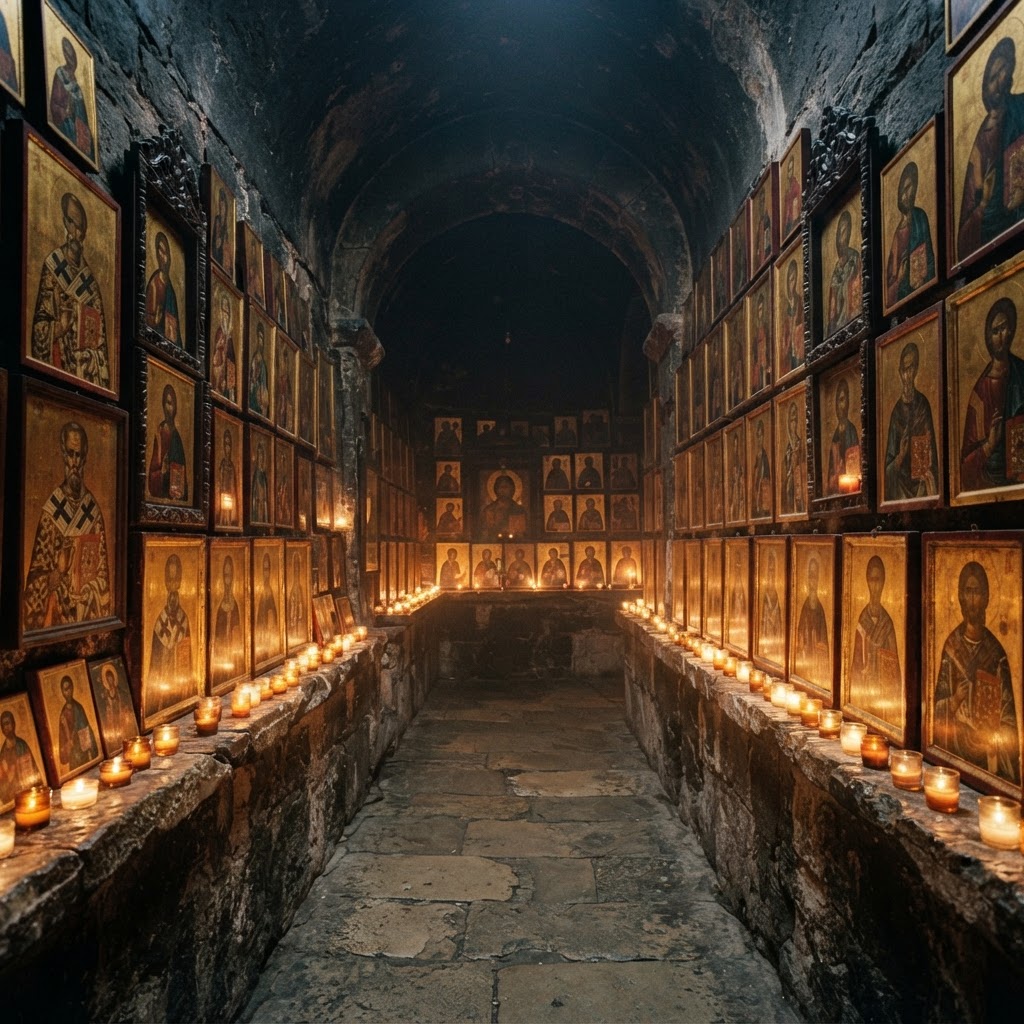
Meet the Cloud of Witnesses
The doctrine is not an abstraction — these are persons. Browse the Saints Library: the martyrs, doctors, mystics and converts whose lives show what grace looks like in a body, in a century, in a family.
Enter the Saints LibraryReferences
- Catechism of the Catholic Church 946–962 (the communion of saints), 2683–2684 (the intercession of the saints), 2115–2117 (against divination), 2132 (images).
- Second Vatican Council, Lumen Gentium 48–51 (the eschatological nature of the pilgrim Church and our union with the saints).
- Council of Nicaea II (787), on the veneration of images and the distinction between latria and dulia.
- Council of Trent, Session 25 (1563), On the Invocation of Saints, and Session 22 on the Eucharist as the memorial of the saints.
- St. Cyril of Jerusalem, Mystagogical Catechesis 5.9–10; St. Augustine, City of God 8.27 and 22.8; St. Jerome, Against Vigilantius 6.
- Papyrus Rylands 470 (the Sub Tuum Præsidium), 3rd–4th century; the catacomb frescoes of the Madonna and the refrigerium meals at martyrs' tombs.
- Scripture: Hebrews 11–12; 1 Corinthians 12; Revelation 5–8; Matthew 17:1–8; 1 Timothy 2:1–6; James 5:16; 2 Maccabees 15.
Patristic quotations are given in standard English translations; where the wording is summarised the citation is given so the reader can check it against the source.