
Dogma · Eschatology · The Last Things
Purgatory
The Fire Before the Gate: from the Flaming Sword of Eden to the Mercy of Christ
The first page of the Bible bars the way to Paradise with holy fire. The last page says nothing unclean may enter the New Jerusalem. Between them runs one of the Church's most misunderstood doctrines: that the love of God finishes in us what grace began. A study for Catholics, and a research guide for the honest Protestant.
“Strive for the holiness without which no one will see the Lord.” — Hebrews 12:14
Section I — What It Is, and What It Is Not
The Final Purification of the Saved
The word comes from the Latin purgare: to cleanse, to purify. The Catechism defines it as the final purification of “those who die in God's grace and friendship, but still imperfectly purified,” who, “although assured of their eternal salvation,” must undergo it “so as to achieve the holiness necessary to enter the joy of heaven” (CCC 1030-1031). The Church adds that this is the Church's own “faith… regarding the fire” as the Scripture sets it out in 1 Corinthians 3:15.
It is the doctrine of a God who is both merciful and just. His mercy saves; His justice and love will not leave us half-finished. Purgatory is the answer to a simple question: What happens to the person who dies loving God, but not yet loving Him with a whole heart?
Not the Limbo of the Fathers
The “Bosom of Abraham” (Luke 16:22) held the righteous dead awaiting Christ, who opened Heaven to them. Purgatory is entered only by those already saved.
Not Sheol / Hades
Sheol is the general realm of the dead in the Old Testament. Purgatory is not a holding cell of the dead but a purification of the saved.
Not Hell
No one in Purgatory is damned. Hell is eternal separation from God (CCC 1033-1037); Purgatory is certain of Heaven (CCC 1030).
Not a second chance
Death fixes the soul's choice for or against God. Purgatory is for those who died in God's grace and friendship, “imperfectly purified” (CCC 1030).
Not eternal
Hell and Heaven are the only eternal states (Matthew 25:46). Purgatory ends when the last of the elect is made holy.
Not a place on a map
John Paul II taught it is “not a place, but a condition of existence” (General Audience, 4 Aug 1999). The Church has never defined its location, length or the nature of its fire.
Three things the Church does teach
- There is a state of purification after death for the saved.
- The living can help the dead by prayer, alms and the Mass.
- Nothing impure enters the presence of God.
Everything else, including whether the fire is literal, its length and its location, is not defined. Trent warned preachers against speculation on these questions.
In plain words
Heaven is for the fully holy, and few of us die fully holy. Purgatory is not God's punishment of the saved; it is the last stretch of the road, walked in His love, so that we arrive as who we were made to be.
Section II — The Origin: Genesis 3:22-24
The Flaming Sword Is the Holy Fire of God
“Then the LORD God said, ‘Behold, the man has become like one of us… lest he put forth his hand and take also of the tree of life, and eat, and live for ever’… He drove out the man; and at the east of the garden of Eden he placed the cherubim, and a flaming sword which turned every way, to guard the way to the tree of life.”
Genesis 3:22-24
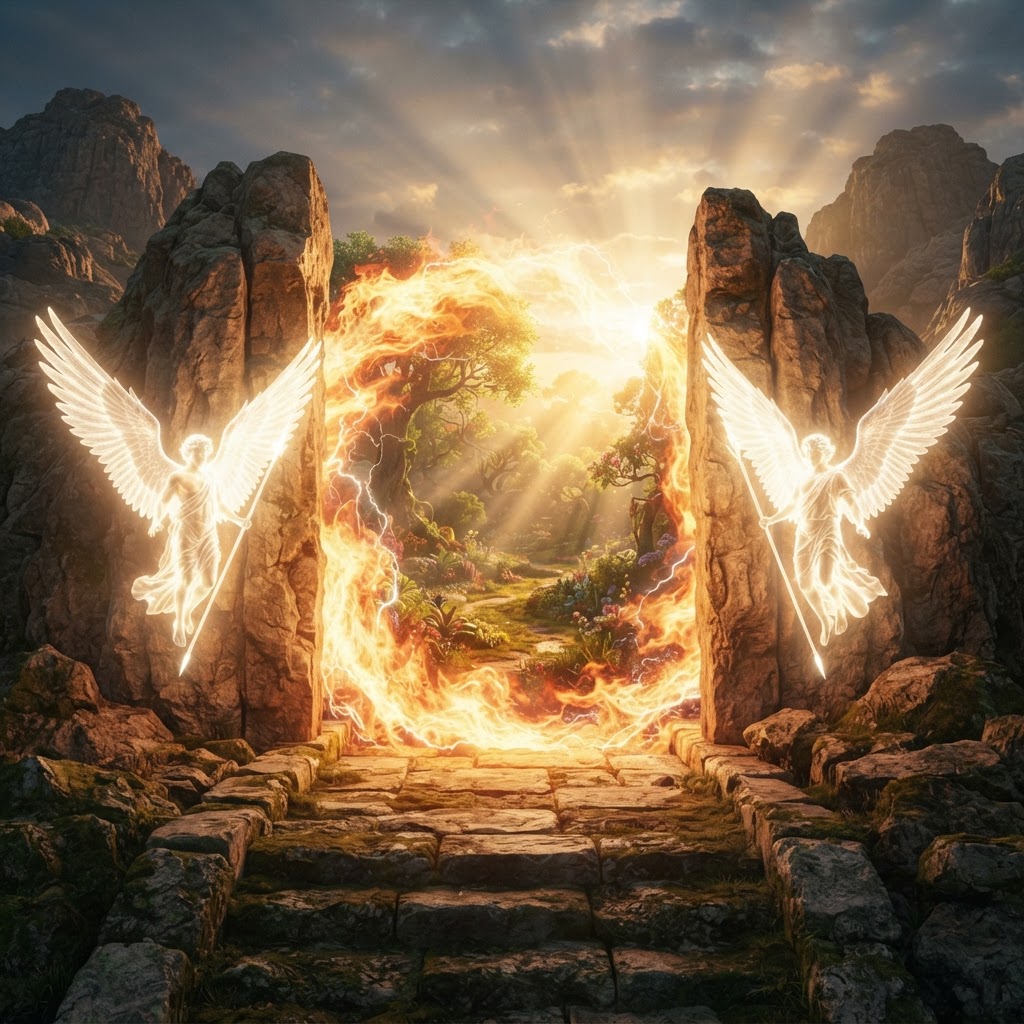
The first appearance of the idea in Scripture is not in the New Testament and not even in the Prophets. It is on the threshold of Paradise itself. After the Fall, man is barred from the tree of life, and the guard is not a wall but a fire: cherubim and a blade of living flame, “turning every way.” The way to God's presence is closed to the unholy, and it is closed by something burning, active and personal.
What the Hebrew says
לַהַט
lahat · Flame, blaze, burning
The word for the flaming of the sword (Strong's H3858). It is the language of fire in motion, not of a static torch.
חֶרֶב
chereb · Sword, cutting instrument
From a root meaning to cut or lay waste (H2719). Fire here has an edge: it divides, and it executes justice.
הַמִּתְהַפֶּכֶת
hammithappekhet · Turning itself every way
From hāphak: to turn, overturn, transform. The same root describes Sodom being “overthrown” and a heart being changed. The fire turns in all directions, as living and penetrating (cf. Hebrews 4:12).
כְּרֻבִים
kerubim · Cherubim
Guardians of the sanctuary. Cherubim later flank the Ark in the Holy of Holies, where the Shekinah dwells (Exodus 25:18-22).
Put together, the verse describes a blazing, cutting, self-turning fire set to guard the way to the tree of life. Jewish commentators long read it as spiritual lightning, the Shekinah glory of God discharged through the cherubim, executing divine justice. Some Hebrew scholars note the verb hāphak is the same root that can mean “to be changed” or “transformed.” The fire at the gate does not only keep out; it turns, and it can turn a person.
The Jewish reading
Rabbeinu Bahya (13th c.)
On Genesis 3:24, he identifies the flame (lahat) with Gehinnom, “the place where justice is meted out to man after death,” and the angels of the sword as its ministers.
Beit Shammai (1st c. BC)
In Rosh Hashanah 16b the School of Shammai teaches three groups at death: the righteous sealed for life, the wicked sealed for Gehinnom, and the middle group who “descend to Gehinnom, cry out, and ascend,” citing Zechariah 13:9.
Mourner's Kaddish
Jewish tradition has long prayed for the departed for eleven months after death, a custom resting on the conviction that the dead can still be helped. The Maccabean text shows it was already practised before Christ.
The thread through Scripture
Follow the fire from Genesis to Revelation and one image holds together: God's holiness is a fire. To the unrepentant it destroys; to the humble it purifies; and no one enters the presence of God without passing it.
1. Genesis 3:24
He placed at the east of the garden of Eden the cherubim, and a flaming sword which turned every way, to guard the way to the tree of life.
Man is shut out of Paradise by holy fire. The only way back runs through it.
2. Exodus 3:2-5
The angel of the LORD appeared to him in a flame of fire out of the midst of a bush… ‘Put off your shoes from your feet, for the place on which you are standing is holy ground.’
Holy fire that does not destroy what it touches: God's presence burns away what cannot stand before Him, and sanctifies the one who is willing.
3. Exodus 24:17
Now the appearance of the glory of the LORD was like a devouring fire on the top of the mountain.
The Shekinah glory is experienced as fire.
4. Isaiah 6:6-7
Then flew one of the seraphim to me, having in his hand a burning coal… ‘Behold, this has touched your lips; your guilt is taken away, and your sin forgiven.’
A coal from the altar touches the mouth of a forgiven man and purifies him in order to stand before God. Purgatory in miniature.
5. Hebrews 4:12
The word of God is living and active, sharper than any two-edged sword, piercing to the division of soul and spirit.
The sword is now the living Word, the Son. The image is carried forward.
6. Hebrews 12:29
For our God is a consuming fire.
The New Testament names the fire at the gate: it is God Himself.
7. Revelation 21:27
But nothing unclean shall enter it.
The gate of the New Jerusalem keeps the same rule as the gate of Eden.

A note on the status of this reading
The Church has not defined Genesis 3:24 as a proof-text for Purgatory. The identification of the flaming sword with the purifying fire of God is a theological and typological reading, supported by the Jewish tradition above and by the New Testament's own use of the sword and fire (Hebrews 4:12; 12:29). It is offered here as the earliest biblical form of the idea, as a way of seeing the doctrine rooted in the first pages of Scripture. The defined doctrine itself rests on the sources in Sections III to V.
In plain words
The same fire guards the gate in Genesis, refines silver in the Prophets, and is the God who is a consuming fire in Hebrews. Purgatory is the Church's name for passing through it as a pardoned child and not as an enemy.
Section III — The Old Testament: Refining and Prayer for the Dead
“I Will Refine Them as Silver”
The prophets take the fire of Eden and give it a purpose. It is not only a barrier; it is a refiner's furnace. And alongside it grows a practice that the Jews of Jesus' day took for granted: praying for the dead.
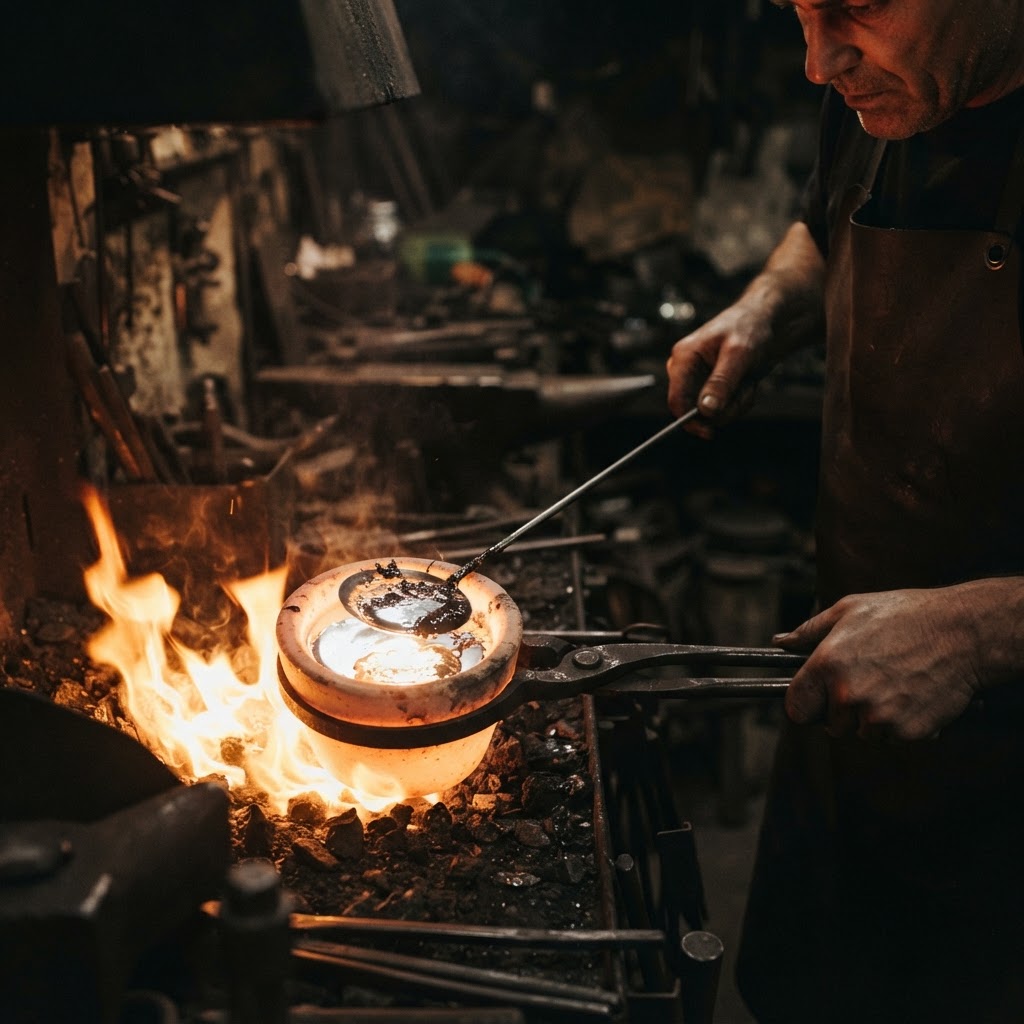
1. Zechariah 13:9
And I will bring the third part through the fire, and refine them as silver is refined, and test them as gold is tested. They will call on my name, and I will answer them. I will say, ‘They are my people’; and they will say, ‘The LORD is my God.’
Refining is for those who are already “my people.” The result of the fire is covenant intimacy, not rejection.
2. Malachi 3:2-3
He is like a refiner's fire… he will purify the sons of Levi and refine them like gold and silver, till they present right offerings to the LORD.
The Lord Himself comes as the refiner, and the purpose is worship.
3. Isaiah 4:4
…when the Lord shall have washed away the filth of the daughters of Zion and cleansed the bloodstains of Jerusalem from its midst by a spirit of judgment and by a spirit of burning.
A purifying judgement, aimed at cleansing.
4. 2 Maccabees 12:43-46
…he took up a collection… and sent it to Jerusalem to provide for a sin offering… Therefore he made atonement for the dead, that they might be delivered from their sin.
Judas Maccabeus prays and offers sacrifice for fallen soldiers. This only makes sense if the dead can be helped, which is neither Heaven nor Hell.
The logic of 2 Maccabees 12 is the key. Judas prays for fallen soldiers who had died wearing idol-tokens under their tunics, and the author comments: “it is a holy and pious thought” to pray for the dead. If the dead were already in Heaven they would need no prayers; if in Hell, prayers could not help. The practice assumes a third condition.
Section IV — The New Testament Witness
Saved, “But Only as Through Fire”
The New Testament does not use the word, but it gives the three pillars of the doctrine: some of the saved still need cleansing, the fire is the fire of God, and nothing unclean enters Heaven.
1. 1 Corinthians 3:11-15
Each man's work will become manifest… the Day will disclose it, because it will be revealed by fire… If any man's work is burned up, he will suffer loss, though he himself will be saved, but only as through fire.
The strongest single text. The man is saved; he suffers loss; the fire is applied after judgement of his works. Augustine, Gregory the Great and many others read it this way.
2. Matthew 12:31-32
Whoever speaks against the Holy Spirit will not be forgiven, either in this age or in the age to come.
Our Lord implies some sins can be forgiven “in the age to come.” Augustine and Gregory the Great drew exactly this conclusion.
3. Matthew 5:25-26
Make friends quickly with your accuser… you will never get out till you have paid the last penny.
A prison from which release comes after payment. The Fathers (Cyprian, Origen) saw a hint of purification after death.
4. Hebrews 12:14, 23
Strive for… the holiness without which no one will see the Lord… you have come to… the spirits of just men made perfect.
The just are “made perfect.” That implies a perfecting.
5. 1 Peter 1:6-7
…your faith, more precious than gold that perishes though it is tested by fire, may be found to result in praise and glory and honor at the revelation of Jesus Christ.
Gold refined by fire is Peter's image for the faith of the saved.
6. Revelation 21:27
Nothing unclean shall enter it, nor anyone who practices abomination or falsehood.
If the saved die with unpurged attachments, something must complete them. This is the logic of the doctrine.
7. 1 John 5:16-17
All wrongdoing is sin, but there is sin which is not mortal.
Scripture itself distinguishes sins that kill the soul from those that wound it. Purgatory concerns the second.
Hebrews connects the whole chain. The sword that pierces soul and spirit (Hebrews 4:12) is the Word. The consuming fire (12:29) is God. And the gate (Revelation 21:27) is guarded in the same manner as Eden. The Bible begins and ends with the same rule: you cannot enter God's presence unpurified, and God Himself provides the purifying.
Section V — The Fathers, the Councils and the Development
A Church That Has Always Prayed for Her Dead
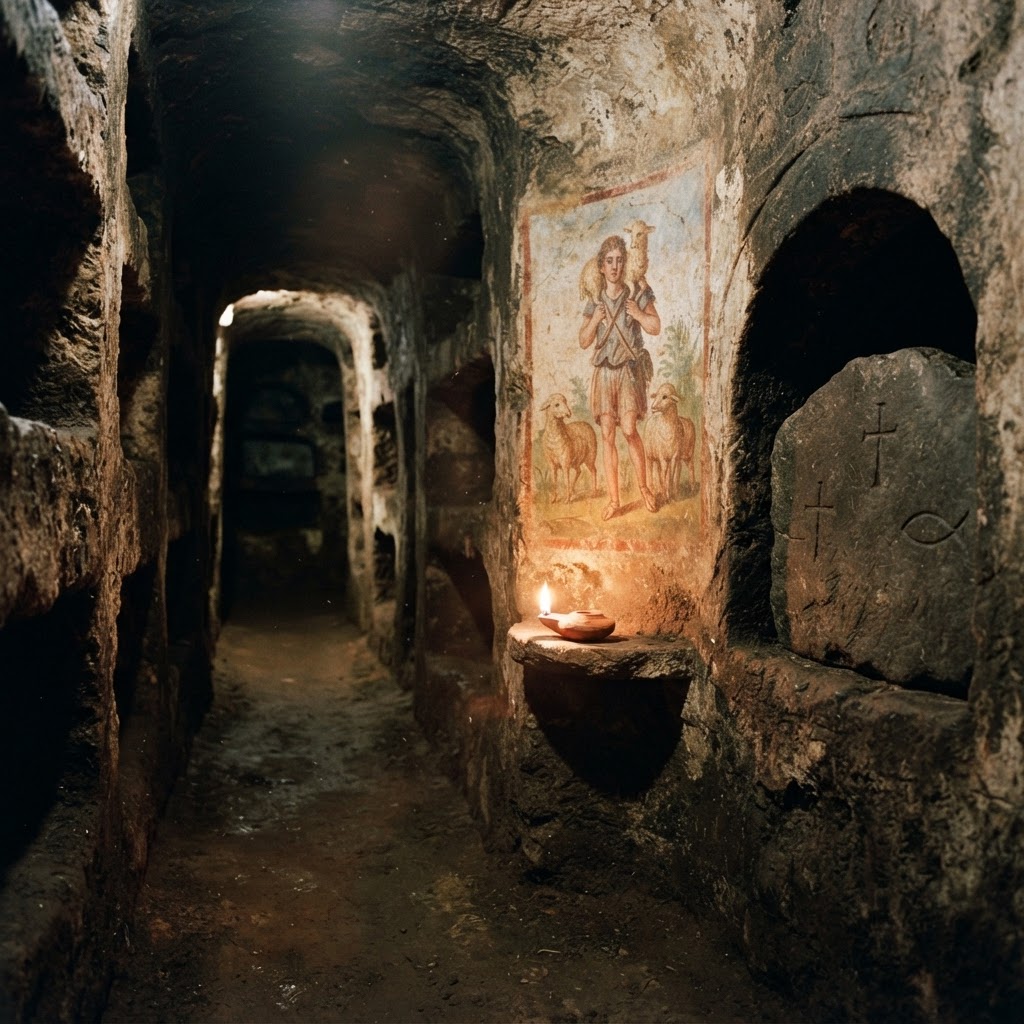
The practice came first, and the theology followed. Nobody invented praying for the dead in the Middle Ages; the catacombs are covered with it. As Bergsma and Pitre observe, prayer cannot help the damned and the blessed need no help, so the universal practice of praying for the dead implies a third condition.
Tertullian (c. 211)
De Corona 3
Offerings for the dead on their anniversary are an established custom, recorded as Tradition and not as a new rule.
Passion of Perpetua (203)
Passio 7-8
The martyr Perpetua prays for her dead brother Dinocrates, sees him in torment, and then sees him healed and refreshed. A young Church already prays for the dead.
St. Cyprian (c. 250)
Letter 55
He distinguishes being “cast out” from a punishment that ends, and says a soul may be “purged by long suffering in fire” and so be saved.
St. Augustine (c. 420)
Enchiridion 109-110
The souls of the dead are helped by the piety of the living when the sacrifice of the Mediator is offered for them or alms are given in the Church. In the Confessions (IX), Monica's last request: “Lay this body anywhere… only remember me at the altar of the Lord.”
St. John Chrysostom (c. 390)
Homily 41 on 1 Corinthians
“Let us help them and commemorate them… not in vain is the offering made for the departed.”
St. Gregory the Great (c. 593)
Dialogues IV
Taught that some lesser faults can be forgiven in the age to come, and developed the Mass offered for the dead.
Development of the doctrine
c. 200 BC
2 Maccabees
Prayer and sacrifice for the dead enter Jewish practice.
c. 200-250
Catacomb inscriptions
Early Christian epitaphs ask prayers for the departed (“Refrigeria”).
c. 420
Augustine
Distinguishes the very good, the very bad and the “not wholly bad” who are helped by prayer.
1254
Pope Innocent IV
Letter to the Greek Church setting out the doctrine in the hope of reunion.
1274
Second Council of Lyons
Defines that the souls of those who die repentant but without full satisfaction are purged after death and helped by suffrages of the living.
1439
Council of Florence
Reaffirms the doctrine and states the Greek and Latin positions together.
1563
Council of Trent, Session 25
Defines Purgatory against the Reformers and warns preachers to keep “the more difficult and subtle questions” from the unlearned, and to avoid curiosity and superstition.
1992
Catechism, 1030-1032
Gives the doctrine in its current form.
1999
John Paul II
General Audience of 4 August: a state of purification, not a place; Christ's love removes “the remnants of imperfection.”
Like the Trinity and the two natures of Christ, Purgatory was defined when it was challenged, not invented when it was defined. The Orthodox share the practice of prayer for the dead and a deep sense of postmortem purification; their objection is to juridical language of “satisfaction” and to a defined third place. Since Vatican II, as John Thiel notes, the doctrine has largely vanished from preaching, with the sense of personal sin and the practice of confession. Recovering it is part of recovering the seriousness and the joy of the Gospel.
Section VI — A Guide for Protestants and Honest Questioners
The Objections, Answered Fairly
If you are a Protestant, you are not being asked to take this on trust. Test it. Below are the standard objections, the Catholic reply, and a reading plan so you can check every claim against the sources yourself.
Objection · “The word ‘Purgatory’ isn't in the Bible.”
Reply · Neither is “Trinity,” “Incarnation” or “Bible.” The question is whether the reality is taught: souls saved yet needing cleansing (1 Cor 3:15), the dead helped by the living (2 Macc 12), and nothing unclean entering Heaven (Rev 21:27). Together these require such a state.
Objection · “2 Maccabees isn't in my Bible.”
Reply · The deuterocanonical books were in the Greek Old Testament read by the apostles and in every Christian Bible until the 16th century, including the 1611 King James. Even setting 2 Maccabees aside, 1 Corinthians 3 and the unanimous liturgical practice of the early Church carry the case. The Jewish custom of prayer for the dead shows the practice was already established before Christ.
Objection · “Christ's sacrifice was finished and sufficient.”
Reply · Yes, absolutely. Purgatory does not add to the Cross; it applies it. Scripture pairs full forgiveness with remaining temporal consequences: David is forgiven yet still loses his child (2 Samuel 12:13-14). Christ's work includes not only pardoning sin but making us holy (Hebrews 12:14). Benedict XVI taught that the fire is Christ Himself: the encounter with the Lord burns away what is false (Spe Salvi 47).
Objection · “Absent from the body, present with the Lord” (2 Cor 5:8).
Reply · That is exactly where Purgatory ends. The saved go to the Lord. The doctrine concerns how the not-yet-fully-holy are readied to see Him. Paul himself prays for the dead Onesiphorus (2 Timothy 1:16-18) and speaks of a trial by fire (1 Cor 3).
Objection · “1 Corinthians 3 is about works, not people.”
Reply · Paul says both: the work burns, and “he himself will be saved, but only as through fire.” The man passes through the fire. Reformation-era commentators had to argue against the plain sense, and a long line of Fathers read it as a purifying fire after death.
Objection · “Doesn't this lead to selling indulgences?”
Reply · The abuses of the 16th century were real, and the Church corrected them at Trent. Abuse of a doctrine does not refute it. Rejecting the doctrine because of Tetzel is like rejecting the Gospel because of Judas: the abuse is real, but it does not decide the truth.
Objection · “The Orthodox reject it.”
Reply · Orthodoxy has never defined against prayer for the dead or against postmortem purification; it rejects juridical “satisfaction” language and the idea of a third place. The Catholic Church has not defined fire, location or duration (Trent), and Florence set both positions side by side. Disagreement is narrower than it first appears.
Your Research Path
- 1
Read the passages in order
Genesis 3:22-24 · Exodus 3 · Isaiah 6:1-7 · Zechariah 13:9 · Malachi 3:1-4 · 2 Maccabees 12:38-46 · Matthew 5:25-26 · Matthew 12:31-32 · 1 Corinthians 3:10-15 · Hebrews 12:14-29 · Revelation 21:22-27.
- 2
Read the earliest Christian witness
The Passion of Perpetua, Tertullian's De Corona, Cyprian's Letters, Augustine's Enchiridion and Confessions IX, Chrysostom on 1 Corinthians.
- 3
Read the Church's own words
Catechism 1030-1032 and 1472; Council of Trent, Session 25; Pope Benedict XVI, Spe Salvi 45-48; John Paul II's General Audience of 4 August 1999.
- 4
Read a respected non-Catholic
C. S. Lewis, Letters to Malcolm (chapter 20), where the Anglican Lewis wrote: “Of course I pray for the dead… I believe in Purgatory.”
- 5
Read the other side fairly
Calvin's Institutes III.5 and Luther's Smalcald Articles (II.2) state the Reformers' objections. Note that Luther in 1519 had not yet rejected the doctrine.
Common ground: Protestants and Catholics agree that nothing impure enters Heaven and that believers must be made holy. Many Protestants already believe in a sanctification completed at death (“glorification”). The difference is whether that completion is a process, and whether the Church on earth can help in it.
Section VII — The Fire Is Christ
“Purgatory Is Christ's Work”
The most common objection is that Purgatory detracts from the finished work of the Cross. Trent Horn, drawing on Benedict XVI, answers: the fire is none other than Christ Himself, judge and saviour at once. “His gaze, the touch of His heart heals us through an undeniably painful transformation ‘as through fire’” (Spe Salvi 47). Purgatory does not take away from Christ's work; it is Christ's work.
John Paul II says those in purification “are already in the love of Christ who removes from them the remnants of imperfection.” Genesis showed the fire at the gate. Hebrews names its identity: God. The Gospel reveals His face. The purification we fear is the embrace of the One who loves us.

What to do with this
- Offer Masses for the faithful departed, the greatest help the Church can give (Augustine).
- Pray the Rosary and the prayer “Eternal rest grant unto them, O Lord.”
- Give alms and fast in their name.
- Pray with special devotion in November, the Church's month of the Holy Souls (All Souls, 2 November).
- Go to confession, receive the Eucharist and seek indulgences under the usual conditions for yourself or for the dead.
- Live now what you hope to finish later: the sacramental life is the “fire” taken in smaller, gentler doses.
In plain words
Do not fear the fire. The same God who closed the gate in Eden has opened it in Christ, and He walks us through it. “Striving for holiness is an absolute requirement and an invitation to partake in the goodness of God's Kingdom here and now.” It is like diving into a cold but refreshing ocean: the dread is worse than the water, and it is an extension of God's wonderful mercy and love.
References
- Catechism of the Catholic Church, nn. 1030-1032, 1472, 1498.
- John Paul II, General Audience, 4 August 1999: “Purgatory: Purification of the Soul.” vatican.va
- Benedict XVI, Spe Salvi (2007), nn. 45-48.
- Council of Trent, Session 25: Decree on Purgatory (1563); Second Council of Lyons (1274); Council of Florence (1439).
- St. Augustine, Enchiridion 109-110; Confessions IX; City of God XXI.
- St. Robert Bellarmine, On Purgatory: The Members of the Church Suffering, trans. Ryan Grant (Mediatrix Press, 2017).
- Karlo Broussard, Purgatory Is For Real (Catholic Answers Press, 2020).
- Trent Horn, Why We're Catholic (Catholic Answers Press).
- John Bergsma and Brant Pitre, A Catholic Introduction to the Bible: The Old Testament (Ignatius, 2018).
- Scott Hahn, Catholic Bible Dictionary (Doubleday, 2009); Hahn and Mitch, Genesis, Ignatius Catholic Study Bible (2010).
- John E. Thiel, “Time, Judgment, and Competitive Spirituality,” Theological Studies 69 (2008): 741-785.
- Rabbeinu Bahya on Genesis 3:24 and Rosh Hashanah 16b (Beit Shammai), via Sefaria.org.
- Strong's Hebrew Lexicon H3858 (lahat), H2719 (chereb), H2015 (hāphak).
- Justin Poor, “Purgatory: An Explanation of the Doctrine, its Development, and Defending the Catholic Position,” THEO2460 Eschatology, University of Notre Dame Australia (2022).
By Justin Poor. Catholic Prophetic Apologist, drawing from Sacred Tradition, the Fathers, Doctors, and the Full Magisterium.