
My Metanoia · The Foundation
The Church — One Body, Not a Solo Faith
Why the Catholic life cannot be lived alone: the Body of Christ, the ordinary avenue of grace Jesus designed, and the community of prayer, communion and faith that carries us.
"They devoted themselves to the apostles' teaching and fellowship, to the breaking of bread and the prayers." — Acts 2:42
The Foundation · The Body of Christ
You Were Never Meant to Walk It Alone
Ask a modern Western Christian where the Christian life is actually lived, and the answer is usually a private one: in my heart, in my own quiet time, between me and God. It is one of the least questioned assumptions of our age — and the New Testament does not know it. From the first pages of Scripture God saves a people, not merely isolated individuals: a family in the ark, a nation brought out of Egypt, a remnant carried through exile, a Body filled with the Spirit at Pentecost.
"For just as the body is one and has many members, and all the members of the body, though many, are one body, so it is with Christ. For by one Spirit we were all baptised into one body — Jews or Greeks, slaves or free — and all were made to drink of one Spirit. Now you are the body of Christ and individually members of it."
— 1 Corinthians 12:12–13, 27
Notice what Paul does not say. He does not say the Church is like a body, an illustration to help us be nicer to one another. He says the Church is the Body of Christ, and that Christ is its head (Colossians 1:18; Ephesians 1:22–23). This is not a metaphor decorating a doctrine; it is the doctrine itself. Our Lord did not leave behind a book and a set of ideas. He left behind a Body — a living organism with Himself as its head, His Spirit as its life, and His members as its limbs (Lumen Gentium 7; Pius XII, Mystici Corporis).
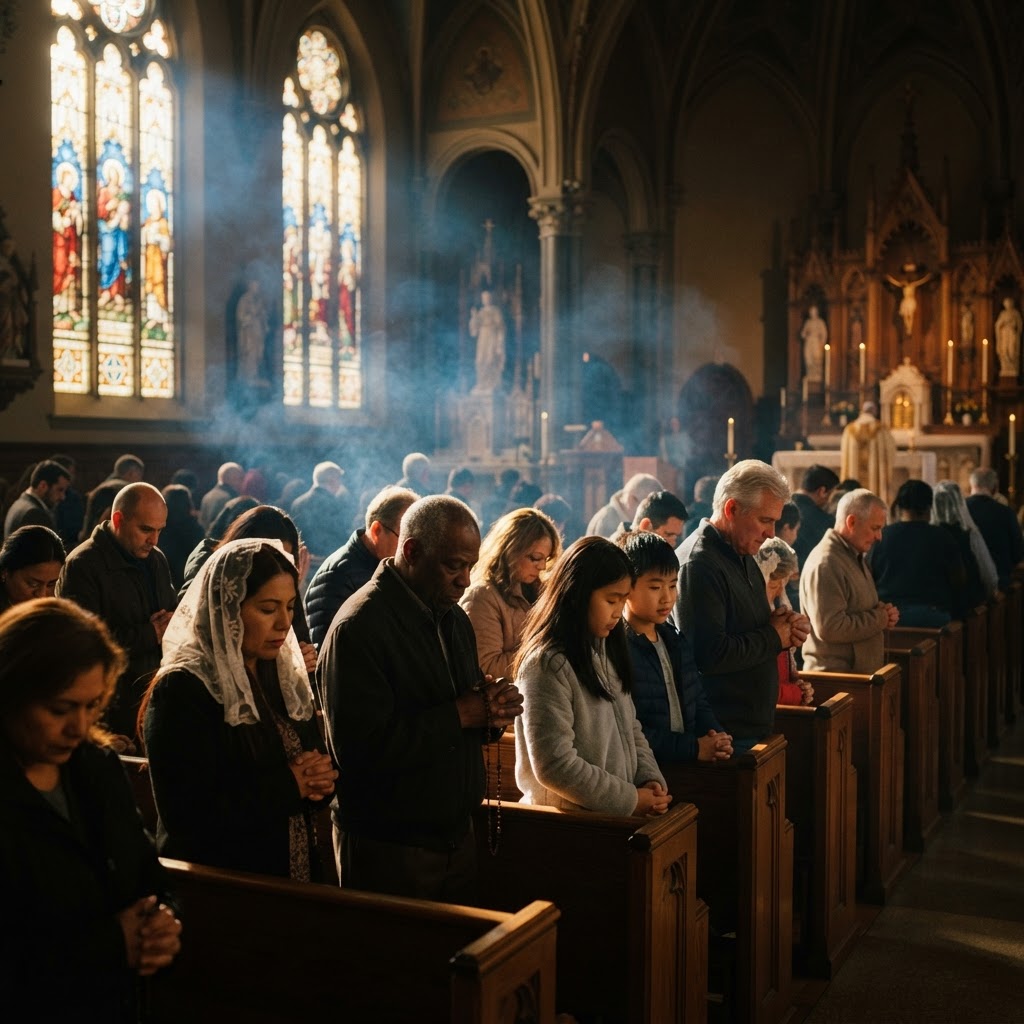
This is why the New Testament speaks of our membership in such physical terms. We are "living stones" built into a spiritual house (1 Peter 2:5). We are "members of the household of God" (Ephesians 2:19). We are branches on one vine (John 15:5). A hand severed from a body does not go on living a slightly reduced life — it dies. That is the Lord's own image, and He intended us to feel its weight.
And notice the purpose. Each member is given a gift "for the common good" (1 Corinthians 12:7). Romans 12, 1 Corinthians 12 and Ephesians 4 all say the same thing: the body grows "when each part is working properly" (Ephesians 4:16). Your holiness is not a private project. It is built, exercised and measured in relation to the other members — in patience with the irritating, service to the needy, forgiveness of the difficult, and the giving and receiving of teaching, correction, comfort and prayer.
Membership, Not Consumption
A Member, Not a Customer
The modern model quietly turns the Church into a provider and the Christian into a consumer: I attend where the preaching is sharpest and the music suits my taste, and I move on when the service stops meeting my needs. But the Body of Christ has no customers, only members. A member does not shop for the Body; a member is given one, as truly as a child is given a family. He does not ask first what the Body will do for him, but what he has been placed in it to do.
This is the plain sense of 1 Corinthians 12:15–26. If the foot says, "Because I am not a hand, I do not belong to the body," that does not make it so. The ear does not get to resign. And the eye cannot say to the hand, "I have no need of you" — the very sentence is absurd, because a member that cuts itself off does not become freer. It becomes unaware of its own death.
So the first question is not what kind of church suits me, but where I have been given to belong — and whether I am living there as a member with duties, or merely attending as a guest with preferences.
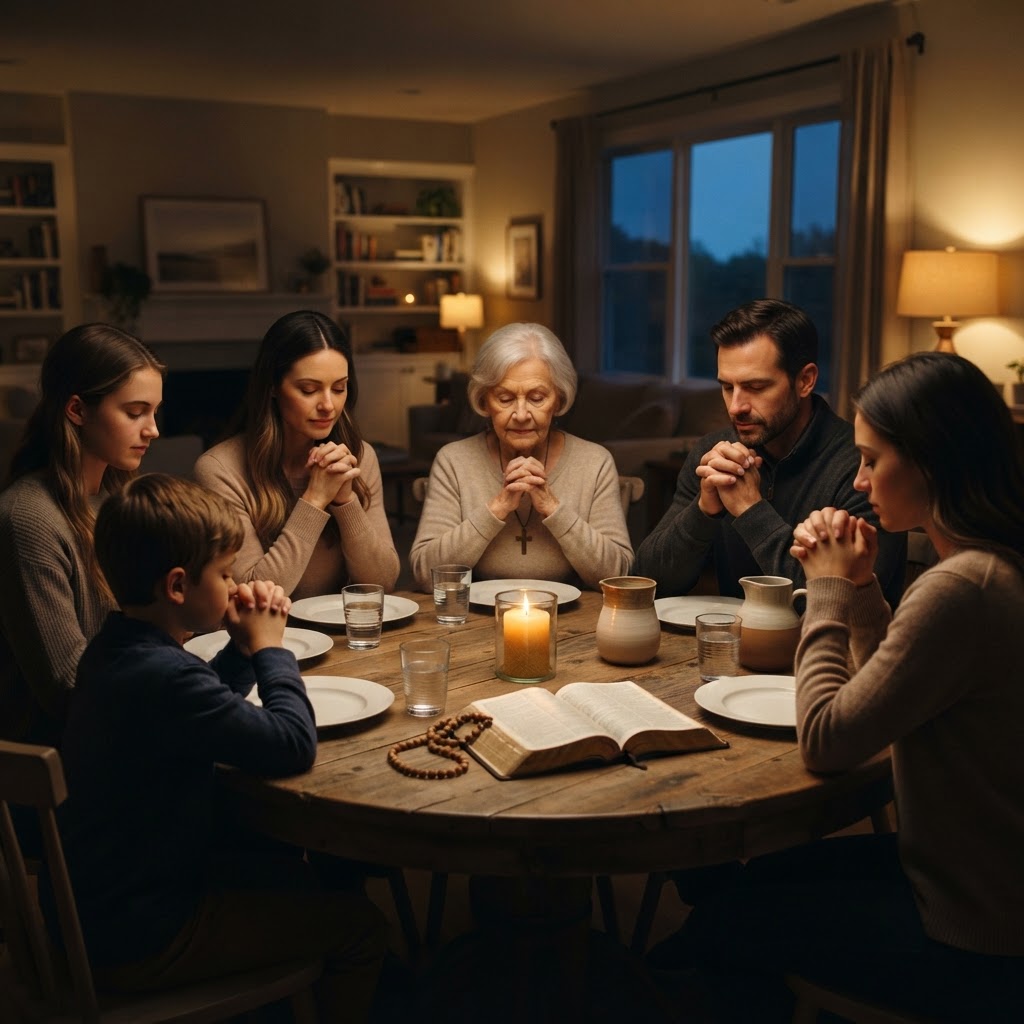
Where two or three are gathered in my name, there am I in the midst of them.
Matthew 18:20
The Pattern of Scripture
No Such Thing as a Lone Christian
The New Testament was written to congregations. Its letters are addressed to churches, read aloud to assembled people, and its authors assume throughout that the ordinary Christian life is lived in the company of the saints. Trace the texture of the text and the assumption is everywhere.
Baptised into one body
Nobody in the New Testament baptises himself. Entry into the Christian life is administered by another member of the Body.
1 Corinthians 12:13
Devoted to the apostles' teaching
The first Christians did not each read the Scriptures privately as their own authority; they devoted themselves to the teaching of the apostles.
Acts 2:42
Forgiven through the Church
Christ gives the power to forgive and retain sins to the apostolic ministry, to be exercised within the Church — not to each believer in isolation.
John 20:21–23; Matthew 18:18
Decisions made together
The first great doctrinal crisis was not settled by every individual's private reading. It was settled by the apostles and elders gathered in council, and the decision was sent out to be obeyed.
Acts 15
Elders appointed and heeded
Leaders are ordained, and the faithful are told to obey and submit to them. Obedience is a word the private model cannot use.
Titus 1:5; Hebrews 13:7, 17
Letters read aloud to congregations
Scripture is a public, communal gift before it is ever a private one. The letters were read to assembled churches.
Colossians 4:16; 1 Thessalonians 5:27
Do not neglect to meet
That such a warning exists at all shows that gathering was the expected norm of Christian life, not an optional extra for the especially sociable.
Hebrews 10:24–25
The Church is the pillar of truth
Not the isolated reader. It is the household of the living God that holds and guards the deposit of faith.
1 Timothy 3:15
Unity is the sign
Christ prays that His followers be one, and says the world will know them by their love. Both are public, visible realities — not invisible states of heart.
John 17:21; 13:34–35
"If I am delayed, you may know how one ought to behave in the household of God, which is the church of the living God, the pillar and bulwark of the truth."
— 1 Timothy 3:15; Ephesians 2:19–22
Set these beside the modern model and the difference is not one of emphasis. It is a different architecture of the Christian life. One is an individual with a text. The other is a member of a Body with a Head, a table, a voice and a family.
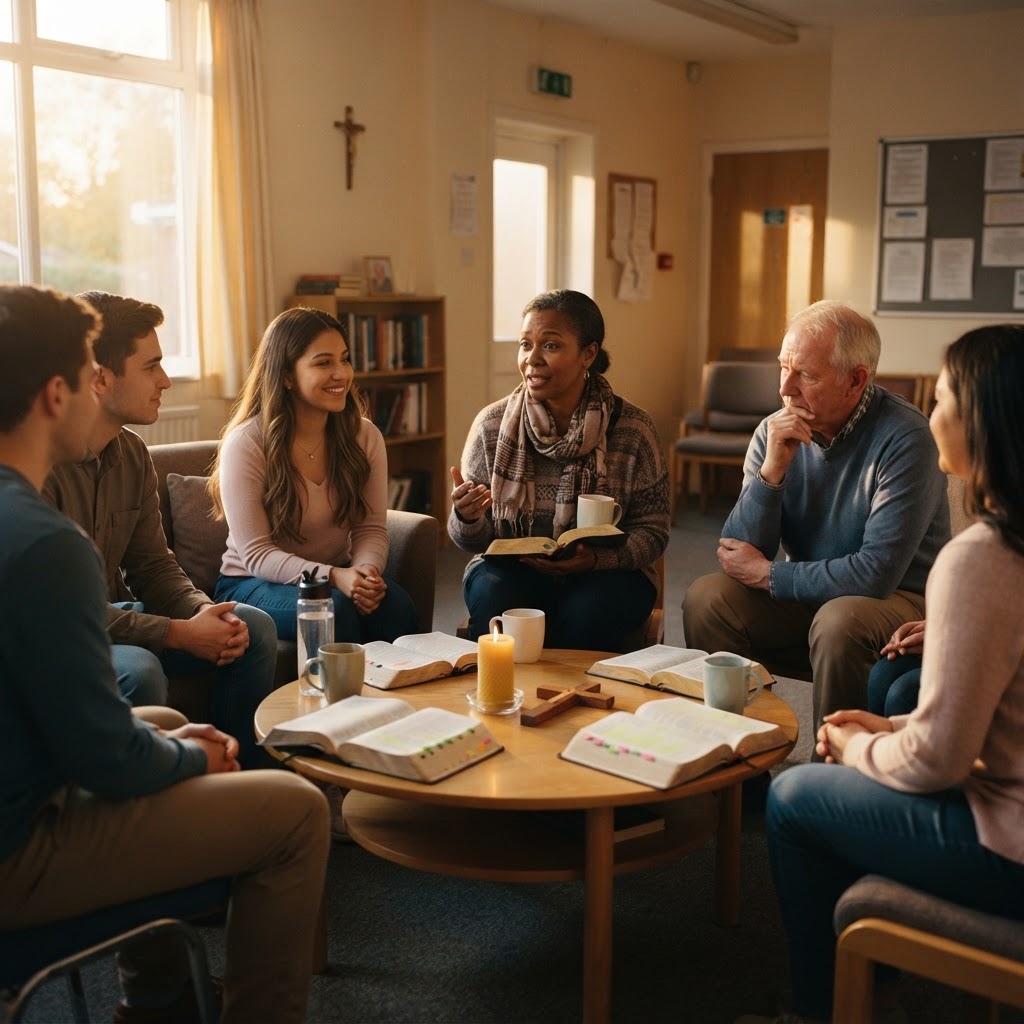
Bear one another's burdens, and so fulfil the law of Christ.
Galatians 6:2
The Modern Turn
Me, My Bible, and God Alone
Charity requires that we state the Reformation position at its best, and history requires that we state what became of it. The Reformers themselves did not set out to invent a solitary Christianity. Luther preached the Church as mother, wrote a catechism for households, retained baptism and the Lord's Supper, and insisted on a visible church with ministers. The Augsburg Confession and Calvin's Institutes alike confess the creeds, the sacraments and churchly discipline.
The problem was not the original intention but the principle that carried it. Once Scripture was severed from the Church's living teaching office and placed in the individual's hands as the final judge of its own meaning, the decisive authority quietly moved from the Church to the reader. Each person became the arbiter of what the text could only tell him.
The fruit appeared immediately and has never stopped. At the Marburg Colloquy in 1529, Luther and Zwingli — both serious believers, both reading the same words of Christ — could not agree on the Eucharist and parted company. Within a generation there were open disputes over baptism, predestination, images, ministry and morals. From that seed has grown a forest of thousands of separate churches, each with a sincere reading, no shared altar, and no court to which a dispute can finally be taken.
"The Word of God is not a private possession to be settled by private opinion. Wherever private judgment becomes the final authority, the answer is only ever as stable as the reader — and there are as many answers as there are readers."
— 2 Peter 3:16; Acts 15:2
The deeper cost, though, was not doctrinal confusion but the disappearance of the ordinary channels of grace. When the sacraments are reduced to ordinances and memorials, the confessional empties, the anointing is retired, the priest's "I absolve you" is gone, and the altar is no longer a place where the Body and Blood of Christ are truly given. What remains is sincerity — and God honours sincerity — but the means He Himself designed have been set aside, and each soul is left to manufacture its own assurance from within.
We do not claim that a Protestant cannot be a saint, or that individual Evangelicals do not love Christ. Many do, ardently, and put Catholics to shame in prayer, generosity and zeal for the gospel. Our claim is narrower and harder: a faith built on the individual and the text cannot carry what our Lord built His Church to give — the Body, the altar, the absolution, and the visible family of God.
Two Architectures of the Christian Life
The Individualist Model
The Catholic (Apostolic) Model
Scripture
My reading, guided privately by the Spirit; the text is mine to interpret and the individual is the final arbiter of its meaning.
Scripture read within the Church's living Tradition, with the Magisterium as servant of the Word (Dei Verbum 10–12).
Grace
Normally inward and immediate; the sacraments become signs of a faith already held, helpful but not necessary.
The sacraments are Christ's own acts — the ordinary means by which His grace actually reaches us (CCC 1127–1129).
Forgiveness
Confessed privately to God alone; assurance is generated from within.
Absolution pronounced by a priest in the person of Christ (John 20:23; James 5:16).
Unity
An invisible unity of like-minded individuals who happen to agree.
One visible Body — one baptism, one faith, one Lord (Ephesians 4:4–5).
Authority
The individual conscience as final court; there is no appeal beyond it.
Apostolic authority handed down from the Twelve (Matthew 16:19; 18:18; Acts 15).
The Church
A voluntary association I attend while it serves me, and leave when it does not.
The household of God, our mother, the pillar and bulwark of the truth (1 Timothy 3:15).
Holiness
A private project of personal improvement, measured mostly by feeling and intention.
Grown in the Body through prayer, sacraments and service to real people (1 Corinthians 12:7; Ephesians 4:16).
The Goal
Assurance held privately, and a faith as private as the assurance.
Communion with God and with His people — which is eternal life already begun (CCC 946–962).
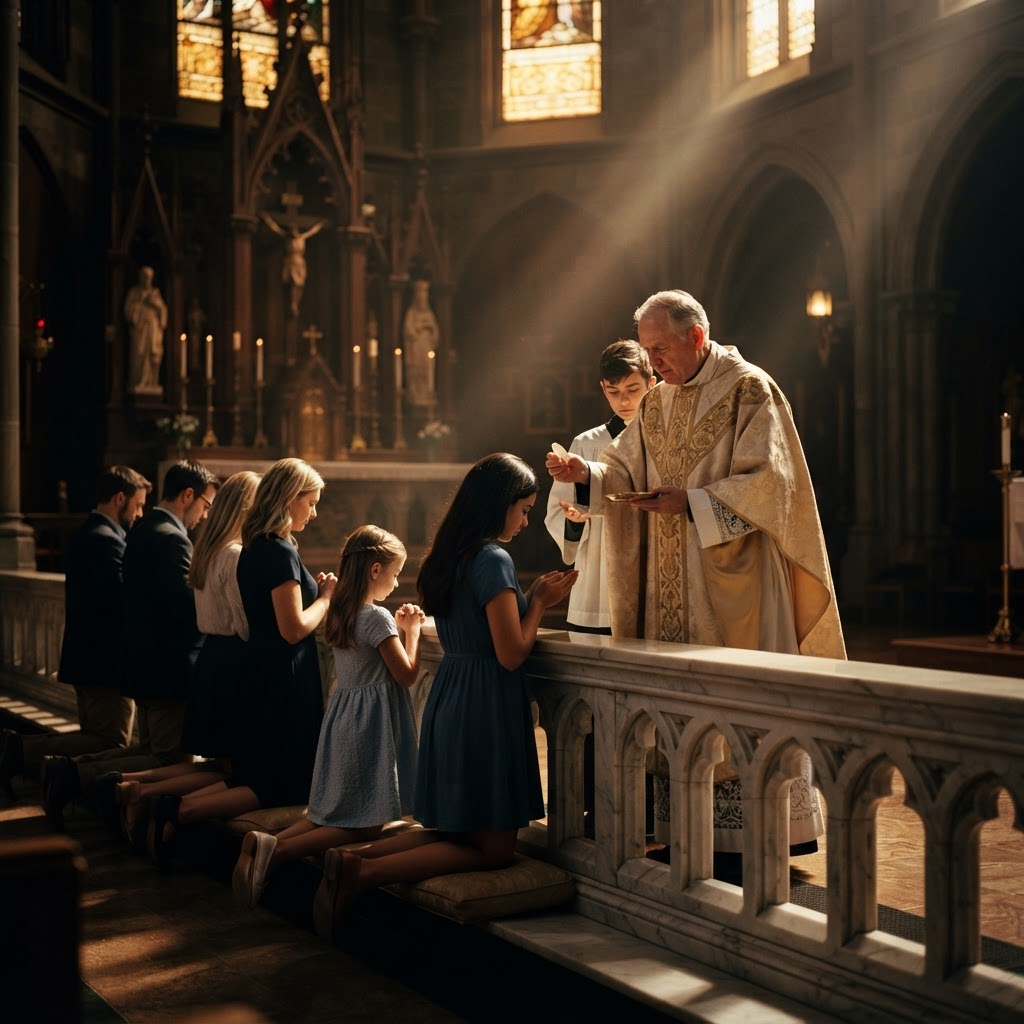
Because there is one bread, we who are many are one body, for we all partake of the one bread.
1 Corinthians 10:17
The Economy of Grace
The Ordinary Avenue of Grace Jesus Designed
God is free. He can reach a soul on a beach, in a car, in a hospital bed, and He often does. Catholic faith does not deny that; it simply refuses to build a whole spirituality on the exception. The Lord did not only promise to be available in general — He told us where He would be found. He attached His grace to things: to water, to oil, to bread and wine, to words spoken over a bowed head, to hands laid on the sick.
"As the Father has sent me, even so I send you." And when he had said this, he breathed on them, and said to them, "Receive the Holy Spirit. If you forgive the sins of any, they are forgiven."
— John 20:21–23
On the evening of His resurrection He did something extraordinary: He breathed on the apostles and gave them authority to forgive and to retain sins. He gave men the power to speak His forgiveness. He gave Peter the keys (Matthew 16:19). He told the disciples that whatever they bound on earth would be bound in heaven (Matthew 18:18). He sent them to baptise (Matthew 28:19). He handed them the command over the Eucharist: "Do this in remembrance of me" (Luke 22:19). In every case the gift is given through a visible Church, and through ministers He appointed.
This is the sacramental economy, and it is where the Catholic faith stands out most sharply in our age. The Church is not merely the gathered audience of the saved; she is the Body through which Christ continues to act, the universal sacrament of salvation (Lumen Gentium 48; CCC 774–776). When a priest baptises, it is Christ who baptises. When he absolves, it is Christ who absolves. When he lifts the Host, it is Christ who feeds His people. The sacraments work because He is faithful — never because we happen to feel anything.
Baptism
The door. We die and rise with Christ, and are made members of His Body (Romans 6:3–4; CCC 1213).
Confirmation
The gift of the Spirit for witness and strength, completing baptismal grace (Acts 8:14–17; CCC 1285).
Eucharist
The source and summit of the Christian life — His Body and Blood as food for the journey (CCC 1324).
Penance
The second plank after shipwreck: sin forgiven in the Church, with the sinner restored (CCC 1446).
Anointing of the Sick
Healing of body and soul, and grace for the passage home (James 5:14–15; CCC 1499).
Holy Orders
The apostolic ministry by which we receive every other sacrament (CCC 1536).
Matrimony
Grace for the domestic church — a family built into the life of the Body (Ephesians 5:32; CCC 1601).
Every one of these is a grace given through another person's hands. That is the whole point.
And notice, in passing, how unlike the slogan it is to say "God alone." God is not alone. He is Father, Son and Holy Spirit — an eternal communion of love. He saves us by drawing us into that communion, and He does it through a Body, with a table, and with hands He has appointed. The religion of the isolated soul does not merely leave out the Church; it leaves out the way God has chosen to love us.
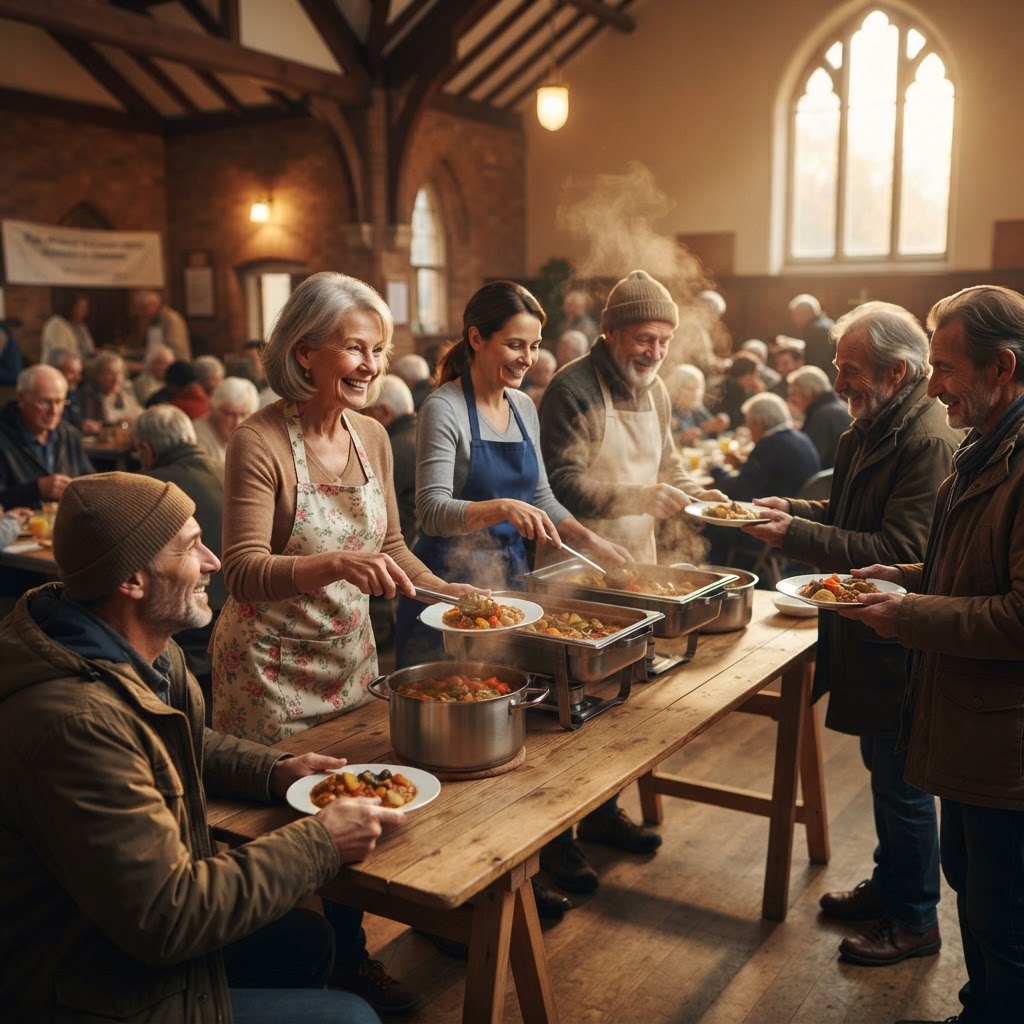
As you did it to one of the least of these my brethren, you did it to me.
Matthew 25:40
The School of Holiness
Holiness That Lasts Is Holiness in Service
A private religion has no one to be patient with. There is no face to forgive, no slow person to wait for, no tedious duty to carry, no one whose feet need washing. Virtue cannot be acquired in a vacuum; it needs something to push against, and community supplies the push. This is where love stops being a feeling and becomes a decision, made over and over, with names attached to it.
That is why the Church has always treated service as the school of holiness rather than an accessory to it. Christ washed feet (John 13:1–17) and said the world would know His disciples by their love for one another (John 13:34–35). He identified Himself with the hungry, the stranger, the sick and the imprisoned (Matthew 25:35–40). Peter told us to use whatever gift we have to serve one another as stewards of God's varied grace (1 Peter 4:10).
"Bear one another's burdens, and so fulfil the law of Christ. To each is given the manifestation of the Spirit for the common good."
— Galatians 6:2; 1 Corinthians 12:7
In a parish this is unglamorous and specific: reading at Mass, preparing the sanctuary, cooking and delivering meals, sitting with the dying, teaching the catechism class nobody wants to teach, driving a widow to church, keeping the books, visiting the prison, praying for the same difficult person for twenty years. That is where the doctrine of the Body becomes biography. Holiness with nobody to serve stays theory; the Body gives it a face.
Service is also what makes holiness sustainable. A life that only receives slowly curdles into spiritual consumerism; a life that pours itself out for others is continually renewed. Our Lord said it plainly: it is more blessed to give than to receive (Acts 20:35).
Sustained by the Body
Prayer, Communion and Faith
Three things carry a Christian: the prayer of the Church, communion in the Body, and the faith handed down. Left alone, all three quietly weaken — and that weakening is usually mistaken for personal failure rather than what it is: life outside the Body that was designed to sustain it.
Prayer in the Body
The Church's own prayer — the Liturgy of the Hours, the Rosary, the communal intercessions — teaches us to pray beyond our own small emergencies. The first Christians devoted themselves to the prayers (Acts 2:42) and prayed together in the face of threat (Acts 4:24). When I pray the Psalms, I pray the prayer of Christ's Body across the centuries, and my prayers are never only mine.
Communion
Koinonia means sharing in common: not merely attending, but belonging. One bread, one body, one cup (1 Corinthians 10:16–17). The first believers held their goods in common and knew one another's needs (Acts 4:32–35). Communion is what makes the Eucharist possible — and the Eucharist is what makes communion real.
The Faith Handed Down
The faith is not reinvented by each generation. It is the faith once for all delivered to the saints (Jude 3), professed together in the Creed, taught to us by the Church, and guarded against erosion. Held alone, faith shrinks to whatever feels useful this season. Held in the Body, it stays apostolic — and we are strengthened by the witnesses who have already run this race (Hebrews 12:1; CCC 946–962).
This is what sustainability looks like in the spiritual life: not intensity of feeling held up by willpower, but the rhythm of a Body — the sacraments feeding, the community carrying, the service pouring out, the tradition holding.
A life that grows in holiness and virtue is fruitful when it is operating in a position of service to others, and it is sustained and strengthened by the Church's prayer, communion and faith. That is not a limitation placed on the Christian life. It is its design.
Honest Objections
Five Questions Worth Asking
These are the objections that sincere Christians actually raise, and they deserve answers rather than slogans. Each one has something true in it — and each one stops short of the whole truth.
"The Church is full of sinners — and scandal."
Yes, and it always has been. Judas was among the Twelve, Peter denied Him, the Corinthians were a scandal to their own founder, and Augustine's flock had barely been converted. Our Lord described the kingdom as wheat and weeds growing together until the harvest (Matthew 13:24–30). Augustine's answer still stands: the Church is a hospital for the sick, not a museum of the healthy. The sins of her members grieve Christ and must never be excused — but leaving every room a sinner enters would mean leaving the world.
"I can read the Bible and pray on my own — God hears me."
He does, and He is glad to. But in the New Testament private devotion is the overflow of a life lived inside the Body, never its replacement. The question is not whether you can pray alone; it is whether you can be a Christian alone. Nobody baptises himself, and nobody absolves himself. The very life of grace is given through another person's hands.
"The liturgy is dry — I get more from my own study."
Feelings are real and worth noticing, but they are not the measure of grace. The sacraments do not work because the music moved us; they work because Christ is faithful. Consolation comes and goes in the life of every saint. The altar has outlasted every mood it has ever been celebrated in, and it will outlast yours.
"I have been wounded by church people."
Then you share something with our Lord, whose own friend handed Him over. The wound is real and no one should dismiss it. But a wound does not heal by leaving the body — a severed limb does not mend in the air. Bring it to a good priest, a faithful parish, a small community where you can be known. And be careful of turning a wound into a theology: 'I was hurt, therefore the Church is not the Church' is the wound speaking, not the Spirit.
"Didn't Jesus say 'where two or three are gathered in my name'? Surely that is enough."
Those words sit inside His teaching on the Church's authority to bind and loose (Matthew 18:15–20). He is not setting a minimum quota for private religion; He is promising His presence to a community acting with the authority He gave. In the same passage He tells the offended brother to 'tell it to the church' (18:17). Wherever He teaches about belonging, He assumes a Body to belong to.
Formation Examen
Where Am I in the Body?
Metanoia is a changed mind that becomes a changed life. So this teaching ends where all teaching should: in honest questions asked before God, not in an argument won.
- Am I a real member of a parish — known by name, with duties — or only a visitor who attends when convenient?
- Do I receive the sacraments as the ordinary channels of grace, and go to Confession regularly rather than rarely?
- Who am I serving by name this month — and could they name me?
- Who knows my sins, my struggles and my doubts, and prays for me? If the answer is no one, that is the gap.
- Do I pray with the Church — the liturgy, the Hours, the communal prayers — or only in private?
- Have I quietly made my own opinion the final authority over what the Church teaches, in a matter where I have simply preferred my reading?
- Do I love the Church as my mother, even while I grieve over her wounds and her failures?
- Have I treated the Church as a service to be consumed, or as a body to which I have been given?
None of these questions is meant to condemn. They are the place where a changed mind begins, little by little, to change a life — and where a private faith becomes a member of the Body.
Closing Prayer
Graft Us Firmly Into Your Body
Lord Jesus Christ, You did not leave us a book and a private opinion; You left us Your Body, and You are its Head. Forgive us for the ways we have tried to follow You alone, and for every place where we have preferred our own reading to Your Church's teaching. Baptise us again in the grace You give through water, oil, bread, wine and words of absolution. Make us faithful members rather than consumers — known, accountable, and given to one another. Teach us to serve with Your own hands, and to be sustained by the prayer, the communion and the faith of Your Church. Keep us in the unity You prayed for, so that the world may believe. Amen.
References
- Sacred Scripture: Acts 2 and 4; 1 Corinthians 10 and 12; Romans 12; Ephesians 2, 4 and 5; Hebrews 10 and 12; John 13–17; Matthew 16, 18 and 25
- Vatican II, Lumen Gentium 7–8 and 48 (the Church as the Body of Christ and the universal sacrament of salvation)
- Pius XII, Mystici Corporis Christi (1943)
- Catechism of the Catholic Church, nn. 771–776 and 787–795 (the Church as communion), 946–962 (the communion of saints), 1127–1129 (the sacraments as Christ's own acts)
- Council of Trent, Session 7 (on the sacraments) and Session 14 (on Penance)
- St. Cyprian of Carthage, On the Unity of the Catholic Church
- St. Augustine, The City of God and Sermon 137 (the Church as mother)
- St. John Chrysostom, Homilies on 1 Corinthians
- St. Thomas Aquinas, Summa Theologiae III, qq. 60–65 (the sacraments)
Metanoia Faith · Personal Formation · The Foundation · metanoiafaith.com