
Pillar V · Conscience & Moral Clarity
The Sanctuary of the Soul.
Formed by Truth, Freed by Grace.
"You shall know the truth, and the truth shall make you free." — John 8:32
The conscience is the inner sanctuary where every human person meets the authority of truth and the supreme Good. This is a full catechesis on what conscience is, how it is formed, how sin disorders it, and how grace restores it — read through the tripartite functionality of man: spirit, soul, and body.
Pillar Definition
What Conscience & Moral Clarity Means
Moral clarity begins in the conscience, the inner sanctum where the human person meets the authority of truth and the supreme Good. It is the capacity to see reality as God sees it, and to say so even under pressure. It is not the same as political opinion, cultural conservatism, or religious tribalism. It is the application of the Catholic moral tradition, grounded in Scripture, natural law, and the Magisterium, to the great questions and crises of the present moment.
The Church has always held that truth is accessible, not only to believers but to all people through reason and the natural law. A conscience formed in Christ therefore speaks not only within the Church but to the world: offering a vision of the human person, of freedom, of justice, and of love that transcends ideology and transcends politics.
Cultural clarity is the prophetic capacity to read the signs of the times: to see where the culture has gone wrong, where it is being manipulated, and where it is crying out for the truth it has suppressed. The prophets of Israel did this. The apostles did this. The Doctors of the Church did this. A conscience formed in Christ does it today.
This is not about winning culture wars. It is about loving people well enough to tell them the truth, the truth about who they are, why they were made, what true freedom requires, and what the consequences of moral error ultimately are. Clarity is an act of love, and conscience is the sanctuary where that love is first formed, wounded, healed, and set alight.
What follows is a full catechesis on conscience: what it is, how it is formed, how sin disorders it, and how grace restores it. The anthropology that carries the whole study is the tripartite functionality of man, spirit, soul, and body, so that what is illumined in the spirit might be judged in the soul and enacted in the body. And because doctrine is finally for living, one moral challenge of our time is examined without flinching: the killing of the unborn, entrenched in our laws and disguised as a woman's right over her own body.

Create in me a clean heart, O God.
Psalm 51:10
The Crisis of Our Age
Why This Matters Now
We are living through a comprehensive assault on moral reality itself. Gender has been declared a personal choice. Marriage has been redefined. Millions of children are killed each year in the womb while the culture calls it healthcare. Human beings are being engineered, rented, and commodified at levels that would have been unimaginable a generation ago.
And the Church, in many places, has gone silent. Homilies avoid controversy. Bishops hedge. Catholics are told to "accompany" without ever actually naming the destination. The result is a generation of Catholics who cannot give a reason for their faith on the most basic moral questions they will face every day of their lives.
The prophetic task of moral and cultural clarity is not political agitation. It is the restoration of a Catholic conscience: a sanctuary where God still speaks, a mind that knows what is true, that can explain why, and that can engage the culture with intelligence, charity, and confidence.
The saints did not go silent when the emperor made them choose between the Gospel and compliance. Neither should we. The weapons of this warfare are not carnal. They are truth, spoken in love, sustained by prayer, and willing to suffer the consequences. This is the hour to speak, and it begins with a conscience honestly examined before God.
The Inner Sanctum
The Sanctuary Where God Speaks
Catholic moral theology affirms that within each human heart lies the conscience: the inner sanctum where the human person encounters the authority of truth and the supreme Good.
"Conscience is a judgment of reason whereby the human person discerns and recognises the moral quality of one's own actions they are about to perform, are in the process of performing, or have already completed."
Catechism of the Catholic Church
When fully realised, conscience is the participation of the human person in God's eternal law, inscribed upon the heart and illuminated by grace. It is not a private opinion, and it is not a licence. It is a capacity given by the Creator, wounded by sin, and healed by the Redeemer.
This moral process is best understood within the biblical and patristic anthropology that identifies moral perception in the whole person: spirit, soul, and body (1 Thessalonians 5:23). St. Irenaeus of Lyon describes the perfect human as one in whom "the soul is receiving the Spirit of the Father" and is united with the body fashioned after God's image.
"You have made us for yourself, O Lord, and our hearts are restless until they rest in you."
St. Augustine, Confessions
Together these Fathers show conscience not merely as cognitive but relational and ontological. The pneuma (spirit: intellect, will, and conscience) receives and responds to the Spirit; the psyche (soul: mind, memory, emotions) mediates through reason and desire; the soma (body) enacts. The tripartite structure of the human person therefore becomes the theological framework through which conscience is understood as the human participation in God's truth.
Theological Framework
The Tripartite Functionality of Man
The diagram of the tripartite functionality of man represents the baptised person's realised interior ordering: the pneuma (spirit: intellect, will, and conscience) enlightened by grace, the psyche (soul: mind, memory, emotions, and lower reason) formed by virtue, and the soma (body and the physical and sensory life) disciplined for right moral action.
pneuma
Spirit: Intellect, Will and Conscience
The higher faculty of the interior soul: intellect, will, and conscience, with the charismata of the Holy Spirit. Here the sacred communion between our spirit and God's Spirit is realised, conscience is illuminated and moved by grace, and the firstfruits of salvation take immediate effect.
psyche
Soul: Mind, Emotions and Lower Reason
The natural life of the person: mind, memory, imagination, emotions, and the lower reason that handles the practical calculations of daily life. Here what the spirit perceives is felt, weighed, and sorted, and fear is separated from truth.
soma
Body and Senses
The bodily and sensory life by which a judgment becomes an act. The soma is disciplined for right moral action, and enacts what conscience has already decided.
This tripartite anthropology is deeply rooted in the patristic tradition. St. Gregory of Nyssa, in On the Making of Man, describes humanity as a unity of spirit, soul, and body, each distinct yet harmoniously ordered toward God. He teaches that the pneuma is capable of communion with God, the psyche mediates through reason and desire, and the soma expresses the soul's choices. For Gregory, moral growth occurs when the soul is "stretched upward" by the spirit and governs the body in accordance with divine truth.
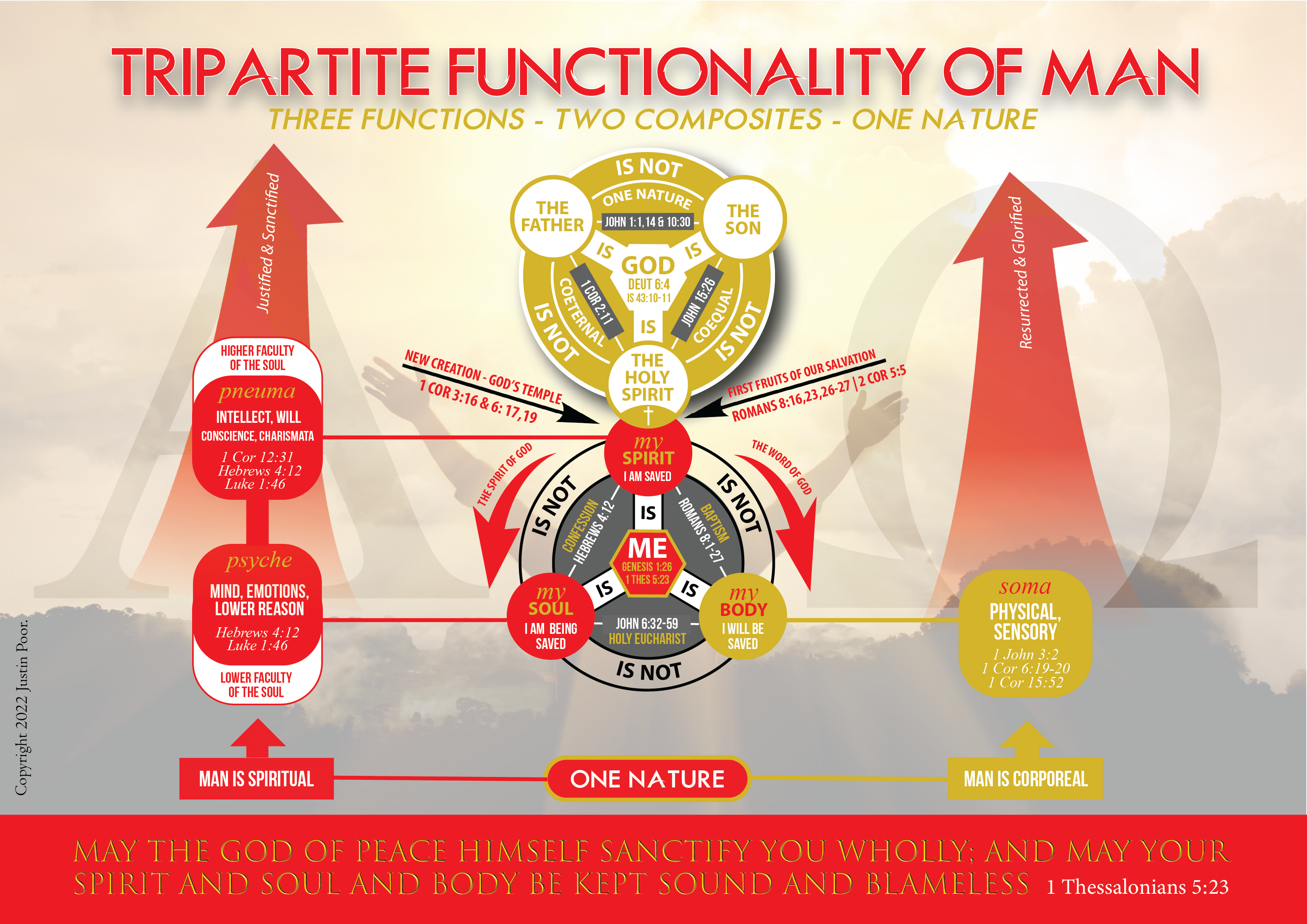
Figure 1. Tripartite Functionality of Man Diagram. A theological representation of the baptised person's interior ordering: pneuma, psyche, and soma, reflecting the relational harmony of the Trinity and the human person as Imago Dei. © Copyright 2022. Designed by Justin T Poor.
The diagram is a theological map for the baptised, and it is functional rather than metaphysical. It highlights how spiritual illumination (pneuma) must translate into moral judgment (psyche) and right action (soma). When these three functions operate in harmony and are ordered toward the good, conscience operates with true clarity and integrity.
It is in the pneuma, the higher faculty of the interior soul, that the sacred communion between our spirit and God's Spirit is realised, the conscience is illuminated and moved by grace, and the firstfruits of one's salvation take immediate effect.
Read the whole study for yourself: the scriptural foundation, the two composites within the one human nature, the higher and lower faculties, and the body destined for resurrection. Conscience cannot be understood apart from the person it belongs to.
For Deeper Understanding
The Tripartite Functionality of Man
Spirit, soul, and body: three functions, two composites, one nature. The full formation study of the human person made in the image of God, and of the conscience formed within him.
Study the Tripartite FunctionalityThe Nature of Conscience
An Act of Reason, a Sanctuary of God
St. Thomas Aquinas defines conscience as an act of reason applying knowledge to a particular situation. Conscience, informed by synderesis (the habitual and hard-wired innate knowledge of what is right) and by prudence, determines the moral quality of an act. It is therefore dynamic, designed for intellectual and moral metanoia, not a static possession but a living faculty meant to grow.
01
Witnessing
Conscience bears witness to moral responsibility. It testifies to what a person has done and to whom he answers for it.
02
Binding and Inciting
Conscience binds and incites action. It commands the good it perceives and moves the will toward it, here and now.
03
Judging
Conscience judges past choices. It approves what was rightly done and accuses what was not, calling the person back to truth.
The Catechism deepens this Thomistic account by describing conscience as "man's most secret core and sanctuary." A sanctuary is a holy place where God dwells, the meeting point where human experience encounters the divine.
Like Moses standing on holy ground before the burning bush, the conscience becomes a place of divine revelation and interior communion: ignited by grace, purified without being consumed, and illuminated with the truth of God and the truth of oneself.
Exodus 3:1-14
St. Paul teaches that even those without the revealed law "show that what the law requires is written on their hearts," and that "their conscience also bears witness" (Romans 2:14-15). Conscience is therefore universal yet limited in clarity. It is an intellectual act rooted in the soul, and when infused with grace it becomes the spirit's ear to hear God's voice.
Seen through the tripartite model, Aquinas' account aligns naturally: conscience is an act of practical reason belonging to the pneuma, the spirit illumined by grace, exercised through the psyche, and expressed through the soma.
From the Sanctuary to the Street
A conscience that never leaves the sanctuary has not yet become a conscience. What is heard in secret must be obeyed in public, or the sanctuary becomes a hiding place rather than a throne.
The Development of Conscience
Natural Conscience, Graced Conscience
Before describing how conscience is formed, it is necessary to distinguish the natural conscience common to all persons from the spiritually illuminated conscience of the baptised. While every person can perceive basic moral truth by natural reason, baptism effects an ontological change. Through baptism a person is infused with sanctifying grace, the theological virtues, and the indwelling of the Holy Spirit, who empowers the person with His sanctifying gifts (Isaiah 11:1-3) and charismata (1 Corinthians 12:1-11).
So while the unbaptised can know and respond to the good by natural means, the baptised possess an interior witness and graced spiritual capacities that elevate moral perception and action.
Common to all persons
The Unbaptised
In the unbaptised, conscience operates through natural reason, moral intuition, and the remnants of the Imago Dei, yet remains wounded by original sin. The unbaptised can know basic moral truths, but lack the Holy Spirit's interior witness and the infused virtues that reorient the person toward God. The Church recognises that an unbaptised individual can act morally and be guided by a well-formed natural conscience, while also acknowledging the limits of natural moral knowledge and the danger of vincible ignorance.
Elevated by grace
The Baptised
For the baptised, the Holy Spirit dwells in the pneuma, perfecting and aiding metanoia and elevating the natural conscience toward divine truth. This becomes a relational experience in which conscience is attuned to the interior voice of God: "the Spirit bears witness with our spirit" (Romans 8:16). The tripartite model reveals the difference: in the unbaptised, intellect, will, and conscience judge by natural light alone, without the indwelling Spirit; in the baptised, the pneuma is enlivened by the Holy Spirit, elevating the entire moral structure.
The unbaptised can know the good; the baptised can be led by the Good unveiled.
What the Church Teaches
The Doctrinal Foundation
The Moral Life in Christ
Human dignity, freedom, conscience, and virtue — the complete framework for moral life grounded in the imago Dei and renewed by baptismal grace.
Conscience
Conscience is not majority opinion or personal preference. It is the proximate norm of morality — and it must be formed, not merely followed.
Natural Law
Moral truth is not invented by religion — it is discovered in the nature of things. Natural law is accessible to reason, confirmed by Revelation.
Marriage & Sexuality
The complementarity of man and woman, the indissolubility of marriage, the meaning of human sexuality — revealed truths that culture now directly contradicts.
The Sanctity of Human Life
From conception to natural death — every human being made in God's image is owed reverence. This is not a political position. It is the logic of Creation.
"Always be ready to make your defence to anyone who demands from you an account of the hope that is in you — yet do it with gentleness and reverence."1 Peter 3:15
Formation Path
How the Conscience Is Formed
The formation of conscience involves the practice of the cardinal virtues of prudence, fortitude, and temperance, which strengthen the habits of practical reasoning, and it is also shaped by faith. When faith and reason work more harmoniously in making moral decisions, the conscience binds the will more fervently to what is right.
Formation is not a single decision but a way of life. It is the harmonising of psyche and soma under the illumination of the pneuma, so that the whole person becomes capable of perceiving and enacting the good.
Immersion in Scripture
The Word read, prayed, and obeyed. Conscience is formed by what it habitually hears.
The Sacramental Economy
Eucharist, confession, and the sacraments of healing — grace given as a remedy, not only as a reward.
Regular Spiritual Direction
Another set of eyes on the soul, so that self-deception is named and corrected early.
Examination of Conscience
The daily and weekly review that keeps the interior life honest before God.
Silence and Prayer
The sanctuary is heard only in quiet. Noise is the first enemy of a formed conscience.
Obedience to the Magisterium
The Church's teaching is not a limit on the conscience but its safeguard and school.
Formation is not the acquisition of information about morality. It is the slow reshaping of an entire person until the good is seen, loved, and done.
Six Disciplines
Six disciplines that build the Catholic moral mind and the cultural voice.
Study the Catechism
Part Three of the Catechism ("Life in Christ") is the most complete and accessible Catholic moral formation resource in existence. Read it section by section.
Develop a Formed Conscience
Conscience formation is not the same as going with your gut. Study Church teaching, read the magisterium, submit your instincts to examination. Authentically free conscience is anchored conscience.
Read the Signs of the Times
Apply the Church's moral framework to the issues of the day — gender ideology, bioethics, AI, political theory. Truth is not timid. Apply it to every conversation.
Learn Natural Law Arguments
Many moral truths can be argued without Scripture — through reason alone. This makes them accessible to anyone. Study natural law to speak to the non-believer with clarity.
Charity as the Foundation
Moral clarity without charity is not Catholic. The truth must always be spoken with love — not compromise, but love. The goal is conversion, not victory in argument.
Stand and Don't Yield
When the culture demands that you call good evil and evil good, refuse. Stand in the tradition of the martyrs. The cost of clarity may be real — but it is never greater than the cost of compromise.
Conscience and Sin
Disordered Love, and the Grace That Restores
St. Thomas Aquinas defines sin as amor inordinatus: disordered love. Sin is not merely rule-breaking. It is a rupture in the person's orientation toward God, and it leaves marks on the whole person.
John R. Sachs emphasises that sin has personal, relational, and structural effects. Sin darkens the intellect, weakens the will, and inflames the passions. In the tripartite model, this is a breakdown in the flow from pneuma to psyche to soma: the spirit no longer hears clearly, the soul no longer judges rightly, and the body enacts what the conscience would once have refused.
Augustine's image of the soul "curving in" on itself captures this collapse of the interior — the person bent back upon his own appetite, no longer open to God.
St. Augustine
Yet it is grace that heals and restores. Scripture invites us to approach the throne of grace, "that we may find mercy in time of help" (Hebrews 4:16). Through confession, prayer, and the Eucharist, the pneuma is rekindled, the psyche reordered, and the soma disciplined. Grace does not merely forgive the damage; it reopens the person to God.
This is why the examination of conscience is not a morbid exercise. It is the doorway of mercy. To name a disorder honestly is already to begin the return, and the sacrament of reconciliation is the ordinary place where the tripartite person is put back in order.

Be still, and know that I am God.
Psalm 46:10
A Moral Challenge of Our Time
Conscience and Abortion
On the matter of abortion, the world has truly collapsed its moral judgment and abandoned the fundamental natural law of the preservation of life. In Australia it is estimated that between 64,000 and 94,000 abortions are performed each year. This is not a private moral failing or a matter of individual preference. It is the genocide of innocent human beings on a vast scale, entrenched in our laws and masquerading as a woman's right to her own body.
64,000–94,000
lives ended by abortion in Australia each year
257
innocent lives destroyed on an average day
Conception
the moment the Church says every human life must be protected
Abortion presents a decisive test of conscience in the modern world because it confronts the human person with the most fundamental moral question of all: what is the value of human life, and who has the authority to take it? No generation has been able to avoid that question for long, and ours has answered it in legislation.
The Teaching of the Church
The Church teaches with unwavering clarity that "human life must be respected and protected absolutely from the moment of conception." This is not merely a doctrinal statement, but a theological affirmation grounded in the Imago Dei. The unborn child is not a "potential" person but a true person with true potential, a human being already known, loved, and called by God.
"Before I formed you in the womb I knew you, and before you were born I consecrated you."
Jeremiah 1:5
The Didache, one of the earliest Christian writings, condemns abortion outright, demonstrating that the Church's moral intuition on this matter has been consistent from the apostolic age. This is not a modern political position. It is the apostolic faith.
What Abortion Severs
If every human being is created for communion with God, beginning at conception, then abortion interrupts not only biological development but a sacred trajectory destined to be expressed through the full human experience. The tripartite model makes this plain: the unborn human possesses pneuma, psyche, and soma in an integrated unity from the very beginning. To end that life is to sever a relationship that God Himself has initiated.
Abortion also distorts the conscience itself. When a culture "normalises" the taking of innocent life, the collective psyche becomes dulled, and the soma follows suit, participating in structures of sin. In Evangelium Vitae, St. John Paul II's diagnosis of a "culture of death" is not hyperbole but a stark recognition that society's acceptance of abortion steers the formation of collective consciences away from truth.
A conscience rooted in the pneuma refuses to reduce abortion to preference, personal convenience, or political ideology. It recognises that defending the unborn is a fundamental act of fidelity to God's creative love and a participation in His justice.
Evangelium Vitae, St. John Paul II
Entrenched in Law, Dressed as Freedom
What makes this evil in our own country so grave is not only that it happens, but that it has been written into law and framed as compassion. The state claims the authority to define which human beings may be killed, and a right to autonomy is invoked as though the body of a child were simply an extension of someone else's will. Freedom is invoked to justify the most absolute form of domination: the power of the strong over the utterly defenseless.
A well-formed conscience cannot accept that framing, however loudly it is repeated, however many institutions and courts endorse it. Truth is not determined by a majority, a parliament, or a slogan. The unborn child remains a gift entrusted to us by God, and rejecting abortion is an act of reverence for the mystery of human life.
At the Ballot Box
Because this is the first non-negotiable, it carries into the voting booth. We have weighed the recorded parliamentary voting patterns and the stated platforms of the Australian parties on the protection of the unborn, to show which have been consistent against abortion and which sit closest to the Magisterial teaching on the matter.
Abortion and the Vote: the Party RecordMercy for the Wounded
The Church's teaching on abortion is not merely prohibitive, but also pastoral. Many women who have had abortions carry deep emotional, relational, and spiritual wounds. The tripartite model helps illuminate this: the pneuma is wounded by guilt, the psyche by grief and confusion, and the soma by the physical and psychological aftermath.
But it is the same Spirit who convicts who also heals. Through confession, spiritual guidance, prayer, and the mercy of Christ, the conscience can truly be restored. Grace does not erase the past but transforms it, allowing the person to move forward in truth and hope, that one day they can be fully restored.
Repentance & ReconciliationA Spiritual Issue, Not Only a Moral One
Abortion is not just a moral issue but a spiritual one. It reveals whether the human heart is oriented toward God's vision of life or toward an existence shaped by fear, selfishness, or despair. A conscience illumined by grace sees the unborn not as an inconvenience but as a gift entrusted to us by God. Every other moral question of our age will be answered in the same place, and by the same conscience.
Personal Conscience and Moral Decision-Making
How a Conscience Actually Decides
The tripartite model is not an abstraction. It is very practical. When discerning anything, the focus begins in the pneuma: prayer, silence, and asking the Holy Spirit for light and clarity. That disposition helps the psyche sort fear from truth, and it keeps the soma from being the prime decision driver. Personal convictions then flow from Scripture, Tradition, and the grace of knowing God's law written on the heart.
Step 01 · pneuma
Begin in the Spirit
Discernment begins in the pneuma: prayer, silence, and asking the Holy Spirit for light and clarity, so that intellect and will are governed by grace before the decision is made.
Step 02 · psyche
Judge in the Soul
The mind, memory, emotions, and lower reason work through what the spirit has perceived, sorting fear from truth. What is felt is examined in the light of Scripture, doctrine, and the Church's teaching.
Step 03 · soma
Enact in the Body
The body is not the prime decision driver. Appetite, fatigue, and pressure do not govern; the body carries out what has been truly discerned.
This model also keeps a person humble. It reminds us that conscience formation is ongoing, and that our judgments must be submitted to the Church and to prayer. Forming the conscience is a path to holiness and into deeper communion with God.
The Church is entrusted with forming conscience. As the "pillar and bulwark of the truth," she safeguards revelation and interprets moral truth with Christ's authority. A conscience separated from the Church risks becoming malformed; a conscience formed within the Church becomes capable of experiencing authentic freedom in the fullness of the faith.
1 Timothy 3:15
Come to me, all who labour and are heavy laden.
Matthew 11:28
Conclusion
The Sanctuary Where the Whole Person Meets God
In summary, conscience is the sacred meeting place between God and the human person. Baptism elevates conscience by infusing grace and the Spirit's witness; the unbaptised possess a natural conscience but lack the Spirit's interior guidance. Formation requires virtue, sacrament, and spiritual practice. The tripartite model — pneuma, psyche, soma — shows how conscience is rooted in the Spirit, formed by the Church, wounded by sin, and healed by grace.
Ultimately, conscience is not merely a moral compass but a sanctuary: the place where the tripartite human person encounters the living God and is transformed into His likeness. That is the whole purpose of moral clarity. Not to win an argument, but to become the kind of person who can stand before God and be made like Him.
May the God of peace himself sanctify you wholly;
and may your spirit and soul and body be kept sound and blameless at the coming of our Lord Jesus Christ.
1 Thessalonians 5:23
Adapted from an analytical study by Justin Poor on the role of conscience in Catholic moral theology.
Related Prophetic Issues
Moral Clarity in the Public Square
Same-Sex Marriage
The Church's teaching on marriage, conjugal complementarity, and the pastoral care of persons with same-sex attraction.
Neo-Communism
The ideological capture of culture, education, media, and government by neo-Marxist thought patterns.
AI & Transhumanism
The threat to human dignity posed by the redefinition of personhood in the age of artificial intelligence.
Climate Alarmism
Separating genuine stewardship from ideological instrumentalisation of the environment against human flourishing.
Daily Reflection
"The time is coming when men will not tolerate sound doctrine, but — to suit their own desires — will gather around them a great number of teachers to say what their itching ears want to hear."
2 Timothy 4:3
Paul wrote those words two thousand years ago, and they have never been more precisely fulfilled. The itching ears are everywhere. The sycophantic teachers are everywhere. What is rare — what is desperately needed — are voices willing to say the hard things with love. The Church has always produced such voices. This generation must become them.
Weekly ReflectionsReferences
Sources and Further Reading
- St. Thomas Aquinas, Summa Theologiae (trans. the Fathers of the English Dominican Province, 1912)
- St. Augustine, Confessions (trans. R. S. Pine-Coffin, Penguin Classics, 1961)
- Catechism of the Catholic Church, 2nd ed. (Libreria Editrice Vaticana, 1997)
- St. Gregory of Nyssa, On the Making of Man (Nicene and Post-Nicene Fathers, Second Series, Vol. 5)
- St. Irenaeus of Lyon, Against Heresies (Ante-Nicene Fathers, Vol. 1)
- St. John Paul II, Evangelium Vitae (Encyclical Letter, 25 March 1995)
- The Didache, in The Apostolic Fathers (trans. J. B. Lightfoot)
- Sebastian Walshe, O.Praem., The Formation and Exercise of Conscience in Private and Public Matters (St. Michael's Abbey, 2018)
- John R. Sachs, The Christian Vision of Humanity: Basic Christian Anthropology (Liturgical Press, 1991)
- Keogh, Bismark, King & Chalmers, "Estimating the abortion rate in Australia from National Hospital Morbidity and Pharmaceutical Benefits Scheme data", Medical Journal of Australia 215, no. 8 (2021)
- Guttmacher Institute, "Australia Country Profile" (2025)
- Scripture: 1 Thessalonians 5:23; Romans 2:14-15, 8:16; Hebrews 4:16; Jeremiah 1:5; Exodus 3:1-14; Isaiah 11:1-3; 1 Corinthians 12:1-11; 1 Timothy 3:15
Walk in This Pillar
Form Your Conscience. Speak the Truth. Stand Firm.
The Church is not a debating society, and moral clarity is not an intellectual hobby. It is prophetic service. It is pastoral love. It is the courage to give someone the truth they need to be free — even when the world will punish you for it. This is the hour that was made for moral courage. And you were made for this hour.