
"May your spirit and soul and body be kept sound and blameless." - 1 Thessalonians 5:23
The Tripartite Functionalityof Man
Three functions - two composites - one nature. A Catholic reading of the human person made in the image of God: spirit, soul, and body ordered to the Triune God, sanctified wholly from justification through glorification.
The Central Diagram
Three Functions - Two Composites - One Nature
Man created in the image of God - spirit, soul, and body ordered to the Triune God.
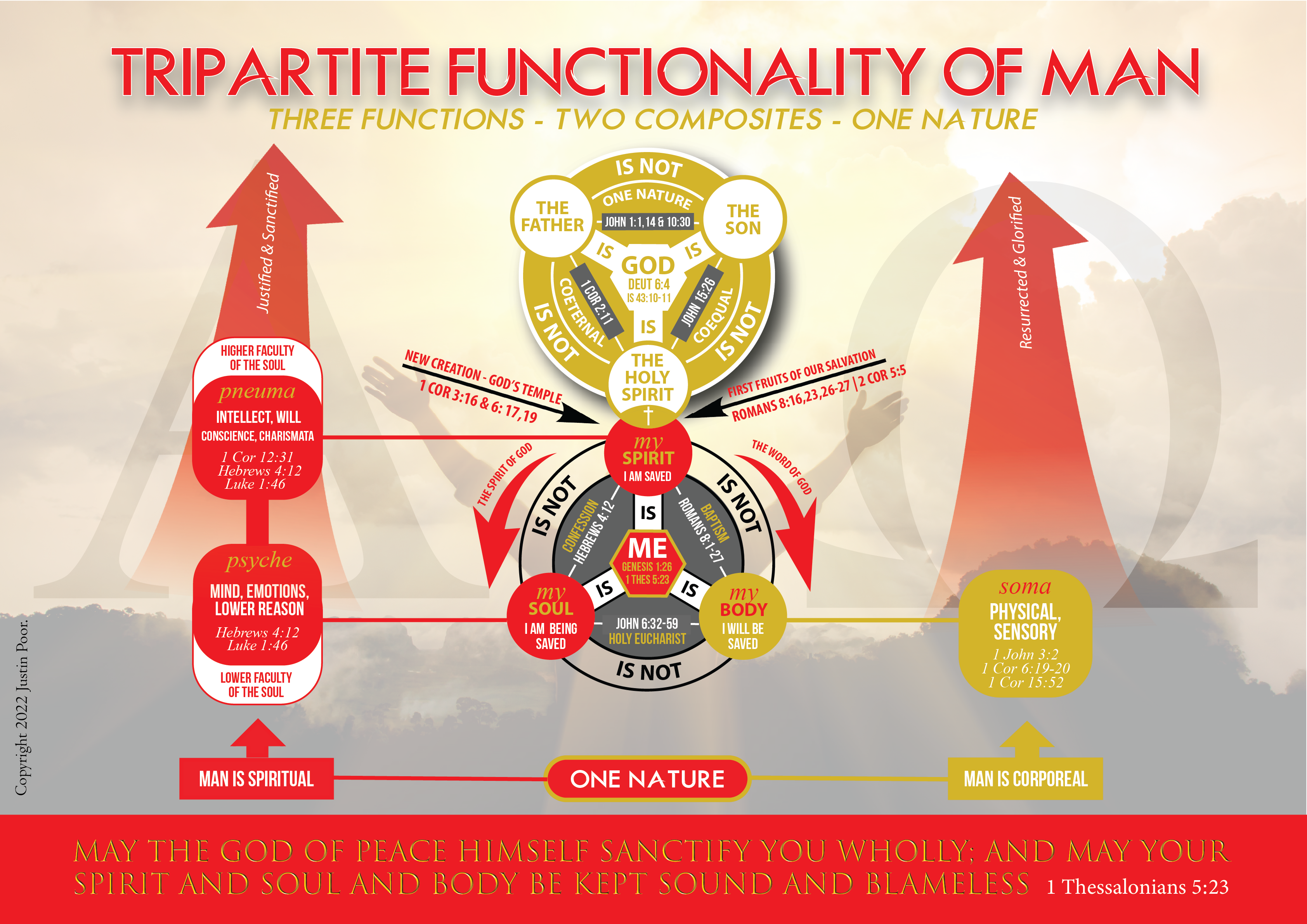
Read from the Godhead downward: as the Triune God is three Persons in one essence, so man - His image - is three functions in one nature. The whole person, the whole salvation.
Section I - Scriptural Foundation
Where Scripture Names the Whole Man
Scripture does not present a systematic anthropology, yet the whole mystery of the human person - spirit, soul, and body - is named in three places whose convergence the Church has received as a single doctrine. To read them together is to hear the apostle bless what God created.
1. 1 Thessalonians 5:23
May the God of peace himself sanctify you wholly; and may your spirit and soul and body be kept sound and blameless at the coming of our Lord Jesus Christ.
The apostolic blessing names the whole man - spirit (pneuma), soul (psyche), body (soma) - as the field of God's sanctifying work. Not a divided creature but one person, wholly made holy.
2. Hebrews 4:12
For the word of God is living and active, sharper than any two-edged sword, piercing to the division of soul and spirit, of joints and marrow...
The Word discerns between soul and spirit - faculties so closely joined that only the divine Word can separate them. Their distinction is real, yet they compose the one inward man.
3. Genesis 1:26-27
Then God said: 'Let us make man in our image, after our likeness.' ... So God created man in his own image; in the image of God he created him; male and female he created them.
The Imago Dei is the foundation. Man is made according to the divine exemplar - ordered, in his whole being, to the Triune God whose image he bears.
You have made us for yourself, O Lord, and our heart is restless until it rests in you.
St. Augustine
Section II - One Nature, Two Composites
The Catechism Names the Composition
The Catechism of the Catholic Church (nn. 362-367) teaches that the human person, though composed of body and soul, is a unity. Within that one nature two composites may be distinguished without being divided: the spiritual composite (the higher life of the soul, called spirit when raised by grace) and the psychical composite (the natural life of the soul, the psyche). The body completes the person and is the sacrament of his inward life.
"The unity of soul and body is so profound that one has to consider the soul to be the 'form' of the body... Spirit and matter, in man, are not two natures united, but rather their union forms a single nature."
- CCC 365
The Spiritual Composite
pneuma · spirit - Higher faculty of the soul
The deepest principle of created life by which man is open to God: intellect, will, conscience, and the reception of charismata. It is the part of man that worships, that hears the Spirit of God, and that is made a new creation in Christ. In the justified, it becomes the temple of the Holy Spirit.
Gen 1:26 · 1 Cor 12:31 · Heb 4:12
The Psychical Composite
psyche · soul - Lower faculty of the soul
The natural life of the human person - mind, emotions, lower reason, memory, imagination. The soul animates the body and gathers the inward life of thought and feeling. It is the seat of personality; sane and holy in measure as it is ruled by the spirit.
Heb 4:12 · Luke 1:46
A caution on terms: "Soul" and "spirit" in Catholic idiom are not two substances but two registers of the same immaterial principle. What the apostle calls spirit is the rational soul insofar as it is raised by grace to live the life of God; what he calls soul is the same principle in its natural operations of thought, affection, and animation. The diagram's three functions lie within the one human nature.
Section III - The Higher Faculty (Pneuma)
Intellect, Will, Conscience, Charismata
The pneuma - the spirit of man - is the highest operative register of the rational soul, the faculty by which the human person is open to God. Here the human is most fully the image of God: here he knows truth, chooses the good, hears the moral law, and receives the gifts of the Holy Spirit. In the justified, this faculty becomes the temple of the indwelling Trinity.
Intellect
The capacity to perceive truth - to know what is. The intellect is meant to be illumined first by faith and ordered to contemplation of God.
1 Cor 12:31
Will
The capacity freely to love the good perceived. The will is meant to choose God above all and to love neighbour for His sake.
Deut 6:5
Conscience
The practical judgment of reason recognising the moral quality of an act. Formed, not merely followed; it is the voice of God heard in the soul.
CCC 1776-1778
Charismata
The supernatural gifts of the Holy Spirit given for the building up of the Body - prophecy, healing, tongues, discernment. Grace upon nature, not its replacement.
1 Cor 12:4-11
New creation, God's temple. When grace raises the spirit, the apostle calls it "a new creation" (2 Cor 5:17) and "the temple of the Holy Spirit" (1 Cor 6:19). What was a natural faculty of knowing and loving becomes a supernatural organ of divine indwelling - the firstfruits of our salvation.
Section IV - The Lower Faculty (Psyche)
Mind, Emotions, Lower Reason
The psyche is the soul in its natural, affective, and rational life - the felt inwardness of the human person. It is not lower in dignity but lower in order: designed to be ruled by the spirit's intellect and will, ordered to truth and love. When the psyche is healed it makes the human person warm, perceptive, and sane; when it dominates, the person becomes a slave of mood and calculation. Mary's magnificat anima mea - "my soul magnifies the Lord" - is the redeemed psyche in its proper posture.
Mind
The discursive reasoning that understands created things - the dwelling of thought and judgment. Noble, but ordered under the intellect of the spirit.
Emotions
The affective responses of the soul - love, fear, desire, sorrow. To be integrated, not suppressed; ordered by reason and grace.
Lower Reason
The practical calculations of daily life - prudence of means, calculation, habit. The servant of the higher reason, never its ruler.
"My soul magnifies the Lord, and my spirit rejoices in God my Saviour." - The Mother of God names both registers in one breath: the psyche magnifies, the spirit rejoices. Order made visible.
- Luke 1:46-47
Section V - The Body (Soma)
Physical, Sensory, Destined for Resurrection
The soma completes the human person. The Catholic faith refuses every contempt for the body: God took flesh; Christ rose bodily; He ascends bodily; and He will raise our bodies on the last day. The body is the sacrament of the inward person and the temple of the Holy Spirit in the justified. Destined not for disposal but for glory - "we shall be like Him, for we shall see Him as He is."
Physical
Flesh and bone, blood and breath. The body is not the prison of the soul but its proper expression - a temple of the Holy Spirit in the justified.
1 Cor 6:19-20
Sensory
The five senses by which the body meets creation. Gateways of knowledge and of temptation alike, ordered by the ruling spirit.
1 John 1:1
Destined for Resurrection
The body is not discarded at death but sown to rise. 'We shall be changed' - the mortal puts on immortality, the corruptible incorruption.
1 Cor 15:52 · 1 John 3:2
Resurrected and glorified. The body sown in corruption is raised incorruptible; sown in dishonour, raised in glory (1 Cor 15:42-44). The same body that carried the Cross is the body that enters the Kingdom. To despise the body is to despise the very thing Christ redeemed.
We shall be like Him, for we shall see Him as He is.
1 John 3:2
Section VI - Alignment with St. Thomas Aquinas
The Common Doctor on the Human Person
St. Thomas Aquinas (Summa Theologiae I.75-89) teaches that the soul is the substantial form of the body - one human nature composed of matter and form. The soul is not the man; the whole - body informed by soul - is the man. The 'soul alone' is a part, and to call a severed soul a 'man' was, for Thomas, to speak improperly.
Following Aristotle yet surpassing him by revelation, Thomas holds the rational soul to be spiritual and immortal, but naturally ordered to the body. The soul is created, not pre-existing; the body is integral, not incidental. Man is neither a fallen spirit nor an animal that happens to think - he is a rational animal, body-soul, made for God.
Within the one soul, Thomas distinguishes vegetative, sensitive, and rational powers. The term 'spirit' (spiritus) in Catholic idiom marks the highest operative powers of the rational soul - intellect and will - that are raised by grace into participation in the divine life. Three functions (spirit, soul, body), two composites (the spiritual and the psychical), one nature (the human person).
Section VII - Salvation's Order
I Am Saved - I Am Being Saved - I Will Be Saved
The Tripartite Functionality clarifies the Catholic doctrine of salvation - which is not a single past event but a three-tense work reaching the whole person. The spirit is justified, the soul is sanctified, the body is glorified. To collapse any of the three into another is to lose the apostle's blessing.
I am saved
JustificationThe completed work of Christ applied in Baptism - the spirit made alive, the record of sin wiped clean. A past and present reality: 'you have been saved' (Eph 2:8).
I am being saved
SanctificationThe ongoing work of grace - the soul renewed, the mind transformed, the will healed. 'We are being saved' (1 Cor 1:18) - the present tense of the pilgrim Church.
I will be saved
GlorificationThe promised consummation - the body raised, the whole person glorified. 'We shall be like Him' (1 John 3:2). The future tense of the resurrection hope.
The whole person, the whole salvation. A Catholic is not merely one whose sins are forgiven; he is one whose soul is being healed and whose body awaits the resurrection. Justification, sanctification, and glorification are not rival gospels but the one work of Christ across the three functions of the one human nature.
Section VIII - What the Doctrine Is Not
Three Errors the Church Has Always Refused
Trichotomism (strict)
Error: Man is three separate beings - a spirit-man, a soul-man, and a body-man - as three parts that can live independently.
Truth: The double accent of 1 Thess 5:23 names three functions of one whole person, not three substances. The Councils and the Catechism preserve one human nature composed of body and one rational soul (CCC 362-367).
Reductive Materialism
Error: Man is only body and brain chemistry. Spirit and soul are at most emergent functions with no reality beyond the nervous system.
Truth: The soul is the form of the body and is spiritual and immortal by nature (CCC 363). The intellect can know immaterial truth; the will can love the infinite God. Matter alone cannot do either.
Platonic Dualism
Error: The true self is the immortal soul, imprisoned in the disposable body; redemption is the escape of the soul from the flesh.
Truth: The body belongs to the personal subject; the risen Christ carries His wounds in glory. Salvation is not the flight of the soul but the resurrection of the whole person - body included.
Section IX - A Call to the Sanctification of the Whole Person
Wholly Sanctified - Spirit, Soul, and Body
The apostle does not ask that a part of you be holy. He asks for the whole - spirit, soul, and body kept sound and blameless at the coming of the Lord. This is metanoia not as a moment of decision but as the formation of an entire person under the hand of the God of peace. Every faculty ordered, every affect healed, every limb made ready for the resurrection.
Begin today where you are: let your intellect seek the truth revealed; let your will choose the good perceived; let your conscience be formed by the Church; let your body become a temple of purity. And trust the God who began this work to complete it - in the present tense of sanctification and the future tense of glory.
May the God of peace himself sanctify you wholly;
and may your spirit and soul and body be kept sound and blameless at the coming of our Lord Jesus Christ.
- 1 Thessalonians 5:23
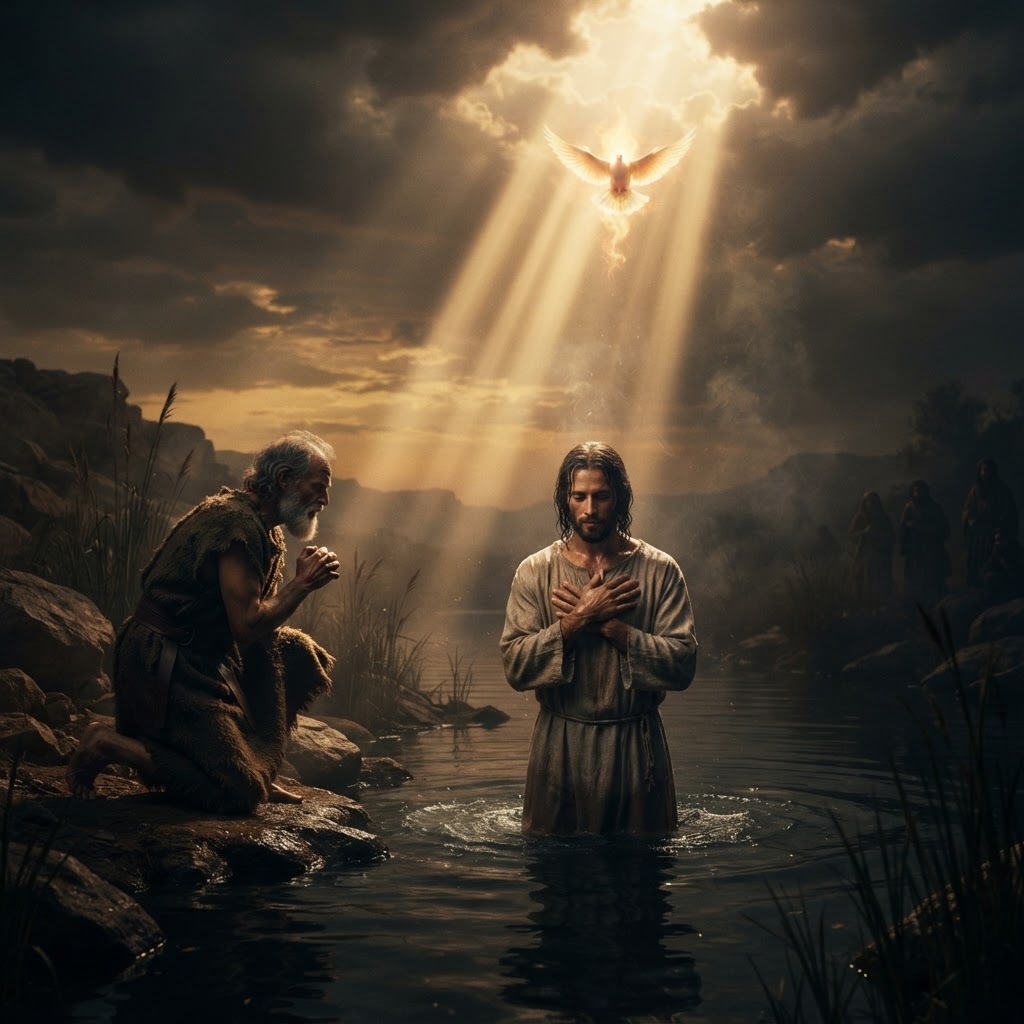
Return to the Original
The Three Who Make Man Three
Man is spirit, soul, and body because God is Father, Son, and Holy Spirit. The image points beyond itself to the uncreated Archetype it was made to mirror.
The Triune GodReferences
- Catechism of the Catholic Church, nn. 362-368 (man, body and soul, spirit and soul)
- Catechism of the Catholic Church, n. 1776-1802 (the conscience)
- St. Thomas Aquinas, Summa Theologiae I, qq. 75-89 (the human soul and its powers)
- St. Thomas Aquinas, Summa Theologiae I-II (habits, virtues, passions)
- St. Augustine, De Trinitate (vestiges of the Trinity in the human soul)
- St. Irenaeus of Lyon, Against Heresies (thewhole man saved - recapitulation)
- Scripture: Genesis 1:26-27; 1 Thessalonians 5:23; Hebrews 4:12; Luke 1:46; 1 Corinthians 6:19-20, 12:4-11, 15:42-52; 1 John 3:2; Ephesians 2:8; 1 Corinthians 1:18
Interpretations follow the hermeneutic of continuity with the perennial Magisterium.