
Catholic Personal Formation · The Liturgy
Understanding the Mass
Every section, element and prayer of the Mass traced back to the Didache, to Justin Martyr and to the first Christians who gathered before dawn — and then explained: what it means, and where your attention is supposed to go.
The Shape It Has Always Had
Acts 2:42, still in act
Luke describes the first Christians as devoting themselves to four things. He was not describing a service — he was describing a life. Every one of the four is still in the Mass, and each of them lives in a particular part of it.
The Liturgy of the Word
The teaching of the apostles
Readings, psalm, Gospel and homily. What the apostles taught, read aloud in the assembly.
The gathering and the peace
The fellowship
Koinonia: one assembly, one greeting, one shared purse for the poor, one peace exchanged.
The Eucharistic Prayer and Communion
The breaking of bread
The name the Mass carried first. Thanksgiving, consecration, fraction, communion.
Collect, universal prayer, Canon
The prayers
The assembly's intercession for the Church, the world, the sick and the dead.
The Mass is therefore not a ceremony the Church invented and has been polishing since. It is the apostolic community's four devotions, given a form, a place and a vestment. What follows goes through the rite as you will hear it this Sunday, part by part.
 I
They were accustomed to meet on a fixed day before dawn and sing responsively a hymn to Christ as to a god.
Pliny the Younger, Letters 10.96 (c. AD 112)
Part I · The Order of Mass
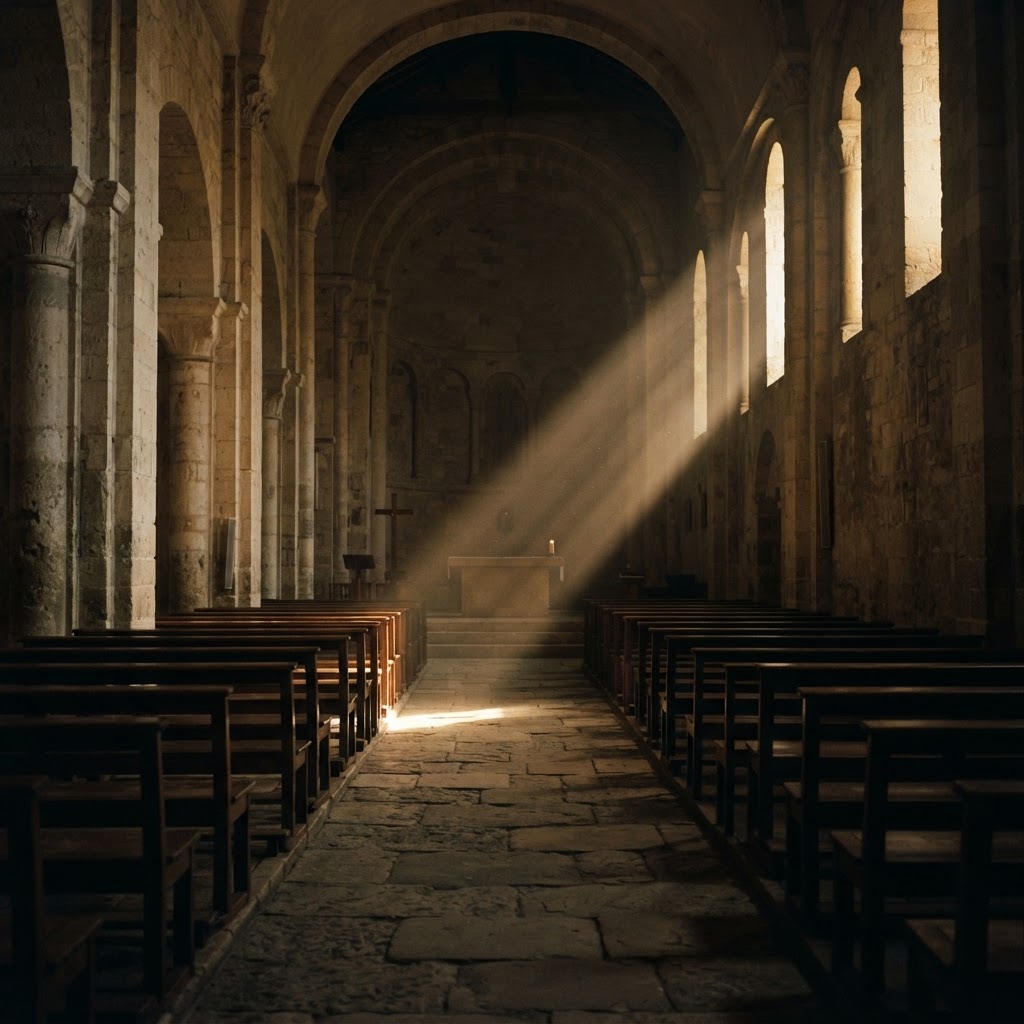
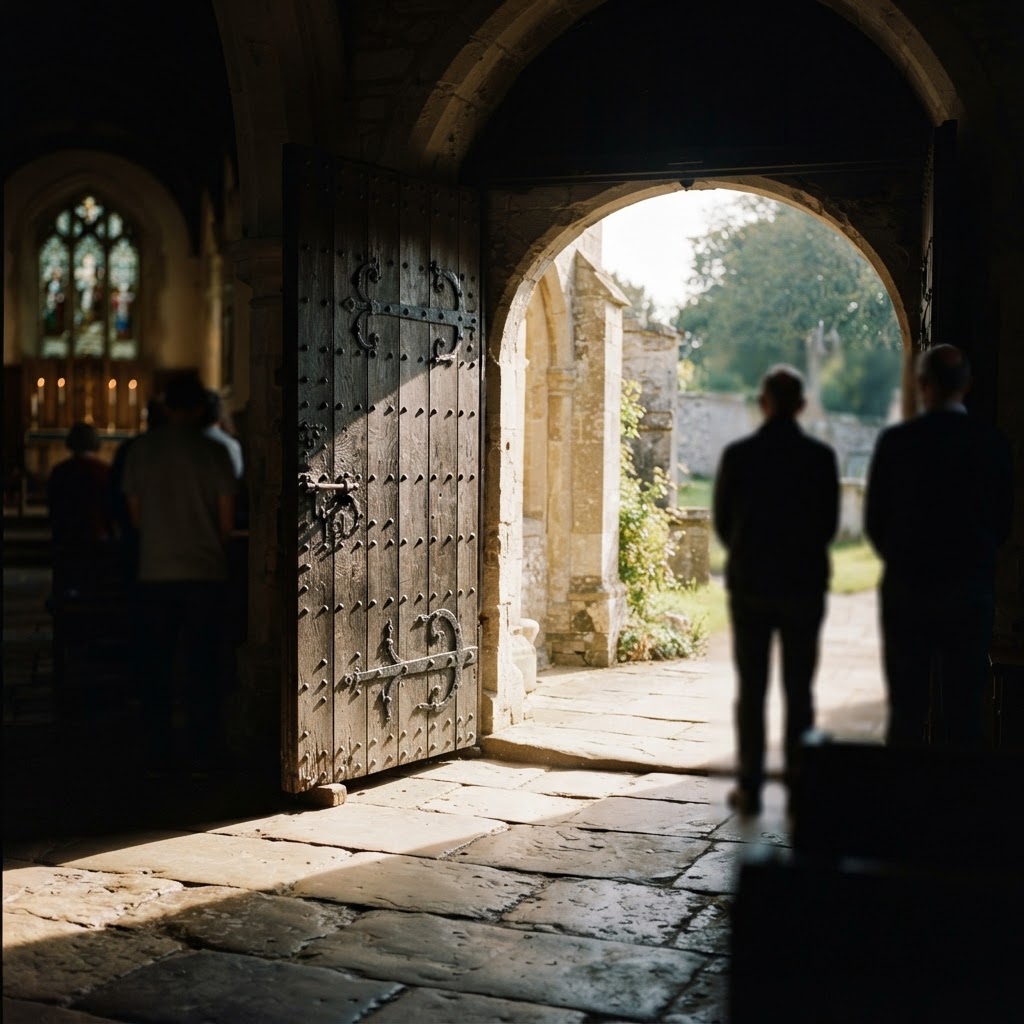
The Gathering
Entrance · Sign of the Cross · Greeting · Penitential Act · Gloria · Collect
What happens now
- The entrance procession, the sign of the cross, and the greeting: “The grace of our Lord Jesus Christ… be with you all.”
- The Penitential Act or the sprinkling of water, the Kyrie, and — on Sundays outside Advent and Lent — the Gloria.
- The collect: one prayer, addressed to the Father, through the Son, in the Holy Spirit, gathering the whole assembly's intention into a single sentence.
Where it comes from
The earliest description of a Christian Sunday we possess already has this shape. Pliny the Younger, writing to Trajan around AD 112, reports that Christians “were accustomed to meet on a fixed day before dawn and sing responsively a hymn to Christ as to a god.” Justin Martyr, around AD 155, describes the assembly coming together in one place. The greeting is older still: “The Lord be with you” runs through Scripture (Ruth 2:4; 2 Thessalonians 3:16) and appears in every ancient liturgy. The Kyrie eleison is a Greek prayer left untranslated in a Latin Church — a living fossil of the centuries when Rome prayed in Greek. The Gloria is a Greek hymn of the second to fourth centuries, long reserved at Rome to the bishop's Mass before it spread to priests.
What it means
The Mass does not begin when the priest reaches the altar; it begins when a scattered people become one assembly. The Greek word for church, ekklesia, means exactly that — a summoned people. Every gesture of the first minutes is doing one thing: turning a room of individuals into a body that can say “we” to God. That is also why the Penitential Act comes first — not to make us feel bad, but because a body cannot be one while its members are still divided from God and from each other.
Where to fix your attention
Arrive early enough to be silent. Let the sign of the cross be the moment you stop being a spectator. Answer the greeting — you are not watching a man perform, you are answering Christ in his minister. And listen to the collect: it holds the whole Mass's intention in one sentence, and it is usually the prayer nobody remembers.
This Sunday: Get there before the bell, and let the first thing you do be silence rather than conversation.
 II
The memoirs of the apostles or the writings of the prophets are read, as long as time permits.
Justin Martyr, First Apology 67 (c. AD 155)
Part II · The Order of Mass
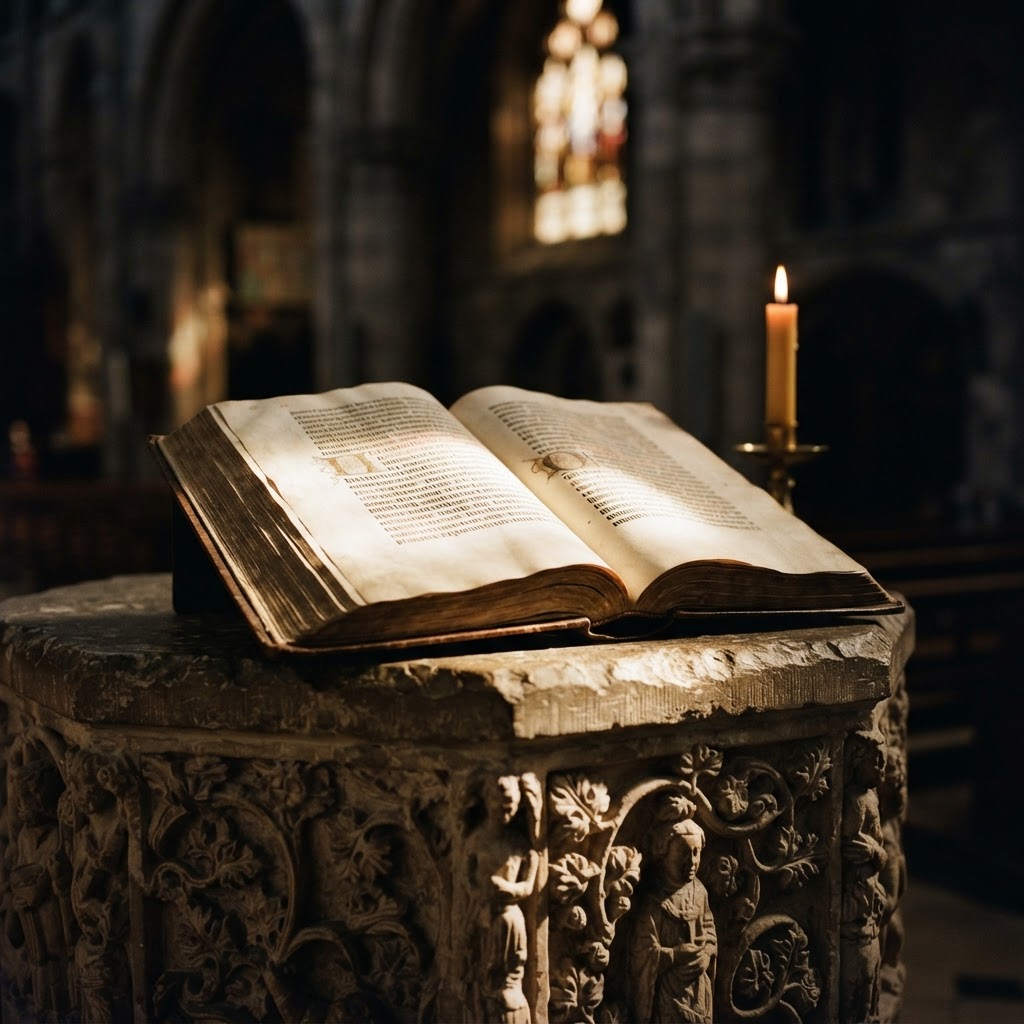
The Liturgy of the Word
First Reading · Responsorial Psalm · Second Reading · Gospel · Homily · Creed · Universal Prayer
What happens now
- First reading, usually from the Old Testament, then the responsorial psalm sung between the readings; the second reading on Sundays.
- The Gospel acclamation, the Gospel read by a deacon or priest, and the homily.
- The Creed on Sundays and solemnities, then the universal prayer — the Prayer of the Faithful — for the Church, the world, the suffering and the dead.
Where it comes from
The first half of the Mass is a Jewish inheritance, and unashamedly so. In the synagogue the Law and the Prophets were read on the Sabbath and expounded (Luke 4:16–21; Acts 13:15). The Church kept the pattern and added the apostolic writings to it. Justin, around 155, says that “the memoirs of the apostles or the writings of the prophets are read, as long as time permits,” after which the president exhorts the people — the homily, already there in the second century. The responsorial psalm preserves the ancient exchange of cantor and congregation. The Creed reached the Roman Mass late, around 1014, though the East had sung it since the fifth century. The Prayer of the Faithful is primitive — Justin describes prayer for all — but it lapsed in Rome for centuries and was restored by the Second Vatican Council.
What it means
In the liturgy God speaks first, and the reading is not a preamble to the homily — the reading is the event. The lectionary is arranged so that, across three years, a Catholic hears most of Scripture, and the readings are chosen to answer one another, the Old Testament usually foreshadowing the Gospel. The assembly stands for the Gospel because Christ himself is speaking: “it is Christ himself who speaks when the holy scriptures are read in the Church” (Sacrosanctum Concilium 7).
Where to fix your attention
Do not bury your head in the missal while the reader reads. Look up and listen as one being addressed. The homily is part of the liturgy, not an interruption to it — expect something from it. And when the universal prayer comes, actually pray it, with a name in mind.
This Sunday: Read the Sunday readings before you arrive, and carry one question in with you.
 III
…he gives praise and glory to the Father of the universe, through the name of the Son and of the Holy Spirit, and offers thanks at considerable length…
Justin Martyr, First Apology 65 (c. AD 155)
Part III · The Order of Mass
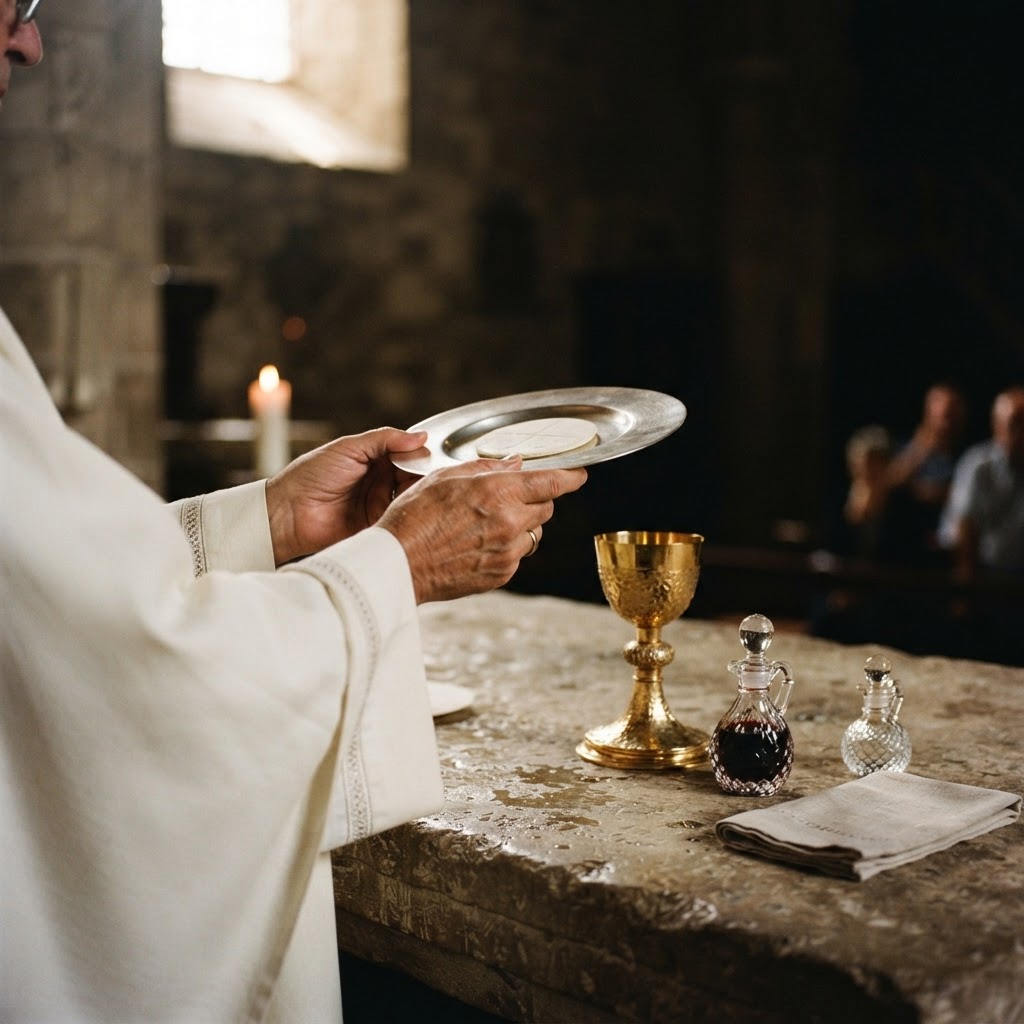
The Preparation of the Gifts
The Collection · Offertory Procession · Washing of Hands · Prayer over the Gifts
What happens now
- The collection, the procession of bread and wine to the altar, and the prayer: “Blessed are you, Lord God of all creation…”
- The washing of the priest's hands — a silent prayer for purity drawn from Psalm 51.
- The prayer over the gifts, and the invitation: “Pray, brothers and sisters, that my sacrifice and yours may be acceptable to God, the almighty Father.”
Where it comes from
In the early Church the people brought their own gifts — bread they had baked, wine they had pressed, oil, produce — so the offertory was a real procession of the community's livelihood, and the surplus went to the poor. Justin, around 155, describes bread and a cup of wine mixed with water being brought to the president, who then gives thanks at length; the Apostolic Tradition, around 215, shows the same offering in the bishop's presence. What is easily missed is that the old Roman rite had almost no offertory prayers at all. The medieval prayers the priest now says quietly (“Suscipe, sancte Pater”) began as his private devotions and were absorbed into the Mass over centuries. The modern translation deliberately recovered the older theology: what is offered is “the work of human hands.”
What it means
Here the Mass becomes specific. Bread and wine are the only things on the altar, and they stand for everything: your week, your work, your money, your body, your unspoken grief. The offertory is the Church's declaration that creation is good enough to be offered to God, and that God will take what is offered and return it as himself. It is also the Church's answer to Cain — worship is only accepted when it comes with a life.
Where to fix your attention
Put something there. The collection is not a fee for a service; it is part of the offering. The washing of hands is not hygiene theatre — the priest is praying Psalm 51 over his own hands. When he asks you to pray that “my sacrifice and yours” be acceptable, he means it: you are a co-offerer, not an audience.
This Sunday: Before the collection, decide what this Mass is offering — a worry, a person, a fault, a thank-you.
 IV
We give you thanks, our Father, for the holy vine of David your servant, which you have made known to us through Jesus your servant. To you be glory for ever.
The Didache 9 (c. AD 100)
Part IV · The Order of Mass
The Eucharistic Prayer
Preface · Sanctus · Epiclesis · Institution Narrative · Anamnesis · Intercessions · Doxology
What happens now
- The Preface — a dialogue, then a burst of thanksgiving that ends with the angels in the Sanctus: “Holy, Holy, Holy…”
- The epiclesis, calling down the Holy Spirit; the institution narrative, the words of Christ over bread and wine; the elevation.
- The anamnesis, the memorial offering; intercessions for the living and the dead; the doxology — “Through him, with him, in him…” — to which you answer Amen.
Where it comes from
This is the oldest thing in the Mass, and the most Jewish. The Didache, written perhaps before the year 100, already gives thanks in eucharistic language: “We give you thanks, our Father, for the holy vine of David your servant.” The Apostolic Tradition, around 215, preserves the earliest complete eucharistic prayer with the institution narrative at its heart. The Sanctus comes from Isaiah 6 and from the synagogue's kedushah — Clement of Rome already quotes the heavenly hymn around AD 96. The great Eastern anaphoras (St James of Jerusalem, St Basil, St John Chrysostom) are contemporaries of the Roman Canon, which reached substantially its present form under Gregory the Great (d. 604) and is quoted by Ambrose around 390. The East Syrian Anaphora of Addai and Mari, still in use, has no institution narrative at all — which is why the Church has thought so carefully about what is essential.
What it means
“Eucharist” means thanksgiving, and this prayer is the Church's great act of it. It is also a sacrifice — not a new immolation but the making-present of the one sacrifice of Calvary (Hebrews 10:12–14). Anamnesis, memorial, is never mere recollection in Scripture: it brings the saving event into the present. That is why the Church can speak of the Lamb of God being on the altar, and equally insist that the Mass adds nothing to the Cross.
Where to fix your attention
Stand at the Sanctus and sing it. The Preface is addressed to the Father, and the whole prayer moves upward — you are meant to be inside that movement, not watching it. The bell at the consecration is a summons to attention, not a cue for your phone. And the great Amen at the doxology is your ratification of everything the priest has just said: say it as though you were signing something.
This Sunday: Pray one line of the Eucharistic Prayer with the priest instead of reading ahead, and let the Amen be the loudest thing you say all week.
 V
Do not pray as the hypocrites do, but as the Lord commanded in his Gospel: Our Father in heaven…
The Didache 8 (c. AD 100)
Part V · The Order of Mass
The Lord's Prayer and the Peace
Our Father · Embolism · Sign of Peace · Agnus Dei
What happens now
- The Our Father, introduced by the priest and prayed by the whole assembly.
- The embolism — “Deliver us, Lord, we pray, from every evil…”
- The sign of peace, then the Agnus Dei as the host is broken.
Where it comes from
The Didache (c. 100) already instructs Christians to pray the Our Father three times a day, making it the oldest datable Christian prayer we possess. It entered the eucharistic liturgy in the fourth century: Cyril of Jerusalem's mystagogical catecheses (c. 350) explain it to the newly baptised as the climax of the rite, and Augustine notes that Rome, unlike the Eastern churches, prayed it only at the Eucharist. Gregory the Great moved it to its present place, immediately before the fraction. The peace is just as ancient — “greet one another with a holy kiss” (Romans 16:16; 1 Corinthians 16:20) — and Justin mentions the kiss before the offering. In Rome it originally came earlier in the rite, and was moved here by Gregory.
What it means
This is the only prayer in the Mass that Christ himself taught, and it is deliberately plural: our Father, our bread, our debts. It cannot be prayed alone without falsifying it, which is why the Church places it here, when the assembly has most fully become one Body. The sign of peace is not a greeting; it is the precondition the Gospel sets for prayer itself — “if you are offering your gift at the altar and there remember that your brother has something against you, leave your gift… be reconciled” (Matthew 5:23–24). Peace is asked for, given, and only then shared, in that order.
Where to fix your attention
Say the Our Father slowly enough to notice the petition you would rather skip — “forgive us our trespasses as we forgive.” Then make the sign of peace to the person nearest you, including the one you have not spoken to since last year. The Agnus Dei is not background music: it is the Baptist's words in John 1:29, being said to the Lamb now present on the altar.
This Sunday: Before the peace, name one person you need to forgive, and offer this Mass for them.
 VI
Make your left hand a throne for your right, since the right is to receive the King… then bow your hand and say Amen.
Cyril of Jerusalem, Mystagogical Catechesis 5 (c. AD 350)
Part VI · The Order of Mass
Holy Communion
Fraction · Behold the Lamb of God · Communion Procession · Silence · Prayer after Communion
What happens now
- The fraction — the breaking of the host — accompanied by the Agnus Dei, and the priest's “Behold the Lamb of God…”
- The communion procession, each communicant answering “Amen” to “The Body of Christ.”
- Silence afterwards, the ablutions, and the prayer after communion.
Where it comes from
The Mass was first called “the breaking of bread” (Acts 2:42, 46), and the Didache calls the Eucharist “the broken bread.” The fraction was so central that the rite was named for it, and in the early Church a single loaf was broken and shared. Cyril of Jerusalem, around 350, describes communion gesture by gesture — how to hold your hands, how to answer — and Justin already records the people's Amen around 155. The Agnus Dei entered the Roman rite in the seventh century under Pope Sergius I. Communion under both kinds was the ancient norm, narrowed in the West between the twelfth and fourteenth centuries and widely restored after Vatican II. Frequency collapsed and was rebuilt: Lateran IV (1215) required communion at Easter, and Pius X (1905) urged frequent and even daily communion.
What it means
Communion is not a reward for the worthy, nor a symbolic gesture. It is the Body and Blood of the risen Christ, given so that the receiver becomes what he receives — Augustine's line is exact: “Behold what you are; become what you receive.” Paul draws the consequence: “because there is one bread, we who are many are one body” (1 Corinthians 10:17). It also explains the Church's discipline — the fast, the state of grace, confession before grave sin — which is not exclusion for its own sake but a refusal to pretend that this is ordinary food.
Where to fix your attention
Prepare: the fast is an hour, the confession is the real preparation. Walk up as someone approaching a person, not as a queue. Answer “Amen” to “The Body of Christ” as an act of faith rather than a formula. Then stay. The silence after communion is the most neglected minute in the Catholic world, and it is where communion becomes prayer.
This Sunday: Do not leave the pew for two minutes after communion. Say nothing. That is the point.
 VII
The liturgy is the summit toward which the activity of the Church is directed; at the same time it is the font from which all her power flows.
Sacrosanctum Concilium 10 (1963)
Part VII · The Order of Mass
The Dismissal
Blessing · Ite, Missa Est · Final Procession
What happens now
- The blessing, given in the name of the Trinity.
- The dismissal — “Ite, missa est,” or “Go and announce the Gospel of the Lord.”
- The final procession, and the church emptied back into the street.
Where it comes from
The very word Mass comes from this line. In the fourth century missa simply meant a dismissal; “Ite, missa est” was what sent the catechumens away before the Eucharist and the faithful away after it, and by degrees the word migrated from the dismissal to the whole rite. The blessing is rooted in the Aaronic benediction (Numbers 6:24–26). At Easter the dismissal is doubled with an alleluia, and in the Byzantine liturgy the deacon's final command is simply “Let us go forth in peace.” The reformed Missal added further dismissals after the Council, each of which turns the departure into a commission.
What it means
The last word of the Mass is a sending, not a release. Ite is plural: go, all of you. The congregation is not dismissed from church as from a performance; it is dispatched into the world as what it has just become — the Body of Christ, scattered. That is why this is the only part of the Mass that names the whole vocation of the baptised: everything before it was receiving, and this is giving.
Where to fix your attention
Do not look at your watch. The Mass is not over when the priest leaves the sanctuary; it is over when you have left and begun acting like someone who has eaten the Bread of Life. Ask on the way out: what did I receive, and what will I do with it before next Sunday?
This Sunday: Leave with one intention for the week, and have done it before Wednesday.
From the Didache to the Missal
How the rite evolved
No single generation wrote the Mass. It grew the way a tree grows — an apostolic core, then centuries of controversy, reform and recovery, with the seams still visible if you know where to look.
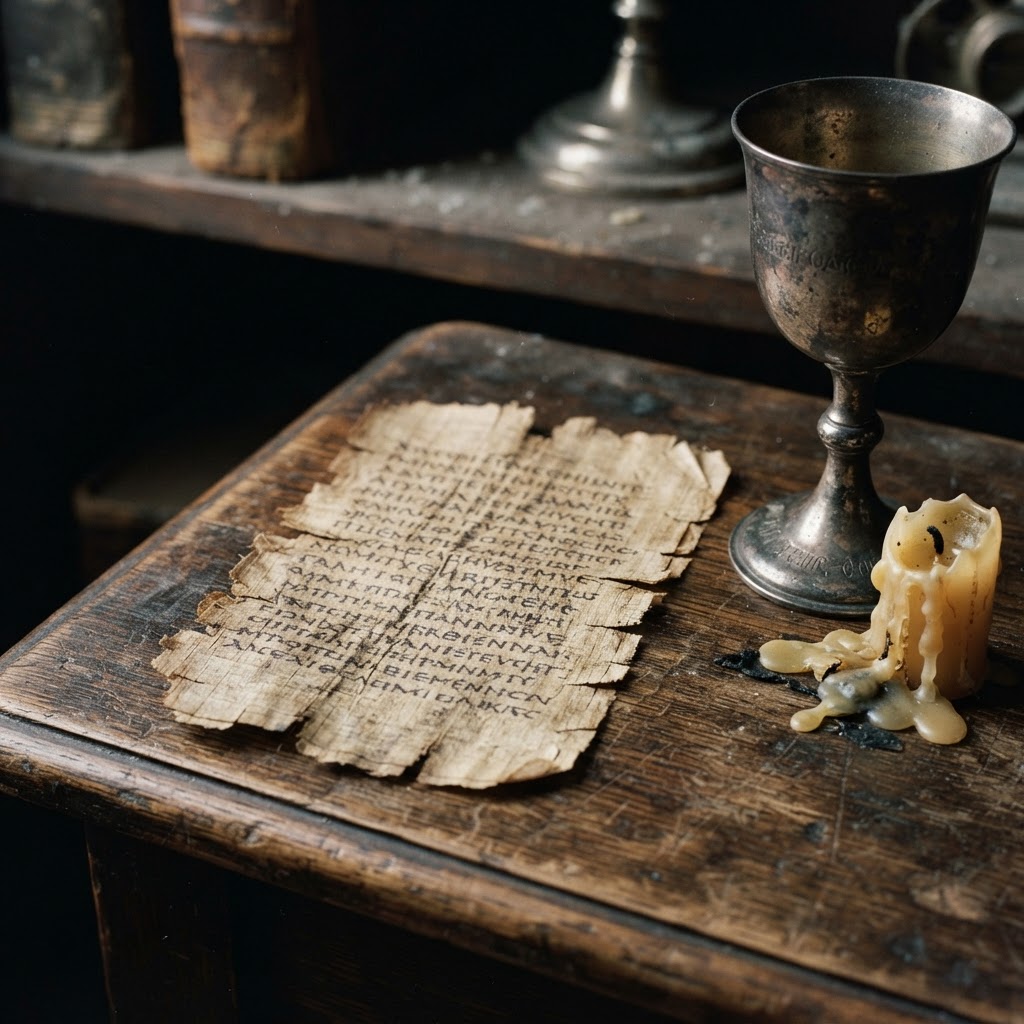
c. AD 55
Paul writes to Corinth
1 Corinthians 10–11 gives the earliest description of a eucharistic assembly we have, and hands on the institution narrative as tradition already received. “You cannot drink the cup of the Lord and the cup of demons” — already the Church took the rite with absolute seriousness.
c. AD 100
The Didache
The oldest surviving church order: prayers of thanksgiving over the cup and the broken bread, confession before communion, a warning against the unbaptised sharing the meal, and the command to gather on the Lord's day and break bread.
AD 112
Pliny interrogates Christians
An outsider's evidence. The Roman governor reports to Trajan that Christians met before dawn to sing to Christ “as to a god,” and bound themselves by an oath not to steal, commit adultery or betray a trust — then reassembled to eat a harmless meal.
AD 155
Justin Martyr describes Sunday
First Apology 65–67 gives the first complete order of the Mass: readings and homily, prayers, the kiss of peace, bread and wine brought to the president, a lengthy thanksgiving, the people's Amen, communion, and a collection for orphans and widows.
c. AD 215
The Apostolic Tradition
The earliest complete eucharistic prayer we possess, with the institution narrative at its centre, together with the ordination prayers and the three baptismal questions. The shape of the Roman Canon is already visible.
c. AD 350
Cyril of Jerusalem teaches the newly baptised
The Mystagogical Catecheses explain the rites they had just experienced — the washing of hands, the epiclesis, receiving in the hand, the Amen. The first ‘explanation of the Mass’ in the Church's literature.
c. AD 390
Ambrose quotes the Roman Canon
In De Sacramentis the Bishop of Milan gives the Roman eucharistic prayer almost word for word as his church uses it — evidence that the Canon was already substantially fixed before Gregory the Great.
d. AD 604
Gregory the Great
The Roman Canon reaches its final shape, the Our Father is moved to just before the fraction, and the Roman liturgy begins to be exported to England and beyond — the rite that will shape the Latin West.
AD 1014
The Creed enters the Roman Mass
Five centuries after the East, Rome begins to sing the Creed at Mass, under Pope Benedict VIII — a reminder that the Mass of ‘today’ was never a single deposited form but an inheritance continually received.
AD 1215
The Fourth Lateran Council
The word transubstantiation enters a council's vocabulary; annual confession and Easter communion are required of every Catholic. The vocabulary was new; the faith it protected was not.
AD 1570
The Missal of Pius V
After Trent, one Roman Missal is standardised for the whole Latin Church — the rite of ‘the Mass of the ages’ that would remain essentially unchanged for four centuries.
1905
Pius X on frequent communion
Centuries of infrequent communion are reversed by a decree urging frequent — even daily — reception, and lowering the age of first communion. The Eucharist moves from spectacle back toward food.
1963–1970
Vatican II and the new Missal
Sacrosanctum Concilium is the Council's first document. The vernacular, the Prayer of the Faithful restored, the three-year lectionary, a fuller use of Scripture, the sign of peace, the homily: a reform argued not as novelty but as recovery.
2011
The new English translation
The third typical edition is translated to draw closer to the Latin — “consubstantial,” “oblation,” “and with your spirit” — a deliberate reminder that the liturgy is received, not composed.
One thing worth remembering
Every age of the Church has had the same temptation: to treat the Mass as something happening at the front while we watch. The Didache, Justin, Cyril and the councils all assume the opposite — that the people are the ones offering, answering, receiving and being sent. The rite has changed in language, music and gesture. That has not.
Reading this with a Protestant friend? There is a companion edition written for them: The Mass, read from the first century.
Keep going
The Sacramental Life
The Mass is the greatest of seven sacraments. See how baptism, confession and anointing all flow toward and from this altar.
OpenThe Eucharist — Formation Study
The doctrine behind what you have just read: Real Presence, sacrifice, the Jewish roots and the Fathers on the Bread of Life.
OpenThe Apostles' Creed
The Creed you profess after the Gospel, article by article — with the history of each line.
OpenThe Seat of Peter
Why the Mass is offered in communion with a bishop, and where that structure came from.
OpenSources & further reading