
The Wormtongue Effect
A Prophetic Word on Deception at the Heart of the Church — Argued from Scripture, Dogma and the Witness of the Saints
Nine propositions, each stated, grounded, and drawn to its conclusion. What the enemy does to a Church is rarely done by force; it is done by a voice inside the hall that sounds like counsel.
This is a theological argument and a prophetic exhortation, not a new revelation. It adds nothing to the deposit of faith; it applies what the Church already believes to the hour she is in, and it is submitted to her judgement.
The Image and the Claim
What the Wormtongue Effect Is
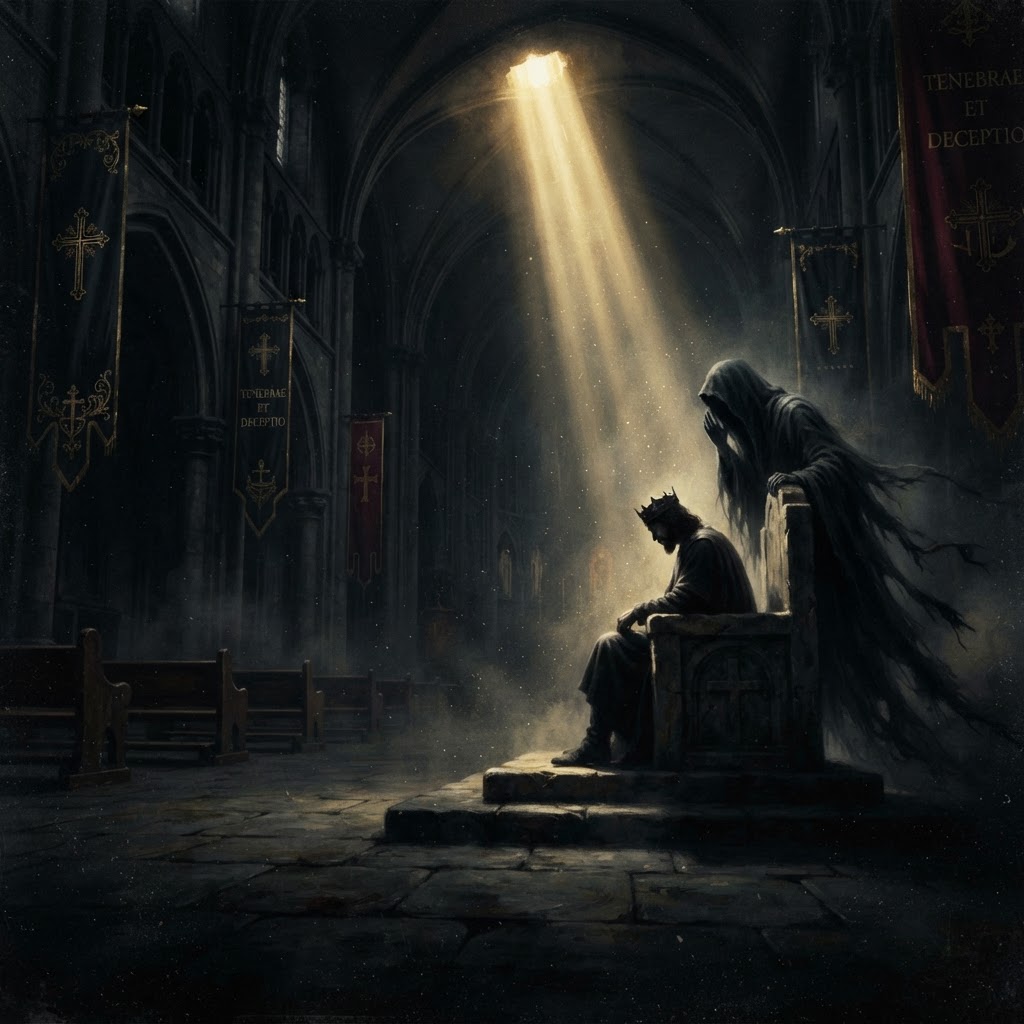
In The Lord of the Rings, King Théoden of Rohan sits upon his throne, and he is still king. His crown is on his head, his hall is standing, his people remain loyal. What has been taken from him is not his authority but his sight. Gríma Wormtongue sits at his ear and speaks: flattery, half-truth, a counsel that sounds like prudence and is in fact captivity. Théoden's will was never seized by force — it was borrowed, a sentence at a time.
The image is not revelation and it is not an allegory in which every figure stands for a person. It is a diagnostic image, of the kind the Church has always permitted: the way a parable or an icon lets a truth be seen whole before it is argued in parts. Its worth is decided by whether what it depicts corresponds to what Scripture actually says about how souls and churches are undone. It does.
The Claim
The Wormtongue effect is the strategy of the enemy against the Church in this age: not to destroy her by assault from without, but to cloud her sight from within, so that a Church still visibly standing becomes practically silent about the one thing she exists to say.
That claim rests on three propositions, and everything that follows in this study depends upon them.
The primary weapon is deception, not persecution.
Persecution kills the body and multiplies the Church; deception kills the faith of the body and leaves the Church standing, dressed and empty. Christ named the enemy's nature exactly: “a murderer from the beginning… a liar and the father of lies” (John 8:44).
The target is the throne — the Church's clarity in teaching.
Not because the office is corrupt, but because the shepherd's sight governs the flock's direction. Strike the shepherd's clarity and the sheep scatter without a single blow being struck against them (Zechariah 13:7; Matthew 26:31).
The spell breaks only from outside the enchanted room.
A deceived mind cannot reason its way out of its own deception, because its reasoning is what has been captured. Deliverance comes by a word with authority — Christ's word, spoken through the Church He authorised (Mark 1:25-27; Matthew 16:19).
If these three hold, then the Church's crisis in this hour is not chiefly a crisis of resources, reputation or politics. It is a crisis of sight — and sight is not recovered by strategy but by obedience to the truth.
The Scriptural Pattern
The Grammar of the Serpent
What Gríma does to a king, the serpent did first to a woman — and Scripture records the exchange in enough detail to be studied as a method rather than merely mourned as a disaster. Genesis 3:1-5 is the Church's primary text on deception, and every later counterfeit repeats its grammar. Three movements, in order.
He questions the word
Genesis 3:1“Did God say, ‘You shall not eat of any tree in the garden’?”
The first move is not a contradiction but a question — and a distorted quotation. Nothing has yet been denied; only distance has been introduced between the soul and the word addressed to it. Every later deception begins here, with the suggestion that what God said may not be quite what He meant.
He removes the consequence
Genesis 3:4“You will not surely die.”
Having loosened the word, he denies its judgement. Mercy is detached from truth and the warning is recast as a threat, so that God is heard as a restrainer rather than a Father. This is the direct ancestor of every Christianity in which nothing is at stake.
He displaces the worshipper
Genesis 3:5“You will be like God, knowing good and evil.”
The final move offers the creature the Creator's own prerogative: to determine what is good. This is not merely a moral slip but a transfer of authority — the source of every ideology that arrives announcing a new humanity, and of the private judgement that sets the individual above the Church.
The mechanism: deception works through desire, not argument alone
Note what Genesis does not say. It does not say the woman was argued into unbelief. It says the fruit was “good for food, and… a delight to the eyes, and… to be desired to make one wise” (Genesis 3:6) — and that the serpent's proposition became credible because it was desirable. John names the same threefold structure as the concupiscence of the flesh, the concupiscence of the eyes, and the pride of life (1 John 2:16).
This is decisive for pastoral discernment. Deception is not overcome by information alone, because it did not enter through ignorance alone. It entered through love — a love turned from its object. Which is why the remedy Scripture prescribes for a deceived Church is never better data but repentance, and why the first word of the Gospel is not explanation but metanoia.
“But I am afraid that as the serpent deceived Eve by his cunning, your thoughts will be led astray from a sincere and pure devotion to Christ… And no wonder, for even Satan disguises himself as an angel of light.”
The disguise: light, not darkness
Paul's warning to a healthy, growing, gifted church is not that a wolf will come snarling but that a false apostle will come looking like an apostle — and that this should surprise no one, since the enemy's own mode is the angel of light. Error in the Church does not present itself as error. It presents as enlightenment, as compassion, as maturity, as finally taking the Gospel seriously.
This is why the counterfeit is so effective in every generation and why our Lord's own prophecy is not that false teaching will be obvious but that it will be persuasive enough to endanger “even the elect” (Matthew 24:24). Christ also described the method in a single image: the enemy sows weeds among the wheat, at night, and lets them grow together (Matthew 13:25-30). Deception is not an invasion across a border; it is a sowing inside a field.
The Wormtongue effect is not a novel threat requiring a novel response. It is the serpent's grammar, repeated. The Church's defence is therefore equally ancient: hold the whole word of God, love the truth more than its convenience, and stay inside the field where the wheat is being grown.
The Strategy
Why the Throne, and Not the Villages
Saruman does not begin with the villages of Rohan. He begins with the king, because the villages are downstream of the king. The military logic is obvious; the theological logic is sharper. Scripture knows this pattern precisely, and it is God Himself who names it.
“Awake, O sword, against my shepherd… strike the shepherd, and the sheep will be scattered.”
The pattern is real — and Christ applied it to Himself
On the night of His arrest, our Lord quoted this very verse and told the disciples it referred to Him: “You will all fall away because of me this night; for it is written, ‘I will strike the shepherd, and the sheep of the flock will be scattered’” (Matthew 26:31). This is a matter of the greatest consequence. The scattering of the flock by a struck shepherd is not merely a diabolical tactic that we fear; it is a providential pattern that God permitted to fall upon His own Son.
And He did not leave it there. In the same breath: “But after I am raised up, I will go before you to Galilee” (Matthew 26:32). The scattered sheep are gathered — not by their own return, but by the Shepherd going ahead of them. Whatever the enemy intends by striking the shepherd, God has already made that strike the place where the flock is saved. This is why the Church may speak of her own crisis with grief but never with despair.
The danger is internal, and it is doctrinal
Paul's farewell to the Ephesian elders is the most precise description of the threat in the New Testament, and it is addressed to pastors: “I know that after my departure fierce wolves will come in among you, not sparing the flock; and from among your own selves will arise men speaking perverse things, to draw away the disciples after them” (Acts 20:29-30). Two sources — outside and inside — and one method, which is not violence but teaching: “speaking perverse things.”
The same diagnosis runs through the pastoral epistles: doctrines of demons delivered by deceitful spirits (1 Timothy 4:1); teachers accumulated because they say what ears itch to hear (2 Timothy 4:3); a faith shipwrecked not by persecution but by “profane chatter” (1 Timothy 6:20-21). The New Testament is far more anxious about the Church's doctrine than about her enemies' power — because her enemies' power cannot prevail against her, while her own unfaithfulness can wound her terribly.
Ezekiel's indictment: the shepherd who feeds himself
Where the shepherds fail, God does not console the flock with a lower standard; He indicts the shepherds and then announces that He will come Himself: “Woe to the shepherds of Israel who have been feeding themselves! Should not the shepherds feed the sheep?” (Ezekiel 34:2). And then: “I myself will be the shepherd of my sheep” (34:15) — a promise Christ applies to Himself in the tenth chapter of John, where He is the shepherd who lays down His life.
This gives the Church an exact standard by which to test her own preaching, and it is uncomfortable. A shepherd feeds himself when his ministry is ordered to his own standing, comfort, relevance or advancement. That is the internal condition on which the Wormtongue spirit thrives — not because a shepherd becomes a monster, but because he becomes occupied with something other than the flock's food.
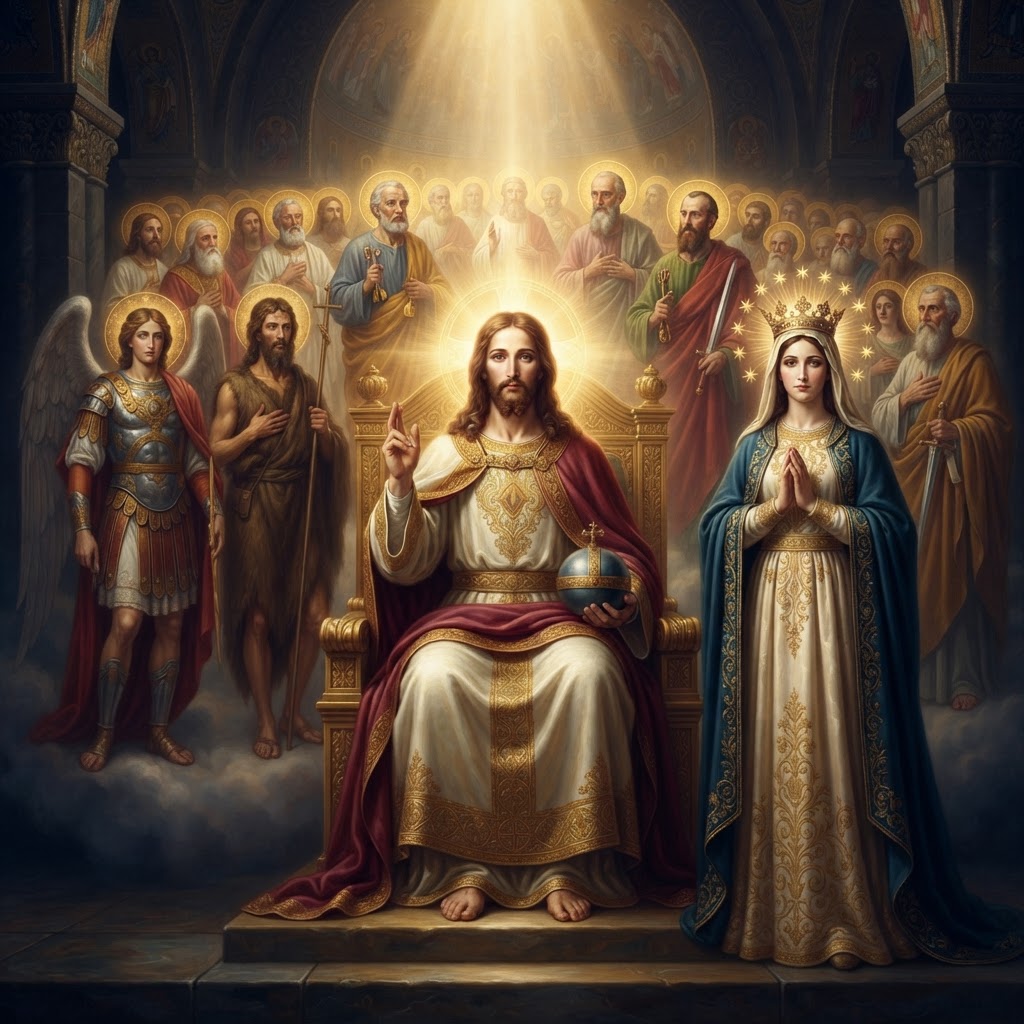
We guard the throne because we love the sheep. And we guard it without fear, because the Shepherd who was struck for us has already gone ahead of the scattered flock to Galilee — and the gates of hell have not prevailed against the Church He built on the rock (Matthew 16:18).
The Diagnostics
Anatomy of the Whisper
If deception is the weapon, the Church needs a description of the weapon — not a mood of suspicion but a set of recognisable marks, so that a voice can be examined rather than merely disliked. Scripture supplies five, and they are cumulative: any one of them may appear in honest teaching, but the counterfeit carries several at once, and always the last.
It is derivative
The counterfeit never begins by denying Scripture; it begins by quoting it. In the wilderness the tempter cites Psalm 91 (Matthew 4:6). Deception in the Church almost always wears the form of the Word while emptying its sense — which is why a text can be adduced for nearly every error ever taught.
It is partial
A half-truth is not half-safe. Heresy is rarely a flat contradiction; it is one true thing inflated until it crowds out the whole — mercy without judgement, dignity without sin, community without creed. “A little leaven leavens the whole lump” (Galatians 5:9).
It flatters
“You will be like God.” The whisper is always agreeable; it tells the hearer what he already wishes to be true. Paul describes the pattern exactly: teachers chosen because “they will accumulate for themselves teachers to suit their own likings” (2 Timothy 4:3).
It works by increments
The king was not overthrown in an hour. Deception proceeds by redefinition rather than assault: a word is softened, then a doctrine is left unmentioned, then its denial becomes respectable. Newman's observation has never been improved on — no doctrine is defined by the Church until it has first been violated by her children.
It isolates
Gríma's subtlest act was not the lie but the quarantine: he cut the king off from Éomer, from the hall, from all counsel but his own. Spiritually, this is the oldest tactic in the manual — sever the member from the body, and the member loses the body's capacity to correct him (Hebrews 10:25; Acts 15:6).
How the whisper sounds in this hour
These are patterns, not accusations. No individual is named here, because the Church's warfare is “not against flesh and blood” (Ephesians 6:12) and because the same whisper has found a hearing in every one of us. Each pattern is given with the truth that answers it — the answer is always a Person, and never merely a correction.
Christological reduction
“Preach the man, not the Lord.”
The truth that answers it
Christ may be admired as teacher and exemplar while His Lordship, His atonement and His exclusivity are quietly retired. But the apostolic preaching was not “Jesus was wise”; it was “Jesus is Lord” (1 Corinthians 2:2; Romans 10:9; John 14:6).
Mercy without repentance
“Mercy means never asking anyone to change.”
The truth that answers it
The Lord said to the woman taken in adultery, “Neither do I condemn you; go, and do not sin again” (John 8:11). He joined pardon to conversion in a single sentence. A mercy that omits the second half is not the mercy of Christ; it is indifference wearing His name.
Kingdom without eschaton
“The kingdom is a project we can complete.”
The truth that answers it
The Catechism names this as the shape of the final deception: an “apparent solution to their problems at the price of apostasy from the truth” (CCC 675). The Church's hope is not a programme that succeeds within history but a Lord who returns (CCC 676).
Ecclesial self-erasure
“The Church must apologise for what she is.”
The truth that answers it
There is a holy humility that confesses the sins of her members, and a quite different thing that repudiates her own constitution — the Cross as folly, the sacraments as superstition, the priesthood as clericalism. “We preach Christ crucified, a stumbling block… the power of God” (1 Corinthians 1:23-24).
Sentimentality in place of faith
“God only ever affirms.”
The truth that answers it
The first lie in Scripture was “You will not surely die.” A god who never judges is not merciful; he is fictional, and he cannot forgive, because forgiveness presupposes that something real is owed (Hebrews 10:31; Revelation 3:19).
The Claim
No single one of these patterns is the great apostasy; together they form a climate. A Church breathing this air for two generations can keep every structure intact and still lose the sentence she was sent to say.
The marks are given so that we may examine ourselves first — “let anyone who thinks that he stands take heed lest he fall” (1 Corinthians 10:12) — and only then the teaching we are offered. Suspicion is not discernment; the difference is repentance.
The Dogmatic Ground
The Final Deception and the Boundary of the Promise
A prophetic word is only as trustworthy as the doctrine that carries it. What has just been described as a pattern of deception is not a private intuition about our times; it is an article of the Church's eschatology, taught in Scripture and named in the Catechism. Two things must be held together here — the reality of the final trial, and the limit set upon it — because to hold only the first produces panic, and only the second produces complacency.
“Let no one deceive you in any way; for that day will not come, unless the rebellion comes first, and the man of lawlessness is revealed… The coming of the lawless one by the activity of Satan will be with all power and with pretended signs and wonders, and with all wicked deception for those who are to perish, because they refused to love the truth and so be saved.”
Apostasy is an interior defection
The Greek word behind “rebellion” is apostasia — a departure, a standing-away. Paul does not describe an army at the gate; he describes a defection from within, and he locates its cause with chilling precision: “they refused to love the truth.” Not that they were unable to find it. That they declined to love it. This is the Wormtongue effect stated as dogma: the tragedy is not that the truth became unavailable but that it became unwelcome.
Paul therefore gives the Church a single, unglamorous prescription in the same chapter: “stand firm and hold to the traditions which you were taught by us” (2 Thessalonians 2:15). In the face of the great deception, the apostolic answer is not cleverness. It is fidelity.
The Catechism names the form of the trial
The Church has spelled this out with a precision that should end all speculation about what the final trial will look like. It will not be primarily an assault on her buildings or her liberty. It will be a religious deception — and its distinguishing mark is that it will appear to solve real human problems.
Before Christ's second coming the Church must pass through a final trial that will shake the faith of many believers. The persecution that accompanies her pilgrimage on earth will unveil the “mystery of iniquity” in the form of a religious deception offering men an apparent solution to their problems at the price of apostasy from the truth.
The Antichrist's deception already begins to take shape in the world every time the claim is made to realize within history that messianic hope which can only be realized beyond history through the eschatological judgement. The Church has rejected even modified forms of this falsification of the kingdom to come.
The Church will enter the glory of the kingdom only through this final Passover, when she will follow her Lord in his death and Resurrection. The kingdom will be fulfilled, then, not by a historic triumph of the Church through a progressive ascendancy, but only by God's victory over the final unleashing of evil.
The boundary: trial, not defeat
Here the argument must be protected from its own exaggeration. The same Lord who foretold a trial also promised that “the gates of hell shall not prevail” against the Church (Matthew 16:18), and prayed for Peter that his faith might not fail and that he might strengthen the brethren (Luke 22:32). He promised the Spirit who “will guide you into all the truth” (John 16:13).
The promise is therefore precise, and it is narrower than we sometimes wish: it guarantees that the Church will not defect from the faith, not that every one of her ministers will be personally faithful, prudent or brave. The indefectibility of the Church and the frailty of her members are both true at once. This is exactly why the enemy's strategy is aimed where it is: he cannot destroy the Church, so he attempts to make her inarticulate — to wound her credibility, cloud her teaching, and scatter her children.
And the Catechism insists on the manner of her passage through it: “through this final Passover” (CCC 677). The way out is not around the Cross but through it. Which means the Church's hope in this hour is not that she will become influential again, but that she will be faithful again.
What this doctrine does not license
It does not license the claim that the Pope is the Antichrist, that the Church has already fallen, or that private discernment may sit in judgement over the successors of the apostles. Nor does it license the naming of living persons as agents of the deception. The moment a prophetic word begins to identify enemies rather than sins, it has stopped doing the Holy Spirit's work and started doing the accuser's, who is called “the accuser of our brethren” (Revelation 12:10).
Because the trial is certain, watchfulness is not pessimism but obedience. Because the promise is certain, that watchfulness is free of fear. The Church will pass through the fire; she will not be consumed by it.
The Method
Testing the Spirits
A warning that cannot be tested is not prophecy; it is atmosphere. Scripture does not leave the Church with an impression that something is wrong — it commands an examination and gives the criteria: “Beloved, do not believe every spirit, but test the spirits to see whether they are of God” (1 John 4:1). Five tests follow, in the order the Church has traditionally applied them. They are to be applied to teaching, to movements, to the words of visionaries, and — first and hardest — to ourselves.
The Christological test
1 John 4:2-3; 1 Corinthians 12:3Does this make Christ greater, or smaller?
Every spirit that comes from God confesses Jesus Christ come in the flesh, crucified and risen, Lord of all. Any teaching whose practical effect is to make Him optional, one option among many, or merely exemplary has already failed at the first hurdle.
The apostolic test
Galatians 1:8-9; Acts 2:42Is this the faith once delivered, or a novelty?
The Gospel does not develop by substitution. Even an angel from heaven is not permitted a different gospel. Novelty is not in itself proof of error — the Church's dogma has deepened — but a claim that contradicts what has always been believed everywhere is not development; it is another thing.
The soteriological test
Acts 4:12; 1 Corinthians 15:3-4Where does it locate salvation?
If salvation is located in Christ's cross and resurrection, received by repentance and faith in the sacraments, the teaching is at least on the map. If it is relocated into politics, therapy, social progress or self-realisation, then something has been substituted — however warm its language.
The test of fruits
Matthew 7:16-20; Galatians 5:19-23What does it produce over time?
Not the fruit of the first enthusiasm but the fruit of a decade: repentance, humility, chastity, charity, reverence, perseverance — or pride, appetite, division and contempt for the simple faithful. A tree is known by what grows on it, not by what is promised.
The test of communion
1 Thessalonians 5:19-21; Matthew 18:17; Luke 10:16Does it submit to the Church's judgement?
Private judgement is precisely the mechanism by which the whisper isolates its hearer. The Spirit's gift of discernment is given to the Church, and the test of a genuine prophet is not the intensity of his conviction but his willingness to be judged by the body he claims to serve.
The Claim
The five tests are not a checklist for condemning others but a grammar for hearing. Applied honestly, they almost always indict the hearer before they indict the speaker.
Two practical observations complete the method. First, discernment is a gift given to the Church and exercised in communion: the model is the council of Jerusalem, where a disputed question was settled not by the sharpest individual but by the apostles and elders together, in prayer, and with the judgement “it has seemed good to the Holy Spirit and to us” (Acts 15:28). Second, the test of a teaching is not its emotional register. A word can be delivered in perfect calm and be poison, or delivered in clumsy heat and be true; the fruit of the Spirit is not a tone of voice.
Where a teaching makes Christ smaller, contradicts the apostolic faith, relocates salvation, produces corruption over time, or refuses the judgement of the Church — there the whisper has been identified. And identification is already the beginning of deliverance.
The Remedy
The Breaking of the Spell
Every account of deception in Scripture is followed by an account of deliverance, and the deliverance is never self-administered. Gandalf does not negotiate with Gríma and does not appeal to Théoden's better judgement — he commands, and the king is freed by a word that stands outside the enchantment. The theology here is exact: a will held captive cannot release itself. “If the Son makes you free, you will be free indeed” (John 8:36).
“And immediately there was in their synagogue a man with an unclean spirit; and he cried out… And Jesus rebuked him, saying, ‘Be silent, and come out of him!’… And they were all amazed… ‘He commands even the unclean spirits, and they obey him.’”
The word has authority because the Speaker is sent
What astonishes the synagogue is not the content of the teaching but its authority — an authority that commands and is obeyed. Our Lord then explains the mechanism of that authority in a single sentence: “No one can enter a strong man's house and plunder his goods, unless he first binds the strong man” (Mark 3:27). The strong man has been bound, and that binding happened at a specific place in history — the Cross.
“He disarmed the principalities and powers and made a public example of them, triumphing over them in him” (Colossians 2:15). And again: “that through death he might destroy him who has the power of death, that is, the devil, and deliver all those who through fear of death were subject to lifelong bondage” (Hebrews 2:14-15). The defeat of the deceiver is not a future hope awaiting our strategy. It is an accomplished fact awaiting our proclamation.
That authority is exercised through the Church He authorised
The commission is as concrete as the authority. “I will give you the keys of the kingdom of heaven, and whatever you bind on earth shall be bound in heaven” (Matthew 16:19). “If you forgive the sins of any, they are forgiven” (John 20:23). “Let him call for the elders of the church, and let them pray over him… and if he has committed sins, he will be forgiven” (James 5:14-15).
This is why the Church's remedy for a clouded age is not a rebrand but the sacraments. Confession is the un-enchantment of a person: sin named, absolution spoken, the spell broken by a word from outside the room. A Church that recovers confession recovers clarity faster than a Church that recovers communications. The ministry of exorcism, rare and carefully governed, exists for the same reason: the Church still speaks to the darkness in her Lord's name and is still obeyed.
The defenders of the throne
And the Church is not left with only a formula. She is given persons. The Holy Spirit is the Spirit of truth, sent to guide her into all truth and to glorify not Himself but Christ (John 16:13-14). The Blessed Virgin is the woman of Genesis 3:15 whose offspring strikes the serpent's head, the woman of Revelation 12 against whom the dragon wages war, and — in the plainest theological terms — the one whose obedience reversed Eve's dissent: “Behold, I am the handmaid of the Lord; let it be to me according to your word” (Luke 1:38). Where Eve listened to a whisper against the word, Mary listened to the word and conceived it.
And the saints: “they have conquered him by the blood of the Lamb and by the word of their testimony” (Revelation 12:11). The Church's answer to a whispering age is a cloud of witnesses who did not whisper back but testified — many of them to the point of blood. This is the company into which every Christian is baptised, and the reason no believer is ever as alone as the whisper insists he is.
The spell is broken by Christ's word, applied through Christ's Church, in the company of Christ's people. Not by better arguments alone, not by politics, not by an awakening of our own resolve — but by the Lord who commands the unclean spirits and is obeyed.
The Witness of the Watchmen
What the Saints Have Said, and How to Weigh It
A doctrine argued from Scripture and the Catechism does not require the support of visionaries — but the Church's watchmen have spoken of this trial for centuries, and their testimony is worth setting out, provided it is set out honestly. Catholic teaching is unambiguous about the status of private revelation: “no new public revelation is to be expected before the glorious manifestation of our Lord Jesus Christ,” and private revelations “do not belong to the deposit of faith” (CCC 66-67). Their role is to help the Church live the Gospel more fully in a particular period, and they are always subject to discernment.
So these are cited as testimony, not as proof — each with its actual standing in the Church, because a warning whose authority is overstated becomes a scandal when it is examined. Read them as you would read the words of a sentry: not infallible, not to be despised.
Pope St. Paul VI
1972, Homily on the Mass for ItalyMagisterial teaching
“We have reason to believe that from some fissure the smoke of Satan has entered into the temple of God. There is doubt, uncertainty, perplexity, dissatisfaction, confrontation. The Church is no longer trusted.”
Venerable Fulton J. Sheen
1974Preaching of a bishop
“We are at the end of Christendom — not of Christianity, but of Christendom. You will live to see the mystical body of Christ on earth reduced, as Christ was reduced upon the Cross, to a seemingly lifeless body. It will be a Passion of the Church.”
Our Lady of Akita
1973; approved for devotion by the local ordinary, 1984Approved private revelation
“The work of the devil will infiltrate even into the Church in such a way that one will see cardinals opposing cardinals, bishops against bishops. The Church will be full of those who accept compromises.”
Bl. Anne Catherine Emmerich
1774–1824Private revelation; beatified, not canonised for her visions
“I saw many pastors, but only the false ones were honoured; the true ones were thrust aside. The whole Church seemed to be in great distress, as if enveloped in a cloud.”
Attributed to St. Francis of Assisi
13th century; textual provenance uncertainAttributed text, not established teaching
“At the time of this tribulation a man, not canonically elected, will by his cunning endeavour to draw many into error. Then scandals will be multiplied… But after this, the Lord, having mercy on His Church, will raise up a pontiff chosen and instructed by Himself.”
What is striking is not the detail, which varies, but the convergence: a Church clouded rather than crushed, a leadership divided, a faithful remnant, and a deliverance that comes from God and not from the situation. That convergence is also the test. Scripture sets the standard for every claimed prophetic word: if it contradicts what has been handed down, or if it produces fear rather than repentance, it is not from the Spirit of truth — for “the prophets who spoke falsely” are known by the fact that they “speak visions of their own minds, not from the mouth of the Lord” (Jeremiah 23:16).
Weigh the watchmen by the word they point to, not by the vividness of their visions. A true warning always ends where this one must: not in fascination with the darkness, but on your knees before the Light.
The Word Now
The Charge, and the Prayer
A prophetic word that ends in analysis has failed. It must end in obedience, and obedience is specific. Three charges follow, and then the Church's own prayer — because the last word in this matter belongs to God, and not to the darkness He has already defeated.
To the shepherds of the flock
Preach Christ crucified, and Him alone, in season and out of season (1 Corinthians 2:2; 2 Timothy 4:2). Guard the deposit committed to you rather than improving it (2 Timothy 1:14). Do not be ashamed of the Gospel, for it is the power of God unto salvation (Romans 1:16). Feed the sheep, and not yourself (Ezekiel 34:2; John 21:17).
To the faithful
Test everything; hold fast what is good (1 Thessalonians 5:21). Do not despise prophecy, and do not swallow it whole. Stay in the assembly (Hebrews 10:25), because the whisper's first work is isolation. Go to confession, and go often: the spell is broken there, by name. Pray for the successor of Peter, for whom the Lord Himself prayed (Luke 22:32), and refuse both cynicism about the Church and credulity about her enemies.
To those who would speak prophetically
Speak as one under authority, not above it. The test of a prophet is not the intensity of his conviction but whether what he says accords with the word already given and comes to pass (Deuteronomy 18:20-22). Any word that inflames contempt for the Church, or that invites you to name enemies rather than sins, has changed masters somewhere in the delivery.
“For the time is coming when people will not endure sound teaching, but having itching ears they will accumulate for themselves teachers to suit their own likings, and will turn away from listening to the truth and wander into myths. As for you, always be steady, endure suffering, do the work of an evangelist, fulfil your ministry.”
A Prayer for a Church That Sees
Lord Jesus Christ, Shepherd and Bishop of our souls, You were struck and we were scattered; You rose and went before us. Break in us now the spell of every comfortable lie. Give Your Church the one thing she cannot manufacture and must not lose: clear sight. Guard the throne You established, confirm the faith of Peter's successor, and make Your pastors bold in the pulpit before they are clever in the world. Send Your Spirit of truth upon every soul held captive by half-truth, and let the whisper of the serpent be answered, in our own day, by the word of Your mouth.
You are the King, and the spell has no claim on Your kingdom. Amen.
Continue in the argument
By Justin Poor. Catholic Prophetic Apologist, drawing from Sacred Tradition, the Fathers, Doctors, and the Full Magisterium.