
“Your adversary the devil prowls like a roaring lion, seeking someone to devour.” — 1 Peter 5:8
SPIRITUAL WARFARE
& DEMONOLOGY
The Battle for the Human Soul.
A sober Catholic study of the fallen angels, the adversary, and the unseen war for the soul — held always within the sovereignty of God and the already-accomplished victory of Christ. Reverent, not sensational; fearful of nothing, watchful in everything.
By Justin Poor - Catholic Apologist, drawing from Sacred Tradition, the Fathers, Doctors, and the Full Magisterium.
Section I — Definition
What Are Demons?
Demons are not a species apart from angels but angels themselves — fallen. They are the same pure spirits created for glory, who refused the grace offered them and now, by their own doing, are “angels who did not keep their own position but left their proper dwelling” (Jude 6).
Because they are spirit, their knowing is intuitive and complete; their will, once set, does not waver. The demonic mind is therefore not stupid but brilliant — the brilliance of the created mind turned against its source, knowing good and evil and choosing evil without the cover of ignorance.
Crucially, their choice is irrevocable. The Catechism teaches that the fall of the angels was “a great and fatal refusal,” made in a single act of free resolve, beyond the reach of conversion (CCC 392–393). What is sealed for a pure spirit is sealed forever.
Every demon, then, is a witness — fearsome and pitiable — to the reality that freedom is real, that love is not coerced, and that the highest gift can be refused. They are “made good by God” and “became evil by their own doing” (CCC 391). Nothing in creation explains them; the fault is freedom turned inward.
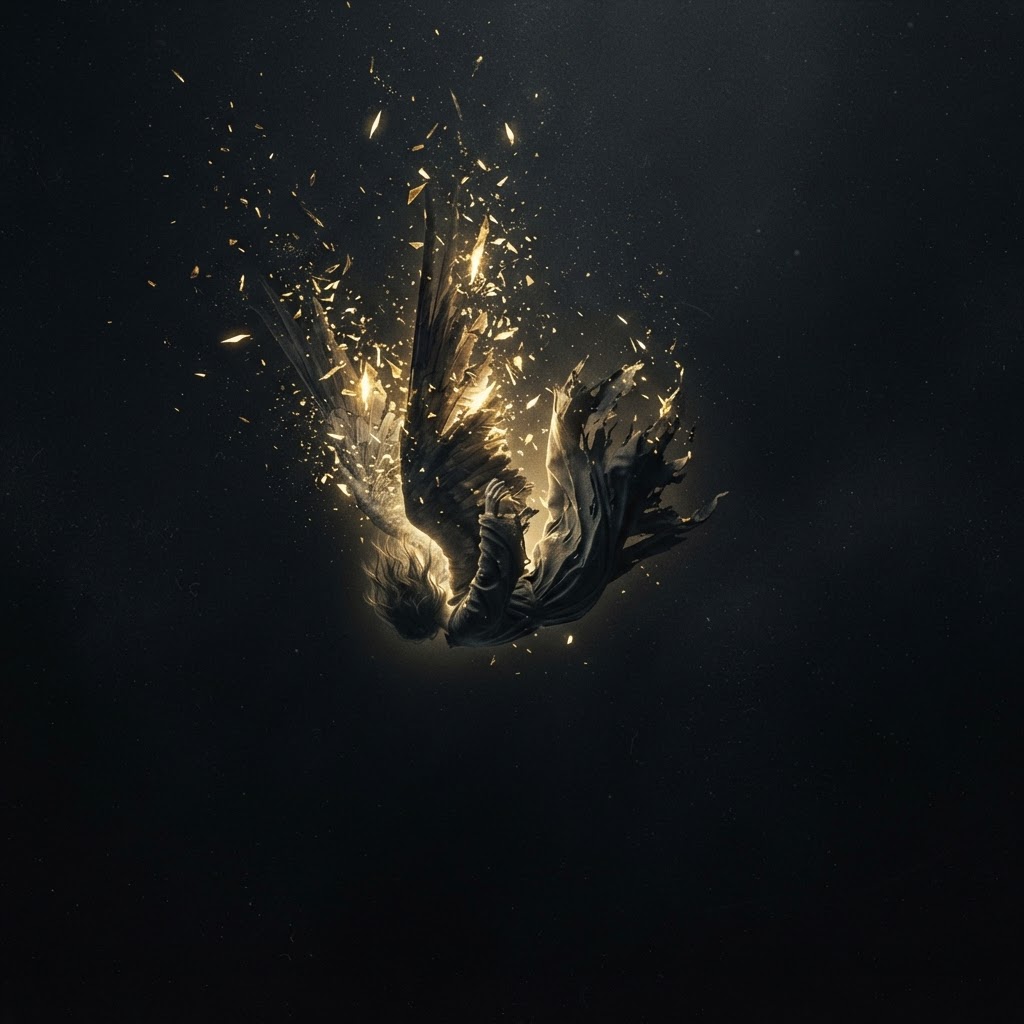
I saw Satan fall like lightning from heaven.
Luke 10:18
Section II — The Rebellion
The Fall of the Angels
Tradition, in figura, gives the highest of fallen spirits the title forfeited: Hel-El, the Morning Star, the bearer of light. His fall is the tragedy of the greatest gift become the greatest ruin — radiance without humility becoming the first darkness. “How you are fallen, O Day Star, son of Dawn!” (Isa 14:12).
The refusal is older than Eden. Before man learned a “No” to God, a spirit in heaven had already spoken it. The dragons of the deep, the king of Tyre lifted above the cherubim — Ezekiel’s vision of a created glory turned proud (Ezek 28:12–17) discloses the root of every rebellion since.
Revelation names the culmination: “Michael and his angels fought against the dragon… and the great dragon was thrown down, the ancient serpent… and his angels were thrown down with him” (Rev 12:7–9). A third of the stars of heaven are swept by the dragon’s tail — a symbolic number of those who chose the creature over the Creator.
The consequence is fixed: a nature of fire and intellect continues, but its end is forfeited. The fallen do not cease to be angels; they cease to be blessed. The same splendor that once ministered now ministers to nothing — ordering, accusing, and dragging down, because there is no longer an “up” for a will that has locked its face from God.
Section III — The Adversary
Who Is Satan?
“Satan” is not a name but a title — the Hebrew for adversary, the one who opposes. Scripture shows him first in the heavenly court, presenting himself before the Lord to accuse Job (Job 1–2), and again standing at the right hand of Joshua the high priest to accuse him (Zech 3:1). The accuser is his office, not a new creation.
Christ names his character without nuance: “He was a murderer from the beginning, and has nothing to do with the truth… he is a liar and the father of lies” (John 8:44). What was once a spirit of light has become the father of the lie that undoes every light — his being now defined by the refusal that made him what he is.
Yet his power is not absolute. The Catechism is clear: the devil’s “action is permitted by divine providence which with strength and gentleness guides the destiny of man and the cosmos; the ultimate permission is always ordered to a greater good” (CCC 395). Satan is a creature on a leash.
He cannot create; he can only twist. He cannot compel the will; he can only solicit. He cannot foreknow the free; he can only infer. He is permitted, never sovereign — a dog chained at the gate of the Father’s house, whose bark is real but whose reach is limited by the very mercy he refuses.
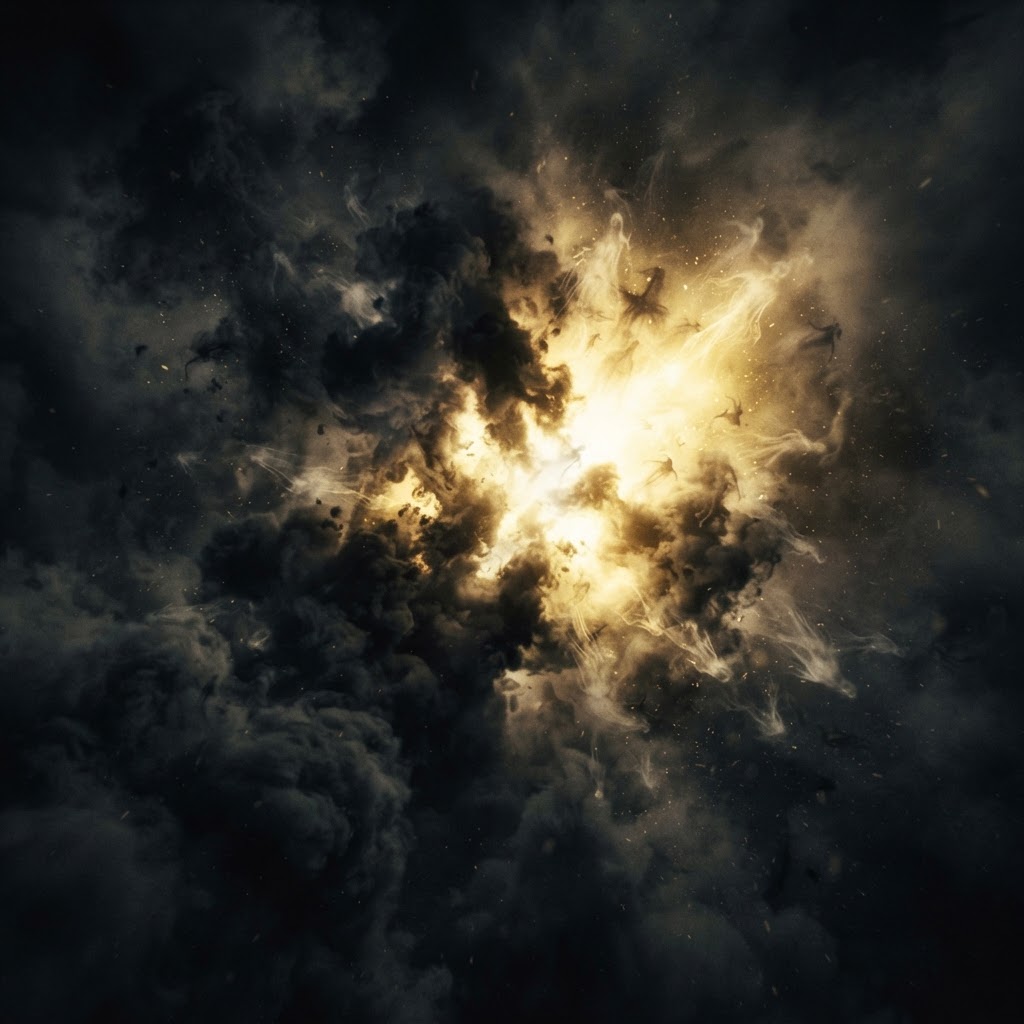
The Son of God appeared to destroy the works of the devil.
1 John 3:8
Section IV — The Ordering of Darkness
The Demonic Hierarchy
The fallen do not lose the nature they were given. They retain the angelic form — intellect and will — and, the Fathers and Doctors suppose, something of the order of their creation. Thus Paul warns not of a single enemy but of a structured assault: “We do not wrestle against flesh and blood, but against the rulers, against the authorities, against the cosmic powers of this present darkness, against the spiritual forces of evil in the heavenly places” (Eph 6:12).
What these ranks are, in their unseen workings, the Church does not define. The language — principalities, powers, world-rulers of darkness — is symbolic, drawn from the imagery of late antiquity to gesture at realities too high and too terrible for literal description.
A sober reading does not speculate about names or ranks; it observes what the imagery reveals: that evil, though a privation, is not chaotic. It organizes itself, imitating the order it refused, and so “apes” the heavenly hierarchy with a parody that is hierarchy without charity, order without love.
A demonology of clarity avoids two errors: it does not demote these powers to metaphor (they are real personal beings), nor does it inflate them to cosmic co-rulers (they are permitted creatures under a sovereign God). The mystery is held where Scripture holds it — between the two.
Details of the demonic order are a symbolic theologoumenon, not doctrinal certitude. The Church warns against curiosity masquerading as wisdom; the names that matter are the three the Church invokes — Father, Son, and Holy Spirit — before whom every principality must bow.
Section V — The Strategy of Darkness
The Mission of Evil
The Trinity sends the Son in the Spirit to reveal the Father, gather the children, and heal the broken. The fallen move against that movement in a single direction — to deceive, to divide, to destroy — because all three evils reverse the one good the Trinity works. A soul deceived cannot receive truth; a soul divided cannot love; a soul destroyed cannot praise.
Deception
“The devil was a murderer from the beginning… there is no truth in him” (John 8:44). He works first by the lie — refashioning reality, bending the conscience, making evil appear as good and bondage as freedom.
Division
“Every kingdom divided against itself is laid waste” (Matt 12:25). He sows suspicion within the family, the parish, the heart — turning love into accusation and communion into suspicion.
Destruction
“Your adversary the devil prowls like a roaring lion, seeking someone to devour” (1 Pet 5:8). Where deception and division have done their work, destruction enters — of persons, of innocence, of faith itself.
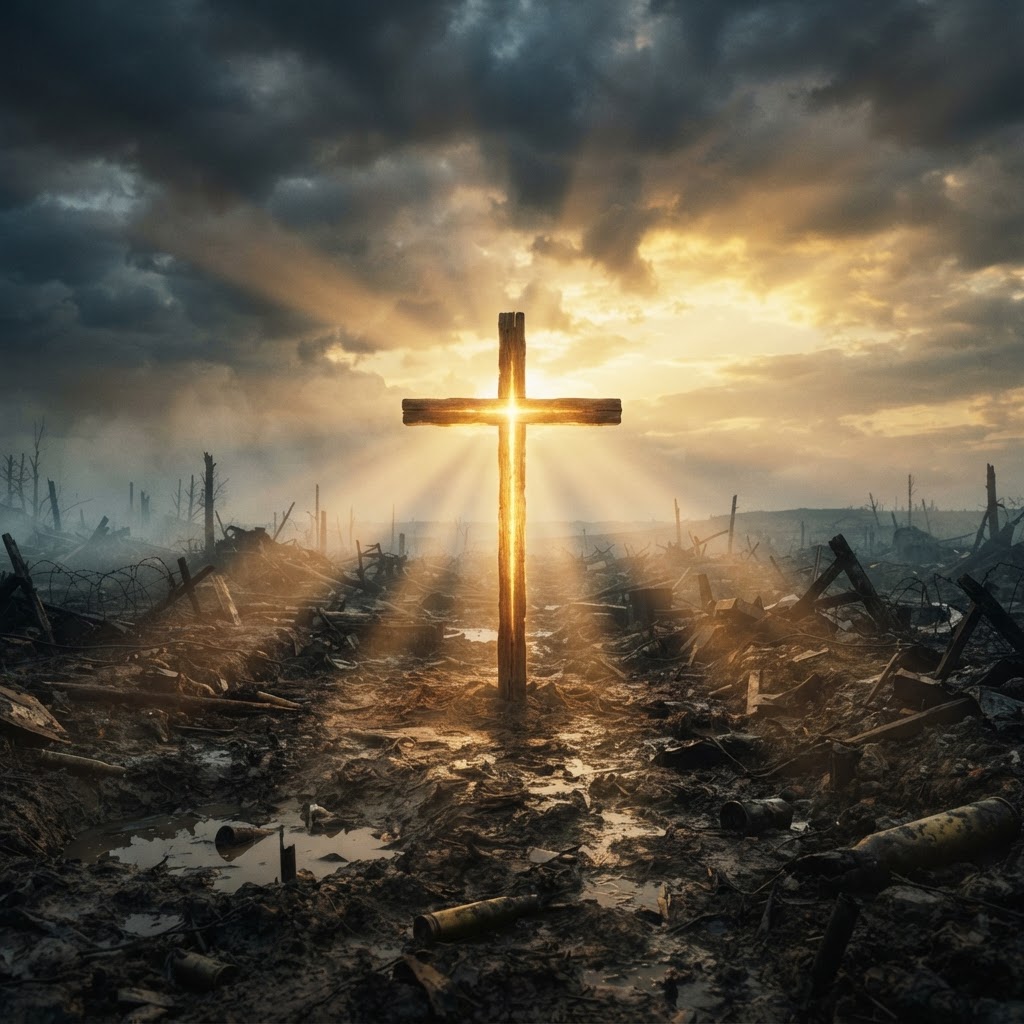
It is finished.
John 19:30
Section VI — The Hour That Won the War
Christ's Victory
From the very moment the promise was spoken — “He shall bruise your head” (Gen 3:15) — the whole of Scripture is the record of a victory already begun. The Cross is its decisive hour. There the accuser, who had held the debt of the law, is “disarmed” and the powers “triumphed over in Christ” (Col 2:15).
The Resurrection is the victory made public. The Enemy who works by death is routed by the One who enters death and leaves it empty, carrying captivity captive. “Death, where is your victory?” is not poetry but the cry of a war already won.
The end is disclosed already in Revelation: “The devil who had deceived them was thrown into the lake of fire and sulfur… and they will be tormented day and night for ever and ever” (Rev 20:10). His time is short precisely because it is measured by a sovereignty he cannot resist.
The Christian does not fight to win; Christ has already won. We fight from victory, not toward it. This single truth refounds the whole discipline of spiritual warfare: we are not anxious, only watchful; not afraid, only armed. Hope is the shape of every weapon.
“Since therefore the children share in flesh and blood, He Himself likewise partook of the same, that through death He might destroy him who has the power of death, that is, the devil.”Hebrews 2:14
Section VII — The Woman Clothed with the Sun
Mary & Spiritual Warfare
Mary is the New Eve. Where the first Eve lent her ear to the serpent and her hand to the fall, Mary lent her ear to the angel and her flesh to the Word — answering for the whole race the “Yes” that was refused at the tree. Her maternity is the reversal of the ancient defeat.
Genesis 3:15 names her from the beginning: the seed of the Woman shall bruise the head of the serpent, and hers the heel that crushes. Revelation discloses the same figure: “A Woman clothed with the sun, with the moon under her feet, and on her head a crown of twelve stars” throws her shadow over the dragon who waits to devour her Child (Rev 12:1–4).
The serpent’s head is bruised wherever Mary is honoured — not as rival to Christ but as the Mother whose fiat became the doorway of our rescue. Her maternal protection is the shelter of the children the Woman bore in the travail of Calvary.
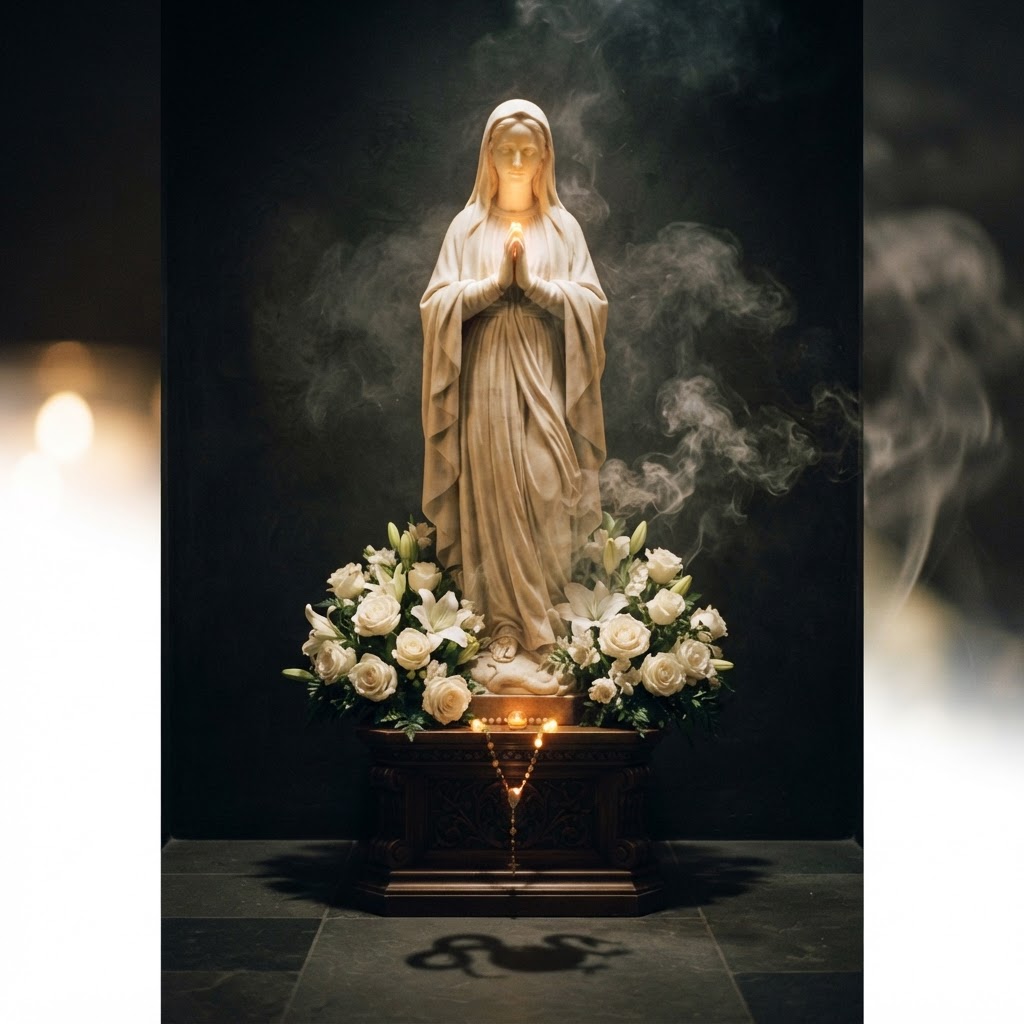
“She shall crush your head.”
Genesis 3:15 · Revelation 12
Section VIII — The Arsenal of Christ
The Church's Weapons
Paul lists the full armour piece by piece; the tradition names them as living practices. They are not tactics to be tried but habits to be worn — until the soul wears Christ.
Scripture
“The sword of the Spirit, which is the word of God” (Eph 6:17). Christ answered every temptation from the Word; so must we. A soul that knows Scripture knows the lie when it comes.
The Sacraments
The ordinary and most powerful instruments of deliverance. The sacraments are not devotions but the continuing action of Christ’s victory in the soul.
Confession
“Confess your sins to one another” (Jas 5:16). The Evil One’s leverage is the unconfessed fault; confession strips him of it. The darkness of a secret yields to the light of absolution.
The Eucharist
“Whoever eats my flesh and drinks my blood has eternal life” (John 6:54). The presence of Christ within is the fortress the enemy cannot breach.
The Rosary
The school of Mary, where the mysteries of Christ are meditated and the serpent’s head is crushed anew in the heart of the one who prays it.
Fasting
“This kind cannot be driven out by anything but prayer and fasting” (Mark 9:29). The body disciplined for love becomes a weapon the proud spirit cannot read.
Prayer
“Pray without ceasing” (1 Thess 5:17). Watchfulness becomes habitual; the heart learns to stand before the Father before it stands before any foe.
Virtue
“Put on the Lord Jesus Christ” (Rom 13:14). The armour is not borrowed but worn — truth, righteousness, faith, love lived until they are the soul’s native habit.
Section IX — The Ministering Spirits
The Archangels in Battle
The holy angels do not wage a separate war; they serve the one victory of Christ. Michael, Gabriel, and Raphael each carry an aspect of the Trinity’s mission into the front line — to defend, to reveal, to heal — and their ministry is the visible kindnesses of an invisible God.
Saint Michael
Rev 12:7–9 · Jude 9
The warrior. Michael casts down the accuser and defends the Church as the Lion of Judah’s standard-bearer. He carries the authority of the Father — “Who is like God?” — the question that ends every rebel’s boast.
Saint Gabriel
Luke 1:26–38
The herald. Gabriel speaks the Word that undoes every lie — the truth of the Father’s address to His children. Where the enemy whispers accusation, Gabriel announces the Gospel.
Saint Raphael
Tobit 12:12–15
The healer. Raphael binds the wounds the battle has left and presents the prayers of the saints before the glory of God. His mercy evokes the inward mission of the Holy Spirit, the Comforter.
Their missions connect to the Trinity’s own: Michael bears the authority of the Father, Gabriel announces the Word who is the Son, Raphael’s mercy evokes the healing of the Holy Spirit. To invoke their help is to approach, after them, the God who sends them — and never to mistake the messenger for the Giver.
Section X — Visual Theology
Iconography & Visual Theology
The Church has always painted the dragon — not to glorify it but to keep it underfoot. These notes sketch a sober visual theology for contouring the unseen war with reverence and without sensationalism.
Michael Defeating the Dragon
The youthful warrior thrusting the lance downward — never in triumphal rage but in settled obedience. Let gold light pour from the wound; let the dragon be coiled, not dramatic. Authority, not ferocity, is the subject.
The Fall of the Angels
A single fragmenting figure descending through shadow; gold light shattering. Avoid the grotesque — let the tragedy be the loss of radiance, never the spectacle of ruin.
Christ Victorious
Silhouette of the cross standing at the dawn of the third day, darkness broken behind it. Let absence of detail carry the mystery; the light that streams from the wounds is enough.
Mary Crushing the Serpent
The Woman clothed with the sun, her heel upon the serpent’s head — never triumphant aggression but maternal calm. White roses, amber radiance, the serpent in shadow beneath.
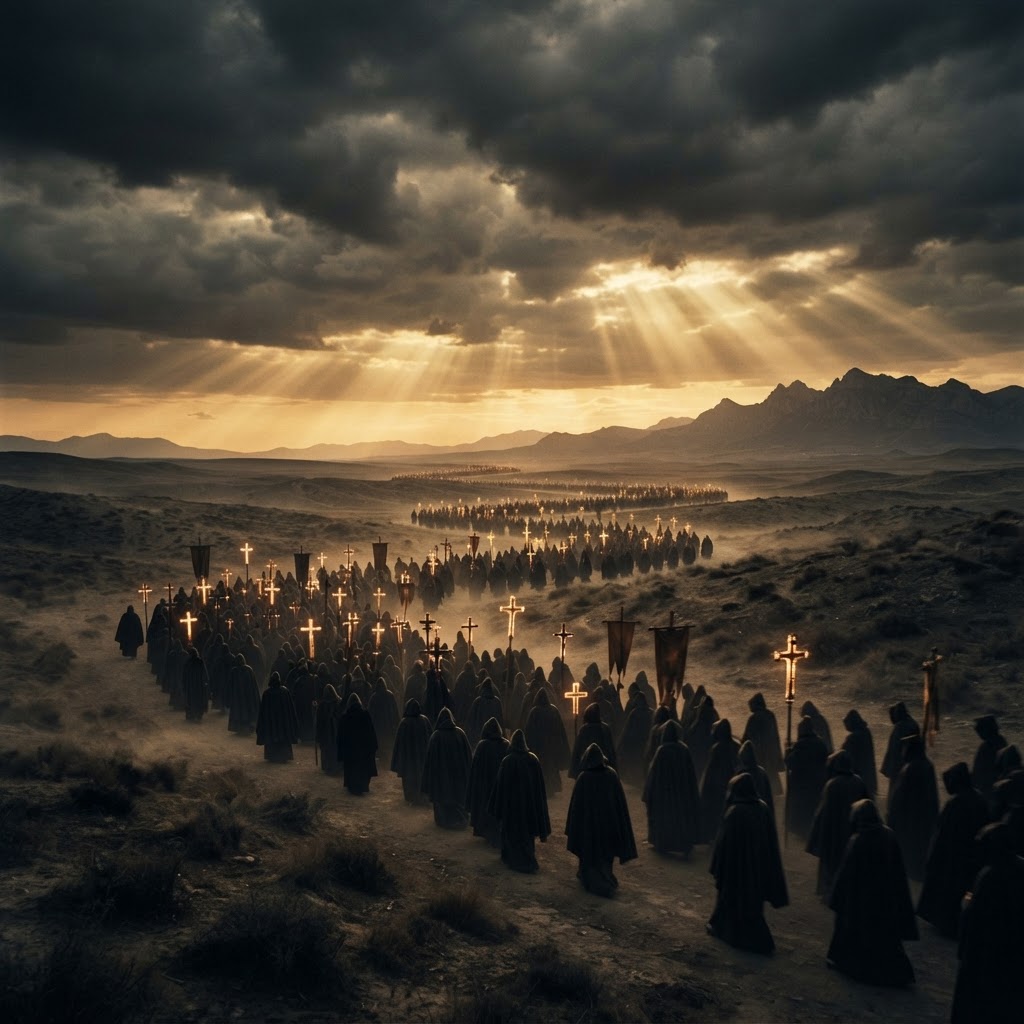
Stand firm, and see the salvation of the Lord.
2 Chronicles 20:17
Section XI — Go Deeper
The Demonology Library
Pathways into the wider vision — the warfare the demons wage and the victory the Church has already been given.
Conclusion
The Battle Is Real —
the Victory Is Certain
Demonology, soberly taught, does not breed fear but exhorts vigilance. The adversary is real, his tactics ancient, his rage without quarter — but his hour is measured, his power permitted, and his defeat already accomplished upon the wood where the true Morning Star stretched out His hands.
Therefore the Christian does not tremble. He arms, he watches, he fasts, he prays — and underneath all, he trusts. The Church is not a fugitive from the battle but the barracks where warriors are formed and the hospital where the wounded are healed. Put on the armour. Live the sacraments. Stand with the angels. The victory is certain — and the battle, even now, is the Lord’s.