
“Train up a child in the way he should go.” — Proverbs 22:6
The Crisis in
Catholic Schools.
When formation collapses, culture collapses.
Catholic schools face a profound and deepening crisis of identity, mission, and formation. The crisis is not primarily academic — it is spiritual. And the consequences are eternal.
What the Issue Is
Catholic schools face
a profound crisis.
loss of Catholic identity in curriculum, culture, and hiring
infiltration of secular ideology under the banner of inclusion
weak catechesis that forms sentiment rather than disciples
compromised leadership that prioritises compliance over mission
deep confusion about what Catholic schooling is actually for
The crisis is not academic.
It is spiritual.

The fear of the Lord is the beginning of knowledge.
Proverbs 1:7
Where the Confusion Comes From
Why the crisis is
invisible to many.
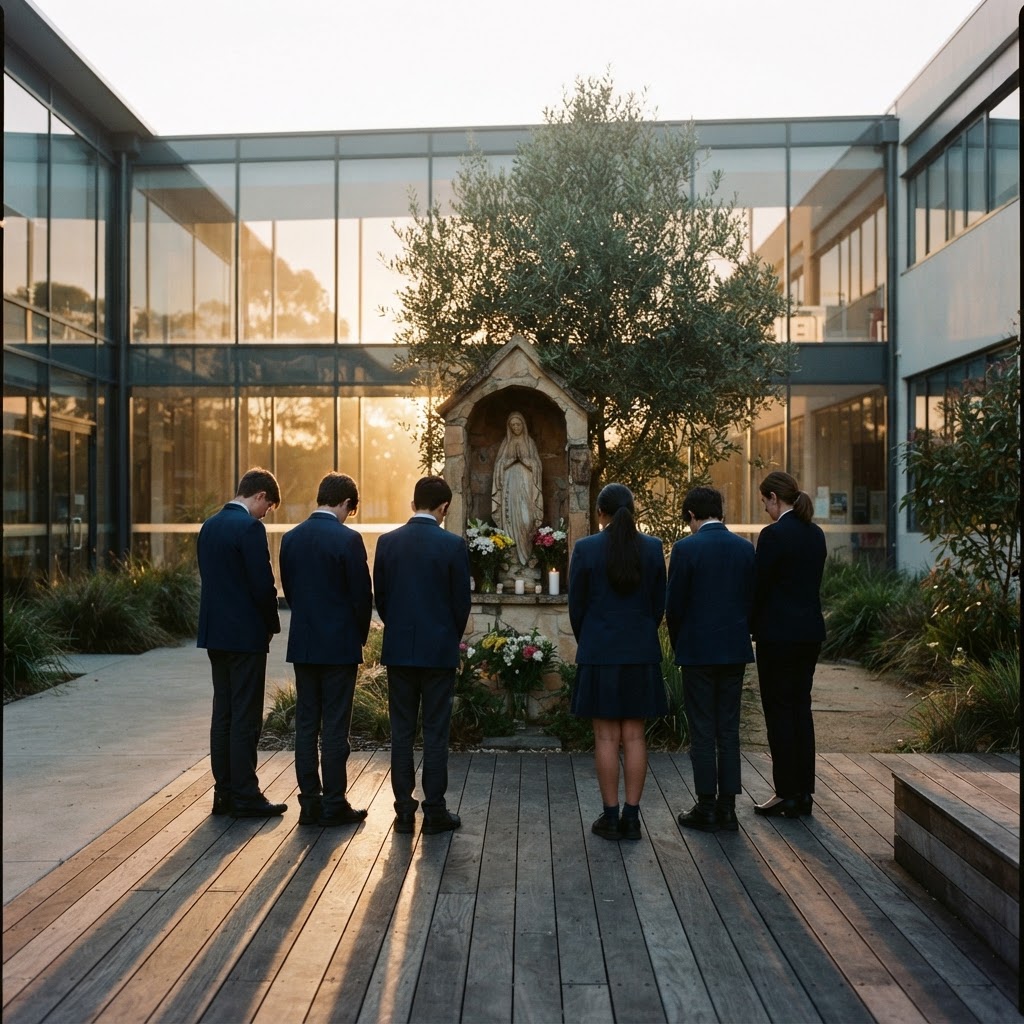
Catholic schools still use Catholic symbols — crosses, prayer, liturgical calendars
but many no longer teach Catholic truth with conviction or clarity
secular anthropology quietly replaces Catholic anthropology in PDHPE and wellbeing programs
teachers are hired for qualifications, not faith — and cannot give what they do not have
government funding shapes curriculum, and schools comply to survive
parents assume Catholic formation is happening — but often it is not
Catholic Teaching
What the Church Teaches
Catholic schools exist to form disciples of Jesus Christ — not merely good citizens.
The Gospel must shape every subject — not be confined to 'Religion' class.
Catholic identity is non-negotiable — it is the school's entire reason for existing.
Truth is objective — not constructed, not relative, not culturally conditioned.
The human person is created by God, for God — this truth must be taught clearly.
The moral law is universal — it cannot be watered down for cultural acceptance.
Prophetic Diagnosis
The crisis is the result of
identifiable choices.
doctrinal compromise accepted as pastoral sensitivity
fear of cultural backlash silencing teachers and leaders
replacing evangelisation with activism and social programmes
elevating prestige, rankings, and enrolment over mission fidelity
losing the parish-school unity that sustained Catholic formation for generations
Structural Causes
The systemic pressures
government funding requirements that shape curriculum away from doctrine
accreditation pressure imposing secular frameworks on Catholic content
secular curriculum mandates including gender ideology and moral relativism
corporate governance models that run Catholic schools like businesses
weak episcopal oversight that fails to hold schools to doctrinal accountability
Spiritual Consequences
The harvest of
lost formation.
loss of faith — graduates who leave the Church within years of finishing school
confusion about identity — young Catholics who cannot articulate what they believe
moral relativism absorbed as default worldview rather than rejected
departure from the Church and from any meaningful relationship with Christ
spiritual apathy — the most dangerous outcome of all
Gravity and Hope

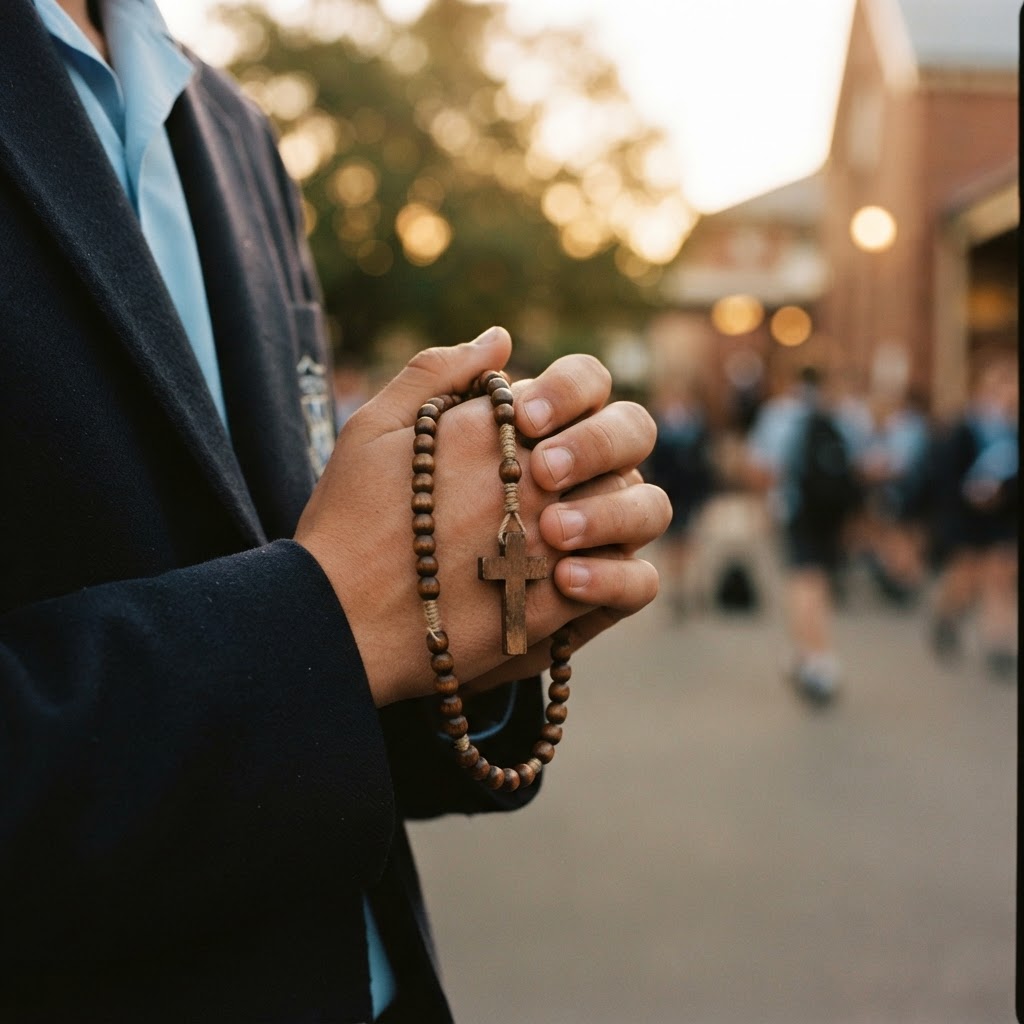
The light shines in the darkness, and the darkness has not overcome it.
John 1:5
Catholic Response
How Catholics Must Respond
Restore Catholic Identity
The name is not enough. Restore Catholic identity through hiring, curriculum, culture, and daily life — not as an add-on but as the animating principle of the school.
Reform Teacher Hiring
Teachers must personally know and live the faith. Doctrinal fidelity is the primary qualification — not a secondary consideration.
Raise Up Evangelists
Catholic schools need teachers who are missionaries — whose vocation is the formation of disciples, not merely the delivery of outcomes.
Rebuild Parish-School Unity
The sacramental life of the parish must be central to the school's identity. A Catholic school divorced from its parish is a school without a soul.
Demand Episcopal Leadership
Bishops bear responsibility for the Catholic identity of every school in their diocese. Catholics must hold their bishops accountable.
Remove Secular Ideology
Gender ideology, moral relativism, and secular anthropology must be named and removed — courageously, charitably, and without apology.
Common Questions
Frequently Asked
Q: Why are so many students leaving the Church?
A: Because they were never truly formed. They received religious sentiment — attending Mass, learning prayers, visiting liturgical celebrations — but not genuine discipleship. Formation that does not produce conviction will not survive the pressures of adult life.
Q: Can the crisis in Catholic schools be reversed?
A: Yes — but it requires episcopal courage, parental engagement, teacher formation, and the willingness to choose mission over market share. Reform is possible. It has happened before. It can happen again.
Q: What can parents do right now?
A: Engage actively with your child's school. Ask direct questions about curriculum. Supplement formation at home and through parish. Consider whether the school is genuinely serving your child's formation — or merely carrying a Catholic name.
A Shining Light of Hope
Mission Renewal in Portland --
a model every bishop should adopt.
The collapse of Catholic education is not the end of the story. In October 2026, Archbishop Alexander K. Sample of Portland in Oregon released a 37-page pastoral letter, Go therefore and make disciples of all nations, that does exactly what this whole series has been calling for. It is the clearest recent example of a bishop taking personal responsibility for the mission of the Church -- and for the renewal of Catholic education as an act of that mission. It deserves to be studied, and imitated.
Writing in 1969, Father Joseph Ratzinger -- later Pope Benedict XVI -- predicted that when the trial of sifting is past, "a great power will flow from a more spiritualized and simplified Church." Archbishop Sample takes up that prophecy and reads our own moment through it: a "watershed moment" in which the Church must be ready. This is the tone every bishop is being invited to adopt.
"I am calling for a significant and genuine renewal of Catholic education in the Archdiocese of Portland, beginning in our Catholic elementary schools, middle schools, and high schools, and eventually extending to the religious education and faith formation programs in our parishes. I am calling for a renewal of what we call 'Mission Passionate Catholic Education.'"
-- Archbishop Alexander K. Sample, Pastoral Letter, 1 October 2026"If the Church, in partnership with parents, does not become intentional and very serious about the renewed education and faith formation of our children, we abandon them to the whims of the prevailing erroneous ideologies of the day. If that were to happen, we would have abdicated our responsibility and the very purpose of Catholic education."
-- Archbishop Sample"Conflict and critical theories have led to seeing education primarily as a task of raising a new generation of socially conscious activists ... Such thought must be challenged and replaced with a Christian anthropology."
-- Archbishop Sample"I look forward to the day when all our Catholic schools are truly on fire as centers of evangelization and formation for our children, forming them as lifelong missionary disciples of the Lord."
-- Archbishop SampleWhat He Models
Six marks of a bishop who is serious about mission
He names the ideologies and replaces them
Secularism, pragmatism, utilitarianism, and critical theory are identified by name. Then, explicitly, they are replaced with a Christian anthropology -- the Catholic philosophical, theological, spiritual, and moral tradition.
He keeps the goal supernatural
Catholic schools stay focused on what matters most: bringing young people to encounter Jesus Christ and be transformed by him, for a formation that is spiritual, religious, intellectual, and human -- ordered to eternal life, not merely to college and career.
He restores parish-school unity
The Catholic school is a mission of the parish, and the pastor must be its leader -- the leader and spiritual father of the school community. A school detached from the parish is a school detached from the sacrament.
He demands witnesses, not just staff
Administrators, teachers, and staff must be living witnesses of the Gospel in their words, attitudes, and manner of life. Renewal of teachers and administrators begins with their own personal spiritual renewal.
He refuses to abandon the poor
No Catholic child should be denied a Catholic education because the family cannot afford it -- including families with children with disabilities. Affordability is treated as a whole-of-archdiocese responsibility.
He begins on his knees
The letter opens with the consecration of the archdiocese to the Sacred Heart of Jesus and is anchored in his episcopal motto, Vultum Christi Contemplari -- to contemplate the Face of Christ. Mission renewal starts with prayer before it starts with policy.
One mission, three movements
Archbishop Sample is careful to refuse false choices -- education is not a side-project, and renewal is not a slogan. His letter holds the whole mission together.
Renewed priests first
Mission renewal must start with personal holiness in the clergy -- prayer, the Eucharist, confession, spiritual direction, and a genuine unity among brother priests. He quotes the abbot Chautard: 'If the priest is a saint, the people will be fervent.'
Mission Passionate Catholic Education
Catholic schools exist to form the hearts and minds of children to know, love, and serve God. Every school must carry a truly Catholic worldview that permeates all of its education and programming.
A culture of evangelisation
The point of it all is to create a genuine culture of evangelisation -- so that the Church can more effectively fulfil the Lord's command to 'go and make disciples'.
Why this is hope and not mere theory. Everything the preceding pages describe -- secular anthropology, ideology dressed as inclusion, formation replaced by compliance, the school detached from the parish -- this letter names in the open and answers with a plan. It reminds us that the last canon of the Code of Canon Law holds "the salvation of souls" as the supreme law of the Church, and that no institutional pressure outranks it. If one metropolitan archbishop in one of the most secular states in America can call for this, then Catholic education anywhere can be rebuilt. The question is whether other bishops will follow, and whether the faithful will support them when they do.
Archbishop Alexander K. Sample, Archdiocese of Portland in Oregon -- "Go therefore and make disciples of all nations", 1 October 2026.
Catholic Education Series
Read the Full Series — In Order
These four issues form a connected analysis. Each builds on the last.
The Collapse of Catholic Education
The broad overview — how and why Catholic education lost its mission.
The Crisis in Catholic Schools
The on-the-ground reality — what is happening inside Catholic classrooms today.
The Infiltration of Catholic Education
The mechanism — how secular ideology entered and took hold.
The Betrayal of Catholic Formation
The deepest wound — the abandonment of genuine formation from within.
A Prophetic Word
Return to
the mission.
Catholic schools exist to make disciples.
Nothing else justifies their existence.