
“A thousand thousands ministered to Him, and ten thousand times ten thousand stood before Him.” — Daniel 7:10
ANGELOLOGY
The Heavenly Hierarchy and the Mystery of the Triune God.
A contemplative study of the angelic choirs, the great archangels, and their symbolic participation in the one mission of the Father, the Son, and the Holy Spirit — drawn from Scripture, the Fathers, the Doctors, and the living tradition of the Church.
By Justin Poor - Catholic Apologist, drawing from Sacred Tradition, the Fathers, Doctors, and the Full Magisterium.
Section I — Definition
What Are Angels?
Angels are pure spirits — personal, immortal beings created in grace and glory, without body, without the weight of flesh, yet fully real and fully personal. They are not metaphors for human moods, nor the residue of ancient myth, but living intelligences who “minister before Him” and carry out His will.
Because they are spirit, their knowing is not discursive but intuitive: they apprehend truth in a single glance, and their will follows the intellect without the slow labor of deliberation. Their mission flows from their nature — to behold, to praise, and to serve — and through that service they participate in the providence by which God governs all that is.
Christendom has never doubted them. From the Psalms and Daniel, through the Fathers who called them “the eyes of God,” to Aquinas who named them the highest of creatures, the Church has confessed a heaven not empty but thronged — a court of ministering spirits ordered around the throne.
The Catechism quietly sums it: the angels are “servants and messengers,” and “with their whole beings the angels are servants and messengers. … they belong to Him” — created for His praise, and sent for our safeguard (CCC 328–336).
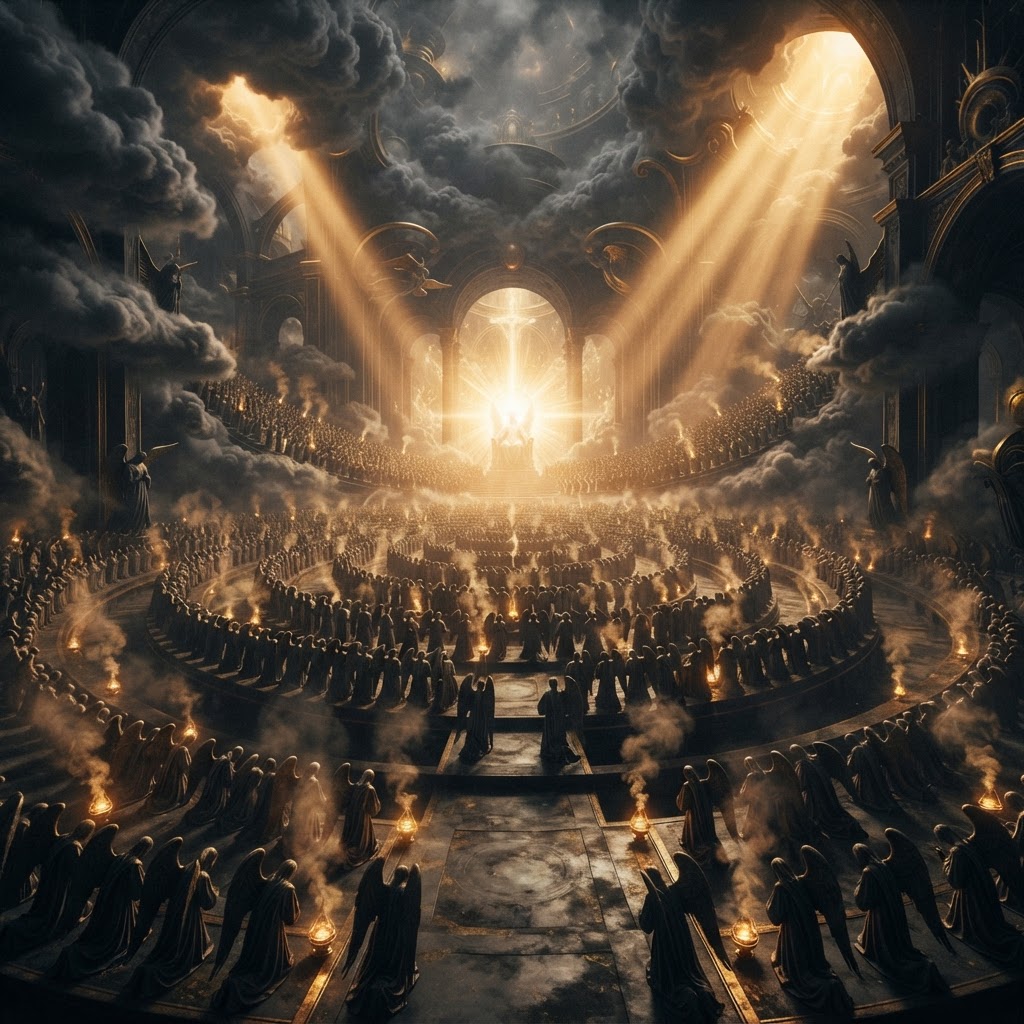
Holy, holy, holy is the Lord of hosts; the whole earth is full of His glory.
Isaiah 6:3
Section II — The Ordering of Heaven
The Nine Choirs
Pseudo-Dionysius, received by Aquinas and the liturgy, names the angelic host in nine ranks — three hierarchies of three — each ordered to the next, each drawn into the same praise. The order is symbolic, not schematic; it teaches that the whole creation is a hierarchy of love, in which the higher enlightens the lower, and all return to God.
I · The Highest
Seraphim
The burning ones — closest to the throne, consumed by love, who cry 'Holy, Holy, Holy' (Isaiah 6). They embody the fire of charity.
Cherubim
Guardians of the divine glory and bearers of wisdom — placed at Eden's gate and over the Ark. They contemplate the depths of God.
Thrones
Symbols of God's judicial authority and the stability of divine justice — upon them the heavenly court rests.
II · The Middle
Dominions
They govern the lower choirs and order the angelic host to the commands of God.
Virtues
Bearers of divine power — through them grace works signs, wonders, and the movement of the cosmos.
Powers
Ward against the influence of the fallen — the ordered resistance of light against darkness.
III · The Lowest
Principalities
Given charge over peoples and nations — the invisible order behind the visible kingdoms.
Archangels
Messengers of the highest mysteries — Michael, Gabriel, Raphael among the most named.
Angels
The closest to man — sent to guard, guide, and accompany the human soul from conception to glory.
“The name 'angels' designates their office, not their nature. … Those who are called angels by their nature are called by higher names when they announce greater things.” — St. Augustine
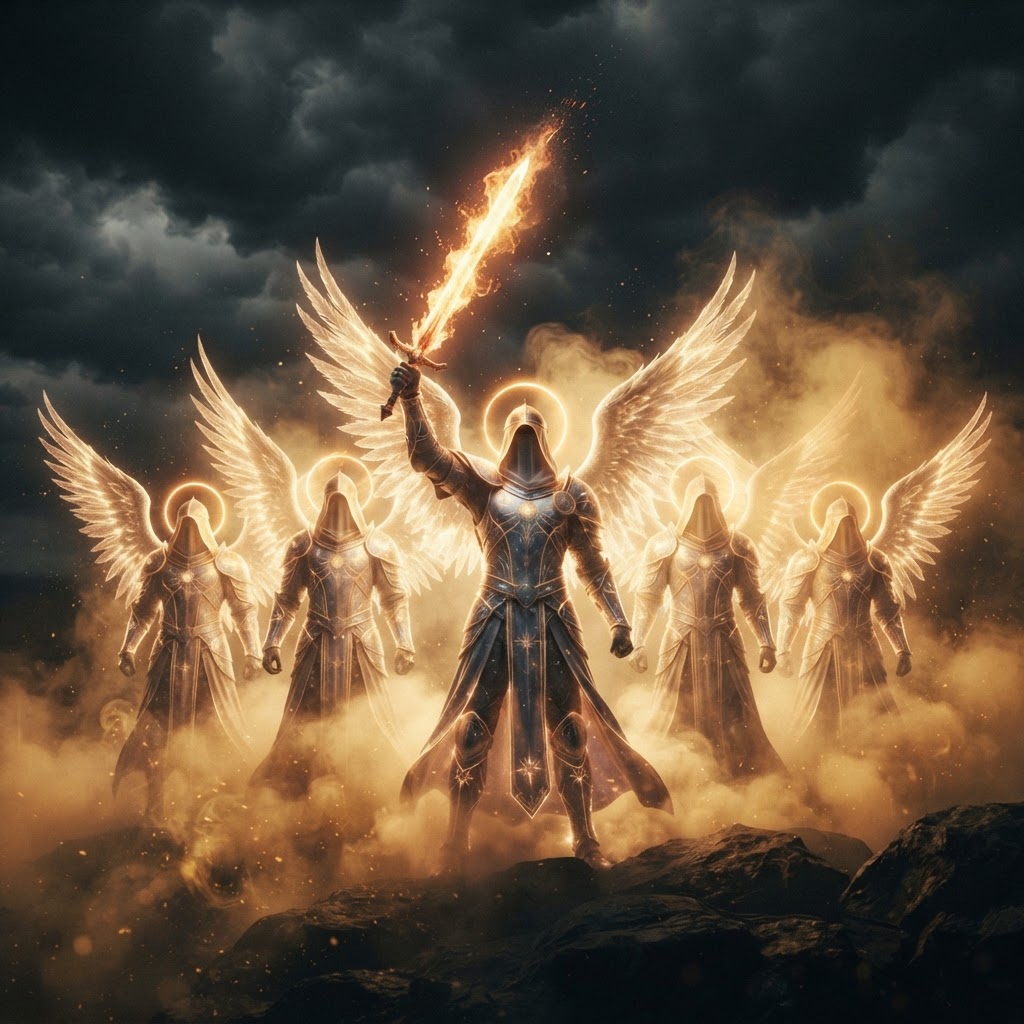
I am Gabriel, who stand before God. I was sent to speak to you and bring you this good news.
Luke 1:19
Section III — The Great Archangels
The Four Great Archangels
Scripture names three archangels who act on the Church's behalf. Tradition, in a symbolic theologoumenon, also remembers the one whose radiance preceded his fall — the Light-Bearer, now forfeited. Together they disclose the whole drama: authority forfeited and authority restored, revelation given and refused, healing offered and refused. Their names end in -El — God — for every angel bears God's name because every angel bears God's errand.
Micha-El
Who is like God?
Authority · Protection · Judgment
Dan 12:1 · Jude 9 · Rev 12:7–9
Michael is the prince of the heavenly host, the warrior who casts down the accuser. His very name is a war-cry of dissent against every creature's pride — 'Who is like God?' — a question that ends all rebellion. He stands for the Father's sovereign authority, the defense of the Church, and the final judgment over the dragon and his angels.
Theological Symbol
Symbolically, Michael bears the sword of justice that proceeds from the throne — the Church's protector in her pilgrimage and the standard-bearer of the last things.
Hel-El
The Light-Bearer (before the Fall)
Radiance · Truth · Light (as gift, before its misuse)
Isa 14:12 · cf. Luke 10:18 · Rev 22:16
Before envy and pride, the one tradition names the Morning Star was created most radiant — the bearer of divine light, a sign of the highest created splendor. His fall is the tragic proof that the greatest gift, turned inward, becomes the greatest ruin. 'Lucifer' is not a counter-name but a forfeited title: the true Morning Star is Christ alone (Rev 22:16).
Theological Symbol
As a symbolic theologoumenon — not a defined dogma — Hel-El's radiance warns that light without humility blinds. The splendor that refuses to serve is the first darkness.
Gabri-El
God is my strength
Revelation · Communication · Inspiration
Dan 8:16 · Dan 9:21 · Luke 1:19, 26–38
Gabriel is the messenger of the Incarnation, the angel who stands before God and is sent to bear the Word. To Daniel he unveils the times; to Zechariah he announces the forerunner; to Mary he speaks the fiat that changed all history. He carries the silence of heaven into the hearing of man.
Theological Symbol
Symbolically, Gabriel participates in the mission of the Son — the Word made flesh is announced by the one whose name means God's strength, for revelation is strength made intelligible.
Rapha-El
God heals
Healing · Restoration · Mercy
Tobit 12:12–15 · John 5:1–9 (figure)
Raphael is the healer of wounds and the guide of pilgrims. In the Book of Tobit he restores sight to the blind, binds the demon, and accompanies the young traveler in disguise — revealing himself only at the journey's end. He presents the prayers of the saints before the glory of the Holy One.
Theological Symbol
Symbolically, Raphael's healing evokes the inward mission of the Holy Spirit — the Comforter who binds the broken, restores communion, and makes the soul whole for love.
Section IV — Trinitarian Participation
One Mission of the Triune God
The angels do not have a mission parallel to the Trinity; they share in the one mission of the Trinity. Created in and for the Word, they are caught up into the single economy by which the Father sends the Son in the Spirit to save and glorify the world.
What we call their “attributes” — protection, revelation, healing — are not private trades but symbolic echoes of the divine missions themselves. They serve what God does; they do not do something else. To honor Michael, Gabriel, and Raphael is therefore to honor the God who sends them.
Yet this language is symbolic, not literal assignment. No angel is “the Father” or “the Spirit”; each is a creature who participates, from a creature's distance, in the sending it serves. The distinction matters: it keeps devotion from sliding into the strange angelolatries the Church has always refused.
In the heavenly liturgy, then, the choirs are not a rival court but a retinue — gathered around the Lamb that was slain, whose blood has ransomed every tongue of fire.
The Father — Origin & Authority
Michael's cry, 'Who is like God?', mirrors the Father as uncreated Source. All authority in heaven and earth has one origin; the angels serve the One who sends.
The Son — Revelation & the Word
Gabriel announces the Word. The angels behold the Face of the Father in the Son; the whole angelic host gathers around the Lamb that was slain.
The Holy Spirit — Healing & Sanctification
Raphael's mercy and the inward fire of charity (the seraphic flame) evoke the Spirit who heals, conforms, and makes holy — the angels as 'ministering spirits' in the economy of grace.
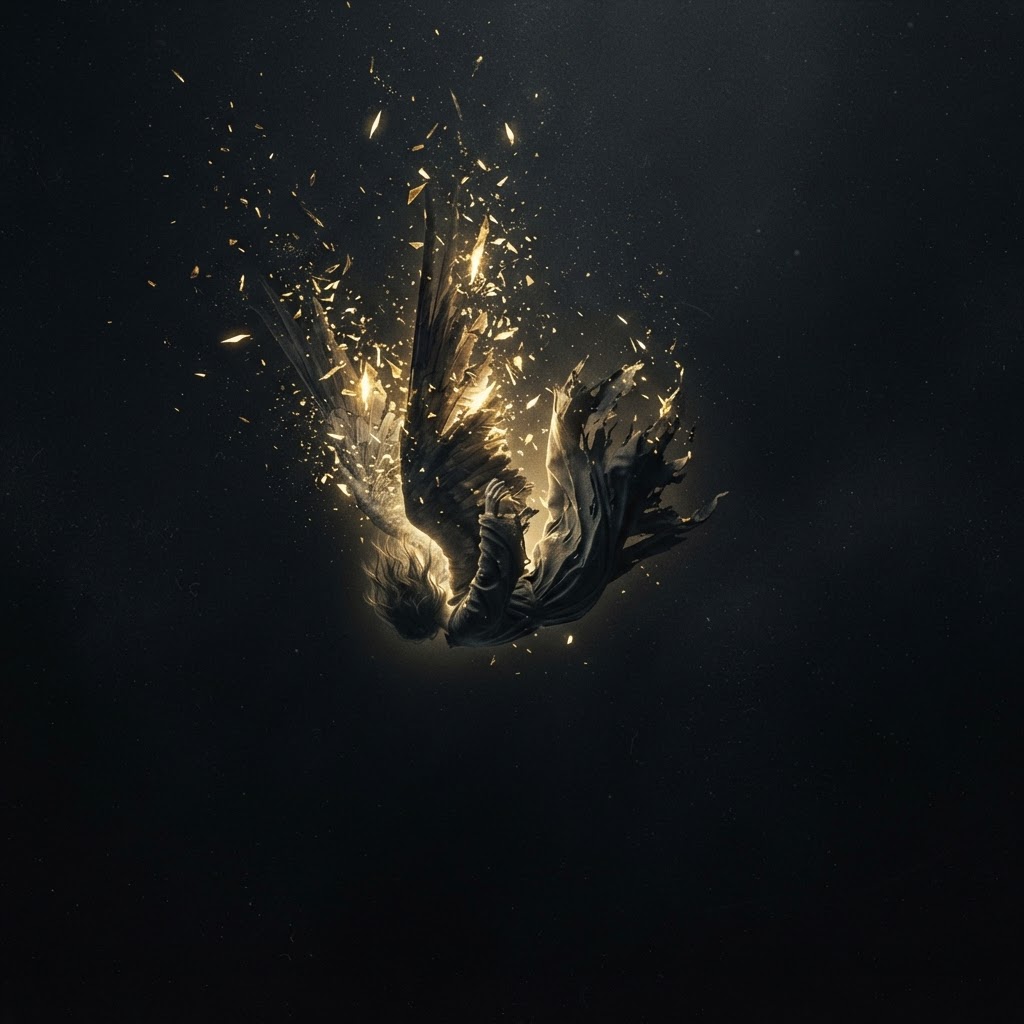
I saw Satan fall like lightning from heaven.
Luke 10:18
Section V — The Rebellion
The Fall of the Angels
Not all the angels stood. Some, “did not keep their own dwelling but left their proper abode” (Jude 6), and from that first defection comes the mystery of iniquity that shadows the world. Their sin was not of the flesh but of the spirit — a refusal, radical and irrevocable, of the supremacy of God.
The Catechism names it plainly: the devil and the other demons were “made good by God” but “became evil by their own doing” (CCC 391). No flaw in creation explains them; the fault is freedom turned inward, a choice without the excuse of weakness.
Tradition, in figura, gives the highest of fallen spirits the title forfeited: Hel-El — the Morning Star, the bearer of light. His fall is the tragedy of the greatest gift become the greatest ruin: radiance without humility becomes the first darkness. “Non serviam” — the refusal that every creature's pride endlessly repeats.
Because the angels chose in a single act, their will is fixed; there is no conversion left for a spirit whose yes or no was sealed at once. Yet the drama is not theirs alone — it becomes ours, the same drama met anew in the heart of every person who hears the Gospel and answers yes, or does not.
Warning. The teaching on the fall is not a mythology of cosmic rebellion but a sober doctrine: a personal, free rejection of God, the root of the evil that Christ came to “destroy.” To preach it without dread, and without hope, is to preach half the Gospel — for the Lamb that was slain has already triumphed.
Section VI — The Battle for the Heart
The Battle Is for the Heart
The war the angels lost in heaven is fought on the ground of the human heart. There the same question comes again: Will the creature serve, or will he refuse? And there, unlike the angels, we may choose — fall, rise, choose again — because in Christ the choice has been turned back toward the Father.
In that battle, the Church does not fight bare-handed. The sacraments arm us; the Scriptures instruct us; the saints encourage us; and the holy angels carry us. The very ones who warred in heaven now minister on earth.
Michael
protects the Church and the soul against the assault of the enemy — the authority of Christ made visible.
Gabriel
speaks the Word that undoes every lie — the truth of the Father's address to His children.
Raphael
binds the wounds the battle has left — the mercy that makes the soul whole once more.
Christ
is not one helper among many but the Victor in whom the whole company — angels and men — is gathered.
Section VII — Devotion
Angelic Devotion & Christian Life
The Guardian Angel
“Their angels always behold the face of my Father in heaven.” From the Church's earliest centuries, the faithful confess that each soul is entrusted to a guardian — an invisible companion entrusted by God to light, guard, rule, and guide.
Saints Michael, Gabriel & Raphael
The Archangels' shared feast proclaims the three named in Scripture who act at the heart of the Church's warfare, revelation, and healing.
The Guardian Angels
A day to renew the prayer to one's guardian and to thank God for the unseen help that accompanies every believer from the womb to the threshold of glory.
“Angel of God, my guardian dear, to whom His love commits me here — ever this day be at my side, to light, to guard, to rule, and guide.”Traditional Prayer to the Guardian Angel
Section VIII — Visual Theology
Iconography & Visual Theology
Christian art of the angels is not decoration but catechesis. It teaches awe without sentimentality, mystery without speculation. The following notes sketch a visual theology for artists and contemplatives alike.
The Throne of God
Radiant light, concentric halos, and the rainbow of Revelation 4. Use amber and white gold for uncreated glory; keep the throne unseen, suggested by light and adoration rather than depicted.
The Seraphim
Six wings covering face and feet, two for flight; bodies of flame, not flesh. Avoid sentimental angels — let fire, trembling, and the triple 'Holy' convey awe.
The Archangels
Michael with sword and scales; Gabriel with lily or scroll; Raphael with staff, fish, and traveler's cloak. Distinct color-coding preserves their mission without confusion.
The Fall of the Angels
A single fragmenting figure descending through shadow; gold light shattering — never grotesque, always the tragedy of lost radiance. Let absence of light carry the horror.
The Heavenly Liturgy
Concentric ranks around the throne, incense rising, censers swinging — the Mass seen from above. Align with Isaiah 6 and Revelation 4–5 to anchor worship, not spectacle.
Section IX — Go Deeper
The Angelology Library
Pathways into the wider vision — formation, discernment, and the spiritual war the angels serve.
Conclusion
A Heaven Not Empty
Angelology is not a flight from the world but a lens upon it: the visible creation unfolds within an invisible court of adoring intelligences, whose fire tells us that love is real, whose service tells us that humility is highest, and whose fall tells us that even greatness is nothing without it.
To contemplate the angels is to lift the heart from what can be weighed to what can only be praised — and to discover, in the company of so great a host, that no soul walks alone. Where Christ is worshipped, there the angels are gathered; and where the angels gather, there heaven begins upon the earth.