
“I will put enmity between you and the woman, and between your seed and her seed.” — Genesis 3:15
THE WOMAN
& THE QUEEN-MOTHER
Mary in the plan of God: the New Eve, the Ark of the New Covenant, and the Mother of the New Davidic King.
The Immaculate Heart of Mary, the Woman in the Garden, the New Eve, the Ark of the New Covenant, and the Jewish roots of the Queen-Mother — and why all of it belongs to the Church's understanding of the Kingdom Christ established.
Mariology · The Immaculate Heart
The Heart of the Mother
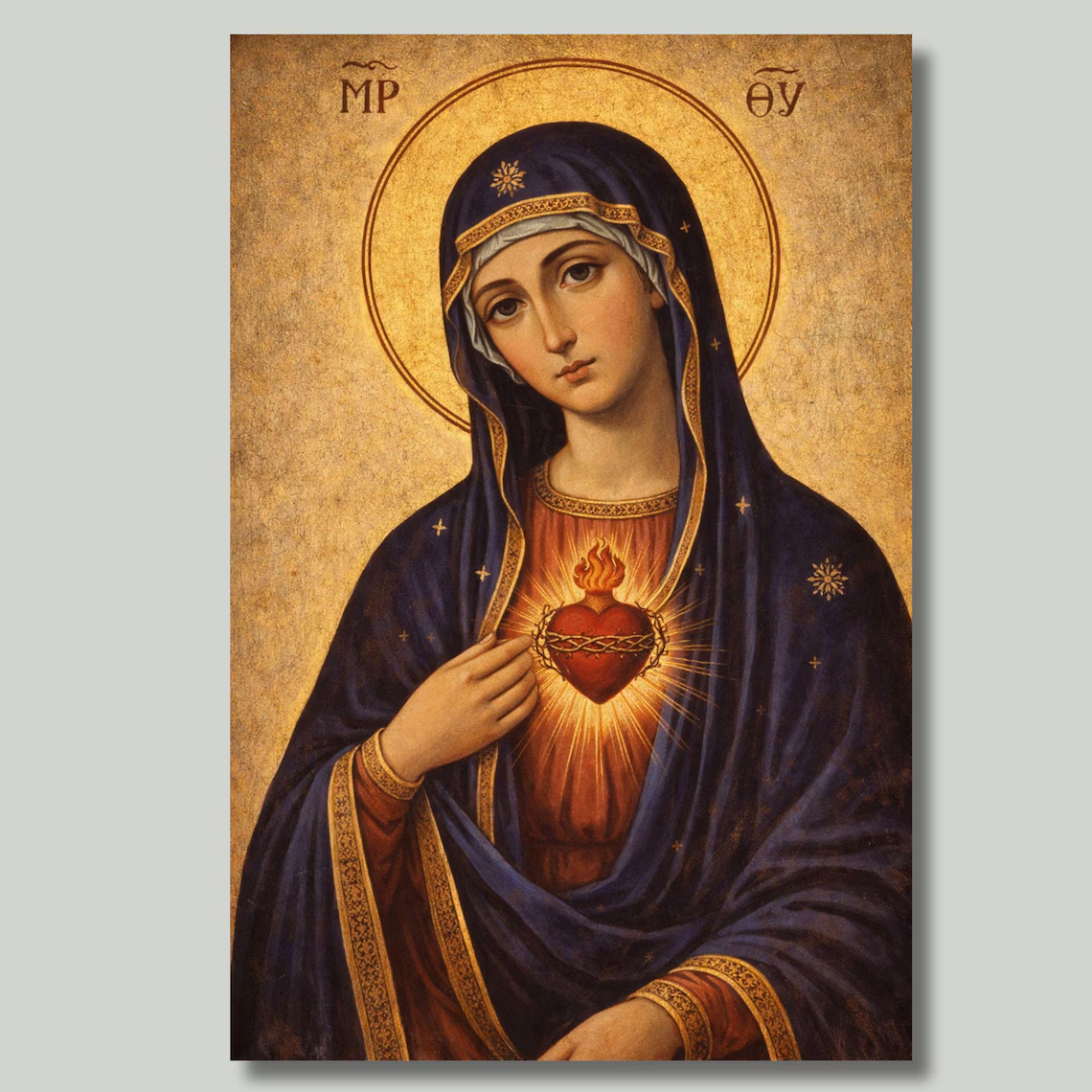
The Immaculate Heart of Mary is not a second, parallel devotion competing with the Sacred Heart of her Son. It is the same mystery seen from the creature's side. What the Church adores in the Heart of Christ is the love of God in a human breast; what she venerates in the Heart of Mary is the love of a creature who received that love perfectly and returned it without reserve. The icon makes the relationship visible in a single glance: the same gold ground, the same thorns, the same flame — but the flame in her heart is a borrowed fire, kindled by grace.
In the icon she holds her hand over that heart, as one guarding something entrusted. That is precisely what Scripture says she did with everything God gave her: she kept it, and pondered it. The Immaculate Heart is therefore the image of the interior life — the place in a human person where the Word is received, kept, and obeyed.
What the Church Means by It
To God alone belongs worship. To Mary the Church gives a unique veneration, infinitely below the worship offered to God, precisely because she is a creature — the most perfectly redeemed of all creatures. When the Church speaks of her Heart, she follows the same logic she applies to the Heart of Christ: the heart is the sign of the whole person. The Immaculate Heart means Mary herself, wholly preserved by grace and wholly given over to God — her faith, her hope, her obedience, her suffering, and her love.
Luke mentions the heart of Mary four times, more than any other New Testament writer mentions the heart of a saint — because in her heart the Church sees how the Word of God is supposed to be received: kept, pondered, and obeyed.
Why the Church reads her heart in Luke above all
The Devotion and Its Form in the Church
The devotion has a solid history and no need of embellishment. St John Eudes in the seventeenth century promoted devotion to the Heart of Mary, and above all to the union of the Hearts of Jesus and Mary, composing a Mass and Office for it. On 31 October 1942, in the middle of the Second World War, Pius XII consecrated the whole world to the Immaculate Heart of Mary, and in 1944 he extended the feast of the Immaculate Heart to the universal Church — placing it on the day after the Solemnity of the Sacred Heart, which is itself a doctrinal statement: the Mother's heart follows the Son's, and is understood only in its light. John Paul II renewed that consecration in 1984.
The devotion reached ordinary Catholics most of all through Fatima, where in 1917 the Immaculate Heart was presented as the refuge and the way of peace, and where the practice of the first Saturdays of reparation was requested. Received with the Church's caution about private revelation, the substance of that message is simply the Gospel applied: conversion, prayer of the Rosary, reparation for sin, and confidence in the Motherhood of Mary.
“Mary kept all these things, pondering them in her heart.”
Luke 2:19
“His mother kept all these things in her heart.”
Luke 2:51
“And a sword will pierce through your own soul also.”
Luke 2:35
“Standing by the cross of Jesus were His mother... Then He said to the disciple, 'Behold, your mother.'”
John 19:25-27
“All these with one accord devoted themselves to prayer, together with the women and Mary the mother of Jesus.”
Acts 1:14
How Her Heart Forms Ours
Ponder
Keep the word in the heart
Twice Luke tells us that Mary kept what she experienced and pondered it in her heart. The Immaculate Heart is first of all a habit of interior attention: the Word received, held, turned over, and obeyed — the opposite of the scattered, scrolling mind.
Obey in the dark
Faith without a safety net
She said yes to a promise whose meaning she would not see for thirty years, and stayed faithful through exile, obscurity, misunderstanding, and the death of her Son. Her heart is the school of obedience when nothing yet makes sense.
Stand
Endurance at the foot of the Cross
The sword Simeon promised did pierce her soul, exactly where she stood: beneath the Cross, refusing to leave. Love that stays is the deepest form of courage the Church has ever witnessed.
First Saturdays
The Rosary and reparation
The devotion as it reached us through Paray-le-Monial and Fatima asks for five first Saturdays of Communion and Confession in reparation, and for the Rosary prayed as a walk through the Gospel in her company.
The Union of the Two Hearts
The Church understands the two devotions as one act of love seen from both ends. The Immaculate Heart exists because the Sacred Heart was coming; the Sacred Heart was welcomed into the world through the Immaculate Heart. The Mother's heart is the doorway, and the Son's heart is the destination. That is why the feast of the Immaculate Heart is kept the day after the Solemnity of the Sacred Heart — the calendar itself preaches the theology.
For formation this means the two pages belong together. To be formed by the Sacred Heart is to learn the love of God in Christ; to be formed by the Immaculate Heart is to learn how a human being receives that love — attentively, obediently, and to the end. Adoration of the Son and imitation of the Mother are not two spiritualities to choose between. They are two halves of one Catholic interior life.
The Sacred Heart of JesusAct of Consecration
O Mary, most holy Mother of God, I give myself to your Immaculate Heart — my mind to be taught, my will to be led, my heart to be kept, and my whole life to be spent in doing whatever He tells me.
Mariology · I
The Woman in the Garden
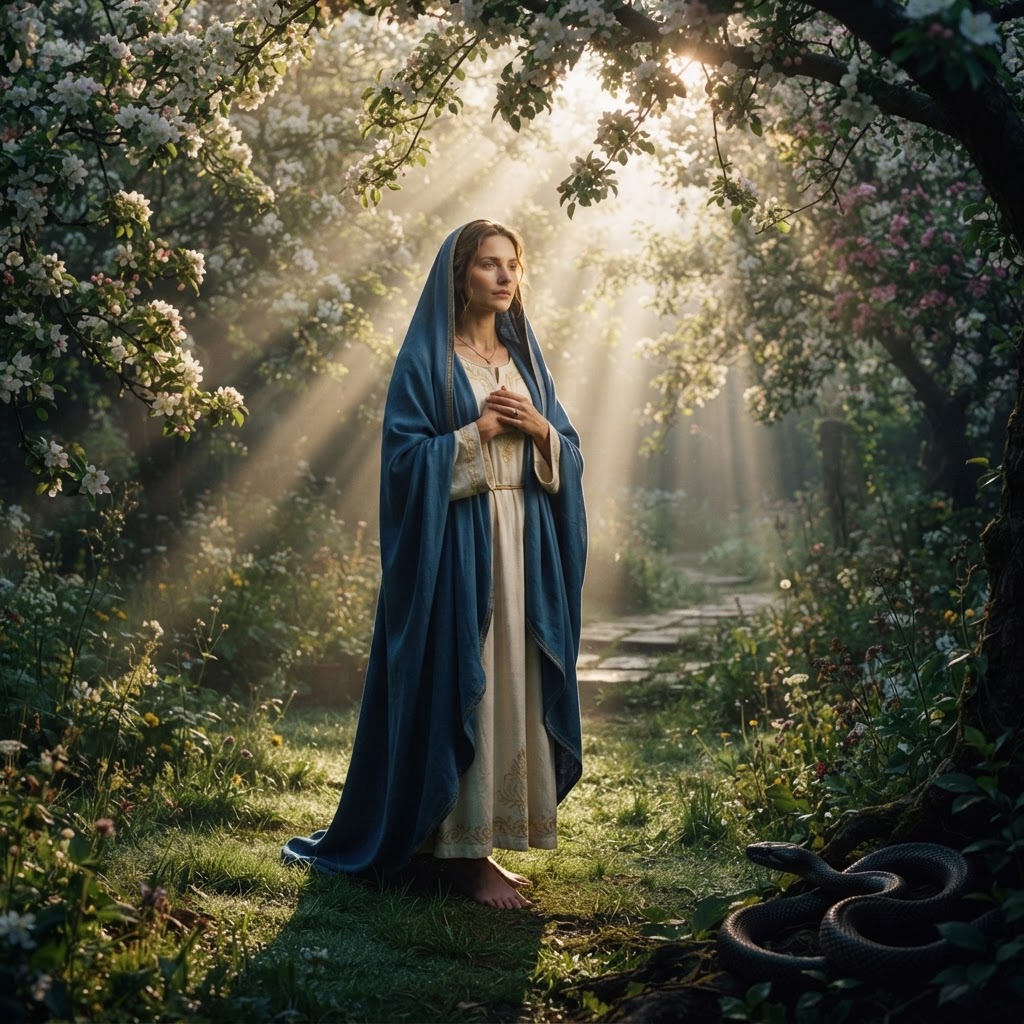
To study Mary is to study the way God keeps His promises. She does not appear in Scripture as a parenthesis between the Old Testament and the New; she appears at the seam where the two are joined, and she stands there as a woman in a garden. The first pages of the Bible and the last pages of the Bible both give us a garden, a tree, a river, and a woman. Mariology is the study of what God did in the middle of that story.
"I will put enmity between you and the woman, and between your seed and her seed; he shall bruise your head, and you shall bruise his heel."
Genesis 3:15 — the protoevangelium, the first Gospel
This verse is the first announcement of a Redeemer, and it is spoken to the serpent in the hearing of the woman. God does not simply reverse the verdict; He announces a conflict, and He places the woman inside it. The Fathers read the sentence with a double reference that the Church has never surrendered: the woman is Eve, and the woman is also the one who is to come — she whose seed will crush the head of the deceiver. Read within the whole canon, that seed is Christ, and the woman who bears Him is Mary. The enmity between the serpent and the woman is therefore not a metaphor for moral effort. It is the announcement of a maternal war, fought and won from the inside.
Three Gardens, One Story
The First Garden
Eden — where the woman was deceived
The story of the human race begins in a garden, and it begins with a woman listening to a question about God's word: 'Did God say?' Eve is not a footnote to the fall; she is the one addressed, the one who considers, and the one through whom the sentence of death enters. Every later promise of Scripture is spoken into that wound.
The Second Garden
Nazareth — where the woman answered
God's answer to Eden begins in Galilee, in a house, to a woman betrothed to a son of David. The angel does not argue; he announces, and he waits. Mary asks the one question that belongs to faith rather than unbelief — 'How shall this be?' — and then gives the answer Eve never gave: 'Behold, I am the handmaid of the Lord; let it be to me according to your word.' The new creation begins with a woman's consent.
The Third Garden
The Tomb — where creation began again
John is careful to tell us that the place of the crucifixion and burial was a garden. On the first day of the week, Mary Magdalene found the stone taken away and, weeping, mistook the risen Lord for the gardener — and she was closer to the truth than she knew. The first Adam was given a garden and lost it; the last Adam rises in one and restores it, and the tree of life reappears at the end of the Bible beside the river of the city of God.
The Woman Clothed with the Sun
Scripture closes with the same figure. In Revelation 12 a woman clothed with the sun, the moon beneath her feet and a crown of twelve stars on her head, is with child, and a dragon stands before her to devour the child. The child is caught up to God and to His throne; the woman is driven into the wilderness and preserved; and the dragon makes war on the rest of her offspring, "those who keep the commandments of God and bear testimony to Jesus."
The Church reads this passage of Mary and of the Church together, and the reading is not a confusion of the two but a revelation of their relation. What is true of the mother is true of the body: the same enmity, the same protection, the same crown. This is why Mariology is never a private enthusiasm for a holy woman. It is the doctrine of what God has done with His Church, shown first and most perfectly in one of its members.
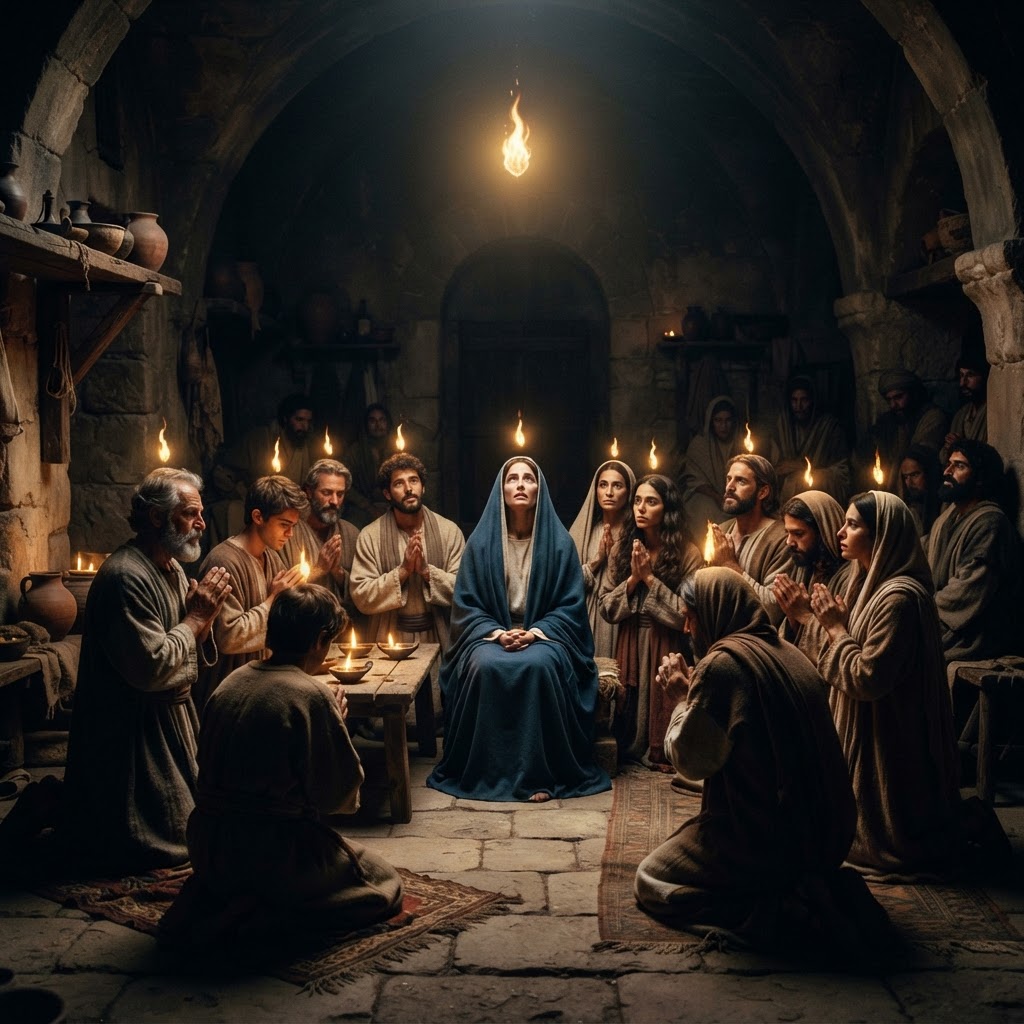
“Behold, I am the handmaid of the Lord; let it be to me according to your word.”
Luke 1:38
Mariology · II
The New Eve
The title "New Eve" is not a devotional flourish invented in the Middle Ages. It is the earliest Marian theology we possess, and it was formed by men arguing against the Gnostics and defending the reality of Christ's flesh. St Justin Martyr, writing in the middle of the second century, set the two virgins against each other: Eve, a virgin, conceived the word of the serpent and brought forth disobedience and death; Mary, a virgin, received the word of the angel with faith and joy, and brought forth the One who is salvation.
"The knot of Eve's disobedience was loosed by the obedience of Mary. For what the virgin Eve had bound fast through unbelief, this did the virgin Mary set free through faith."
St Irenaeus of Lyons, Against Heresies III.22.4 (c. 180 AD)
Irenaeus built a whole theology on it. His word for the pattern is recapitulation: Christ does not simply cancel the first Adam's failure from outside the story; He enters the story at the same points and does them rightly — born of a woman, tested in a garden, obedient unto death. Mary's place in that pattern is real and interior. Irenaeus can even say, with an audacity the Church has kept while guarding it, that she became "the cause of salvation for herself and for the whole human race." The Second Vatican Council received that language and set the boundary around it in Lumen Gentium 56, 60-62: her cooperation is wholly dependent on Christ's, drawn from His abundance, and in no way competes with the one mediation of the Redeemer.
Adam · Christ
One man's disobedience, one man's obedience
Sin entered the world through one man and death through sin; so grace and life enter through one man, Jesus Christ. The parallelism is Paul's, not a later invention (Romans 5:12-19; 1 Corinthians 15:21-22).
Eve · Mary
One woman's unbelief, one woman's faith
The Fathers saw the same structure on the woman's side of the story. Where Eve believed the serpent against God's word, Mary believed God against all appearances — and the knot the first woman tied, the second untied.
The Tree · The Cross
What was taken by a tree is given back on a tree
The fruit taken in the garden and the wood of the Cross are held together by the whole tradition, and by the liturgy itself, which sings of the happy fault that merited so great a Redeemer.
The Garden · The City
From an enclosed garden to a garden-city
The Bible ends where it began and then surpasses it: not a garden guarded by cherubim, but a city with a garden at its centre, whose gates stand open because the tree of life is there for the healing of the nations.
What the Doctrine Claims, and What It Does Not
The doctrine claims that Mary's obedience is free, deliberate, and meritorious in the order of grace; that she consented to the Incarnation on behalf of the whole human race as its representative in that moment; and that she sustained that consent from the Annunciation to the Cross, where it cost her everything the first Eve's refusal had cost God.
It does not claim that she is a second saviour. She does not add to the merits of Christ; she receives them and cooperates with them. Nor does it claim that her obedience was easier because she was immaculate — an immaculate will is a free will, and freedom is not diminished by the absence of sin but perfected by it. If anything, her obedience is more costly than Eve's consent to the serpent, because she alone knew the sword Simeon promised would pierce her own soul, and she went on saying yes.
The Two Errors to Avoid
The first error is excess: a piety that quietly transfers to the creature what belongs to the Creator, that treats Marian private revelations as doctrine, or that makes devotion to Mary the substance of the Christian life instead of the doorway into Christ. The second error is defect: a reaction that leaves the mother God gave us standing unused at the foot of the Cross, as though the words "Behold, your mother" were spoken to John about somebody else. The Catholic path runs between them, and the doctrine of the New Eve is what keeps the road straight: she is not God, and she is not optional.
Mariology · The Greeting
Most Blessed Among Women
Three times in a single chapter of the Gospel the word blessed is fastened to one woman. The angel addresses her as full of grace (Luke 1:28). Elizabeth cries out, filled with the Holy Spirit, that she is blessed among women and that the fruit of her womb is blessed (1:42). And Mary herself foretells that all generations will call her blessed (1:48). Every Marian doctrine the Church has ever defined is an unfolding of those three sentences.
Note what kind of blessedness this is. She is not blessed for anything she possessed by nature, achieved by effort, or merited in advance. She is blessed because of the Son she was given to bear, and because of the faith with which she received Him. Her greatness is entirely derivative, and that is precisely what makes it the greatest creaturely greatness there is: on the measure of the Kingdom, a creature is great in the exact proportion that it receives from God. The one who received the most is the one who is called blessed among women.
A woman in the crowd raised her voice and said to Him, “Blessed is the womb that bore you, and the breasts that you sucked!” But He said, “Blessed rather are those who hear the word of God and keep it!”
Luke 11:27-28
Christ does not deny the woman's blessing; He names its deepest root. Her body bore Him, and her obedience kept Him. The Church refuses to choose between the two, because Mary did not choose between them either: she who conceived the Word in her flesh first received Him in her faith, and she who bore Him in her body kept Him in her heart all the way to the Cross.
Why “Blessed Among Women” Is a Formula, Not a Sentiment
The phrase is not an invention of Christian piety. It is a technical, prophetic formula that appears three times in the Old Testament, each time over a woman who struck a decisive blow against the enemy of God's people. Luke deliberately puts it on Elizabeth's lips, and she speaks it “filled with the Holy Spirit” — which is Scripture's way of saying that what she says is not her own opinion but God's verdict.
Judges 5:24
Jael, blessed among women
Deborah's song blesses Jael as the most blessed “of tent-dwelling women” for driving a tent peg through the head of Israel's enemy. The formula is not a remark about her personality: it announces a victory won against the enemy of God's people through a woman's hand.
The Song of Deborah
Judith 13:18
“Above all the women on the earth”
When Judith returns carrying the head of Holofernes, the priest Uzziah blesses her in almost exactly the words Elizabeth will later use of Mary. Israel's deliverance came through a woman, by her own free act, at real risk to herself, and the blessing is spoken over her by a priest of God.
The deliverance of Bethulia
Genesis 3:15
The promise the formula was waiting for
Every such deliverance looks back to the first promise: the woman's seed would crush the serpent's head, and God would set enmity between the woman and the serpent. Luke 1:42 places the ancient formula on Elizabeth's lips at the very moment the two promises meet in one house, and in one womb.
The protoevangelium
Luke 1:48
A prophecy still being fulfilled
“All generations will call me blessed” is the only self-description of its kind in all of Scripture, and it is a prediction. Two thousand years of generations, languages, liturgies and nations doing precisely that is not sentimentality; it is a prophecy that has never once stopped coming true.
The Magnificat
The Immaculate Conception: What It Actually Claims
In 1854 Pius IX defined the doctrine in Ineffabilis Deus: that the most Blessed Virgin Mary, in the first instant of her conception, by a singular grace and privilege of almighty God and in view of the merits of Jesus Christ, the Saviour of the human race, was preserved immune from all stain of original sin. The grammar of that sentence is the whole doctrine. She was preserved, not cleansed. Prevented, not repaired.
This means she is not standing outside redemption; she is the most perfectly redeemed person who has ever lived. Every other soul is saved by being drawn out of sin; she was saved by being kept from it. Her sinlessness is not a private possession, it is a debt — owed entirely to the Cross of her Son, which reached backward in time to the first moment of her existence as surely as it reaches forward to ours. Grace got there first, and that is the point. She is the proof that God is free to give more than He must.
What the doctrine does not claim is equally important. It does not claim she had no need of a Saviour, nor that she was divine, nor that she was immune from suffering, temptation or growth. She was tempted as we are; she grew in grace, as Luke says plainly (2:52); she was puzzled at the Temple, uncertain at Cana, and pierced at the Cross. Her freedom was real, and so was her faith — which is the only reason her yes is worth anything at all.
Why It Is Biblical
Scripture's warrant here comes in two forms. There is the explicit word: the enmity of Genesis 3:15, the perfect passive fullness of Luke 1:28, the holiness grounded in the overshadowing of Luke 1:35. And there is the pattern of types, which is not a later embroidery on the text but the way the New Testament itself reads the Old: Adam and Christ, Eve and Mary, the Ark and the woman who carries God. The doctrine is the conclusion the Church draws when she asks what kind of dwelling the Word would prepare for Himself.
Genesis 3:15
Total enmity
God sets enmity — absolute hostility — between the woman and the serpent, and between her seed and his. A creature who had ever been the serpent's possession, even for an instant, would not be in total enmity with him. The first promise of the Gospel already implies a woman untouched by his dominion.
Read by the Church since the second century
Luke 1:28
“Having been graced”
The angel does not greet Mary by name first but by state: kecharitōmene, the one who has been and remains filled with grace. It is a perfect participle — a completed action with a permanent result. Gabriel addresses a condition already hers, before her consent, before the Child is conceived.
The angelic salutation
Exodus 25 · 2 Samuel 6
The Ark that could not be defiled
The Ark of the Covenant was made of incorruptible wood overlaid with pure gold, and the presence of God rested upon it. David was afraid to bring it into his own house, asking, “How can the ark of the Lord come to me?” Elizabeth asks the same question at the Visitation. The Church reads Mary as the Ark of the New Covenant, carrying not the tablets but the Word, not the manna but the Bread of Life.
Luke 1:43 echoes 2 Samuel 6:9
Irenaeus · Justin · the Fathers
The New Eve, and the logic of fittingness
The first Eve was made without sin, in a garden, before the fall. If God's work in Christ surpasses His work in Adam, the second Eve cannot be less endowed than the first: she begins where the old one began, and goes further. The Fathers argued this from the second century; the Church defined it in 1854 as a truth contained in the deposit of faith.
Ineffabilis Deus, 8 December 1854
Why It Is Prophetic
The doctrine is prophetic in the strict sense, because it stands on a prophecy: the woman of Genesis 3:15, and the sign seen in heaven in Revelation 12 — a woman clothed with the sun, crowned with twelve stars, whose offspring keep the testimony of Jesus. The Church has always read that sign as the same woman, in the same war, at the end of the same story.
But it is prophetic in a second sense too, and this one is uncomfortable. A Church that has stopped believing in sin has no need of a sinless Mother; a Christianity that has quietly reduced salvation to self-improvement finds the doctrine embarrassing. The recovery of this teaching is therefore a prophetic act in a generation that has made peace with sin. It says, in one sentence, that sin is real, that God is holy, and that His grace is free enough to arrive before we do.
The history of the doctrine carries the same witness. The feast was celebrated in the East for centuries before it was defined, the faithful prayed it long before the theologians settled it, and the last objection — that a sinless conception would exempt Mary from redemption — was answered not by diminishing her privilege but by seeing it as redemption in its most perfect mode. The Church defined it in 1854, in the age of rationalism, as a declaration that God is not bound by our plausibility. Four years later, at Lourdes, a fourteen-year-old girl was told a name: I am the Immaculate Conception.
The knot of Eve's disobedience was untied by Mary's obedience; what the virgin Eve had bound through her unbelief, the virgin Mary loosened through her faith.
Irenaeus, Against Heresies III.22
This is why the Church calls her blessed and does not stop calling her blessed. Not because she is a rival to her Son, but because she is the clearest evidence of what her Son does when He is given a free human yes. Hold the greeting, the formula and the doctrine together and one question remains: what would grace do in the flesh of a woman who never once refused it? The next section asks what the science of our own century has, without intending to, gone on to show.
Mariology · The Mother's Body
The Flesh He Took From Her
The Incarnation is not a metaphor, and the Creed is not a poem. Christ is consubstantial with the Father according to His divinity and consubstantial with us according to His humanity; He was born of a woman, born under the law (Galatians 4:4). That is a biological statement before it is anything else. The Word did not borrow a human appearance; He was knit together in a womb, from a mother's tissue, with a mother's genome, and He grew from a single cell that was hers.
So Mary gave her Son His flesh — truly, materially, down to the last chromosome. Every doctrine in this section rests on that one fact, and it is the fact the modern world finds easiest to spiritualise away. The Church has never allowed it to be spiritualised. She has said instead, in the language of the councils, that the Son of God is of one substance with us, and that the One who hung on the Cross was the One she carried, nursed and raised.
What the science of the last thirty years has uncovered is this: the traffic between a mother's body and her child's does not stop at birth. It never stops at all.
The mutual indwelling of mother and child
Fetal Microchimerism: The Discovery
During pregnancy, cells from the child pass across the placenta into the mother's bloodstream. Some of those cells are stem cells. They do not merely pass through; they settle. They engraft into maternal tissue — bone marrow, liver, thyroid, lung, heart, and the brain — and they stay there for decades, sometimes for the rest of the mother's life. The phenomenon is called fetal microchimerism (also fetomaternal or fetal-maternal microchimerism), and it is now one of the better-documented facts in reproductive immunology. The traffic runs both ways: a mother's cells also cross to her child, and remain in him.
Read that in the light of the Annunciation and it becomes difficult to put down. If this is true of every mother who has ever conceived, then it was true of the Mother. The cells of the incarnate Word — the flesh she had given Him, now living within Him — returned to her and made a home in her own body. She carried Him twice: for nine months in her womb, and then for the remainder of her earthly life, in her own blood and tissue, through Bethlehem and Egypt, through Nazareth and Cana, along the Via Dolorosa, at the foot of the Cross, and in the upper room waiting for the Spirit.
Established by research
What the science shows
Fetal cells, including stem cells, cross the placenta from the earliest weeks of pregnancy and are found not only in the mother's blood but in her organs, where they engraft and persist. Male fetal DNA has been detected in women's blood as long as 27 years after giving birth (Bianchi et al., PNAS, 1996), in thyroid tissue (Srivatsa et al., The Lancet, 2001), and in the brain itself, in multiple regions, decades after bearing a son (Chan et al., PLoS ONE, 2012). In experimental models, fetal cells have been shown to travel to injured maternal heart muscle and take on cardiac characteristics (Kara et al., Circulation Research, 2012).
The phenomenon is called fetal microchimerism
The limits of the evidence
What the science does not show
It does not prove the Immaculate Conception. It does not prove the Assumption. It says nothing about the state of anyone's soul, and it is not a new revelation. It is a fact about bodies: human beings carry one another's cells for life, and a mother carries her child's. Doctrine rests on Scripture and Tradition. Biology at most shows how completely the Incarnation took flesh, and how unnatural it would be for a body given to God to be simply abandoned.
Mystery is received by faith, not measured in a laboratory
The Assumption: The Fitting End of a Chain of Grace
On 1 November 1950, Pius XII defined the Assumption: that the Immaculate Mother of God, the ever-Virgin Mary, having completed the course of her earthly life, was assumed body and soul into heavenly glory. Note that the definition does not settle whether she died first. What it defines is that death did not get to keep her body — and it defines something else, which is easy to miss: that her body mattered enough for God to take it with her.
Scripture's nearest warrant is a sequence in the book of Revelation, where the Ark of the covenant is seen in the temple of heaven and a woman appears in the very next verse. The Ark of the New Covenant is in heaven, and so is the woman; that sequence is set out in full in the section that follows. And where the Psalmist writes that God will not let His Holy One see corruption (Psalm 16:10), the Church reads it first of Christ, and then of the Ark that bore Him: it was never fitting that the dwelling of God should return to dust while the memory of the Incarnation was still young.
This is why the scientific discovery matters, and it matters in a very precise way. It cannot demonstrate the Assumption, and it should never be sold as though it could. What it does is remove the impression that the doctrine is a pious embroidery on the Gospel. If the Son of God took a real body from a real woman, and if bodies carry one another, then the Assumption is the only ending that fits the story. The Mother's body is not a container that was used and set aside. It is the place where God lived. The theology of the Immaculate Conception, the biology of the motherhood, and the definition of the Assumption are three statements about the same reality: the flesh that belonged wholly to God.
The Chain of Fittingness
Preserved at the beginning
Immaculate from the first instant of her conception: the dwelling is prepared before the Guest arrives.
Filled with grace
Addressed by state rather than by name — the one who has been and remains full of grace (Luke 1:28).
The Word takes flesh
Every cell of Christ's human body, and the whole human genome within each of those cells, came from her. He is of her substance, truly.
Her flesh carries Him still
The Child's cells crossed into her body and remained there for the rest of her life. She bore Him twice.
Assumed at the end
The flesh that bore God, and continued to carry Him, is not left to corruption (defined 1 November 1950).
What This Means for the Mother of God
Put the doctrine and the discovery side by side and three things follow. First, the Incarnation was physical: the Word really became a man, with a body formed from a woman's body, which is the only reason the Cross, the Eucharist and the Resurrection of the body can mean anything at all. Second, Mary's motherhood did not end at Bethlehem. It began there, and it continued in a way no mother before or since could claim: the One she bore lived in her, and His cells lived in her until the day she was taken up. Third, the Assumption is not a reward bolted on to a life well lived. It is the harvest of the Incarnation. What God joined to Himself in the womb He did not intend to leave behind in a tomb.
Which means the Immaculate Conception and the Assumption are not two separate devotions but one argument with two ends. She was preserved from sin at the beginning because God was preparing a dwelling. She was assumed at the end because that dwelling had been inhabited. Between the two stands a woman who said yes, and who never stopped carrying Him.
A Word for Mothers
If bodies carry one another, then the woman who miscarried still carries her child, and the woman whose child died at forty still carries her child, and the woman who gave a child away carries her child too. The discovery cuts across grief and comfort together: nothing about a pregnancy is ever nothing, and no child is ever entirely gone from the body that bore him or her. The Mother of God is the pattern of that union, and she is also its comfort. Nothing offered to God is lost.
The Annunciation · The Throne of David
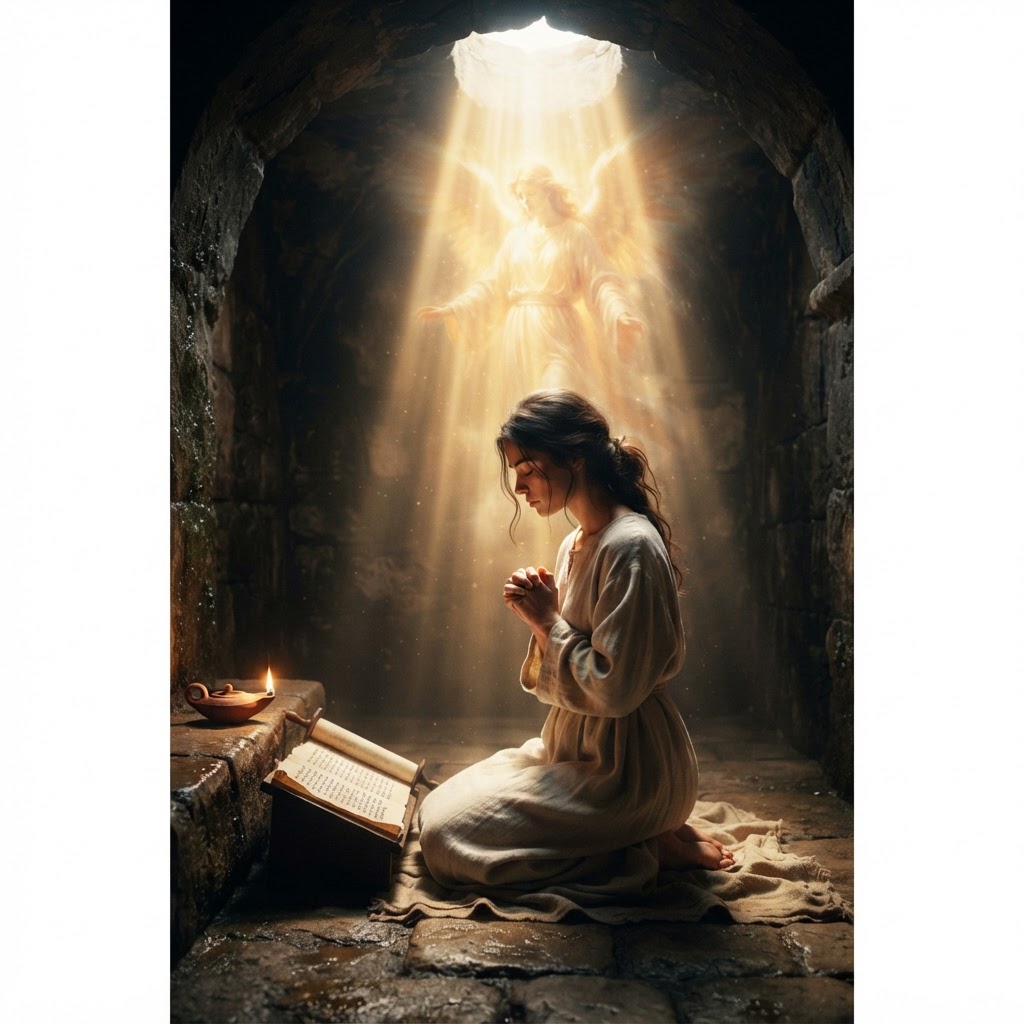
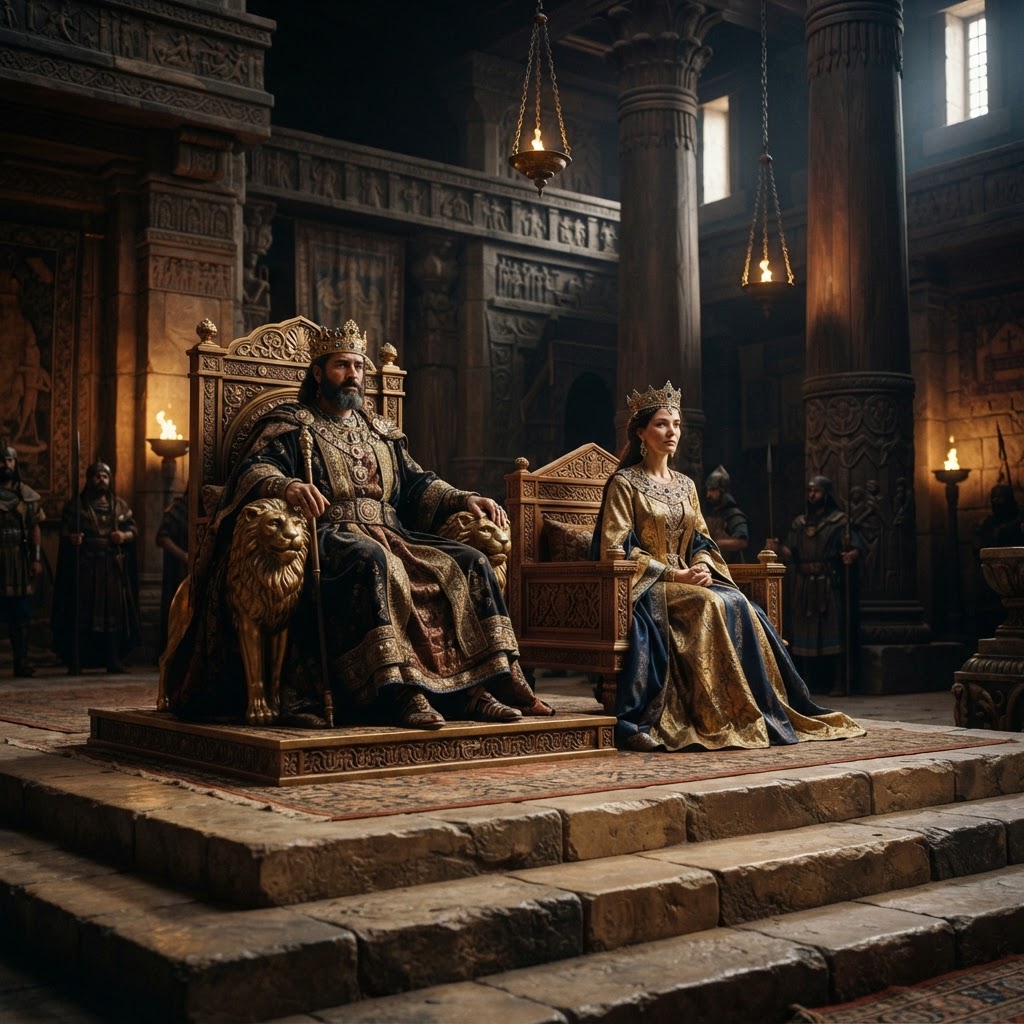
What Israel knew in its palace, the Church confesses of Mary: the Kingdom has a King, and the King has a Mother.
The Davidic Office of the Queen-Mother
Mariology · III
The Ark of the New Covenant
In Israel there was one object of unsurpassable significance: a chest of acacia wood, overlaid within and without with pure gold, with two cherubim overshadowing the mercy seat, kept in the holiest place of the tabernacle and then of the temple. Inside it were the two tablets of the Law, a jar of manna, and the rod of Aaron that budded (Exodus 25:10-22; Hebrews 9:4). It was the place of the divine presence — "there I will meet with you" — and it was not to be touched. A man died for steadying it with his hand when the oxen stumbled.
The ark contained the word of God written on stone, the bread from heaven, and the sign of the priesthood. Luke, a careful historian with an ear for the Septuagint, tells the story of the Visitation so that no reader can miss what he is doing: Mary is the Ark. She bears the Word made flesh, the true bread come down from heaven, and the High Priest who is also the sacrifice. She is wood overlaid with gold, humanity filled with divinity, and she is not to be handled casually.
The Parallels Luke Intends
David arose and went with all the people to the hill country of Judah, to bring up from there the ark of God.
2 Samuel 6:2-11
In those days Mary arose and went with haste into the hill country, to a city of Judah.
Luke 1:39
And David was afraid of the LORD that day; and he said, 'How can the ark of the LORD come to me?'
2 Samuel 6:9
And why is this granted me, that the mother of my Lord should come to me?
Luke 1:43
And David danced before the LORD with all his might... with shouting and the sound of the horn.
2 Samuel 6:14-15
The babe leaped in her womb; and Elizabeth was filled with the Holy Spirit and cried out with a loud voice.
Luke 1:41-42
And the ark of the LORD remained in the house of Obed-edom three months; and the LORD blessed him.
2 Samuel 6:11
And Mary remained with her about three months, and returned to her home.
Luke 1:56
If Mary is the Ark, then the two defining doctrines about her are not flattery but fittingness: the vessel that carries the Presence must be consecrated, and the vessel that has borne the Lord of life cannot be left to corruption.
Why the arkship of Mary matters for formation
Defined 8 December 1854
The Immaculate Conception
By the singular grace and privilege of Almighty God, and in view of the merits of Jesus Christ, Saviour of the human race, Mary was preserved immune from all stain of original sin from the first instant of her conception. Four things must be held together: she was redeemed, not exempt — she needed a Saviour, and was saved preventively rather than after the fact; this is not the Virgin Birth, which concerns the conception of Christ by the Holy Spirit; it is God's gift, not her achievement, so it magnifies grace and not merit; and its scriptural anchors are Genesis 3:15, read within the whole canon, and the angel's greeting in Luke 1:28, where she is addressed as one who has already been, and remains, full of grace.
Defined 1 November 1950
The Assumption
Having completed the course of her earthly life, Mary was assumed body and soul into heavenly glory. The definition rests on the unbroken liturgical memory of the Church, East and West, which kept the feast of her Dormition from antiquity; on the fittingness of the Ark of the New Covenant being preserved from the corruption that follows sin; and on the fact that, in her, redemption has already reached its final term. She is not an exception to the Church's destiny but the first realisation of it — a sign of what the resurrection will do for the whole body.
Dogma and opinion
What is defined, and what is debated
The Church has defined that she was preserved from original sin and that she is in glory, body and soul. She has not defined whether Mary died before being assumed, nor the circumstances, nor the date. These remain matters of legitimate theological and liturgical discussion, and the Eastern tradition speaks of the Dormition where the West speaks of the Assumption. Distinguishing the defined doctrine from the honoured opinion is not scepticism; it is the discipline by which devotion is kept honest.
What This Means for the Disciple
The doctrine of the Ark gives the disciple a habit of reverence. The presence of God is not a casual thing; it has never been casual. God prepared a place for Himself among us, and He prepared the one who would carry Him — purified, overshadowed, and filled. If the Lord was willing to prepare a mother of such holiness for His own coming, then the work of formation is not the Church's attempt to earn grace but the Church's cooperation with a grace that has always been preparing people for a purpose. Holiness is not an intensification of our own effort. It is what happens to a life that the Spirit is allowed to overshadow.
Mariology · The Ark in Heaven
The Woman, the Ark and the Ancient Serpent
There is a place in Scripture where the Ark of the Covenant reappears, and it is not in a museum or a excavation report. It is in the last book of the Bible, at the climax of the seventh trumpet, and John sees it in the temple of heaven. What follows in the very next sentence is one of the most consequential verses in Mariology, and most readers never see it as connected, because a chapter number sits between them.
Then God's temple in heaven was opened, and the ark of his covenant was seen within his temple... And a great portent appeared in heaven: a woman clothed with the sun, with the moon under her feet, and on her head a crown of twelve stars.
Revelation 11:19 & 12:1, read as one sentence
Read that way, without the interruption, the vision does something extraordinary. The Ark is seen; and then, in the same breath, the vision shows us what has been seen. It is a woman. The Ark of the Covenant, missing from the second temple, never recovered from the ruin of the first, and promised by Jeremiah to be remembered no more because the Lord Himself would be the throne (Jeremiah 3:16), is located at last: not buried in a cave, but in heaven, and not as a box of gold but as a mother with a child.
A Seam That Is Not in the Text
The division between chapters 11 and 12 of Revelation is not part of the inspired text. The Greek manuscripts, including the great fourth-century codices, run continuously, with no chapters, no verses, and often no spaces between words. Chapter numbers came into common use with Stephen Langton, Archbishop of Canterbury, in the early thirteenth century; verse numbers with Robert Estienne in the 1550s. The seam between Revelation 11:19 and 12:1 is a medieval and Renaissance editorial convenience, roughly twelve hundred years younger than the book itself.
This matters because chapter divisions were never intended to be theological, but they do shape what readers notice, and this one hides a link the original text makes emphatically. The same thing has happened elsewhere: the fourth Servant Song of Isaiah begins at 52:13, and the chapter break at 53:1 orphans its opening line from the rest of the poem, which is why it took centuries of preaching to make “Behold, my servant shall prosper” and “Who has believed our report?” sound like one song. The Ark and the Woman have suffered the same fate.
The Manuscripts
No chapters, no verses
The text John wrote had no numbers in it at all. The connection between the Ark and the Woman is not a reading imposed on the text; it is a reading of the text as it actually runs.
Fourth-century codices
The Parallel Case
Isaiah 52:13-53:12
The most famous chapter break in Scripture splits a single poem in half. Chapter divisions are useful for finding your place and misleading when they fall inside an argument.
The Suffering Servant
The Liturgy
The Church reads it as one
The lectionary for the Assumption takes Revelation 11:19a and 12:1-6a, 10ab as a single continuous reading. At the altar, the seam disappears.
Mass of the Assumption
The Ark Was a Chest; the Woman Is a Person
The Ark was the place where the presence of God rested among His people, and everything it contained was a prophecy of what the woman of Revelation 12 would carry. This is not an invention of later piety: Luke has already told the Visitation in the language of the Ark's journey. When David brought the Ark up to Jerusalem he was afraid and asked, “How can the ark of the LORD come to me?” (2 Samuel 6:9). Elizabeth, filled with the Holy Spirit, asks, “And why is this granted me, that the mother of my Lord should come to me?” (Luke 1:43). The Ark stayed three months in the house of Obed-edom; Mary stayed about three months with Elizabeth. David danced leaping before the LORD; the infant leapt in Elizabeth's womb, and Luke uses the same verb twice to make sure we notice (1:41, 44).
The Manna
Bread from heaven becomes the Bread of Life
The Ark held the golden urn of manna, the bread God rained down in the wilderness (Exodus 16:33; Hebrews 9:4). The woman of the Apocalypse carries the One who said, “I am the bread of life; your fathers ate the manna in the wilderness and they died” (John 6:48-49). What the Ark contained as a relic, she contained as a Person.
Exodus 16 · John 6
Aaron's Rod
The priesthood that budded becomes the great High Priest
Aaron's rod that blossomed overnight settled the question of who had the right to stand before God in Israel (Numbers 17:1-11). The Child of Revelation 12:5 is the High Priest who does not offer the blood of goats but His own (Hebrews 9:11-14). The wooden sign is swallowed by the reality.
Numbers 17 · Hebrews 9
The Tablets
The written word becomes the living Word
The two stone tablets of the covenant were kept inside the Ark, the Law written by the finger of God. She who bore the Word made flesh carried the author of the tablets in her own body (John 1:14). John does not say the Law appeared; he says the Word was made flesh and dwelt among us.
Exodus 25:16 · John 1:14
Incorruptible Gold
The wood that could not decay
The Ark was made of acacia wood overlaid with pure gold, inside and out (Exodus 25:11), a construction chosen so that it would not rot. The Church read that detail and drew the conclusion the Assumption gives: the dwelling of God was not made to see corruption.
Exodus 25:11 · Psalm 16:10
Clothed with the Sun
The woman is described by what she wears before she is described by who she is. She is clothed with the sun, standing on the moon, crowned with twelve stars. If the sun is Christ — and Scripture says so, calling God a sun and shield (Psalm 84:11) and promising the sun of righteousness who rises with healing in his wings (Malachi 4:2) — then the woman is a creature clothed in the light of her Son, wearing nothing of her own making. Paul uses the same idiom for every baptised Christian: you have put on Christ (Galatians 3:27). She simply wears Him first and wears Him whole.
The moon under her feet is the lesser, borrowed light, the light that changes with its phases and governs nothing; she stands on it, not under it. The crown of twelve stars joins the twelve tribes to the twelve apostles, Israel and the Church, one people in two Testaments. And John calls her a sign — a great portent in the sky — which is why the Church has always been willing to see her in the sky, exactly as she appears in the iconography of the Woman of the Apocalypse, and in the image left at Guadalupe: a woman clothed in the sun, standing on the moon, crowned with stars.
The Ancient Serpent
The serpent of the Apocalypse is not a new enemy. The dragon standing before the woman to devour her child is named by John in the same chapter as “the great dragon... that ancient serpent, who is called the Devil and Satan, the deceiver of the whole world” (Revelation 12:9). “That ancient serpent” is the serpent of Genesis 3, and the enmity set between the serpent and the woman in the garden is the same enmity played out at the scale of heaven. The Protoevangelium is not left behind in Genesis; it is the plot of the last book of the Bible.
In the middle of that war stands the woman, nourished in the wilderness for 1,260 days, hidden from the dragon's jaws, while Michael and his angels cast the dragon out. The victory is named explicitly: “they have conquered him by the blood of the Lamb and by the word of their testimony” (12:11). Nothing in the text allows the woman to be a rival to her Son in the battle. She is the place where the victory was planted, and the flesh from which the conqueror was taken.
This is why the Church reads Genesis 3:15 with such care. The Hebrew text gives the crushing to the woman's seed; the Greek translation gives it to him; the Latin Vulgate reads it as “she shall crush your head” — and from that reading came centuries of Marian iconography in which Mary's foot rests on the serpent. The Church has never permitted the image to be read as though Mary won the victory by her own power. Her enmity with the serpent is total, and it is real, because it is the enmity God Himself placed there; but the heel that crushes is her Son's, and she shares in His victory by grace and by motherhood, not by force. Which is also why Paul can say the same thing of all the faithful: the God of peace will soon crush Satan under your feet (Romans 16:20).
Who Is the Woman?
The vision does not answer that question with a single name, and we should resist making it do so. It answers with a family of names, because the woman is a corporate figure with a personal heart. The same woman is Israel in travail, who gave the world its Messiah; Mary in person, who bore the child and fed Him; and the Church, whose offspring are those who keep the commandments and hold the testimony of Jesus. Israel, Mary, Church: one woman, growing like a seed through the story of salvation.
Israel
The daughter of Zion in travail
The prophets describe Israel herself as a woman in labour, crying out in her anguish to be delivered (Isaiah 26:17; 66:7-9; Micah 4:10). Joseph's dream shows the same figure from below: the sun, the moon and eleven stars bowing to one man, and his father asking whether they are meant to bow (Genesis 37:9-10). The woman clothed with sun, moon and stars is Israel, from whom the Messiah comes.
Genesis 37 · Isaiah 26 · Micah 4
Mary
The one who bore the child who rules the nations
The child is caught up to God and His throne and is destined to rule the nations with a rod of iron, which is Psalm 2 applied to Christ (Psalm 2:9; Revelation 2:27). The Church has therefore read the woman in her personal sense as Mary, and John's Gospel gives her the same title the vision does: she is “the woman” at Cana, and “the woman” at the Cross (John 2:4; 19:26).
Psalm 2 · John 2 & 19
The Church
The mother whose offspring keep the testimony of Jesus
The vision moves immediately from the child to “the rest of her offspring, those who keep the commandments of God and bear testimony to Jesus” (Revelation 12:17). That is the Church. The woman is therefore Israel fulfilled, Mary personally, and the Church corporately, with Mary as the personal centre in whom the type becomes a body.
Revelation 12:17
What the Liturgy Does With It
The Church has already made a judgment on all of this, and she made it in her calendar rather than in a commentary. On 15 August, the Solemnity of the Assumption, the first reading is Revelation 11:19a with 12:1-6a and 10ab — the Ark and the Woman, one reading, uninterrupted. When the doctrine was defined in 1950, the same passage stood behind it: the Ark of the Covenant, made of wood that would not rot, appears in heaven, and the woman appears in heaven with it. If the dwelling of God is in heavenly glory, then a doctrine that says her body and soul are in heavenly glory is not an addition to Scripture. It is the identification of the figure Scripture shows us.
And note where the woman of Revelation 12:2 stands in her anguish, crying out in the pains of childbirth. Read alongside the Gospel, that cry puts her at one more place: at the foot of the Cross, where the child is born into the world a second time, when the soldier opens His side and blood and water flow out (John 19:25-34). That is the scene where Jesus calls her “woman” and gives her to John, and John to her: the same woman, the same child, and the beginning of the offspring who keep the testimony of Jesus.
What Is and Is Not Claimed
Honesty serves the doctrine here. Revelation 12 is first of all about Israel and the Church under persecution; it is not a Marian portrait with the other meanings stripped out, and the Church's reading of it is typological and theological rather than a single flat literalism. Nor is the chapter break a conspiracy; Langton and Estienne gave us a useful reference system, and this seam is simply a place where the system costs the reader something. What can be said without overreach is this: Scripture shows us an Ark in heaven, and in the next breath a woman. It shows us the ancient serpent, and a woman in enmity with him. It shows us a child who rules the nations, caught up to the throne of God, and a mother whose other offspring hold the testimony of Jesus. Gather those threads and the Assumption stops being an isolated privilege and becomes the plain end of the story.
The temple was opened, the Ark was seen, and the Woman appeared. The Ark was never lost. It was taken up — and she conquered him by the blood of the Lamb.
Revelation 11:19-12:1, 12:11
Mariology · Watch
Mary in the Bible
The case made on this page was not built by Catholics reasoning in a corner. It was built by men reading the text, and one of the most useful living witnesses to that is Dr Scott Hahn: a former Protestant pastor who spent years in Scripture before the biblical Mary became unavoidable to him. Here he sets out the references and the significance of Mary in the Bible, in the order Scripture gives them.
Watch · Mary in the Bible
Dr Scott Hahn, former Protestant pastor and Catholic convert
Why this belongs here. Every claim on this page stands on the same ground: the Ark of the Covenant, the New Eve, the Mother of the Davidic King, and the woman clothed with the sun. Hahn's value is that he did not arrive at any of it by inheritance. He read the Old Testament as a Protestant minister, found the mother of the Messiah already there, and was led by the text rather than by sentiment. Watch it as a second pass over the argument you have just read.
Mariology · IV
The Queen-Mother of the New Davidic Kingdom
Here the Jewish roots of Marian doctrine become unavoidable, because the title that Scripture gives to Mary is not an honour invented by later piety. It is an office. In the monarchy of David, the woman who took the seat of honour at the king's right hand was not his wife but his mother. She was called the gebirah, the great lady, and the books of Kings and Jeremiah name her with each reign as a public figure of the realm.
"So Bathsheba went to King Solomon, to speak to him on behalf of Adonijah. And the king rose to meet her, and bowed down to her; then he sat on his throne, and had a throne brought for the king's mother; and she sat on his right hand."
1 Kings 2:19
The scene is worth lingering over, because it defines everything. A petition is brought to the king through his mother. He rises before her, bows to her, and seats her on a throne beside his own — the son who rules the nation honouring the woman who bore him, and receiving petitions through her. The same institution runs through the history: Maacah, mother of Asa, is named as queen mother and removed from her position when her idolatry became a scandal (1 Kings 15:13); Jeremiah addresses the queen mother as a person of consequence whose crown would be brought down (13:18); and the final chapter of Proverbs places a queen mother's instruction at the end of the wisdom of Israel (31:1).
Psalm 45 completes the picture. It is a royal wedding psalm, and at its centre is a single image: the queen, in gold of Ophir, standing at the right hand of the king. The Church has always read that psalm of Christ — and the woman at His right hand as His mother and His bride, Israel perfected, the Church crowned.
The Kingdom Christ Established
When we say that Christ established a Kingdom, we are not speaking of an inward disposition of the soul. We are speaking of the restoration of the Davidic monarchy in a form that will never end, with all the offices of that monarchy filled. This is why the New Testament is so insistent on the son of David, on the keys, on the throne, on the banquet, and on the Mother.
The King
The anointed son of David
The angel's word to Mary is a political announcement in the most literal sense: 'The Lord God will give to Him the throne of His father David, and He will reign over the house of Jacob for ever' (Luke 1:32-33). Christ's kingship is not a metaphor borrowed from Israel's monarchy; Israel's monarchy was a shadow of His.
The Gebirah
The mother of the king, crowned and enthroned
In the Davidic court the first lady of the realm was not the king's wife but the king's mother, the gebirah — a settled office, because the mother never changes though queens might. She sat at the king's right hand and could be approached as an intercessor.
The Prime Minister
The steward with the keys
Isaiah 22:20-23 describes the royal steward, Eliakim, who is given the key of the house of David, authority to open and shut, and a throne of honour in his father's house. Christ gives precisely this office to Peter (Matthew 16:18-19): a kingdom with a prime minister is a kingdom with a government.
The Banquet & the Bride
The wedding feast and the queen
The Kingdom is described by its King as a wedding banquet, and the Church is His bride — the language of the Song of Songs, of Psalm 45, and of Revelation 19 and 21. A kingdom with a King, a Mother, a steward, a banquet and a bride is not an idea. It is a family.
Mary as Gebirah: Cana as the Model
The wedding at Cana (John 2:1-11) is the clearest portrait we have of Mary's office in the Kingdom, and it is placed deliberately at the beginning of Christ's public ministry. The wine fails. Mary notices before anyone else and brings the need to her Son: "They have no wine." He answers in the idiom of a king addressing a woman of the court — His hour has not yet come — and then He acts. She turns to the servants with the sentence that is the whole of Marian spirituality: "Do whatever He tells you."
Three things follow from that scene. Her intercession is real: she asks, and the request is granted. Her intercession is not autonomous: it does not override the King's will or His hour; it occasions them. And her intercession always terminates in obedience to Him: she is never an alternative to Christ, she is the way a mother sends her children to her Son. Elizabeth's greeting is the doctrinal summary — "the mother of my Lord" — and the Council of Ephesus in 431 defended precisely this title, Theotokos, because confessing Mary as Mother of God is confessing her Son as God.
The crown of twelve stars in Revelation 12 is not a decoration on this. A crown belongs to royalty, and the mother of the Davidic king wears one because her Son does. What Israel knew in its palace, and what the Church confesses of Mary, is the same truth: the Kingdom has a King, and the King has a Mother.
Mariology · V
Mother of the Church, First of the Saints
If Christ restored the Davidic Kingdom, then that Kingdom now exists, and it exists in the Church. This is the claim the New Testament makes on almost every page: the keys given to Peter, the banquet that is the Eucharist, the royal priesthood of the baptized, the bride adorned for her husband, the city whose gates are open. Mary's place is inside that Kingdom, at the head of the household, and the doctrine of her motherhood is inseparable from the doctrine of the Church herself.
The Second Vatican Council said it plainly: Mary is "a type of the Church in the order of faith, charity, and perfect union with Christ" (Lumen Gentium 63). She is not a figure standing outside the Church and pointing at it. She is what the Church is, in one member, already complete. Paul VI gave the title that expresses this at the close of the Council in 1964: Mary is Mater Ecclesiae, the Mother of the Church.
"Since we are surrounded by so great a cloud of witnesses..." — and in heaven, "the smoke of the incense rose with the prayers of the saints from the hand of the angel before God." The prayers of the saints are not a sentiment. They are offered at the altar of heaven.
The communion of saints — Hebrews 12:1 and Revelation 8:3-4
One Body, Three States
The Church professes one communion of saints in three conditions: the pilgrim Church on earth, the holy souls being purified, and the blessed in glory. These are not three churches but one body with different members (1 Corinthians 12:12-27), held together by Christ and joined by a real exchange — the saints intercede for us, we honour them and can aid the holy souls by prayer and sacrifice. Intercession is therefore not a supplement to the Gospel; it is what a body does for its members. If Christ is the one Mediator (1 Timothy 2:5), it is He who makes the members of His body mediators of one another — which is precisely what the doctrine of Mary's motherhood teaches, in its highest instance.
The order is a family order, not a chain of command: the Father sends the Son, the Son takes a Mother, the Mother bears the King, the King gathers a body, and the body is filled with saints. Everything comes from Christ, and everything returns to Him. Mary is not placed between the soul and Christ as an obstacle; she is the one who says most clearly, and always, "Do whatever He tells you."
Her Three Firsts
First Disciple
She heard the word of God and kept it
When a woman in the crowd blessed the womb that bore Him, Christ answered by naming the deeper blessedness: 'Blessed rather are those who hear the word of God and keep it' (Luke 11:28). No one has ever done that as Mary did. She believed the word at the Annunciation when nothing yet confirmed it (Luke 1:45); she kept and pondered it in her heart through the hidden years (Luke 2:19, 51); she stood by the Cross when keeping it cost her everything (John 19:25); and she was at prayer with the Church when the promise was poured out (Acts 1:14). Discipleship is measured by those four movements, and she is their pattern.
First Among the Saints
The highest of all creatures by grace
The communion of saints is a graded communion, not a flat assembly. Every saint is a creature transformed by grace, and grace is given differently: 'star differs from star in glory' (1 Corinthians 15:41). Mary, addressed as full of grace, is the first fruits of the redemption — what every one of the saints is becoming, in her already complete. That is why the Church calls her Queen of Angels and Saints, not as a rival to Christ but as the purest evidence of what He does with a human being who does not resist Him.
First Member of the Church
She was the Church in its beginning
In the order of time she believed before the apostles, received the Word before the Church existed as a gathered body, and so is the first member of the Church — the first to hold the faith that the rest would receive from her Son. At the Cross she is given the disciples as her children — 'Woman, behold your son' — and becomes Mother of the Church. At Pentecost the Spirit falls upon the whole assembled company, and she is in the midst of them, praying: not standing over the Church, but wholly within it, as its mother and its first member.
Worship, Veneration, and the Fear of Idolatry
The Church distinguishes with precision what belongs to whom. To God alone belongs latria, the worship of adoration. To Mary belongs hyperdulia, a unique veneration higher than that given to the other saints but infinitely below worship. To the saints belongs dulia, veneration of those whom God has glorified. These are not theological niceties; they are the walls that keep devotion from becoming idolatry. Ask Mary to pray for you, as you would ask a holy friend to pray for you. Do not offer her what belongs to God.
Within those walls, devotion is meant to be substantial, not embarrassed. The Rosary is a scriptural school, praying the Gospel through the eyes of the one who lived it. The consecration to Jesus through Mary, made classical by St Louis de Montfort, is a way of handing over our attachments to the mother whose obedience untied the knot of the first woman's. The Hail Mary is itself two-thirds Scripture. A Catholic who knows how to use these things is a Catholic with a formidable formation.
And the measure of all of it is whether Christ becomes more visible in us. Where Marian devotion does not produce obedience, humility, purity, and courage, it has gone wrong somewhere. Where it produces those things, it is working exactly as God intended when He said, from the Cross, "Behold, your mother."
Daily Reflection · Mariology
The Mother Who Sends Us to Her Son
"My soul magnifies the Lord, and my spirit rejoices in God my Saviour... for He who is mighty has done great things for me, and holy is His name."
Luke 1:46-49
The Magnificat is the Church's own song, and it is a woman's song about a Kingdom in which the proud are scattered, the lowly are lifted, and the hungry are filled. Every doctrine gathered on this page terminates in that one sentence she spoke at Cana and speaks still: do whatever He tells you. Hold the Mother, and she will hold you to the Son. Ask her to pray for you tonight, and then go where she sends you.