
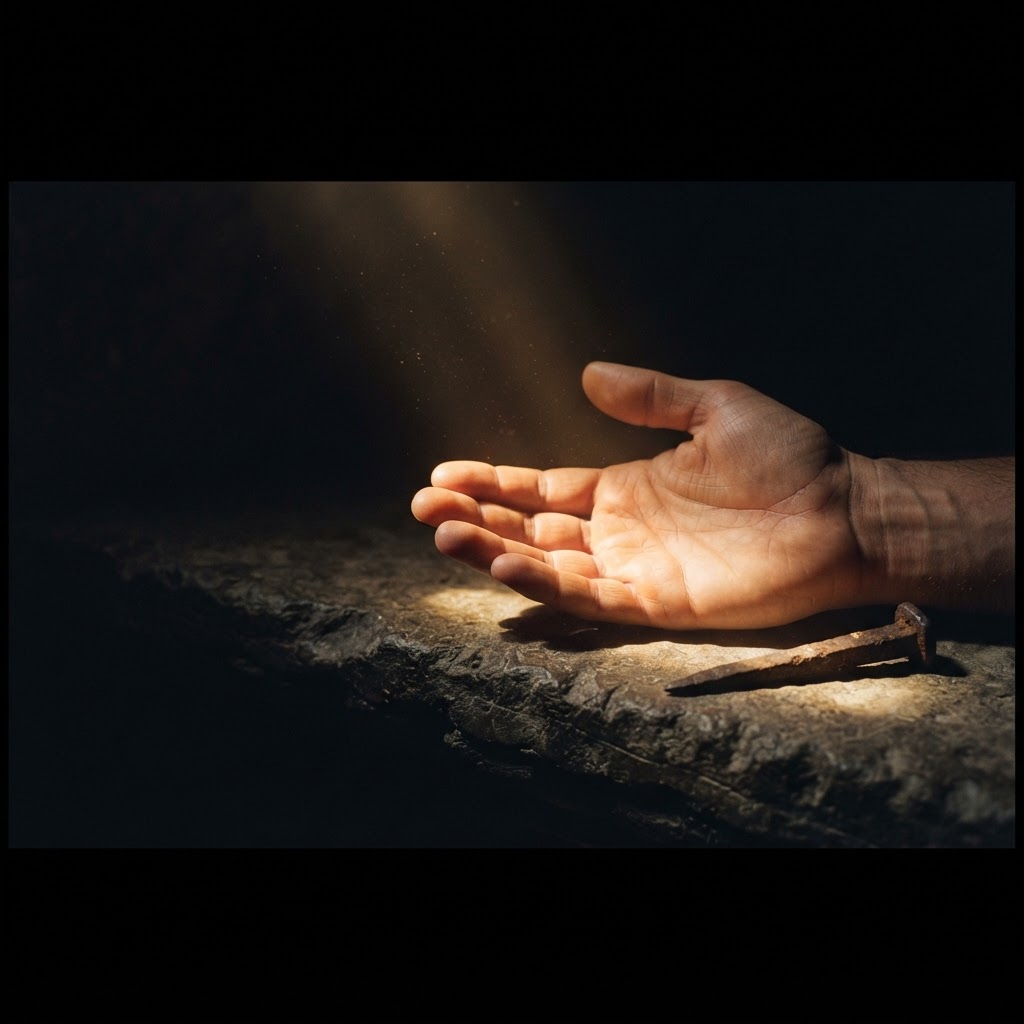
Behold the Hand,
Behold the Nail?
A popular infographic says the four letters of God's name spell out the crucifixion. Hebrew says otherwise. Then Thomas says something greater, and he says it to a man who still had the nail marks.
By Justin Poor. Catholic Prophetic Apologist, drawing from Sacred Tradition, the Fathers, Doctors, and the Full Magisterium
I · The Claim
Four letters, and a picture of the cross
The infographic is an old and much shared one. It sets out the four consonants of the divine name, yod, he, waw, he, gives each one a picture, and reads the sentence that the pictures make: behold the hand, behold the nail. It then sets a wounded hand and a nail beside the crown of thorns and calls the whole thing a prophetic picture of the Messiah.
The instinct behind it is reverent, and the conclusion it reaches is true. The crucified one is God. What follows here is not a defence of the conclusion but a test of the method, because the method is where the trouble lies. Three questions settle it.

Did the Hebrew letters begin as pictures?
Yes. The alphabet began with pictures, and the Hebrew letters descend from it.
If they did, does a Hebrew word mean the sum of its pictures?
No. Once the signs became an alphabet they stood for sounds, not for the things they once drew.
Do these four glosses hold up?
One does. One names the wrong object. Two are invented, and the sentence rests on them.
II · The Test
The letters, one at a time
Take each sign in turn and hold it against the standard Hebrew lexicons, the ordinary reference works that every seminarian uses and every Jewish schoolchild eventually meets. The question is not whether the claim is beautiful. It is whether the letters mean what the picture says they mean.
Yod
Sound: y
The picture says
Hand · A hand or a forearm, as the picture says.
The evidence says
Yod is short for yad, the ordinary Hebrew word for a hand, and the earliest form of the sign is a forearm ending in a hand. Of the four claims, this one is sound. It is also the only one that is.
He
Sound: h
The picture says
Behold · A figure standing with both arms raised.
The evidence says
Behold is hinneh in Hebrew, a different word that merely happens to begin with this letter. The picture behind he is disputed among scholars: a figure with raised arms taken from a root meaning to praise, or perhaps a window or lattice. Neither gloss is behold.
Waw, or vav
Sound: v
The picture says
Nail · A long spike driven through wood.
The evidence says
Vav is the Hebrew word for a hook, the silver hooks that held the curtains of the tabernacle. The earliest sign is a peg with a bend, not a spike. A nail in Hebrew is masmer, the iron nails David prepared for the doors of the temple. A bent hook is not a nail, and the shape does not match either.
He
Sound: h
The picture says
Behold · The same figure, repeated for symmetry.
The evidence says
The letter is repeated, so the claim is repeated, and so is the problem. Two invented glosses do not become one true sentence because the sentence reads well.
The deeper problem: letters stand for sounds
Even if a gloss were right, the method would fail. Hebrew is an alphabet. Once the signs settled, they stood for sounds, and a reader who met four of them read a name. He did not walk through four pictures and make a sentence. The origins are real and worth knowing, but they are origins, not meanings carried into every word.
English keeps the same inheritance. The letter A began as an ox head and B as the plan of a house. By the method of the infographic, the word abbey would read ox, house, house, and the word abba would read ox, house, house. No one thinks so. The pictures are the history of the alphabet, not a code hidden inside it.
Where the method comes from
The reading of Hebrew letters as combinable pictures is recent. It was popularised in the last fifty years through books and study aids on the so called Hebrew word pictures, and it spread quickly because it is memorable and easy to teach. It is not the method of the lexicons, the grammars, the Dead Sea Scrolls scholars, or the Israeli academy.
Jewish tradition has its own letter symbolism, in gematria and in the rabbinic habit of noticing the shape of a letter. It never reads the divine name as this sentence. The claim is modern, devotional and Christian in origin, and it is not Hebrew.
And the script does not match the claim
The image presents the name in the square letters used in Hebrew today, and labels them the ancient pictographic script. The square letters are of Aramaic descent and came into use after the exile. The older Hebrew script had different shapes, a forearm for yod, a bent peg for waw, a figure or a lattice for he. The picture is a modern font with an ancient claim printed underneath it.
The verdict
Not correct as stated. One letter holds. One names the wrong object. Two are invented glosses. And the method that joins them into a sentence is not how Hebrew works. Behold the hand, behold the nail is not a translation of the divine name. It is a modern devotional composition.
III · What the Name Actually Says
The name has an explanation, and Scripture gives it
We are not left to guess what the name means. It is explained at the moment it is given, at the burning bush, and the explanation is a sentence about being.
“God said to Moses, I AM WHO I AM. And he said, Say this to the people of Israel: I AM has sent me to you. God also said to Moses, Say this to the people of Israel: The LORD, the God of your fathers, the God of Abraham, the God of Isaac, and the God of Jacob, has sent me to you. This is my name for ever.”
Exodus 3:14 to 15
The four consonants belong to the verb hayah, to be. The name is a form of that verb, and the sense the Church and the synagogue have both given it is the sense of the sentence spoken at the bush: he is, he was, he will be, he causes to be. The name speaks of eternal being and of faithful presence with his people. It does not speak of an instrument of execution, and it was given long before Rome had invented one.
There is a further difficulty for the picture. Nobody knows how the name was pronounced. The consonants were written and the vowels were not, and by the time the vowel points were added the name was no longer spoken aloud. Jehovah, the form most people know, is a late hybrid made by setting the consonants beside the vowels of another word, and it appeared in print only in the sixteenth century. A reading built on the consonants is therefore a reading of a word that no one can say.
So does the name point to Christ?
Yes, but the New Testament does not get there by decoding letters. It gets there by identifying the Person. The one who bears the name is the one who comes in the name, and the Gospel of John says so on nearly every page.
“Jesus said to them, Truly, truly, I say to you, before Abraham was, I am.”
John 8:58
When he says it in the garden, the soldiers who came to arrest him draw back and fall to the ground. When he prays for his own, he asks the Father to keep them in his name, the name given to him. And when the letter to the Philippians describes his exaltation, it says that God has bestowed on him the name which is above every name, so that at that name every knee should bow. The name is not a code hidden in four pictures. It is a person, and the person is knowable.
A word about the picture itself
The infographic is not wicked, and the people who share it are not deceiving anyone. It is a devotional composition that has been repeated often enough to feel like a discovery. Used as an icon it can move a soul toward the cross.
Used as evidence it is a liability. A prepared sceptic can take it apart with a lexicon in five minutes, and when he does he will believe he has taken the gospel apart with it. We do not need the claim, and the claim costs us the hearing we might otherwise have had.
“Unless I see the nail marks in his hands and put my finger where the nails were, and put my hand into his side, I will not believe.”
John 20:25
IV · The Wounds
The evidence Thomas asked for
Thomas was not there the first time. The others told him what they had seen, and he refused the report. He did not ask for a sign from heaven or for an argument. He asked for the wounds.
“Now Thomas, one of the Twelve, was not with the disciples when Jesus came. So the other disciples told him, We have seen the Lord. But he said to them, Unless I see the nail marks in his hands and put my finger where the nails were, and put my hand into his side, I will not believe.”
John 20:24 to 25
He is the only man in the New Testament to make the nails the object of faith, and the detail is his alone. He wants the marks in the hands, and he wants the side, and John has told us how the side was opened, with a spear, when the body was already dead. Thomas was not asking to see that a man had survived. He was asking to see that the dead man had returned, and to see the particular body that had been killed.
“A week later his disciples were in the house again, and Thomas was with them. Though the doors were locked, Jesus came and stood among them and said, Peace be with you. Then he said to Thomas, Put your finger here, see my hands. Reach out your hand and put it into my side. Stop doubting and believe.”
John 20:26 to 27
Read the invitation again, because it is astonishing. The risen Christ does not reproach the man for wanting evidence. He offers him the evidence he named, and more besides. He matches the test exactly, and he does it in a locked room, in a body that can be touched.
Why this matters more than any code in a letter
The wounds are the resurrection's signature. A body that had never died would have no scars, and a ghost could not be handled. When Luke records the same evening he has Jesus say it plainly: a spirit does not have flesh and bones as you see that I have. The risen life is not the escape from the body. It is the body, taken up, healed and glorified, carrying its history in its hands.
That is also why the Christian claim is not a philosophy with a moral at the end. It is an announcement about something that happened to a body, and it was first believed by people who had every reason to check. The Church has never asked anyone to believe less than Thomas asked to see. She has simply reported that the sight was granted to him, and that his report is now the report she carries.
Stop doubting and believe
The Greek behind that sentence is not a scolding but a summons, and it is addressed to a man already reaching out. Unbelief is not the same thing as an honest question. Thomas asked his question out loud, brought it to the only place it could be answered, and was answered in person.
V · My Lord and My God
“My Lord and my God!”
Thomas, to Jesus, John 20:28
Six words, and the Gospel is finished. He does not say the Lord, as he might of any master. He says my Lord and my God, and he says it to a man standing in front of him with holes in his hands. The possessive is what makes it a confession rather than a comment. He has staked himself on it.
Three things keep this from being an exclamation of surprise. The grammar is an address, spoken directly to Jesus, and Jesus receives it as faith rather than as blasphemy. The words carry the psalm the whole nation prayed to God, addressed to God. And the Gospel has been building to this sentence from its first line, where the Word was with God and the Word was God, and from its prologue's last verse, where the only Son who is in the bosom of the Father has made him known.
He was not corrected
Scripture is careful about this. Every other time a creature is taken for God, the creature refuses, and refuses at once.
Peter, at Joppa · Acts 10:25 to 26
“Stand up. I am only a man myself.”
Paul and Barnabas, at Lystra · Acts 14:14 to 15
“We also are men, of like nature with you.”
The angel, to John · Revelation 22:8 to 9
“You must not do that. Worship God.”
Jesus does not say any of it. He does not tell Thomas to get up. He does not say that he is only a man. He accepts the words, and then he turns them into a blessing that reaches past the room and lands on everyone who will ever read this page.
“Because you have seen me, you have believed. Blessed are those who have not seen and yet have believed.”
John 20:29
That blessing is the reason the book was written, and John says so two verses later: these things are written that you may believe that Jesus is the Christ, the Son of God, and that believing you may have life in his name. The confession of Thomas is not an isolated cry of relief. It is the destination of the whole Gospel, and the doorway through which every later reader walks in.
It is also, incidentally, the answer to the infographic. The name given at the bush is I AM. Here is a Jew of the first century, raised on the Shema, who has just spent a week refusing to believe that his master is alive. He looks at a body with nail marks and says my God. He did not need a code in four letters. He needed the wounds, and he needed the person they belonged to.
VI · Where They Meet
Not in the letters. In the wounds.
The infographic wanted to find the cross inside the name given at the bush. The gospel does the reverse, and it does it better. It takes the name and finds it in the man who came out of the tomb.
“Fear not, I am the first and the last, and the living one. I died, and behold I am alive for evermore, and I have the keys of Death and Hades.”
Revelation 1:17 to 18
The speaker is the risen Christ, and the words he uses for himself are the words of the one who spoke from the bush. The first and the last is the title of the LORD in Isaiah. He takes it, and then he adds something no one in the Old Testament could say: I died. The eternal being has a date of death in his own biography, and he carries the keys.
John had already seen this in the passion and said so. When the soldier pierced the side and the blood and water came out, he quoted the prophet: they shall look on him whom they have pierced. In Zechariah it is the LORD who is pierced, and the house of David mourns for him as for an only son. John applies the verse to a Roman spear in a man's side. He is not decoding letters. He is identifying a person.
“See my hands and my feet, that it is I myself. Touch me, and see. For a spirit does not have flesh and bones as you see that I have.”
Luke 24:39
The body is the argument. It is the same body, with the same hands, and it is not a memory or a vision or a feeling of presence. Whatever the resurrection is, it is not an escape from matter. It is matter taken up, wounds and all, and made alive in God for ever. That is why the wounds are not a blemish on the resurrection. They are the proof of its continuity, and the eternal record of what it cost.
And he still has them
The Church has always taken that literally, and it is why the altar makes sense. The body Thomas was invited to touch is the body given to the Church in the Eucharist, the same body, in a different manner, under the signs of bread and wine. When he said that his flesh is true food and his blood is true drink, some of his disciples left. He did not call them back to explain the metaphor. He let them go, and he asked the Twelve if they wanted to leave as well.
If someone shares the picture with you
Thank them for the instinct, because the instinct is right: the crucified one is God. Then be honest about the Hebrew, gently and without contempt. A hook is not a nail, and letters stand for sounds.
Then give them the better thing. Read the twenty fourth to twenty eighth verses of the twentieth chapter of John aloud, all five, without commentary, and ask what Thomas meant by my Lord and my God.
The man who would not believe without the wounds is the man who gave the Church her shortest creed. That argument has never needed a diagram, and it has never been dismantled by one.
On the Hebrew, for the record
The standard lexicons give yad as hand, vav as hook or peg, masmer as nail, yated as tent peg, and hinneh as behold. The name is explained in Exodus 3:14 to 15 and again in Exodus 6:2 to 3. The vowels of the name are not preserved, and the form Jehovah is a late hybrid of the consonants with the vowels of Adonai. Anyone who wishes to check these things will find them in any seminary library, and in most Jewish homes the answer would come faster still.
The shortest creed in the New Testament
“My Lord and my God.”
Said by a doubter, to a man with nail marks, and never corrected.
Blessed are those who have not seen and yet have believed. John 20:29
By Justin Poor. Catholic Prophetic Apologist, drawing from Sacred Tradition, the Fathers, Doctors, and the Full Magisterium