The Bread
That Saves.
Jesus said the bread he gives is his own flesh, and that whoever eats it will live for ever. It is the hardest thing he ever said. Here is why the Church has never stopped taking it literally.
By Justin Poor. Catholic Prophetic Apologist, drawing from Sacred Tradition, the Fathers, Doctors, and the Full Magisterium
The Sign
They came for breakfast.
They had eaten the loaves. That is where the story starts.
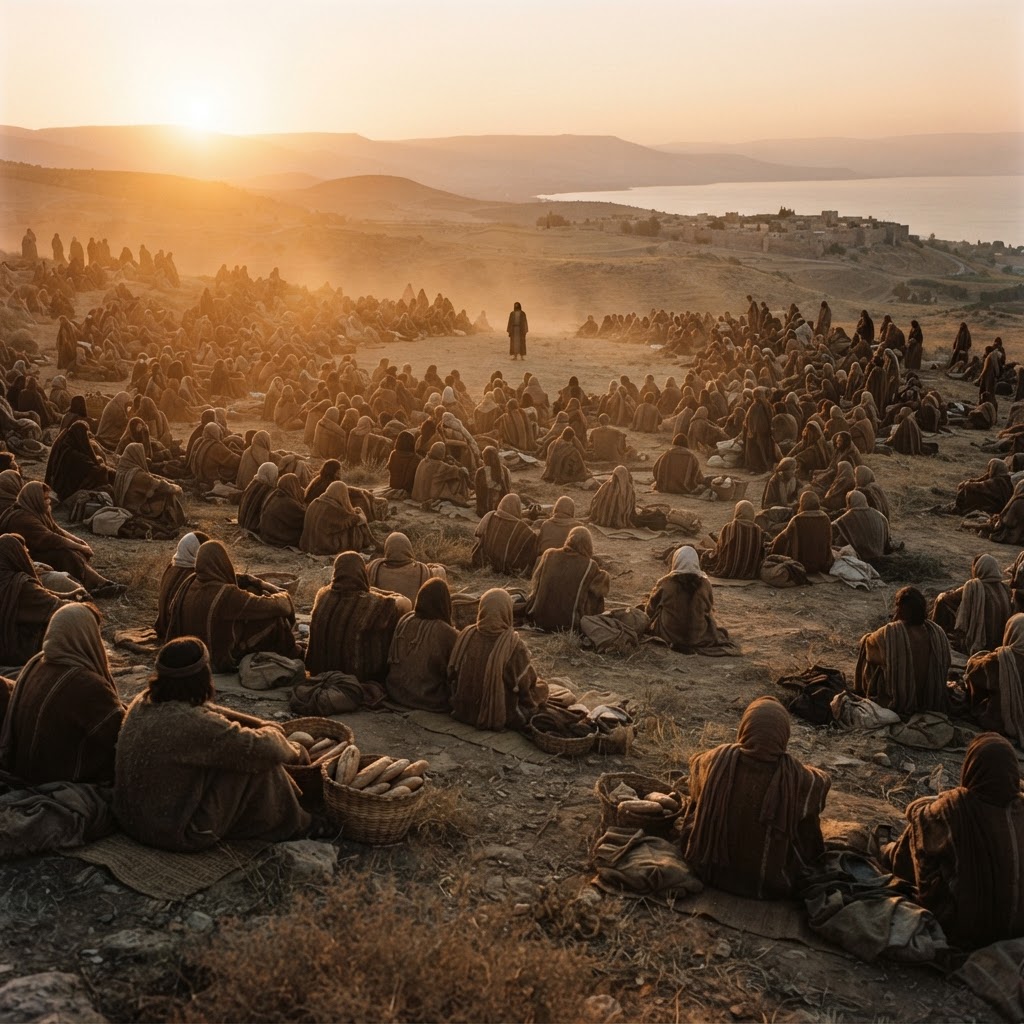
A boy's lunch had fed a crowd on the hillside by the lake, and the next morning the same crowd came looking for Jesus. They found him in the synagogue at Capernaum and asked him for a sign, as though the sign were not the reason they had crossed the water.
He told them what they were really after. Not a sign. Bread.
Then he said something nobody had asked him for. There is bread that perishes and bread that gives life, and the bread he gives is himself: “I am the bread of life; he who comes to me shall not hunger.”
They thought they had him. They brought up Moses, and the manna in the desert, and asked for that bread always. They were still thinking of food, and history, and a prophet greater than Moses.
He was not talking about food, and he was not talking about history. He was talking about his own flesh, given as food, and over the next twenty verses he said it plainly.
“I am the bread of life; he who comes to me shall not hunger, and he who believes in me shall never thirst.”
The Hard Saying
He did not explain
himself.
The crowd began to argue among themselves. “How can this man give us his flesh to eat?”
Most teachers would have cleared the misunderstanding up at that point. He did not. He repeated it, and made it heavier: “Truly, truly, I say to you, unless you eat the flesh of the Son of man and drink his blood, you have no life in you.” The word John uses for eating is not the polite word for a meal at a table. It is closer to chewing. Whatever else Jesus was being, he was not being delicate.
That is the moment the crowd stopped being a crowd and became a decision.
Many of his disciples said, “This is a hard saying; who can listen to it?” And John records the sentence that ends the argument: “After this many of his disciples drew back and no longer went about with him.”
Here is the detail worth your attention. Elsewhere in this Gospel, when someone misunderstands Jesus, Jesus corrects them. Nicodemus thinks he must climb back into the womb, and is told about water and the Spirit. The woman at the well thinks of a bucket, and is told about a spring. In this chapter the misunderstanding is met with repetition, then with a wider claim, then with silence, and the hearers walk away.
Nobody walks away over a metaphor.
“Jesus said to the twelve, ‘Do you also wish to go away?’ Simon Peter answered him, ‘Lord, to whom shall we go? You have the words of eternal life.’”
Notice that Peter does not explain the saying either. He does not say, surely he means something else. He stays, in the dark, because of who is speaking. That is the only answer the chapter allows, and it is the answer the Church has given ever since.
What the Church Heard
Two ways to read
that afternoon.
Since the Reformation there have been two answers to this chapter, and they are still the two answers today.
The first says Jesus was speaking about faith. To eat his flesh, on this reading, means to believe in his death for you. The language is a picture: a strong picture, a true one, but a picture.
The second says he meant what he said. To eat his flesh is to receive him, really and bodily, in the bread and the cup. The words are hard because the gift is enormous.
Catholics hold the second, and not because we love ceremony. We hold it because the chapter will not sit still as a picture. Flesh and blood are not how anyone talks about believing. And the same Lord who said these things in the synagogue said, on the night he was handed over, “This is my body,” and told his friends to keep doing it until he comes.
That is the whole Catholic teaching in one sentence: the Eucharist is Jesus, and the Church has been eating his flesh and drinking his blood ever since, because he told her to.
Nothing here is a second gospel. It is the same gospel in a form you can swallow. Grace does not stop being grace by becoming food.
Vatican II, Sacrosanctum Concilium 10
“The liturgy is the summit toward which the activity of the Church is directed; at the same time it is the font from which all her power flows.”
Catechism 1324
“The Eucharist is the source and summit of the Christian life.”
Source and summit: both directions at once. Everything the Christian life pours out comes from that table, and everything it climbs toward ends there.
The First Witnesses
They were not
arguing with Protestants.
The usual objection is that all of this developed much later, in the medieval Church. The record does not allow it. Three writers, from three different worlds, describe the same thing, two hundred years before anyone had a reason to argue about it.
“Breaking one bread, which is the medicine of immortality, the antidote that we should not die but live for ever in Jesus Christ.”
Ignatius of Antioch · c. 107
Letter to the Ephesians 20
Written by a bishop on his way to be executed, within a generation of the apostles. It is the earliest description of the Eucharist outside the New Testament, and he calls it medicine for dying men.
“Not as common bread and common drink do we receive these; but we have been taught that the food which is blessed by the prayer of his word is the flesh and blood of that Jesus who was made flesh.”
Justin Martyr · c. 155
First Apology 66
Addressed to a pagan emperor who was killing Christians. Justin had nothing to gain by exaggerating and everything to lose, and he did not soften a word.
“As the bread from the earth, receiving the invocation of God, is no longer common bread but the Eucharist, so also our bodies, receiving the Eucharist, are no longer corruptible, having the hope of the resurrection.”
Irenaeus of Lyons · c. 189
Against Heresies IV.18.5
The whole argument of this article in one sentence from the second century: the bread gives life because it is joined to God, and our flesh is saved because it is fed.
A doctrine taught by a prisoner awaiting execution, defended before a hostile emperor, and handed to catechumens did not quietly evolve in a comfortable library.
If This Is True
Then nothing about
the Mass is ordinary.
The priest is not performing a memory. The bread is not a reminder. The Lord who fed a hillside, and who watched a crowd walk away rather than soften a sentence, is feeding his people with himself, and he has not grown tired of it.
You do not need to have this worked out before you come. You only need to be hungry.
“He who eats my flesh and drinks my blood has eternal life, and I will raise him up at the last day.”
John 6:54