
'Render to Caesar the things that are Caesar's, and to God the things that are God's.' - Matthew 22:21
The Catholic in theAustralian Public Square
An introduction to the Australian political system, the political map, and the formation a Catholic takes with him into the voting booth - and into every civic act between elections. Faith forms politics. Prudence guards it. No party owns it.
Where the Church's Political Vocation Began
From the Edict of Thessalonica to the Australian Ballot
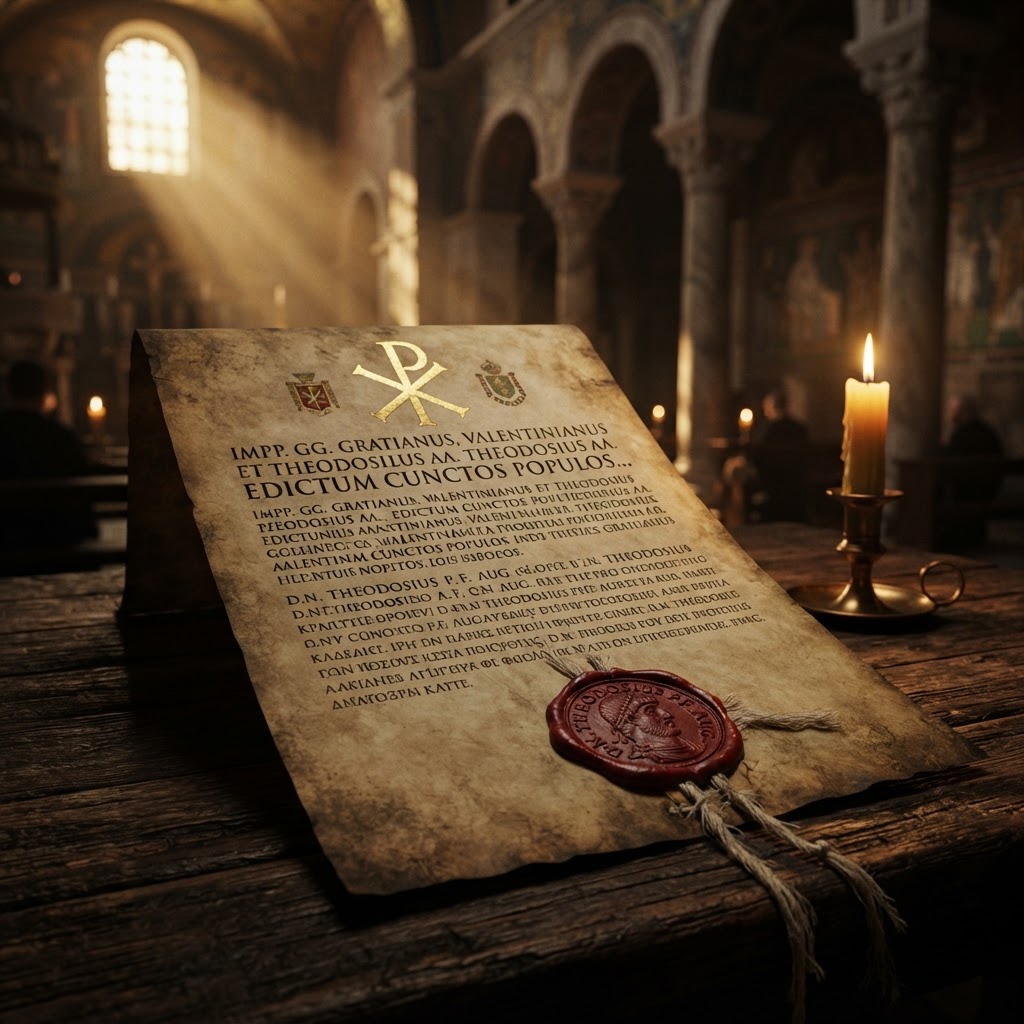
In February 380 the Emperors Theodosius, Gratian and Valentinian issued the Edict of Thessalonica, declaring Nicene Christianity the official faith of the Roman Empire and effectively binding the civic order to a confession of the Trinity. From that moment forward the Church ceased to be a tolerated sect and became a partner in the ordering of public life.
The Church did not seek this role by ambition; she inherited it by the conversion of the Empire. But once given it, she never surrendered it. Her bishops warned emperors, her councils corrected princes, her popes deposed kings who claimed authority no Christian ruler may hold. The geo-political vocation of the Church is not a modern compromise - it is her inheritance from the day the Empire bent its knee to Christ.
That inheritance continues in Australia today. The Catholic enters the public square not as a private citizen with a private hobby, but as a member of a Body whose Lord claimed authority over every nation - 'All authority in heaven and on earth has been given to me' (Matthew 28:18).
The Catholic does not enter politics as a stranger. He enters as the heir of eighteen centuries in which his Church has warned kings, corrected empires, and ordered the common good toward Christ. To vote as a Catholic is to continue that stewardship - humbly, prudently, but without apology.
By Justin Poor - Catholic Apologist, drawing from Sacred Tradition, the Fathers, Doctors, and the Full Magisterium.

The common good is the reason the political community exists.
Pacem in Terris - St. John XXIII
The Principle
The Church Calls Us to Be Political
Catholic political engagement is not optional. The lay faithful are called to sanctify the temporal order from within. But the call always comes with a guardrail: faith forms politics, never the reverse.
The Church calls us to be political
Politics is the ordering of the common good among persons. The Church has never taught the faithful to abandon that order to others. From Rerum Novarum to Fratelli Tutti she calls the lay Catholic to enter public life, to vote, to serve, to build, and to reform - because the common good is the reason the political community exists (Pacem in Terris, John XXIII).
But not to be captured by politics
The same Church warns against allowing a party, an ideology, or a political figure to become the measure of conscience. 'Faith must form our politics, not the other way around' - the duty runs in one direction. When politics reshapes the faith, the faith has ceased to be Catholic and has become a chaplaincy to the age.
Prudence, not zealotry
The cardinal virtue of prudence (Summa Theologiae II-II.47-49) is the ruler of the political life: it chooses the right means to the right end, revises when the facts change, refuses both despair and triumphalism. The prudent Catholic neither sits out the contest nor surrenders his judgment to it.
What "Faith Forming Politics" Actually Means - and What It Is Not
A clarification the age demands. "Faith must form our politics" is not a licence for the private conscience to decide what Catholicism means to me. It is not the conviction that belief in God - however I see Him - is enough to govern a public life. That is moral relativism wearing the costume of faith, and it is the very error this formation is meant to resist. The faith that forms politics is not subjective, not personal, not privately authored.
Faith forming our conscience means this: a complete, irrevocable surrender to the Divine Will as that Will has been revealed and handed on in the deposit of faith - Scripture, Sacred Tradition, and the living Magisterium of the Church Christ founded. The Catechism calls it the obedience of faith (CCC 144-149): the free submission of the whole person - intellect and will - to the God who reveals, "so that a person entrusts his whole self to God" (Dei Verbum 5). It is the same surrender Mary made at the Annunciation - "Let it be to me according to your word" (Luke 1:38) - and the same obedience Christ rendered to the Father even to the Cross.
To form a political conscience from that faith is therefore to be governed not by how I happen to read God, but by the objective deposit the Church has received and safeguards. It is to let the encyclicals, the Fathers, the Doctors, and the councils - not my preferences - set the measure by which a party, a candidate, and a vote are judged. The Catholic conscience is not an interior feeling; it is the voice of God heard through the obedience of faith.
The obedience of faith is the beginning of every faithful Catholic vote. Surrender to the Divine Will first; only then does your judgment in the public square become Catholic - rather than merely your own opinion, dressed up in religious language.
If any of you lacks wisdom, let him ask God, who gives generously to all without reproach.
James 1:5
A Warning Before Everything Else
Do Not Idolise the Figure
The single most common failure of the Christian voter is not apathy. It is the surrender of judgment to a personality. Knowing the system means nothing if you cannot judge the men who run it.
No politician is Christ. A leader may be a useful instrument of justice or a barrier against evil, but he is never the Saviour. To give a party or a personality the loyalty that belongs to Christ alone is the sin the prophets rebuked in Israel's kings and the Church rebukes in every age.
Blind loyalty is not loyalty - it is the surrender of the reason God gave you. The Catechism (1790) names the upright conscience as the place where the human person 'perceives and recognises the prescriptions of the divine law.' To surrender that perception to a party line is to silence the voice of God in your own soul.
Idolising a figure means losing the capacity to judge him. The moment a Catholic cannot name the defect of his own party's candidate - can only defend, only explain away, only attack the critic - he has ceased to be a Catholic voter and has become a partisan.
The test is simple: would you apply the same moral standard to this man that you applied to his opponent? If not, the figure has become an idol, and your politics has begun to deform your faith.
The rule for every Catholic voter: your party does not own your conscience. Your favourite candidate does not own your judgment. When loyalty costs you the capacity to name evil in your own camp, the loyalty has become the sin.
Do not be deceived; God is not mocked. Whatever a man sows, that he will also reap.
Galatians 6:7
Policy Over Personality
Judge the Policy, Not the Person
Charisma is not consistency. Eloquence is not law. What a party enacts endures long after the man who spoke it has gone. The Catholic voter measures what lasts.
Politicians have to talk a big game, and some are more charismatic than others. A commanding presence, a warm handshake, a memorable line on the campaign trail - these move crowds, and they are meant to. But the Catholic voter is not formed by crowds; he is formed by the deposit of faith and by prudence. And prudence asks a single, stubborn question of every candidate: what has he actually done, and what does his platform actually do to the role and mission of the Church in light of the Gospel and the Magisterial teaching?
Personalities are flawed. Every statesman carries private faults; every orator disappoints the moment he is measured by his fruit. But what has lasting impact for better or worse is not the man - it is the policy and the plan a party wishes to implement. A government's legacy is the legislation it passes, the appointments it makes, the protections it grants or withdraws, and the order it establishes. The man leaves office; his policy remains. A Catholic judges the policy because the policy outlives the personality.
Lessons from History
Constantine the Great - 4th century
A charismatic convert who, in power, legalised the Church, convened Nicaea, and built a Christian civilisation.
Constantine's personal virtues were uneven - he had a son executed and a wife killed - yet the policy he set in motion (toleration of Christianity, the Edict of Milan, imperial support for the councils) shaped a thousand years of Christian order. The lesson cuts both ways: a flawed man can enshrine a just policy, and a noble man can leave behind a ruinous one. Catholics judged the policy's fruit, not the emperor's charm.
Thomas Becket vs. Henry II - 12th century
The charismatic king who sought counsel from his accomplished friend, and the archbishop who resisted him.
Henry II was brilliant, energetic, and personally close to Becket. The king sought to bring the Church under royal courts. Becket resisted - not on personality grounds but on principle: the Church's courts and the sacraments are not the Crown's to dispense. Henry eventually had his friend murdered in his own cathedral. The personality relationship between the two men was affectionate; the policy conflict was the whole of the matter. The Church canonised the policy's defender.
The Reformation Parliaments - 16th century
Charismatic monarchs used a compliant Parliament to legislate the Church out of communion with Rome.
Both Henry VIII and Elizabeth I possessed considerable personal magnetism and political skill. Yet the lasting damage was not the personality - it was the statute: the Acts of Supremacy, the dissolution of the monasteries, the legal establishment of a state church severed from the See of Peter. Centuries later England is still shaped by those statutes, long after the monarchs are dust. The Catholic measure was always the law's effect on the Church's mission, never the ruler's personal appeal.
The Present Landscape
Liberal / National Coalition
Charismatic leaders across two decades - Howard, Abbott, Morrison - have risen and fallen on personality. What endures is the party's mixed policy record: a stronger defense of religious-school freedoms, faltering on economic justice and on defending the conscience of the citizen during COVID. The Catholic reading weighs the policy, not the prime ministerial bearing.
Labor (ALP)
No Federal Labor leader in living memory has carried the personal magnetism of a Whitlam or a Hawke into a defense of the non-negotiables. Yet the party platform's commitments - expanded abortion access, progressive gender-identity law, the state labor governments' closure of the sacraments - remain regardless of who leads. The policy is the legacy; the leader is a temporary steward of it.
The Greens
Greens senators are often articulate, media-savvy, and personally likeable. But the platform is the most direct conflict with the non-negotiables of any party in the Parliament. A Catholic voter who warmed to a Greens candidate's temperament would still be bound to resist the platform, because the platform - not the personality - is what the Church measures.
One Nation
The party's founder is a singular, polarising personality. Setting that aside, the apostolate credits One Nation's consistent policy stand against coerced medical treatment and rolling emergency powers, while naming its broad divergences elsewhere. The point holds even here: judge the policy with the Church's measure, not the press's portrait of the person.
Three Tests a Catholic Applies
Consistency under pressure
Where did he stand when the vote cost him something? A charismatic leader who folds on religious liberty when it costs his majority has no platform to defend. The record under pressure is the true policy.
Impact on the Church's mission
Does the platform expand or restrict the Church's liberty to preach Christ, form her children, and serve the poor? A policy that muffles the Church does lasting harm no charm can offset.
Fruit over the long arc
Prudence reads the policy's effect across years, not news cycles. A tax reform, a school-funding change, a conscience exemption - these shape a generation. The personality will be gone before the fruit is fully known.
The Rule That Outlives the Man
A Catholic is free to admire a leader's gifts, and free to be put off by his faults. What he is not free to do is let the admiration or the distaste decide his vote. Decisions are made by measuring the policy against the Gospel and the Magisterium; the man is a steward who passes, but the policy is a stone laid in the wall of the nation that those who come after us must build upon or pull down.
Know the System
How the Australian System Actually Works
You cannot vote prudently in a system you do not understand. Here is the working knowledge every Catholic voter in Australia owes himself.
A Federal Parliamentary Democracy
Australia is a constitutional monarchy under the Westminster system. Power flows from the people through elected representatives, not from a monarch by divine right. Our Head of State (the King) acts on the advice of his Australian ministers; the real authority rests with the Prime Minister and Cabinet drawn from and accountable to the Parliament.
Three Layers of Government
Federal (Commonwealth), State (six states), and Territory. Each has its own parliaments, laws and elections. The federal Parliament legislates on national matters (defence, migration, currency); the states retain broad authority over policing, health, education and civil law. Local councils administer the nearest level of daily life. A Catholic must know which layer governs the issue he cares about - many of the most contested moral questions (religious school hiring, abortion, surrogacy) sit with the states.
Two Houses - and Preferential Voting
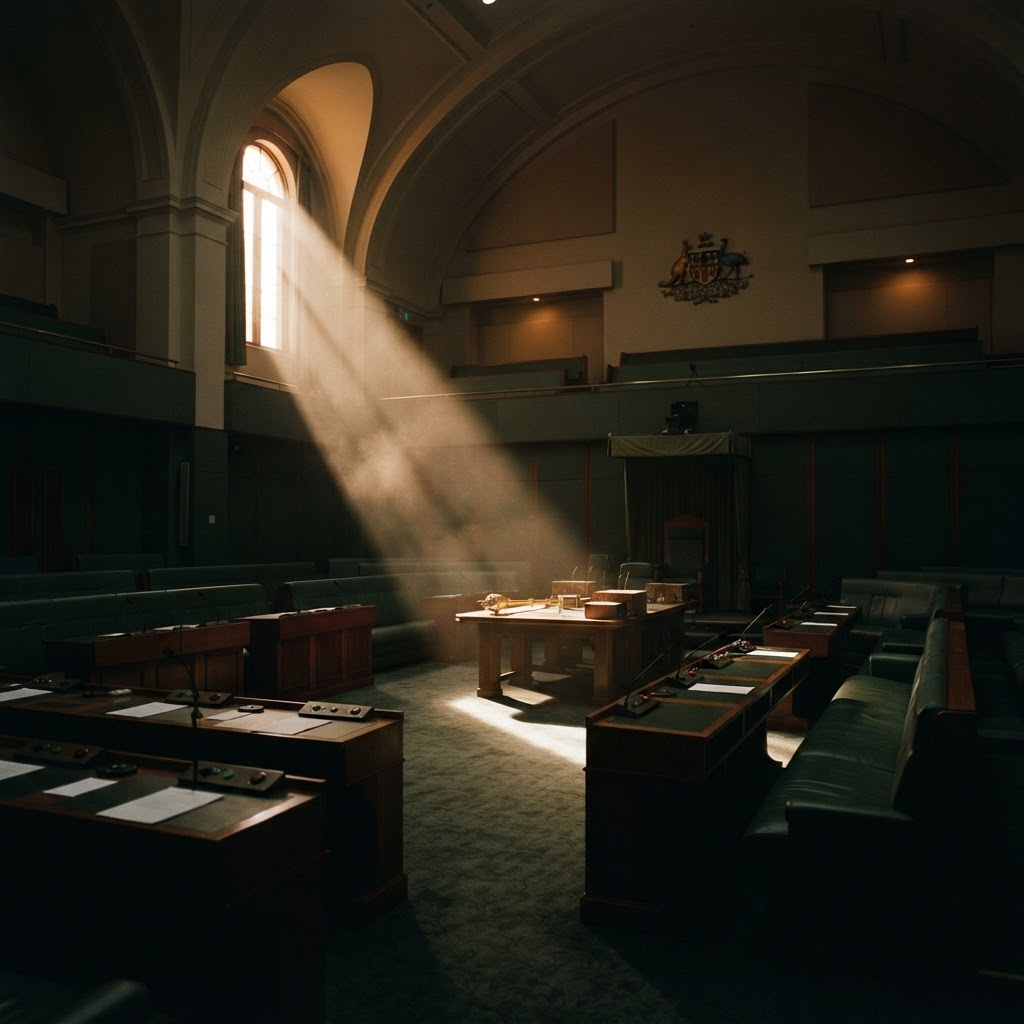
The federal Parliament has two chambers: the House of Representatives (members elected from single-member electorates) and the Senate (12 senators per state, plus territory senators). Voting is compulsory and preferential: you number the candidates in order. Your preferences are redistributed until one candidate reaches a majority. This preferential system is a gift to the Catholic voter - it lets you order your conscience above your pragmatism, limiting harm when no whole option stands.
Why This Matters for Conscience
Three layers of government mean three places to form and three places to be held accountable. Two houses mean two records to read. Preferential voting means you are never forced to choose between one deficient option and another - you can order your conscience above your pragmatism and let your preferences limit harm. Understanding the system frees you from the despair that there is 'no good choice'; it equips you to make the best choice the moment allows.
The Founding Document
Read the text for yourself. The Commonwealth of Australia Constitution Act 1900 is the supreme law under which the system you have just learned actually operates - and the measure by which every statute, treaty, and ministerial power in this country is ultimately tested.
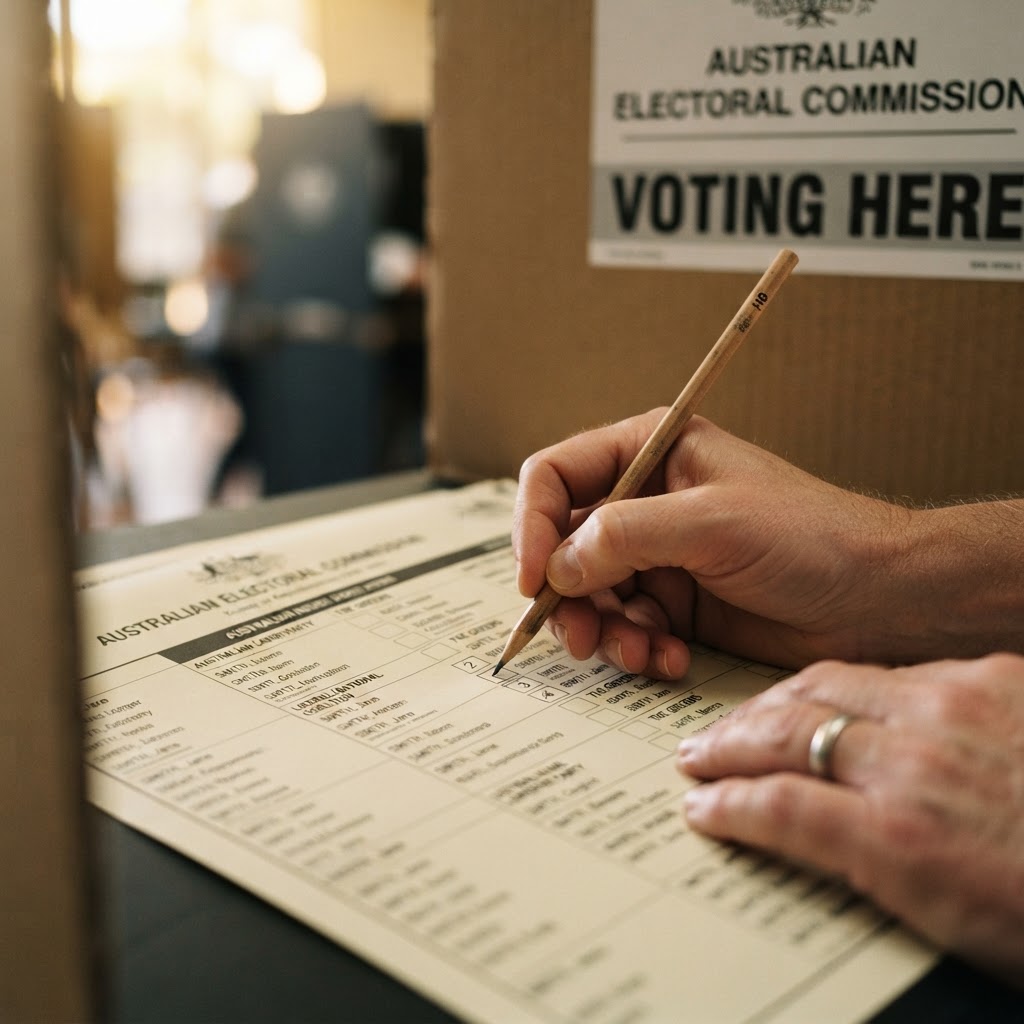
Number them in the order of your conscience - not the order of your tribe.
Prudence, not pragmatism
The Political Map
Where the Major Parties Stand - by the Record
The apostolate has measured every major Australian party against the same fixed doctrinal standard - the social encyclicals weighed against their actual voting record. Here is the map at a glance; the full analysis lives on The Nation.
Liberal / National Coalition
Records the strongest coalition-level defence of religious freedom and faith-based schooling; mixed record on economic and life issues.
Full record on The NationLabor (ALP)
Strongest on labour and the working poor; hardest conflict with Church teaching on life, family, and the state labor governments' COVID-era suspension of the sacraments.
Full record on The NationThe Greens
Highest recorded ideological commitment to the progressive agenda; most consistent and direct conflict with the non-negotiable Catholic positions.
Full record on The NationOne Nation
The most consistent federal voice against coerced medical treatment and rolling emergency powers; broad platform divergences elsewhere.
Full record on The NationTeal Independents / Crossbench
Civil-libertarian rhetoric with a progressive voting pattern; voted to strip religious-school exemptions in 2022; conscience protections unadvanced as a crossbench priority.
Full record on The NationAustralian Christians
The most confessionally Catholic-aligned platform in the field - pro-life, pro-natural-marriage, pro-religious-liberty, pro-Christian education. A minor party without federal seats, so the pledge outruns the votes.
Full record on The NationRead the Map - Do Not Marry It
This map is a starting point - a snapshot of where parties have stood when the votes were cast. It is not a prescription and not an endorsement. A party moves; a candidate breaks with his party; local conditions shift. Always cross-check the specific person in your electorate. The full ranking, voting record, and Catholic reading of each party lives on The Nation page.
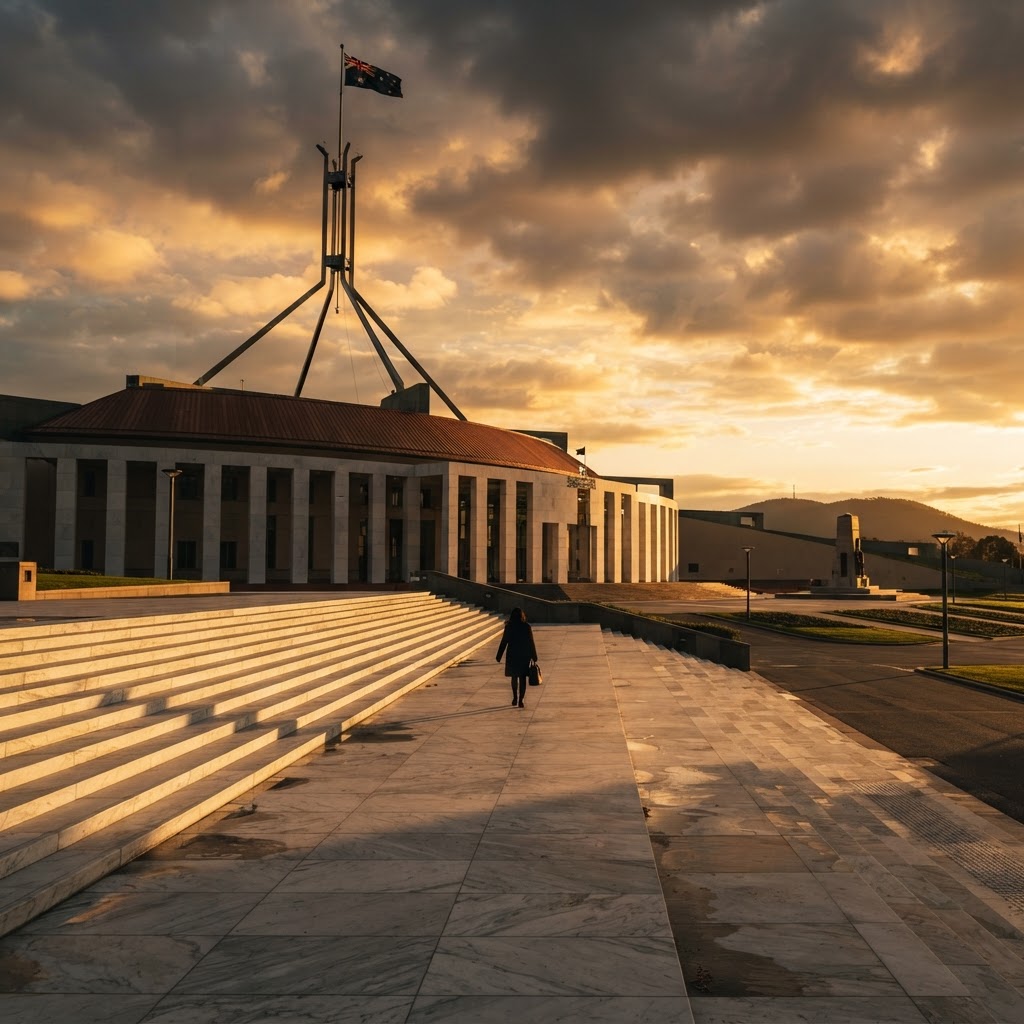
The political community exists for the common good.
Gaudium et Spes 74
Recommended Formation Resource
Why Catholics Cannot Be Socialists
The Church has condemned socialism in every form since Leo XIII. Trent Horn of Catholic Answers lays out the doctrinal and economic case with clarity. A formation resource for the Catholic weighing any party that carries the socialist label.
The Counsel of Trent
with Trent Horn · Catholic Answers
Why this belongs here. The encyclical tradition from Rerum Novarum (1891) through Quadragesimo Anno and Divini Redemptoris condemns socialism as contrary to the natural law, to private property, and to the dignity of the family. This episode is offered as a clear, contemporary teaching companion to that same magisterial witness — not as an endorsement of Catholic Answers in every respect, but as a useful voice making the Catholic case the Church has always made.

We must obey God rather than men.
Acts 5:29
Staying Informed
A Catholic Habit - Not Just at Election Time
Elections are a fraction of civic life. The Catholic is called to a steady, prudential habit of remaining informed - one that does not rise and fall with the news cycle or the ballot.
Read Hansard, not headlines
The parliamentary record (aph.gov.au) publishes every bill, debate and division. A headline tells you what a party said; Hansard tells you what it did. Begin there before any election.
Know your sitting members
Find your federal and state representatives. Read their voting record, not their press releases. A party label is an imperfect guide; the vote cast under pressure is the truer measure.
Track the non-negotiables
Life from conception to natural death, the family as the foundational cell, religious liberty, the rights of parents over their children's formation. When a bill bears on these, the test is the Church's, not the party's.
Pray before you read
Politicalinformation is a moral act. Ask God for prudence before you open the news; the same fact read in pride hardens, read in humility enlightens.
Form community, not echo-chambers
Speak with Catholics who disagree with you about tactics, but never about the non-negotiables. Coalition sharpening conscience is discipleship; coalition flattening it is tribalism.
Vote every election - and attend between them
Democracy is not a triennial ritual. Submit to inquiries, write to your MP, attend council meetings, run for office if called. The Church calls us to the public square between elections as much as during them.
A Final Word
Be Political. Be Prudent. Be Catholic.
The Church has stood in the public square since the day the Empire bent its knee to Christ. She has not asked you to sit it out. Enter the Australian political order with a heart formed by the Gospel, a conscience formed by the encyclicals, and a prudence that refuses to hand that conscience to any party or personality. Vote. Stay informed. Speak. And never let the politics of the age reshape the faith that comes from Christ.
METANOIA FAITH
Converted Hearts. Transformed Culture.