
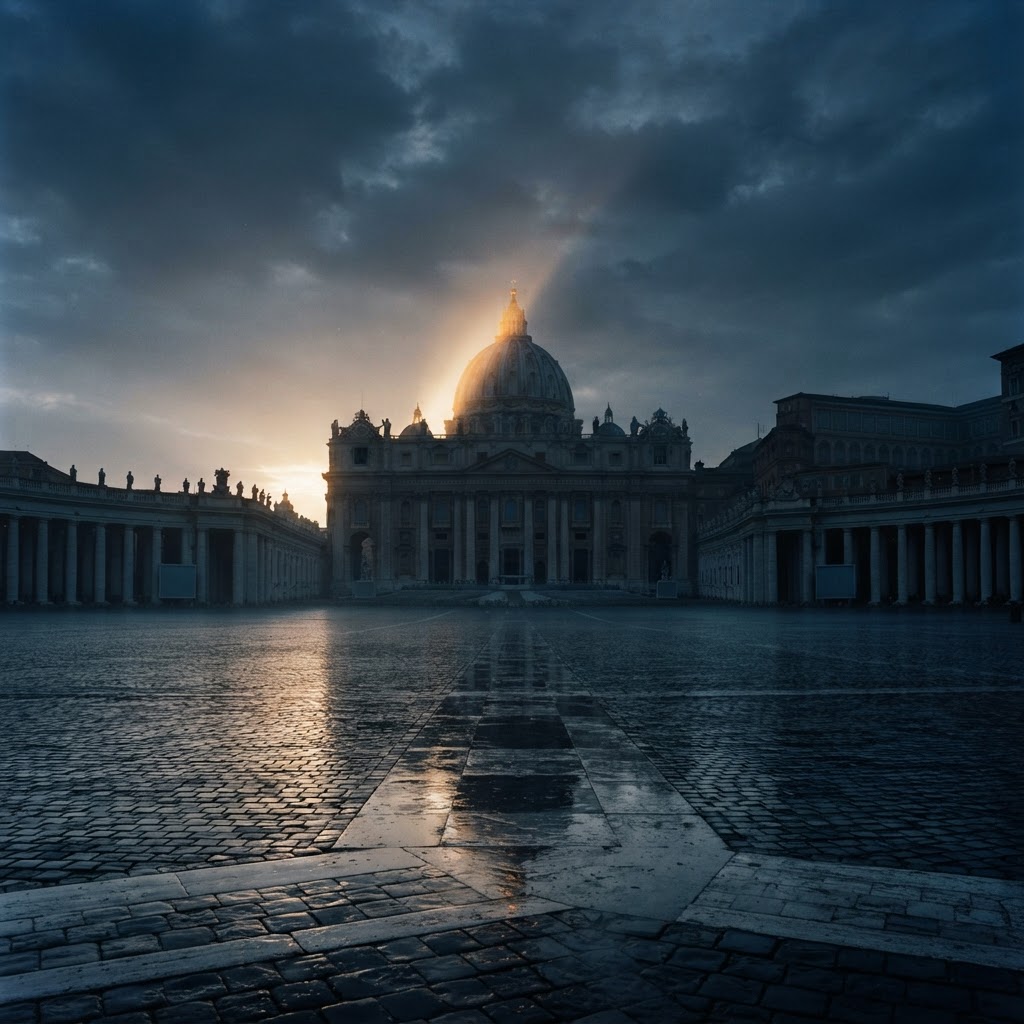
Every Road to Unity Ends at the Same Door
Every serious conversation about Christian unity arrives, sooner or later, at a single door, and the door has a name. It is not the papacy considered as an administrative convenience, about which much sensible negotiation is possible. It is the papacy considered as a dogma: that Christ gave to Peter and to his successors a real, personal, abiding authority over the whole Church, and that the Church's visible unity is therefore not a metaphor but a communion with a living centre.
This is the claim no other Christian body has been able to accept, and pretending otherwise has never helped anybody. It is wiser to look honestly at what the popes themselves have said about it — for the strongest case for the Petrine office was not made by its enemies, nor even by its defenders in the abstract, but by a pope who spent a long pontificate trying to make reunion real.
Leo XIII and the Vision of a Reunited Christendom
Vincenzo Gioacchino Pecci was already sixty-eight and had been Bishop of Perugia for thirty-two years when he was elected in 1878. He came to the See of Peter with a historian's instincts and a patristic mind, and he understood something that the polemicists of his century did not: that the East had never been persuaded by Latin arguments, and had been wounded by Latin behaviour.
On 20 June 1894 he issued the apostolic letter Praeclara Gratulationis Publicae, addressed to the rulers and peoples of the world and, in substance, to every separated Christian body. It was an invitation, not a summons. Leo praised the liturgies, the monasticism and the councils of the Christian East, acknowledged that the separation had been aggravated by the sins of both sides, and asked the Eastern Churches for one thing only: to reconsider communion with the successor of Peter, without surrendering their rites, their discipline, or their ancient customs.
In the same year he issued Orientalium Dignitas, which bound the Latin Church to protect the rites, laws and traditions of the Eastern Catholic Churches. This was not a detail. It told the East, in canon law, that reunion would not mean Latinisation — that Rome had learned, or was learning, what the sack of a city in 1204 had cost.
Two years later, on 29 June 1896, came Satis Cognitum, on the unity of the Church: a sustained argument that the oneness Christ prayed for is a visible society with a visible head, not an invisible federation of the like-minded. And in the same year, on 13 September, Apostolicae Curae declared that ordinations carried out according to the Anglican rite had been and were "absolutely null and utterly void".
Read together, these three documents are the Leonine vision, and they are uncomfortable for partisans on both sides. A door held wide open to the East, with its rites protected. A rigorous case for a visible centre of unity. And a blunt refusal to pretend that doctrine is negotiable in order to secure a pleasant result. Leo XIII believed that unity is a gift Christ actually gave, and that it therefore has a definite content. To trade that content for agreement would have been, on his own premises, to give away the very thing he was offering.
Why the Papacy, and Not Something Else
The Catholic argument does not begin with Vatican I. It begins with the Gospel: the rock and the keys (Matthew 16:18-19), the charge to strengthen the brethren (Luke 22:32), the threefold commission to feed the sheep (John 21:15-17). It continues in the first generation after the apostles, where the Church of Rome intervenes in the affairs of Corinth and is heard with deference, and in Irenaeus, who points the scattered churches to the Roman see as the necessary reference point of apostolic faith.
The Fathers are not unanimous in the way a modern dogmatic manual would like, and honesty requires saying so. But the direction of travel is clear, and the Catholic claim is modest in form and immodest in content: the Bishop of Rome is the successor of Peter in a way the other bishops are not, and this is a gift to the whole Church rather than a possession of the Latin West.
Vatican II said the same thing in the language of communion rather than jurisdiction: the Church is a "people made one with the unity of the Father, the Son and the Holy Spirit", and the Pope's office exists so that the college of bishops may remain one and the flock may not be scattered (Lumen Gentium 4, 18-19). The Catechism gives the resulting bonds of unity as one faith, one worship, and apostolic succession with Peter's successor at its head (CCC 815).
Not a Monarchy, but a Service
The most important words a pope has spoken on this subject in living memory came on 25 May 1995. In Ut Unum Sint, John Paul II invited "a patient and fraternal dialogue" about the forms in which the Petrine ministry might be exercised, saying explicitly that he was asking the pastors and theologians of other Churches to help him find a way of exercising the primacy which is "open to a new situation" while renouncing nothing essential to its mission.
That invitation has been shrugged off by many and taken up by few, but it is the official Catholic position, and it is remarkable. The papacy is not offered for abolition; its shape is offered for discussion. Benedict XVI repeated the point by distinguishing the Petrine ministry from its merely Latin and curial accretions. Anyone who imagines that Rome's answer to the ecumenical question is simply "submit" has not read what Rome has actually written.
What the Vision Cost, and What It Brought
Leo XIII saw almost none of the fruit. Reunion did not come in 1894, or 1896, or in his lifetime. But the direction he set has proved to be the path history took. The Malines Conversations between Cardinal Mercier and Lord Halifax (1921-1925) were unthinkable without the Leonine precedent. The Second Vatican Council's decree Unitatis Redintegratio (1964) made ecumenism the ordinary business of the Catholic Church. In 1965 Paul VI and the Ecumenical Patriarch Athenagoras lifted the mutual excommunications of 1054. And in 1999 the Catholic Church and the Lutheran World Federation signed a Joint Declaration on the doctrine of justification, declaring that the condemnations of the sixteenth century no longer apply to the teaching of the other — the single largest act of doctrinal reconciliation since the Reformation.
None of that is full communion. The papacy remains the great unresolved question, and it will remain so until it is settled by conversion and not by committee. But the Leonine wager was that a Church confident in what she has been given can afford to be patient, generous, and immovable at once; and that wager is still being paid out.
The Second Leo, and the Same Prayer
On 8 May 2025 the Church elected Robert Francis Prevost, an Augustinian who had spent his priesthood in Peru and his episcopate in Chiclayo, and he took a name that was itself an argument: Leo. He said plainly why. Leo XIII had been the first pope to teach modern social doctrine in Rerum Novarum, and the new Leo meant to stand in that line. But the name carries a second inheritance, and it is the one this page is about. Leo XIII spent his pontificate trying to make the reunion of Christians real. The pope who now wears his name came into the office with unity written on his shield.
"Help us, one and all, to build bridges through dialogue and encounter, joining together as one people, always at peace." — Leo XIV, first address from the Loggia of St Peter's, 8 May 2025
His motto, kept from his years as a bishop, is In illo uno unum — "In the One, we are one." It is not a slogan he chose for the occasion; it is a sentence of Augustine's, from the Exposition on Psalm 127, where the bishop of Hippo explains that "although we Christians are many, in the one Christ we are one… We are many and we are one — because we are united to Him, and if our Head is in heaven, the members will follow." As Cardinal, Prevost had already described the motto as the heart of his own way of thinking: "unity and communion are truly part of the charism of the Order of Saint Augustine… I believe it is very important to promote communion in the Church." (Vatican News, 10 May 2025)
Look closely at the words, because everything else follows from them. The motto is not John 17:21. Ut unum sint — "that they may all be one" — is Christ's prayer. In illo uno unum is Augustine's answer to it, and the answer puts unity exactly where Catholics say it is. Not in one idea. Not in one book, one method, one structure, one agreed statement. In the One. "That they may be one" is a prayer no committee can answer; "in the One, we are one" is a Person in whom the answer is already given. This is the whole difference between unity as agreement and unity as communion — and the man whose task it is to guard communion has made the second his rule of life.
His coat of arms says the same thing twice. On a shield divided diagonally there is a white lily, the sign of purity and of the see he serves, and beneath it the emblem of the Augustinian order: a closed book with a heart pierced by an arrow. The arrow is Augustine's own verse — Vulnerasti cor meum verbo tuo, "You have pierced my heart with your Word." The Word wounds the heart, and the wounded heart is what makes the many one. It is worth pausing on: the pope whose office is the great obstacle to every ecumenical scheme carries on his own shield a picture of a man converted by Scripture. Catholic unity, on that reading, is not a merger. It is a conversion — the same one Ezekiel promised, a heart of stone exchanged for a heart of flesh, and then a people made one.
"I would like that our first great desire be for a united Church, a sign of unity and communion, which becomes a leaven for a reconciled world." — Leo XIV, homily at the Mass for the Beginning of his Pontificate, 18 May 2025
None of this is a new ecumenism. It is the old one, and it is now three popes deep. Leo XIII asked the separated Churches to reconsider communion with the see of Peter (Praeclara Gratulationis, 1894). John Paul II took the title of his encyclical on unity straight from the Lord's prayer — Ut Unum Sint, "that they may be one" (1995) — and invited the other Churches to help him find the form the Petrine ministry should take. Leo XIV has taken the same prayer and made it the motto cut into his arms. Whatever else a pope does with his office, the office itself is now described in public, in three generations, as a service of that one petition.
So let the papacy be judged by its own stated purpose. Its motto is not primus inter pares, still less submission; it is in illo uno unum. A pope who prays "that they may be one" and signs himself "in the One, we are one" has bound himself to a promise he cannot keep by politics. He can only keep it by the same door Leo XIII opened in 1894: a door held open to the East, a case made for a visible centre, and no trading of the truth to get a pleasant result. The prayer is Christ's. The answer is Augustine's. The man whose name is on the door is Peter's.
Where to Go From Here
The Catholic claim, stated without decoration, is this: unity is a gift, not an achievement; the gift has a shape; the shape has a centre; and the centre is a man who is a servant. Every other question in ecumenism is downstream of that one.
- Read the Catholic case for the office itself: The Seat of Peter — The Rock
- Read what Rome and the Lutherans now confess together: The Joint Declaration on Justification
- Ask the question you actually have: Ask the Faith
"I insistently pray the Holy Spirit to shine his light upon us, enlightening all the Pastors and theologians of our Churches, that we may seek — together, of course — the forms in which this ministry may accomplish a service of love recognised by all concerned." — John Paul II, Ut Unum Sint 95
By Justin Poor - Catholic Apologist, drawing from Sacred Tradition, the Fathers, Doctors, and the Full Magisterium.