
“Go therefore and make disciples of all nations.” — Matthew 28:19
Evangelii
Nuntiandi.
The exhortation that reclaimed the Church's reason for being. Proclaiming the Gospel.
On 8 December 1975, Pope Paul VI insisted that the Church's deepest identity is not to manage or to bless the world but to evangelize. This is a prophetic study guide to the document the post-conciliar Church forgot — and must recover.
By Justin Poor - Catholic Apologist, drawing from Sacred Tradition, the Fathers, Doctors, and the Full Magisterium.
On Evangelization in the Modern World
A Church that forgot
her own reason for being.
Vatican II set the Church on a path of renewal — and then a question arose that no document of the Council had answered directly: what does it mean, today, to evangelize?
In the decade that followed, much had been said about dialogue, justice, and aggiornamento; little had been said about the proclamation of Jesus Christ as Lord and Saviour.
On 8 December 1975, Pope Paul VI issued Evangelii Nuntiandi — “Proclaiming the Gospel” — insisting that the Church's deepest identity is not to manage, to bless, or to update, but to evangelize.
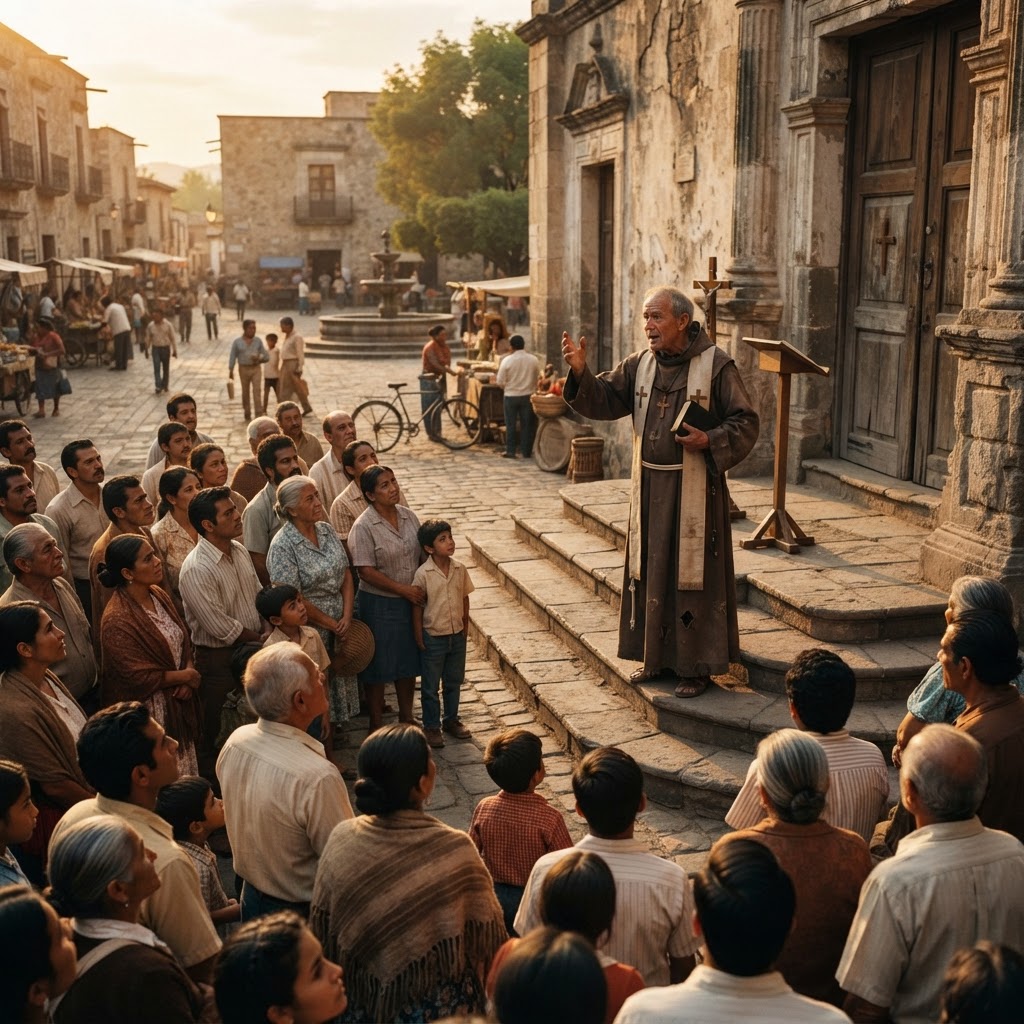
The modern world listens more willingly to witnesses than to teachers.
Evangelii Nuntiandi · §41
What the Issue Is
Evangelization is the Church's deepest identity.
Paul VI exposed four temptations that, together, hollow the mission out — and the four goods that hold it whole:
Evangelization
Not a department of the Church but her deepest identity: to make the Kingdom present by proclaiming Christ and calling all to conversion.
Witness
The modern world listens more willingly to witnesses than to teachers; and if it does listen to teachers, it is because they are witnesses. Evangelization begins with a life.
Inculturation
The Gospel enters every culture to take root and bear fruit — not to vanish into it, but to transform it from within as leaven in the dough.
Liberation
The Church announces a liberation first of all from sin, and from it every other liberation flows. Justice is part of the Gospel — it is not the whole of it.

No one can witness to Christ without the power of the Holy Spirit.
Evangelii Nuntiandi · §75
Summary of the Exhortation
The main points of Evangelii Nuntiandi.
Evangelization Is the Church's Vocation
Paul VI does not present evangelization as an option for the zealous. It is the Church's reason for being — she exists in order to evangelize, born of the mission and sent on the mission.
Witness Precedes and Carries the Word
The first proclamation is a life transfigured by Christ. The modern world distrusts words; it believes witnesses. But the witness must finally speak the word he has seen.
The Explicit Proclamation of Christ Is Inescapable
However beautiful the witness, it does not suffice. The Name of Jesus must be preached, the invitation to faith spoken, the call to conversion issued. A silent Church does not evangelize.
The Content: The Kerygma and the Whole Gospel
Evangelization is anchored in the kerygma — Christ crucified and risen — and unfolds into the whole of the faith. It can never be trimmed to fit the preferences of an age.
Culture, Development, and Liberation
The Gospel enters and transforms culture. Human advancement and liberation belong to evangelization, but cannot replace the saving proclamation from which they flow.
The Holy Spirit — Principal Agent of Evangelization
The Church evangelizes in the power of the Spirit, not in the strength of her own strategies. Prayer, holiness, and docility are the conditions of every fruitful mission.
The Exhortation
“Evangelize, not merely bless.”
Paul VI did not merely encourage — he warned. He named the temptations that quietly hollow out mission: action without proclamation, witness without word, dialogue that forgets to invite, and a Gospel trimmed to the age's taste.
The remedy is always the same: a Church that knows she exists to evangelize, that forms witnesses capable of speaking, and that trusts the Holy Spirit more than any technique.
Hence the 'new evangelization' — a phrase this exhortation seeds — calling the baptized to evangelize not only the unbaptized but the baptized themselves: the cultures once Christian that now need to hear the Gospel as if for the first time.
The new evangelization began here: not a new message, but a new urgency for an old one — calling cultures once Christian to hear the Gospel as if for the first time, and the baptized themselves to become its witnesses once more.
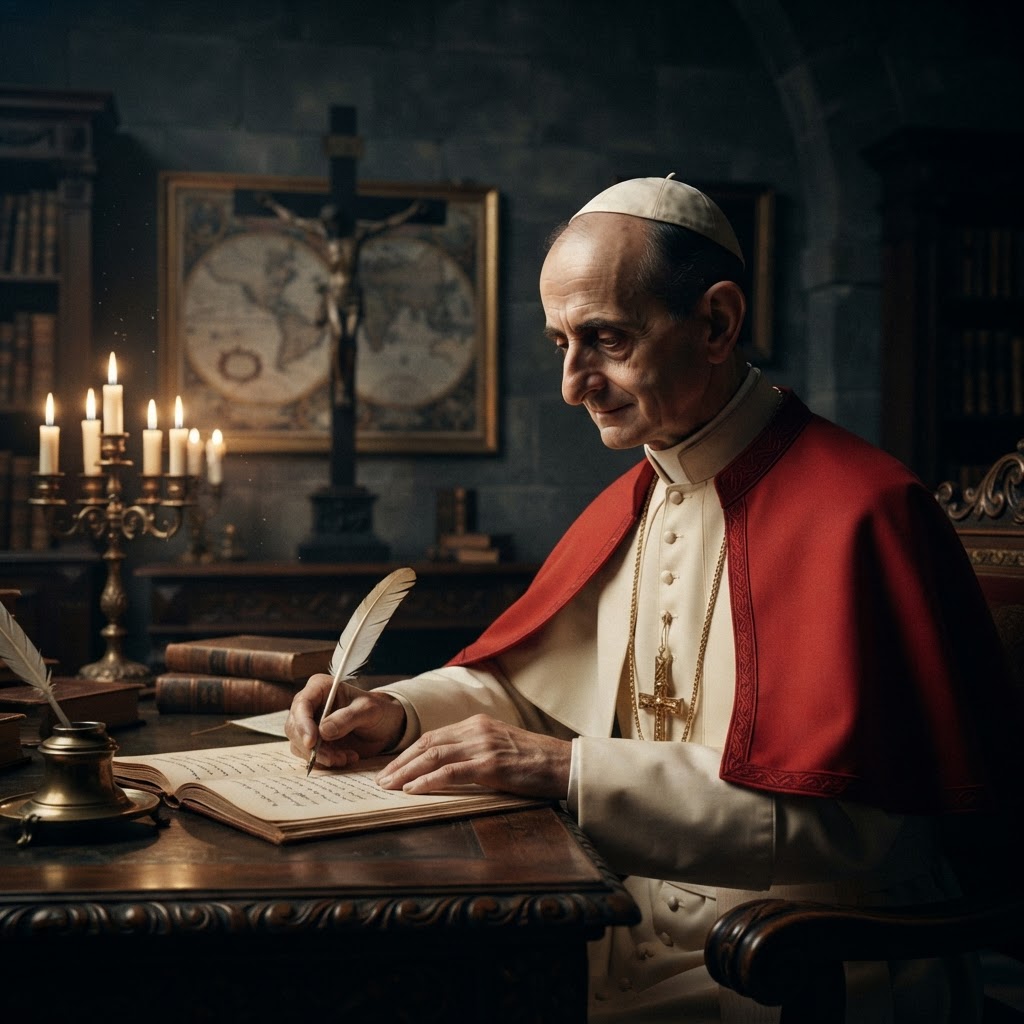
Read the Source
Evangelii Nuntiandi
The complete apostolic exhortation, promulgated 8 December 1975, in the official English translation from the Holy See.
Open on the Vatican Website
The Good News proclaimed by the witness of a life conformed to Christ.
Evangelii Nuntiandi · §21
Prophetic Diagnosis
Why this document
is prophetic today.
Evangelii Nuntiandi was written for our hour. The temptations it named have become the air the post-conciliar Church breathes: dialogue without proclamation, activism without conversion, a Gospel reduced to social service or cultural commentary.
Every crisis this apostolate names — the collapse of formation, the silence of witness, the dilution of doctrine — is, at root, an evangelization crisis. The mission Paul VI clarified is the mission we have forgotten.
Evangelii Nuntiandi is not a relic. It is the prophetic charter for the work of Metanoia: to convert the heart, recover the proclamation, and restore a Church that has forgotten she exists to evangelize.
The mission is not a quarrel of the past. It is the forgotten vocation of a Church that has learned to bless the world and forgotten to convert it. To preach Metanoia is to recover the proclamation Paul VI reclaimed.
For Personal Formation & Metanoia
A Reflective Prophetic
Study Guide.
Learn the document, understand its warning, and let it shape your conversion of heart.
Purpose & Approach
Evangelii Nuntiandi — “Proclaiming the Gospel” — was promulgated by Pope Paul VI on 8 December 1975, at the close of the Council's aggiornamento. It answers a question the Council opened and the age tried to settle on its own: what does it mean for the Church to evangelize in the modern world?
A faithful study reads this exhortation in two ways at once — historically, as the meditated pastoral summa of a pope who carried the Council into the post-conciliar years, and prophetically, as a warning against perennial temptations: reducing evangelization to social action, severing witness from word, treating the Gospel as the servant of culture rather than its judge, and forgetting that the Church exists to evangelize. Read prophetically, it becomes a manual for personal formation and Metanoia.
Prophetic Summary
Six principles to carry into formation
The Church exists to evangelize
Evangelization is not a department of the Church but her deepest identity. The Church is born of evangelizing activity; she exists to make the Kingdom present by proclaiming Christ and calling all to conversion.
Witness precedes and carries the word
The modern world listens more willingly to witnesses than to teachers — and listens to teachers only when they are witnesses. Evangelization begins with a life, not with a program.
The Gospel transforms culture; culture does not domesticate it
The Gospel enters every culture to take root and bear fruit — not to vanish into it, but to leaven it from within. Where culture reshapes the Gospel, evangelization has already failed.
Liberation belongs to evangelization but is not the whole of it
The Church proclaims a liberation first of all from sin — from which every other freedom flows. Justice is part of the Gospel; it is not a substitute for it.
The explicit proclamation of Christ is inescapable
Witness alone, however beautiful, does not suffice. The Name of Christ must be preached, the invitation to faith spoken, the call to conversion issued. A silent Church does not evangelize.
The Holy Spirit is the principal agent
No technique, no program, no persuasion of ours builds the Church. The Holy Spirit alone opens hearts; our task is to be his usable instruments.
Key Concepts for Study
The vocabulary of the debate
Evangelization
Meaning in the debate
The bringing of the Good News into every human situation, transforming humanity from within and making it new.
Catholic discernment
Not words alone, nor social work alone, but the whole person and culture renewed in Christ.
The New Evangelization
Meaning in the debate
The call to evangelize not only the unbaptized but cultures once Christian that now need to hear the Gospel as if for the first time.
Catholic discernment
Names the urgency of our era: a baptized world that must be re-evangelized.
Witness of life
Meaning in the debate
A life conformed to Christ that makes the Gospel credible before any word is spoken.
Catholic discernment
Necessary but not sufficient; the word must finally be spoken.
Inculturation
Meaning in the debate
The Gospel taking root within a culture and transforming it from inside.
Catholic discernment
Differs from accommodation: it changes the culture, it is not dissolved by it.
Kerygma
Meaning in the debate
The first proclamation of Christ crucified and risen, the core of evangelization.
Catholic discernment
Every evangelization must return to this center; without it there is no evangelization.
Human liberation & development
Meaning in the debate
The Church's concern for justice, peace, and the elevation of the human person.
Catholic discernment
Integral to evangelization, but cannot replace the saving proclamation of Christ.
The arenas of evangelization
Meaning in the debate
The many settings where the Gospel must reach: persons, families, cultures, the poor, the sciences, religions, the human city.
Catholic discernment
Evangelization is total; no zone of human life is closed to the Gospel.
The principal agent
Meaning in the debate
The Holy Spirit, who alone makes evangelization fruitful.
Catholic discernment
Frees the Church from reliance on her own strategies; calls her to prayer, holiness, and docility.
A Six-Session Study Guide
Walk through the exhortation, session by session
Tap a session to unfold its reading, reflection questions, and main insight.
Read · The opening sections of the exhortation.
Reflection Questions
- Why does Paul VI feel compelled to clarify evangelization after the Council?
- What tensions does he name within the post-conciliar Church?
- What is the difference between renewal and dilution?
- What responsibility does he place on every baptized person?
Main Insight
The Council opened the Church to the world; Evangelii Nuntiandi insists the Church still has something definitive to say. Openness without proclamation becomes accommodation.
Applying Evangelii Nuntiandi to Contemporary Issues
Where the warning still speaks
Social-media evangelization
The Gospel is now encountered through posts, clips, and testimonies before it is met in a pew. This can evangelise — but it can also build a faith on fragments and feeling, where 'this speaks to me' is mistaken for proclamation of the living Christ.
Application
- Let the Name of Christ be spoken, not only his values implied.
- Form witnesses who root their posting in real holiness.
- Distinguish sharing the Gospel from curating a personal brand.
- Ask whether a post invites to conversion or only to reaction.
AI and the digital mission
New tools can carry the Gospel into places the priest may never reach — yet no algorithm converts a heart. The principal agent is the Spirit, not the system. Technology serves; it does not evangelize.
Application
- Order every tool to the dignity of the person.
- Keep the human witness at the centre of the message.
- Resist the temptation to substitute output for holiness.
Activism without proclamation (and proclamation without witness)
Two errors hollow out mission: the social action that serves the poor yet never names Christ, and the word preached by a life that contradicts it. Evangelii Nuntiandi holds witness and word together — neither alone will do.
Application
- Serve the poor and tell them the reason you serve.
- Preach only what your life can underwrite.
- Unite justice and the kerygma; they are one mission.
Dialogue that dissolves the call to conversion
Dialogue and respect are genuine goods of the Council — and they are not evangelization. Where dialogue becomes a permanent way to avoid inviting the other to Christ, the Church has quietly retired her mission.
Application
- Respect the conscience and dignity of every person.
- Recognise truth and holiness outside the visible Church.
- Yet never let respect silence the invitation to conversion.
Liturgy and the new evangelization
The liturgy is the first school of evangelization: here the Church learns who Christ is and is sent as witness. Where worship becomes self-expression of the community, it ceases to make witnesses and starts merely to entertain.
Application
- Seek reverent worship before relevant worship.
- Let renewal draw from Christ, not from trend.
- Send the faithful from the altar into the world.
The formation of evangelizers
You cannot give what you do not have. The Church re-evangelizes cultures only by forming Catholics who know the kerygma, live the witness, and can speak the word. Formation is the engine of the new evangelization — and its most neglected part.
Application
- Root every Catholic in the Gospel's core message.
- Form witnesses who can speak, not only feel.
- Send the formed into arenas the clergy cannot reach.
The family as the first evangelizer
The family is the first place the Gospel is heard or forgotten. A home that prays, witnesses, and forgives evangelizes its own children before any program does — and through them, the world. The domestic church is the seedbed of every mission.
Application
- Pray together at home; the liturgy of the family forms witnesses.
- Speak the faith to your children; do not leave it to the culture.
- Let the home be a school of conversion and forgiveness.
Questions for Theological Discernment
Test any contemporary mission
Does it proclaim Christ by name?
Does it make the Name of Jesus heard, or only his values implied?
Does it form witnesses, or only admire values?
Does it call people to holiness of life, or merely to agreement with a message?
Does it respect culture while judging it?
Does it let the Gospel enter and transform the culture, or bend the Gospel to fit it?
Does it confuse social action with the Gospel?
Does it serve the poor and also tell them the reason it serves?
Does it trust the Holy Spirit, or rely on technique?
Is it born of prayer and holiness, or of method and output?
Does it invite to conversion — Metanoia?
Does it call the hearer to turn and be changed, or merely to feel affirmed?
What fruits does it bear?
Faith, holiness, communion with the Church, charity toward the poor — or fragmentation and self-authorisation?
Important Cautions
Evangelii Nuntiandi should not be interpreted as condemning…
- all concern for justice and for the poor
- all dialogue with other religions and cultures
- all adaptation of language and method to new contexts
- all legitimate updating of pastoral practice
- all respect for truth and holiness found outside the visible Church
- every effort to serve human development and peace
The central issue is not whether the Church should engage the modern world — she must. It is whether she evangelizes the world: proclaiming Christ, calling to conversion, transforming culture — or merely blesses the world's aspirations without naming the Name that saves.
Concluding Synthesis
Evangelii Nuntiandi offers a continuing warning against a Christianity reduced to ethics, activism, dialogue, or cultural accommodation. Its positive vision is equally important: the Church exists to evangelize; witness and word belong together; the Gospel transforms culture from within; the explicit proclamation of Christ is inescapable; the kerygma is the anchor; and the Holy Spirit is the principal agent of every true mission. To evangelize is to invite the other to Metanoia — to encounter the living Christ and be changed.
The prophetic message for today, in one sentence
The Church exists to evangelize — to make the Name of Christ heard, trusted, and loved, until every culture meets the conversion it was made for.
Putting It Into Practice
For Personal Metanoia & the Recovery of the Mission
Three arenas where Evangelii Nuntiandi must be lived: in your own conversion, in the domestic church of your home, and in the parish and public square the Gospel has not yet reached.
Personal Metanoia
Practices
- Examine your faith: is it a life that others would believe, or only a set of opinions you hold?
- Receive the kerygma yourself before you try to give it: Christ crucified and risen, offered to you.
- Let your witness and your word grow together — a silent life and a wordless creed are both incomplete.
- Pray for the Spirit's lead before you plan your strategy; he is the principal agent, you the instrument.
Reflection Questions
- Could anyone meet Christ through my life as it is today?
- Have I spoken the Name of Jesus to anyone this month?
- What one person could I begin to evangelize by witness and word this season?
The Domestic Church
Practices
- Make the home a school of witness: the family that prays together evangelises its own first.
- Speak the faith to your children; do not leave it to the culture to form or unform them.
- Let the home be a place of conversion and forgiveness — the first sermon a child hears.
- Send the family into the world as ministers of the Gospel: neighbours, schools, workplaces.
Reflection Questions
- Does our home make Christ believable to those who live in it?
- Where have we quietly outsourced the faith to the culture?
- What one practice could make our home a seedbed of evangelization?
The Mission Field: Parish & Public Square
Practices
- Reclaim the parish's reason for being: not to manage, but to evangelise — every program measured by whether it makes disciples.
- Form witnesses who can speak: the kerygma known, the word rehearsed, the conversion lived.
- Carry the Gospel into the public square: the poor, the sciences, the city, the places the clergy cannot reach.
- Serve justice and name Christ together; never let one swallow the other.
Reflection Questions
- Would a visitor to our parish meet Christ, or only a religious association?
- Where has our mission retired into maintenance?
- What arena of our city has the Gospel not yet been carried into?

The Church exists to evangelize — every culture, every city, until He comes.
Study Guide · The New Evangelization
Common Questions
Frequently Asked
Q: Was Evangelii Nuntiandi a retreat from Vatican II's openness to the world?
A: No. It is the Council's fruit, not its betrayal. Paul VI opens the Church to the world precisely in order to give the world what she alone has: Christ. Openness without proclamation becomes accommodation; Evangelii Nuntiandi keeps the two together.
Q: Does evangelization mean proselytism or forcing faith?
A: No. The Church proposes, she does not impose; she respects conscience and the slow work of grace. But to propose is still to speak — to invite, to name Christ, to call to conversion. Silence in the name of respect is not respect; it is abandonment.
Q: Is evangelization still relevant in a pluralist, secular age?
A: More than ever. A culture that has forgotten the Gospel is the very culture the 'new evangelization' was named for. The pluralist age needs witnesses who can still speak — and a Church that remembers she exists to evangelize, not merely to bless the age's aspirations.
The Church exists to evangelize — to the very end of the age.
Evangelii Nuntiandi · The Prophetic Word
A Prophetic Word
Proclaim the Name
until He comes.
The Church exists to evangelize.
That is Metanoia.