
“They shall look on Him whom they have pierced.” — Zechariah 12:10
THE SACRED
HEART OF JESUS
The love of Christ made visible, and the mercy that flows from His wound.
The history and theological origin of the devotion, why it must be restored as a practice of personal formation, and how it opens out into the Divine Mercy without which it cannot be fully understood.
Personal Formation · The Sacred Heart
The Heart That Was Pierced
On the evening of the Crucifixion, a soldier drove a lance into the side of a dead man. It is the single most deliberate act of brutality recorded in the Gospels, and the Church has never been able to stop looking at it. St John, who stood beneath the Cross and saw it happen, records it as the moment the whole prophecy of Israel reached its term: "They shall look on Him whom they have pierced." Whatever the soldier intended, God intended something else — a door.
The devotion to the Sacred Heart of Jesus is the Church's sustained, affectionate contemplation of that wound. It is not a curiosity of Baroque piety, nor an optional ornament attached to a faith that would otherwise be fine without it. It is one of the most exact expressions of the Gospel: that the God who made all things has a human heart, that this heart loves us, and that it was broken open so that we might enter.

Reading the Icon
The traditional icon of the Sacred Heart is a summary of the Gospel. The gold ground is the glory of God, the uncreated light in which the saints are depicted; the red tunic and blue mantle clothe a real human body, because the One who loves us is a man of flesh and blood; the right hand is raised in blessing, as it blessed the children and the bread; and the heart is not hidden but shown — crowned with thorns, burning with fire, surmounted by the Cross.
Everything the Church states in doctrine, the icon says in a single glance: the wounds of the Passion gathered into a furnace of love rather than a display of suffering. This is the image the devotion has given to ordinary Catholic households for four centuries — the one to be enthroned, the one to be looked at, and the one in which the heart learns what it is being asked to become.
Why "Heart"?
In the language of Scripture the heart is not the seat of sentiment. The Hebrew leb is the centre of the whole person: where a man thinks, decides, remembers, wills, and loves. God is said to search the heart; the heart is where the law is written or broken; out of the heart come both evil and good. So when the Church speaks of the Heart of Jesus, she is not singling out an organ of His body. She is naming the inner centre of His Person — the whole Christ, in the totality of His love.
This matters, because a devotion wrongly understood becomes either sentimental or superstitious. Devotion to the Sacred Heart is devotion to the Person of the Incarnate Word, and to the love that moved Him to redeem us. The heart of flesh is the natural, God-given sign of that love; it is the symbol that the Holy Spirit and the Gospel itself have chosen. What is venerated is the Lord Jesus Christ, true God and true man, who loves us with all that He is.
What the Church Means by the Threefold Love
First
The Love of the Word
The infinite, eternal love of the Son for the Father and the Spirit, the very life of the Trinity, which the Incarnate Word carries in His human breast. This is the love that no creature could ever merit and that stooped to become flesh for us.
Second
His Human Spiritual Love
The perfect, deliberate love of Christ's human will, freely choosing the Father's will unto death. He said 'I lay down My life... no one takes it from Me' (Jn 10:18) — the heart of the God-Man is the seat of a fully free human decision to love us.
Third
His Human Sensible Love
The affections, grief, compassion, and joy of the man Jesus: He wept at the tomb of Lazarus, He was moved with pity for the crowd, He was in agony in the garden. The Heart of Christ beats with real human feeling, and that feeling is love.
This threefold love is the theological heart of the devotion. It was set out with full doctrinal weight in Pius XII's encyclical Haurietis Aquas (1956), which remains the most authoritative statement the Church has given on the subject. Its argument is that the Heart of the Redeemer is the sign and summary of the entire mystery of our redemption: the love of the Word, the love of His human will, and the love of His human affections, all beating together in one Heart, laid open on the Cross for us.
From the open side of the Redeemer the sacraments of the Church flow, and the door of life is opened — the wound is not a symptom of defeat but the entrance by which the whole Church enters into Him.
The teaching of St. Augustine on the pierced side
This is why the devotion is inseparable from the Eucharist. The water and the blood point directly to Baptism and the Chalice, and it is in the Blessed Sacrament that the pierced Heart of Christ remains present among us, offering still, in an unbloody manner, the same love once offered on Calvary. A devotion to the Sacred Heart that neglects the Eucharist has lost its centre; a devotion that enters into the Eucharist will find the Sacred Heart waiting for it there.
Nor is the devotion chiefly about reparation received by us. It begins with what has been given to us. The primary movement is the Father's gift of the Son, and the Son's own self-gift. Only from that gift does there arise the answering movement of love, gratitude, and — where love has been refused or wounded — consolation and reparation.
What the Devotion Is Not
Not a novelty
It is not a private revelation standing over the Gospel
The revelations to St Margaret Mary Alacoque did not add doctrine to the faith once delivered. They recalled the Church to what was already hers: the love of Christ in the Eucharist, the reality of His human heart, the call to repentance and reparation. Private revelation is a reminder, never a foundation.
Not sentiment
It is not a devotional mood or a warm feeling
The measure of the devotion is not how much we feel but how much we love: whether the will is given to Christ, whether the commandments are kept, whether the neighbour is loved in deed. A tearful piety that leaves the will unmoved has not yet reached the Heart of Christ.
Not a body part
It is not a fragment of the Lord's humanity
We do not venerate a portion of a corpse. The Heart of Christ belongs to a Person who is risen, living, and present; it is adored together with the Person, with the worship due to God alone.
Not optional
It is not an extra for the especially devout
If the Heart of Jesus is the summary of the Gospel, then being formed by it is not an advanced elective. It is the ordinary school of Christian love, and the Church has offered it to the whole people of God, lay and cleric alike.
Scriptural Foundations
“You shall love the LORD your God with all your heart, and with all your soul, and with all your might.”
Deuteronomy 6:5
“I will put my law within them, and I will write it upon their hearts; and I will be their God, and they shall be my people.”
Jeremiah 31:33
“A new heart I will give you, and a new spirit I will put within you; I will take out of your flesh the heart of stone and give you a heart of flesh.”
Ezekiel 36:26
“They shall look on Him whom they have pierced, and they shall mourn for Him as one mourns for an only child.”
Zechariah 12:10
“Having loved His own who were in the world, He loved them to the end.”
John 13:1
“One of the soldiers pierced His side with a spear, and at once there came out blood and water.”
John 19:34
“That you may have power to comprehend... the breadth and length and height and depth, and to know the love of Christ which surpasses knowledge.”
Ephesians 3:18-19
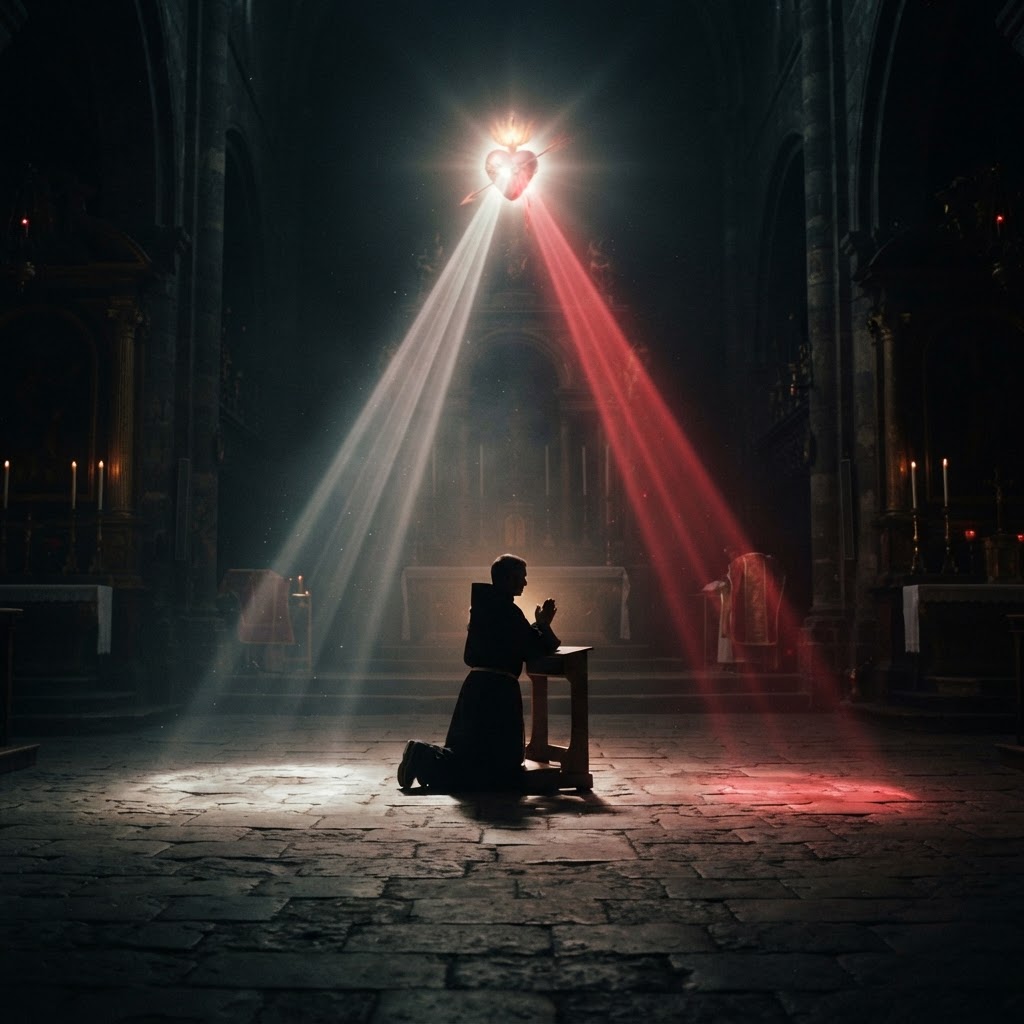
“O Sacred Heart of Jesus, I place my trust in You.”
Act of Consecration
History & Ecclesial Origin
From the Side of Christ to the Whole Church
The Sacred Heart was not invented in the seventeenth century. What happened at Paray-le-Monial was not the creation of a new mystery but the unveiling of an old one, and the Church received it the way she receives everything: slowly, testing the spirits, and finally giving it liturgical form. The history below is the record of that reception — the story of a devotion moving from personal contemplation to the altar of the whole Church.

The message given to St Margaret Mary was not new doctrine but an old complaint and an old invitation: love that is not returned, and a heart that asks to be loved in return.
At Paray-le-Monial, 1673-1675
What makes Paray-le-Monial significant is not the number of its revelations but the shape of them. They ask for nothing exotic. They ask for the Eucharist to be loved, for reparation to be made, for a feast to be kept, for a holy hour to be watched. Every element is already present in the Gospel and the sacraments — the revelations simply gave the Church a form in which to live what she already believed.
The Fathers
The wound that opens the Church
The earliest Christian writers read the pierced side as the birth of the sacraments and of the Church herself. St John Chrysostom saw in the water and blood the fountain of Baptism and the Eucharist; St Augustine returned again and again to the open side as the door of life. The devotion is therefore as old as the Church's contemplation of the Cross — it simply had not yet been given a feast.
The Medieval Flowering
Gertrude, Mechtilde, and the school of love
In the twelfth and thirteenth centuries the devotion becomes explicit and personal. St Lutgarde of Aywières, St Mechtilde of Hackeborn, and above all St Gertrude the Great were granted a contemplative familiarity with the Heart of Christ, resting there as at a throne of mercy. The tradition of the Vitis Mystica, long associated with St Bonaventure, gathered this contemplation of the Lord's heart into words.
The Seventeenth Century
Francis de Sales, John Eudes, and the first feast
St Francis de Sales made the love of Christ's heart the whole substance of his spirituality, and his teaching formed a generation. St John Eudes, who had received a vision of a union of the Hearts of Jesus and Mary, composed a Mass and Office for the Sacred Heart and had the feast celebrated privately as early as 1672 — nearly two centuries before Rome extended it to the whole Church.
1673-1675 · Paray-le-Monial
St Margaret Mary Alacoque
A young Visitation nun in a small French convent received a series of revelations of the Heart of Christ: His love poured out and not returned; His request to be loved especially in the Blessed Sacrament; His desire for a feast of reparation. Her spiritual director, St Claude de la Colombière, tested every element of her experience and judged it sound. From Paray-le-Monial came the Holy Hour, the Communion of reparation on the first Friday of the month, and the Twelve Promises — remembered by the faithful ever since as a private message, not as dogma.
1856
The feast given to the whole Church
Blessed Pius IX extended the feast of the Sacred Heart to the universal Church, to be kept on the Friday after the octave of Corpus Christi — the day St Margaret Mary had named, joining the two loves of Christ in one liturgical act: His Body given, and His Heart opened.
1899
Leo XIII and Annum Sacrum
Leo XIII consecrated the whole human race to the Sacred Heart, announcing that this Heart is the symbol of the whole mystery of the Incarnation and that in it all the hopes of the world are laid up. It was a consecration of nations and families, not merely of individuals.
1925 - 1928
Christ the King and the call to reparation
Pius XI, having given the Church the feast of Christ the King in Quas Primas (1925), issued Miserentissimus Redemptor (1928) on reparation: the devotion is not exhausted by receiving love, but returns it — consoling the Heart that is still wounded by sin, especially by coldness and ingratitude.
1956
Haurietis Aquas — the doctrinal charter
Pius XII's encyclical gave the devotion its fullest theological statement, grounding it in Scripture and Tradition and defining its object: the Person of the Incarnate Word, and the threefold love of His divine will, His human will, and His human affections. Since 1956 the devotion can no longer be dismissed as a passing piety without dismissing the doctrine it expresses.
1907 - Today
Enthronement and renewal
From the work of Blessed Mateo Crawley-Boevey onward, families have been invited to enthrone the image of the Sacred Heart in the home as an act of consecration and a daily profession that Christ is Lord of the household. The devotion has been commended in turn by John Paul II, Benedict XVI, and Francis, and remains the ordinary formation in love given to ordinary Catholics.
The Twelve Promises
Among the words recorded by St Margaret Mary are the promises traditionally listed as twelve — rest for the troubled, consolation in sorrow, strength in trial, blessings on the homes that honour the image, grace for those who spread the devotion, and finally the grace of perseverance for those who receive Communion on nine consecutive first Fridays. These promises are the Church's pastoral inheritance and have comforted countless souls, but they are to be received as the words of a private revelation: they do not add to the deposit of faith, and they do not function as guarantees detached from the sacraments and from conversion of life.
The discipline of nine first Fridays is therefore not a charm but a discipline. It is a sustained, monthly turning back to the Eucharist and to Confession across nine months — the length of a school year, a novena without haste — which is exactly what formation requires: repetition over time, until love becomes habit and habit becomes character.
Restoring the Devotion
A School of Love for a Cold Age
Every age has a sin that shapes it, and ours is a certain coldness of heart. It is not that we are cruel; it is that we are distracted, self-curated, and increasingly unable to receive love or to give it. We are formed daily by feeds and algorithms in the habit of consuming images rather than loving persons. Prayer becomes another task; religion becomes a set of positions to hold rather than a relationship to live. The heart is not at peace, because the heart was made for a Person it has stopped attending to.
This is why the devotion to the Sacred Heart needs to be restored as a central practice of personal formation, and not merely admired as a historical piety. It is the one devotion that goes directly to the wound of our condition. It teaches the affections to rest where they were made to rest. It converts knowledge about God into love of God, and love of God into acts of love of neighbour. Formation in the Heart of Christ is formation in the one thing that cannot be replaced by information or technique.
The Sacred Heart does not ask the disciple to feel more, but to give more: to love as Christ has loved, with an affection at once warm and unbreakable, and to make reparation where that love has been refused.
The logic of the devotion
Restoring It in the Home and the Heart
Restoration begins with three acts that are entirely within the reach of any Catholic household. First, enthronement: placing an image of the Sacred Heart in a place of honour and making the family's consecration to it, not as decoration but as a public pledge that the home belongs to Christ. Second, reparation: naming the four wounds the devotion has always identified — ingratitude, indifference, coldness, and sacrilege toward the Blessed Sacrament — and answering them with the Holy Hour and the first Friday. Third, the Litany: prayed slowly and attentively, it is a complete catechesis of the Heart of Christ in the form of prayer, and it forms the mind while it forms the affection.
What follows is a simple rule of life. It is deliberately unambitious: the point is not heroic intensity but regularity over years, which is the only way the heart is ever actually formed.
Daily
A minute of reparation
Begin or end the day with the Acts of Consecration and Reparation, and the Litany of the Sacred Heart. One minute, offered deliberately: 'Sacred Heart of Jesus, I place my trust in You.' Over a year, a minute becomes a habit of turning toward Christ in the middle of ordinary life.
Weekly
The Holy Hour
One hour of Eucharistic adoration, preferably on Thursday evening or before the Blessed Sacrament exposed. This is the practice St Margaret Mary was told to keep: to watch with Christ in Gethsemane, where He asked His disciples to stay awake with Him and they could not.
Monthly
First Friday
Confession, then Communion in a spirit of reparation on the first Friday of the month. Nine consecutive first Fridays constitute the classical discipline — a school of perseverance rather than a formula for favours.
Annually
The Solemnity of the Sacred Heart
The Friday after the octave of Corpus Christi. Keep it as the feast of the household too: if the image has been enthroned in the home, renew the consecration of the family on that day.
What the Devotion Forms in the Soul
Formation of the affections
The heart is trained, not merely informed
Eucharistic hunger
Devotion that empties into the sacraments
Compunction
Sorrow for sin that is hopeful rather than despairing
Zeal
A love that cannot stay private — it evangelises
Family order
The household placed explicitly under Christ's lordship
Reparation
Love returning to console the Heart that gave it
The Social Consequence
The devotion has never been merely interior. Leo XIII consecrated the human race to the Sacred Heart because the Kingdom of Christ is a real claim over nations, families, work, and public life — the same claim later given liturgical form in the feast of Christ the King. A household that has enthroned the Sacred Heart has made a political statement in the original sense of the word: this house has a Lord, and it is not the state, the market, or the age.
Which means the restoration of this devotion is one of the quietly subversive works available to ordinary Catholics. It requires no platform, no funding, and no permission. It requires a wall, an image, a family willing to kneel, and the patience to keep the first Fridays for nine months. That is how a culture of devotion is rebuilt — one household at a time.
Expanded & Completed
The Sacred Heart and Divine Mercy
The devotion to the Divine Mercy is not a rival to the Sacred Heart, nor a later correction of it. It is the same mystery named from the other side. The Sacred Heart is the love of Christ in itself — divine, human, and enduring; Divine Mercy is that same love turned toward us in our misery. Mercy is what love looks like when it meets a wounded creature who cannot repay it. To contemplate the Heart is to discover that it is merciful; to receive mercy is to be drawn into the Heart.
The wound in the side is the fountain of both: the love that is wounded shows itself as the mercy that heals. What the Church venerates in the Sacred Heart, she begs in the Divine Mercy.
The unity of the two devotions
The Message Given to St Faustina
Helena Kowalska (1905-1938), a Polish nun of the Congregation of the Sisters of Our Lady of Mercy, was granted a series of interior revelations recorded in her diary, Divine Mercy in My Soul. In 1931 at Plock she was shown the image of the merciful Christ with the two rays and told to have it painted and venerated; in 1935 at Vilnius she was given the Chaplet; and she was told of a feast of mercy to be celebrated on the Sunday after Easter, before which souls should approach Confession and Communion. The core of the message was a single sentence she was to repeat to a frightened world: that mercy is God's greatest attribute, and that the one thing that blocks it is despair masquerading as humility.
The Church moved carefully. A notification in 1958 restricted the spread of her writings in their then-current form while translations were corrected; the ban was lifted in 1978, the cause advanced, and in 1993 she was beatified and in 2000 canonised. That slow process is not an embarrassment — it is the Church exercising the discernment she owes to the faithful. Private revelation is always tested, and what survived the testing was not sensationalism but the Gospel in a new key.
Mercy Is Not Cheap
The doctrine of mercy is easily caricatured into a permission for sin. It is nothing of the kind. In Dives in Misericordia (1980), John Paul II taught that mercy is love's second name and that it presupposes justice and does not abolish it; mercy is not the suspension of the moral order but its fulfilment in the person of the Redeemer, who takes the debt upon Himself. Francis made the same point in Misericordiae Vultus (2015): mercy is not licence, it is the call to conversion received with confidence.
Which means the devotion has a built-in test. It is not measured by how often we say "Jesus, I trust in You," but by whether we confess, whether we forgive, whether we feed the hungry and visit the imprisoned. The works of mercy in Matthew 25 are the examination by which the devotion is graded, because the mercy we have received must pass through us or it has not been received at all.
The Practices the Devotion Gives Us
The Image
“Jesus, I trust in You”
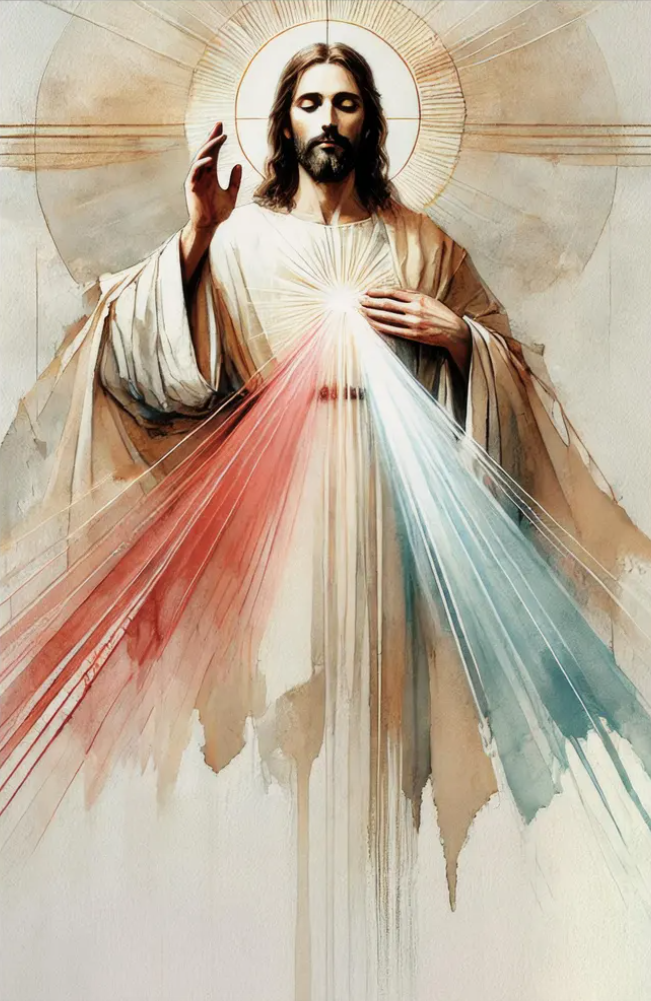
The image given to St Faustina shows the risen Christ with two rays, one pale and one red, streaming from His pierced heart. The signature beneath it is not a decoration but the whole theology: trust is the posture of the one who receives mercy.
The Chaplet
Mercy on the beads
Prayed on ordinary rosary beads, the Chaplet of Divine Mercy offers the Father the Body, Blood, Soul, and Divinity of His Son as the price of mercy for the world and for the dying. It is, in substance, a prayer of the Eucharist — offered in the absence of the altar, and in union with it.
The Hour
Three o'clock
The Hour of Mercy recalls the moment of the Lord's death. It is not superstition about a clock but a daily appointment with the Cross: whatever one is doing at three, one stops to give the hour back to the One who died in it.
The Feast
Second Sunday of Easter
Instituted for the whole Church by John Paul II on 30 April 2000, at the canonisation of St Faustina: Divine Mercy Sunday, the octave day of Easter, when the Church celebrates above all the mercy that the Resurrection pours out on sinners. Confession and Communion on that day are its intended observance.
The Two Rays
St Faustina was told that the two rays signify the blood and the water — the blood that is the price of redemption, the water that cleanses and refreshes the soul. It is the same wound St John saw opened on Calvary, and it means the same thing. The devotion to Divine Mercy is therefore the devotion to the Sacred Heart, read at the level of our need: not only "He is love", but "His love is for me, here, in this sin, in this failure, in this deathbed".
Hold the two together and a complete formation emerges. The Sacred Heart forms us in adoration: the love of Christ contemplated, adored, and repaid. Divine Mercy forms us in trust: the same love received by sinners who have nothing to bring but their need. Adoration without trust becomes cold; trust without adoration becomes presumptuous. The Heart gives us both, and the Church asks us to live both.
A Daily Rule
Morning: consecration to the Sacred Heart, and the Litany. Three o'clock: the Hour of Mercy, however briefly. Evening: the Chaplet, with the dying named before God. Weekly: Confession when needed, the Holy Hour, and one deliberate work of mercy for someone who cannot repay it.
Daily Reflection · The Sacred Heart
Learn the Heart That Loves You
"Come to Me, all who labour and are heavy laden, and I will give you rest... for I am gentle and lowly in heart."
Matthew 11:28-29
The devotion to the Sacred Heart asks nothing of us that the Gospel has not already asked, and offers nothing less than the love of God in the Person of Christ. Begin where the Church has always begun: in Confession, in the Eucharist, and in one deliberate act of love today. The heart is formed the way a muscle is formed — by repetition in the ordinary hours of an ordinary life.