
"You will receive power when the Holy Spirit comes upon you; and you will be my witnesses." — Acts 1:8
Come, Holy Spirit.
The gifts of the Holy Spirit are not relics of the past. They are active graces given for the mission of the Church today — received with gratitude, exercised with humility, tested with wisdom.
Emptied at the cross, now filled at Pentecost. The third pillar is the life of grace lived in the Spirit — taking nothing for granted, praying in His power, walking in His gifts.
There appeared to them tongues as of fire, distributed and resting on each one of them.
Acts 2:3
CCC 799–801
The Church's Teaching on Charisms
CCC 799 — "Whether extraordinary or simple and humble, charisms are graces of the Holy Spirit which directly or indirectly serve charity."
CCC 800 — "Charisms are to be accepted with gratitude by the person who receives them and by all members of the Church as well."
CCC 801 — "It is for the Church's pastors to pass judgment on the authenticity and proper use of charisms."
The Gifts
The Charisms of the Holy Spirit
Wisdom
1 Cor 12:8The supernatural capacity to judge all things in the light of God — seeing the deepest meaning of events, scripture, and circumstances from the Spirit's vantage point.
Knowledge
1 Cor 12:8Supernatural knowledge given for another's healing, conversion, or comfort — bringing hidden things to light for the building up of the Body.
Faith
1 Cor 12:9A special grace of confident trust for impossible situations — the mountain-moving gift that lays hold of God's promise.
Healing
1 Cor 12:9Physical and inner healing as a sign that the Kingdom of God is breaking in — the restoration of the whole person, body and soul.
Working of Miracles
1 Cor 12:10Extraordinary interventions of divine power — nature itself bends to the Spirit's command as a sign that the Risen Christ is still Lord.
Prophecy
1 Cor 12:10Words of building up, encouragement, and consolation — always tested by Scripture and the Church, never above her authority.
Discernment of Spirits
1 Cor 12:10The gift of recognising what is of God, what is of man, and what is of the enemy — guarding the Church from deception.
Tongues
1 Cor 12:10A prayer language that bypasses the intellect and intercedes from the spirit directly to God — personal and corporate edification.
Interpretation of Tongues
1 Cor 12:10The companion gift that renders tongues intelligible to the assembly, so the whole Body may be built up in love.
Receive the Holy Spirit.
John 20:22
A Legacy Before the Renewal
Charisms in the Lives of the Saints
Charismatic gifts have always been present in the Catholic Church, rooted deeply in the lives of the saints and mystics. While the Azusa Street revival is considered a catalyst for classical Pentecostalism, and the 1967 Duquesne University weekend birthed the Catholic Charismatic Renewal, historical records abound with outpourings of the Holy Spirit throughout the 19th century.
Historically, the Church distinguishes between "charismatic" gifts (graces given for the building up of the Church, such as tongues and prophecy) and "mystical" experiences. The accounts below bear witness that the same Spirit who fell at Pentecost has never ceased to pour out His gifts upon the Church — long before any modern renewal movement.
St. Jean-Marie Vianney
The Curé of Ars
The patron saint of parish priests was documented to have spoken and understood languages he had never learned when engaging with foreigners and pilgrims — an experience analogous to the scriptural gift of tongues.
St. John Bosco
Prophetic Visions & Locutions
Renowned for his prophetic visions and locutions, St. John Bosco often spoke of the future of the Church and Italy with profound accuracy. His prophetic outpourings are detailed in his biographical memoirs.
St. Bernadette Soubirous
The Apparitions at Lourdes
During the 1858 Marian apparitions at Lourdes, Bernadette experienced profound outpourings of the Holy Spirit. Her states of ecstasy were accompanied by prophecies regarding the healing waters of Lourdes and the dogma of the Immaculate Conception.
Pope Leo XIII
Veni Creator Spiritus
On January 1, 1901 — just hours before the historic outpouring at Topeka, Kansas — Pope Leo XIII invoked the Holy Spirit over the entire 20th century by officially chanting the hymn Veni Creator Spiritus in St. Peter's Basilica, a profound institutional opening to a renewed presence of the Spirit in the modern Church.
St. Gemma Galgani
The Gem of Christ
Known as the "Gem of Christ," she experienced intense spiritual ecstasies. Her mystical life involved frequent conversations with her guardian angel, the Virgin Mary, and Jesus, along with the reception of the stigmata — showcasing the profound spiritual gifts continuously active in Catholicism.
The Spirit of the Lord is upon me, because He has anointed me.
Luke 4:18
From the Early Church to the Counter-Reformation
Charisms Through the Centuries
Charismatic gifts were active in the Catholic Church centuries before the modern era, heavily documented in the lives of early and medieval saints. Church history shows that phenomena like speaking in tongues (glossolalia / xenoglossia), prophecy, and supernatural outpourings were frequently recorded by monastic chroniclers and biographers. The chronological records below outline these manifestations from the Early Church through the 17th century.
The Early Church Fathers
St. Irenaeus of Lyons
In his landmark work Against Heresies, he wrote about Christians who "speak all kinds of languages through the Spirit" and bring hidden things of men to light for the general benefit.
St. Pachomius
The founder of Christian communal monasticism was recorded by his biographers as suddenly receiving the ability to speak Greek and Latin fluently under the influence of the Holy Spirit, despite only knowing Egyptian.
The High Middle Ages
St. Hildegard of Bingen
This German Benedictine abbess and Doctor of the Church experienced powerful outpourings of the Holy Spirit from childhood, resulting in vivid prophetic visions, ecstatic states, and the composition of complex theological texts and music without formal training.
St. Anthony of Padua
During a papal consistory, St. Anthony preached with such intense spiritual fervor that witnesses from diverse nations — including Greeks, Latins, French, and Germans — all heard and understood him perfectly in their own native languages.
St. Dominick
Early Dominican histories record that during his journeys, St. Dominick and his companions miraculously spoke and understood local dialects they had never studied, specifically to preach the Gospel.
The Renaissance & Counter-Reformation
St. Vincent Ferrer
A Dominican friar known as the "Angel of the Judgment," he preached across Europe. Witnesses routinely documented that while he spoke only his native Valencian, crowds of thousands from different linguistic backgrounds understood every word.
St. Francis Xavier
During his missionary journeys in Asia, multiple contemporary accounts and subsequent canonisation records detailed his ability to preach to diverse tribal groups in their own specific languages without prior instruction.
St. Louis Bertrand
A Spanish Dominican who missioned in South America, he was widely reported to have possessed the biblical gift of tongues, allowing native tribesmen to comprehend his Spanish sermons as if spoken in their own indigenous tongues.
St. Mary Magdalene de' Pazzi
This Carmelite mystic experienced profound spiritual ecstasies after receiving Holy Communion, during which she would prophesy, speak rapidly in elevated theological language, and experience intense physical heat from the "fire of the Holy Spirit."
All these are inspired by one and the same Spirit, who apportions to each one individually as He wills.
1 Corinthians 12:11
Deep Dive · CDF Letter, 15 May 2016
Iuvenescit Ecclesia — "The Church Rejuvenates"
In 2016, the Congregation for the Doctrine of the Faith (now the Dicastery for the Doctrine of the Faith), with the approval of Pope Francis, issued Iuvenescit Ecclesia — a letter to the bishops of the Catholic Church on the relationship between hierarchical and charismatic gifts in the life and mission of the Church.
Its central teaching: hierarchical gifts (received through Holy Orders — the ministry of bishops, priests, and deacons) and charismatic gifts (freely distributed by the Holy Spirit for the Church's mission) are co-essential to the Church's constitution. Neither is optional; neither is superior. Both flow from the same Spirit, for the same purpose — the building up of the Body of Christ.
The letter insists that charisms — including the extraordinary gifts prized in charismatic spirituality — are never private possessions or badges of prestige. They are ordered, always, toward communion. A charism that separates itself from the Church's hierarchical structure, or that sets itself up in rivalry to the pastors of the Church, has already ceased to be authentic.
For this reason, the discernment of charisms belongs properly to the Church's pastors (cf. CCC 801), who test movements and gifts not to suppress the Spirit but to safeguard the unity and fruitfulness of what He is doing.
Co-Essentiality: One Spirit, One Purpose
"Aroused by the same Spirit, [the hierarchical and charismatic gifts] have the same origin and the same purpose" — the sanctification of the Church and her mission to the world. Neither can be reduced to a mere function of the other.
Hierarchical Gifts
Given through the Sacrament of Holy Orders — the episcopal, priestly, and diaconal ministries that govern, teach, and sanctify the Body of Christ.
Charismatic Gifts
Freely distributed by the Holy Spirit — independent of Holy Orders — for the renewal and mission of the whole Church, always subject to ecclesial discernment.
Criteria for Ecclesial Discernment
Iuvenescit Ecclesia gives pastors — and the faithful — concrete criteria for testing whether a charism or ecclesial movement bears the marks of the Holy Spirit:
The primacy of every Christian's vocation to holiness.
Commitment to spreading the Gospel.
Profession of the Catholic faith in communion with the Bishops and the Magisterium.
Witness to a real, unbroken communion with the whole Church.
Recognition of and esteem for the complementarity of other charismatic and institutional elements of ecclesial life.
Acceptance of moments of trial in the discernment of charisms.
Presence of the spiritual fruits of charity, joy, peace, and human maturity.
A genuine social dimension of evangelisation, ordered to the common good.
Orthodox Prudence
Receiving the Spirit Faithfully
Sovereignty of the Spirit
The Spirit distributes gifts as He wills (1 Cor 12:11). We receive — we do not manufacture. Authentic charisms are always humble.
Ordered to the Common Good
CCC 799–801: Charisms are not for personal prestige but for the building up of the Body of Christ in love.
Discernment by the Church
All charismatic gifts must be exercised with and under the authority of the Church. The tree is known by its fruit.
Guarded by Orthodoxy
Catholic Charismatic spirituality is always anchored to Scripture, Tradition, and the Magisterium. Enthusiasm is never above fidelity.
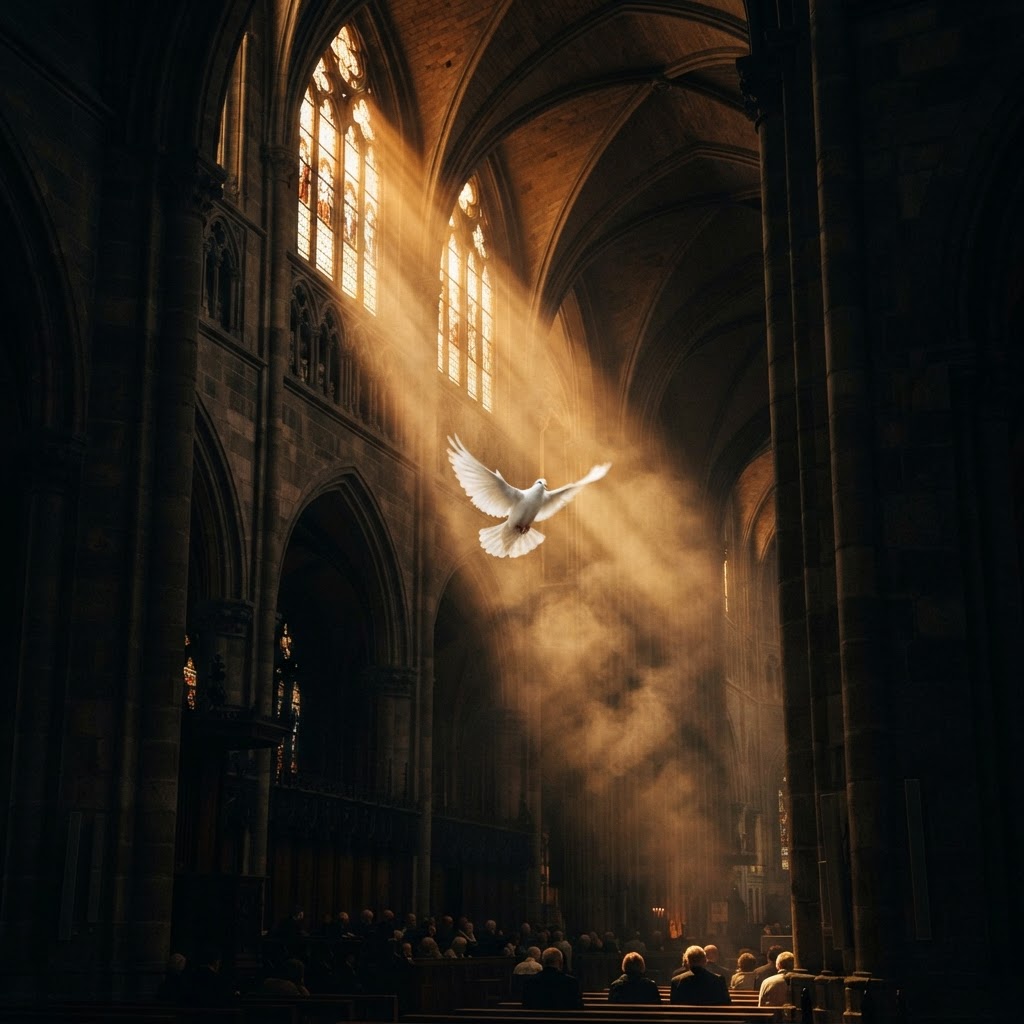
You will receive power when the Holy Spirit comes upon you; and you will be my witnesses.
Acts 1:8
Be Grateful · Receive the Gift
"You will receive power when the Holy Spirit comes upon you; and you will be my witnesses."
Acts 1:8
The Spirit has already been poured out. The gifts have already been given. The only question is whether we will receive them with gratitude, exercise them in humility, and submit them to the discernment of Christ's Church — that the whole Body be built up in love.