
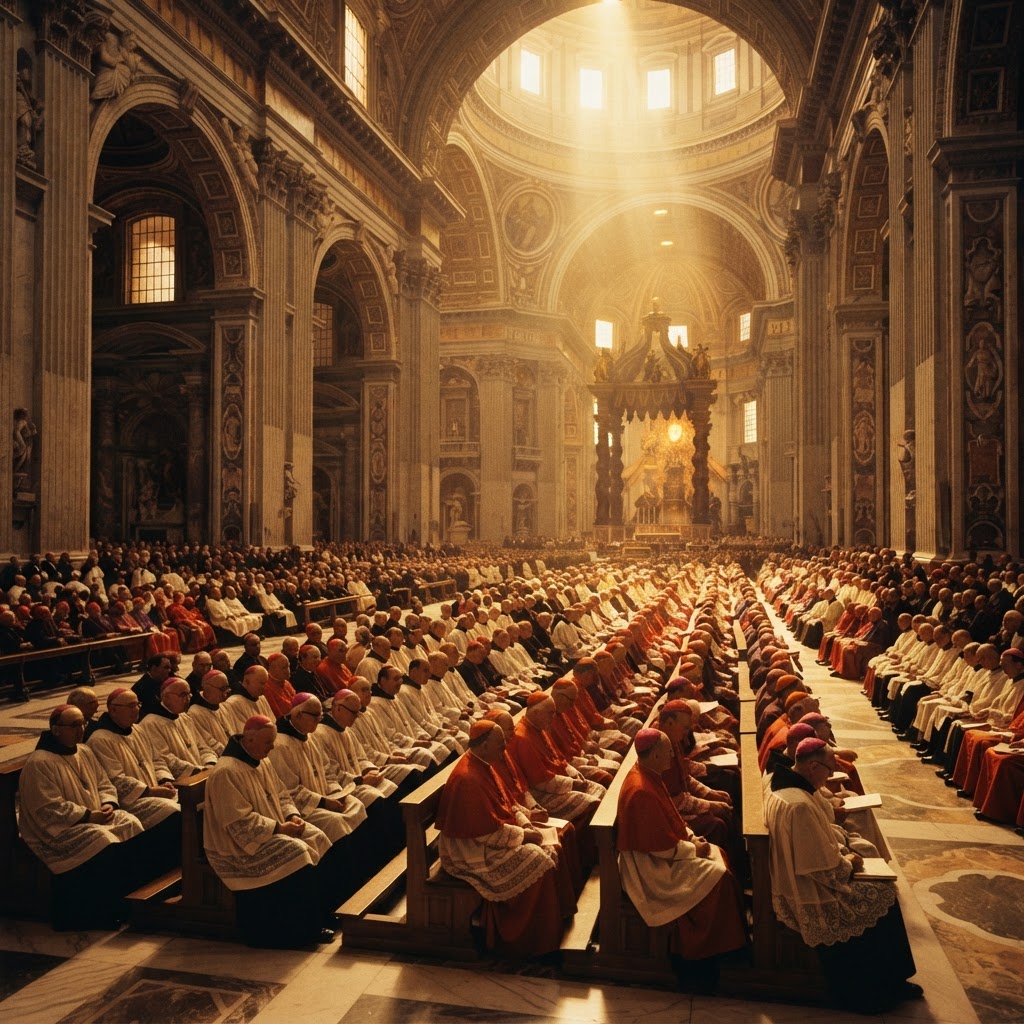
Nostra Aetate · Anniversary Essay
The Mandate They Buried: Nostra Aetate at Sixty-One
On its anniversary, a reading of the Council's declaration on the religions as it was actually written — governed by Lumen Gentium, and bound to the preaching of Christ crucified.
By Justin Poor. Catholic Prophetic Apologist, drawing from Sacred Tradition, the Fathers, Doctors, and the Full Magisterium.
Read the essayI. The Sentence Everyone Skips
The Mandate Is Inside the Document
On 28 October 1965 Pope St. Paul VI promulgated Nostra Aetate — the shortest document of the Second Vatican Council, five brief paragraphs, fewer than two thousand words. In sixty-one years it has become the most quoted and least read text of the Council.
It is quoted, almost always, for one sentence: “The Catholic Church rejects nothing that is true and holy in these religions” (NA 2). That sentence is real, and it is beautiful. It is also the first half of an argument whose second half is almost never printed: “Indeed, she proclaims, and ever must proclaim Christ ‘the way, the truth, and the life’ (John 14:6): in whom men may find the fullness of religious life, in whom God has reconciled all things to Himself.”
Read the verbs. Not she may proclaim. Not she proclaims where she is welcome. She proclaims, and ever must proclaim — a permanent obligation, stated in the same paragraph, about the same religions, in the same breath as the reverence. The document does not balance two ideas; it orders them. The reverence is the manner. The proclamation is the matter.
The same paragraph supplies the grammar for every conversation that follows: “Let Christians, while witnessing to their own faith and way of life, acknowledge, preserve and encourage the spiritual and moral truths found among non-Christians, also their social life and culture” (NA 2). While witnessing. That participle governs the sentence. A Christian who admires the good in another religion and stops witnessing has not fulfilled the instruction; he has broken it in half.
“The Catholic Church rejects nothing that is true and holy in these religions… Indeed, she proclaims, and ever must proclaim Christ ‘the way, the truth, and the life’ (John 14:6): in whom men may find the fullness of religious life, in whom God has reconciled all things to Himself.”
So what has gone wrong?
A generation of catechesis has kept the first clause and dropped the second. What remains is a document that appears to say the religions are already fine, and a Church that appears to have nothing to bring them. Neither impression is in the text. Both are now the settled assumption of the average Catholic in the pew — which is why the anniversary deserves an argument rather than a press release.
II. The Document That Governs It
Read Nostra Aetate Through Lumen Gentium
No declaration of the Council is read in isolation, and the rank of the documents is not a technicality. Lumen Gentium, the dogmatic constitution on the Church, was promulgated on 21 November 1964 — nearly a year before Nostra Aetate. It is the Council's doctrinal spine, and it establishes the framework within which the later declaration on religions has any meaning at all.
Its sixteenth article is the passage every discussion of Nostra Aetate must begin with. Those who have not received the Gospel, it says, are “related in various ways to the people of God.” Israel, on account of the fathers, “remains most dear to God.” Among those who acknowledge the Creator, “in the first place there are the Muslims.” And then the sentence that settles the question: “whatever good or truth is found amongst them is looked upon by the Church as a preparation for the Gospel” (LG 16).
A preparation is not a destination. A seed is not a harvest. The Council's vocabulary is deliberately agricultural and deliberately directional: the good in the religions is real, and it is pointing somewhere — toward the One who is the truth it only approximates.
The same constitution holds the other end of the chain. The Church “is necessary for salvation” (LG 14). And she “has the obligation and the sacred right to evangelize all peoples,” because Christ said: “Go therefore and make disciples of all nations” (LG 17; Matthew 28:19). A Catholic cannot accept Lumen Gentium 16 while treating 14 and 17 as embarrassments. They are one argument in one document.
When the Congregation for the Doctrine of the Faith finally had to draw the line in Dominus Iesus (2000), it drew it exactly here: in interreligious dialogue, “equality, which is a presupposition of interreligious dialogue, refers to the equal personal dignity of the parties in dialogue, not to doctrinal content, nor even less to the position of Jesus Christ” (DI 21). And again: the Church “must be primarily committed to proclaiming to all people the truth definitively revealed by the Lord” (DI 22). Dialogue is a part of the Church's evangelising mission, as Redemptoris Missio 55 says plainly. It is a part. It is not the whole, and it is never the end.
“The Church, guided by charity and respect for freedom, must be primarily committed to proclaiming to all people the truth definitively revealed by the Lord, and to announcing the necessity of conversion to Jesus Christ and of adherence to the Church through Baptism and the other sacraments.”
III. Clearing the Ground
Five Things Nostra Aetate Does Not Say
Most of the argument on this subject is not about what the Council taught but about what people have been told it taught. Five corrections, each with the text behind it.
- 01
It does not say the religions are equal.
It says the Church “rejects nothing that is true and holy” in them — a judgement about fragments of truth, not a grading of systems. To say that a religion contains truths is not to say it is true in the way the Church is true, and the paragraph goes on to say exactly why: the fullness of religious life is found in Christ alone.
- 02
It does not say dialogue replaces proclamation.
Dialogue is the manner of the encounter; proclamation is its content. Nostra Aetate 2 commands both in the same sentence, and no reading that preserves one while deleting the other can claim to be the Council's.
- 03
It does not say the Church has no mission to Jews or Muslims.
It forbids contempt, not mission. The declaration's own fourth paragraph has the Church “awaiting that day, known to God alone, on which all peoples will address the Lord in a single voice” (NA 4; Zephaniah 3:9). You do not await a day you believe has already arrived.
- 04
It does not say sincerity is enough.
Lumen Gentium 16 says God does not deny the helps necessary for salvation to those who, through no fault of their own, do not know the Gospel. That is a statement about the reach of God's mercy, and about His freedom to save whom He will. It is not a doctrine that the religions are alternative roads, and the Council never says it is.
- 05
It does not say the faith has changed.
Nostra Aetate 1 says the Church “examines more closely” her relationship to the non-Christian religions. Examining more closely is a deepening of understanding, not a reversal of revelation. Nothing in a declaration may be read as contradicting what a dogmatic constitution has already defined.
IV. The First Burden
To Israel: “Not Repudiated” Is Not “Not Summoned”
Nostra Aetate 4 accomplished something the Church had owed for two thousand years. It decreed that “the Jews should not be presented as repudiated or cursed by God, as if such views followed from the holy Scriptures,” and it deplored “hatreds, persecutions, displays of anti-Semitism, directed against Jews at any time and by anyone.” That repudiation of contempt is irrevocable, and any Catholic who trades it away for polemical advantage has betrayed the Council and the Gospel at once.
But note precisely what was repaired and what was not. The Council removed a false charge. It did not remove a mission. In the same paragraph it says that the Church, “mindful of the patrimony she shares with the Jews,” is moved “by the Gospel's spiritual love” — and then that she “awaits that day, known to God alone, on which all peoples will address the Lord in a single voice.” The waiting is explicitly theological, not diplomatic.
St. Paul had already told us what that day looks like. Israel is the cultivated olive tree; the Gentiles are branches grafted in contrary to nature; and the natural branches, he says, “will much more readily be grafted back into their own olive tree” (Romans 11:24). There has come “a partial hardening upon Israel, until the fullness of the Gentiles comes in, and so all Israel will be saved” (Romans 11:25–26). One root. One tree. One Messiah. “The gifts and the calling of God are irrevocable” (Romans 11:29). The Catechism draws the conclusion without flinching: the glorious Messiah's coming is “suspended at every moment of history until his recognition by ‘all Israel’” (CCC 674).
To say that the veil of which St. Paul speaks “is removed in Christ” (2 Corinthians 3:14–16) is not contempt for the synagogue. It is grief that her own Scriptures are still waiting for their Yes, who is Christ (2 Corinthians 1:20). A Church that stops longing for that recognition has not become more respectful of Judaism; she has stopped believing her own Bible, and has left a people she loves with the veil still on.
Some post-conciliar texts — notably the 2015 reflection The Gifts and the Calling of God Are Irrevocable — have been read as settling the matter and closing the question of mission to Israel. No such text is a definition, and none can repeal Romans 11 or CCC 674. The Church has never defined, and will never define, that Israel's Messiah is anyone other than Jesus of Nazareth.
What this rules out
Two errors, opposite and both common. The first is contempt: treating Jews as a cursed people, which Nostra Aetate 4 forbids absolutely. The second is abandonment: treating Israel as a people who need no Messiah, which the same Council never said, and which no council could say without contradicting St. Paul. The Catholic position is neither. It is love that refuses both the insult and the silence.
V. The Second Burden
To Islam: The Creator Without the Mediator
Nostra Aetate 3 is the warmest paragraph in the document, and it is worth quoting at its full strength. Muslims, it says, “adore the one God, living and subsisting in Himself, merciful and all-powerful, the Creator of heaven and earth, who has spoken to men”; they submit “wholeheartedly to even His inscrutable decrees”; they honour Jesus as a prophet and Mary His virgin Mother; they await the day of judgement; they “value the moral life and worship God especially through prayer, almsgiving and fasting.” All of that is true, and a Catholic should say it gladly.
Now the provenance, because in this paragraph it is not a detail. The declaration John XXIII asked Cardinal Bea to prepare in 1960 was a statement on the Church and the Jewish people — a reply to the Holocaust, and nothing else. He did not live to see it widened. He died on 3 June 1963, before the text reached its final shape. The paragraphs on Islam entered under his successor, when the schema was turned from a decree on the Jews into a declaration on all the non-Christian religions — the decisive step taken at the third session, in the autumn of 1964, and promulgated by Paul VI on 28 October 1965.
The reason for that widening was not a development of doctrine. It was fear. Eastern patriarchs and bishops from the Arab world, joined by Arab governments working through their embassies, warned publicly and privately that a Council document naming the Jews and no one else would be read in Cairo and Damascus as a religious endorsement of Israel — and would be answered on the bodies of the Christian minorities living under Islamic rule. The remedy proposed was not a deeper study of Islam. It was a political remedy: put Islam into the text, and put it ahead of the treatment of the Jews, which is exactly where the final numbering of the declaration places it (§3 before §4). Then the document can be shown in the region as even-handed. That is the manoeuvre, and it is not a conspiracy theory: the men who made it were shepherds trying to keep their flocks alive. But it tells you what kind of text §3 is.
And a text written to avert reprisal reads the way fear reads. It gathers up everything that can be affirmed — the one God and Creator, His decrees, Jesus honoured as a prophet, Mary His virgin Mother, the judgement, prayer, almsgiving, fasting — and never once names the Cross. That silence is not an oversight of the drafting committee. It is the price the paragraph was built to avoid paying, and the men who built it knew the price to the last denarius.
And then, in the middle of that same paragraph — almost against the grain of the paragraph's own purpose — the Council names the deficit: “Though they do not acknowledge Jesus as God, they revere Him as a prophet.” There it is, in the document itself, unsoftened and unretracted. The Council did not say Muslims have a different emphasis. It said they do not acknowledge what the Church acknowledges. That clause is the hinge on which the whole paragraph turns, and it is the clause that is never read aloud.
What Islam denies is not peripheral. It denies the Trinity — “Say not ‘Three’” (Qur'an 4:171); it denies the Incarnation; it denies the Cross — “they did not kill him, and they did not crucify him” (Qur'an 4:157); it denies the divine Sonship — “He has not begotten and has not been begotten” (Qur'an 112:3). These are not ornaments on the Gospel. Remove them and there is no Gospel left: no God who became man, no sacrifice that expiates, no risen body to verify the claim.
The architecture is what matters. Islam keeps the Creator, the law, the judgement, the prophet, the honour of Jesus and Mary — and removes the Mediator. What remains is an austere and often noble monotheism with no expiation: a sovereign will, a creature, and scales to be balanced. The Church's answer is one sentence of St. Paul: “there is one mediator between God and men, the man Christ Jesus, who gave himself as a ransom for all” (1 Timothy 2:5–6). Take the mediator away and you have not simplified Christianity; you have made salvation a matter of arithmetic.
This is not a novel severity invented by the internet. St. John of Damascus, writing in Arabic under Islamic rule in the eighth century, called it the heresy of the Ishmaelites and traced its denials one by one. St. Thomas Aquinas, in the Summa contra Gentiles, treated it as the missionary's question and answered it with the Cross. And St. Francis of Assisi walked unarmed into the Sultan's camp at Damietta in 1219 to say it to his face — not with a sword, but with the Gospel, and at the risk of his life. That is the Catholic pattern: the clearest possible doctrine, carried by the gentlest possible men.
None of this makes the paragraph false. What it affirms, it affirms truly, and its own clause about Muslims not acknowledging Jesus as God keeps it honest against every reading that would flatten the religions into one. But a paragraph assembled under pressure to offend no one is a pastoral and diplomatic instrument, not a dogmatic definition, and nobody is bound to treat it as more than it is. Receive it with gratitude where it is true; read it without deference where it went quiet. The Council did not define that Islam is a parallel road. It declined, for a season and for reasons of state, to say out loud where the road diverges.
The distinction that keeps this charitable is simple and non-negotiable: the Muslim is not the error. Nostra Aetate 3's esteem is not a diplomatic formula, and the Church's love for Muslims is not a strategy. But love that will not name the absence of the Cross is not love. It is politeness purchased at the price of a soul.

VI. The Qur'anic Question
‘Isa Is Not Yeshua: Steelmanning the Case
The conciliar paragraph on Islam rests on an assumption of continuity, and it is worth naming it plainly. It assumes that when the Qur'an speaks of ‘Isa ibn Maryam, the Catholic reader may quietly supply the Gospels' Jesus — that the honour paid to a prophet is the beginning of the honour owed to the Son, and that the reverence for Mary is the same reverence in a different tongue. The assumption was generous. It was made by men trying to stop a fire, and it bought a generation of goodwill. It is also the weakest joint in the whole conciliar teaching on the religions, because unlike the rest of the document it is not a statement of principle but a claim of fact, and claims of fact can be tested.
So let the opposite case be made at full strength, and made with Catholic instruments rather than polemical ones. The claim is not that Muslims are insincere, nor that they worship nothing. The claim is narrower and harder: that the ‘Isa of the Qur'an is not the Jesus of the New Testament — not the same Person differently described, but a figure built from other materials, bearing a borrowed name. If that is true, then the Council's warmth is not false, but its assumption of identity is doing work it cannot bear.
- 01
Scripture supplies the test, and the test is negative
St. Paul does not merely assert one gospel; he legislates against a second. “If someone comes and proclaims another Jesus than the one we proclaimed… you submit to it readily enough” (2 Corinthians 11:4). And to the Galatians: “even if we, or an angel from heaven, should preach to you a gospel contrary to that which we preached to you, let him be accursed” (Galatians 1:8). St. John gives the same test in a single line: “every spirit which does not confess Jesus is not of God” (1 John 4:3). Note what kind of criterion this is. It is not sincerity, not monotheism, not moral seriousness. It is content. If the apostolic kerygma is the measure of who Jesus is, then a proclamation that can be given without the crucified and risen Lord is not a description of the same Person — Paul has already filed it under “another Jesus”.
- 02
Identity is constituted by origin — and the Qur'an changes the origin
The Qur'an's Jesus is made as Adam was made: “the likeness of Jesus with God is as the likeness of Adam; He created him of dust, then said He unto him, ‘Be’, and he was” (3:59); “he is nothing but a servant whom We have favoured” (43:59); “it is not for God to take a son unto Him” (19:35); “the Messiah, Jesus son of Mary, was only a Messenger” (4:171). Against this stands the Church's most precise instrument, the Definition of Chalcedon: “one and the same Christ, Son, Lord, Only-begotten”, and the Athanasian confession that the Son is “not made, nor created, but begotten”. Catholic theology holds that the divine Persons are distinguished by nothing but their relations of origin (St. Thomas Aquinas, Summa Theologiae I, qq. 28–29); the Son is the Son because He is eternally begotten of the Father. Change the origin and you have not changed the biography of one Person — you have posited another. A Christ whose existence begins with a creative fiat is not the eternal Word under a different description; he is a creature, and a creature is not the Person.
- 03
The Cross is not an episode in the identity; it is the identity
“They slew him not, and they crucified him not, but they had only his likeness” (4:157). Remove that and the figure who remains may be revered, but he is not the one the Church knows: “I delivered to you as of first importance what I also received, that Christ died for our sins in accordance with the scriptures, that he was buried, that he was raised on the third day” (1 Corinthians 15:3–4). Catholic theology has never treated the Passion as an additive. St. Anselm's Cur Deus Homo argues that the Mediator must be both God and man precisely because the satisfaction must be offered by a man who is God; St. Athanasius's De Incarnatione makes death and resurrection the very reason for the assumption of flesh; St. Thomas treats the Passion as the efficient cause of salvation (ST III, q. 46). A teacher who is taken up without dying has not passed through the act that constitutes the Mediator. He can be admired; he cannot be the same Person, because the Person is known by what He did in the flesh.
- 04
The Qur'an's Christology sits inside heresies the Church had already judged
The substitution at the crucifixion — “they had only his likeness” — is the docetic move, and the Church met it in the second century: St. Irenaeus records that Basilides taught that Simon of Cyrene was crucified in Christ's place while Christ looked on (Adversus Haereses I.24.4). The triad of Surah 5:116 — God asking, “O Jesus son of Mary, didst thou say unto men, ‘Take me and my mother as gods, apart from God’?” — is not the Nicene Trinity and not any orthodoxy the Church has ever professed; it is close to the Collyridian error, the Arab Marian sect of women who offered cakes to the Virgin as a goddess, which St. Epiphanius catalogues and condemns (Panarion 79). Read this way, the Qur'an is not refuting the faith of Nicæa. It is refuting Christian-flavoured errors of the peninsula and, in refuting them, denying the truth as well. That is a serious argument for discontinuity, and it does not depend on contempt for anyone — only on the historical record of what the Church had already defined.
- 05
Even the name is evidence of borrowing, not of continuity
This is a smaller point, and it must not be overstated: it is a linguistic puzzle, not a proof. ‘Isa is not the ordinary Arabic reflex of Yeshua, which would yield a form like Yasu‘; the Qur'anic form has no documented pre-Qur'anic Arabic pedigree, and a number of scholars argue it arrived through a Syriac Christian form such as Isho‘. If so, the name was learned from Christians and then re-filled with another content — which is exactly what the wider case alleges. The Church's own habit confirms the principle that a name is not a person: she has always kept the names of heretics while refusing their Christs. The name ‘Isa proves nothing on its own. It simply removes the last comfort that the word itself guarantees the referent.
- 06
The magisterium's own reserve, read exactly, leaves the gap open
Nostra Aetate 3 and Lumen Gentium 16 affirm that Muslims “adore the one God” and “profess to hold the faith of Abraham”; the Catechism repeats it (CCC 841). But the Council says this in the same paragraph in which it records that they “do not acknowledge Jesus as God”, and it honours Him only as a prophet. The distinction the Church is drawing is between a shared referent in the one Creator and a shared mediator in the Son, and those are not the same claim. St. Paul at the Areopagus supplies the principle: “what therefore you worship as unknown, this I proclaim to you” (Acts 17:23) — the unknown God is the true God, and the proclamation is what is missing. There is one God and “one mediator between God and men, the man Christ Jesus” (1 Timothy 2:5). Dominus Iesus 7 and the Pontifical Council's Dialogue and Proclamation (1991, nn. 30–32) forbid the inference that the religions' contents are complementary registers of one truth; they require purification and correction, not merely appreciation. So the magisterial texts give the steelman its floor: they assert the oneness of God and never once assert the identity of ‘Isa with the Son.
- 07
The strongest Catholic objection — and why it fails here
The objection is fair and it should be put: the Church did not treat Arius's Christ as another person. She called Arianism a false doctrine about the same Lord, because Arius kept the Incarnation, the Cross, the Resurrection, the Scriptures and the baptismal name, and erred in the metaphysical account of them. If that is the rule, then perhaps ‘Isa is the same Person misdescribed. But the rule has a boundary, and the Qur'an crosses it. Arianism denied the how of the Son's divinity; the Qur'an denies the that — no sonship, no cross, no risen Lord, and a different commission, since the Qur'anic Jesus announces a messenger to come after him (61:6). Where the entire constitutive series is overturned, “another doctrine about the same person” is no longer available; what is left is Irenaeus's rule of faith (Adversus Haereses I.10), the Church's identity test from the beginning — Father, Son, Spirit, incarnation, passion, resurrection — which this Christology fails at every article. Benedict XVI made the deeper point at Regensburg in 2006, quoting the Paleologus principle that “not to act in accordance with reason is contrary to God's nature”: a God whose liberty is sheer will, unbound even by His own Logos, has no reason to be the Father of a Son or the Lord of a Cross. The ‘Isa of the Qur'an is coherent on that premise. He is simply not the Jesus who was crucified under Pontius Pilate.
“Following therefore the holy Fathers, we unanimously teach to confess one and the same Son, our Lord Jesus Christ, the same perfect in divinity and perfect in humanity… one and the same Christ, Son, Lord, Only-begotten, acknowledged in two natures without confusion, without change, without division, without separation.”
What this case does not license
It does not license contempt, and it does not retract Nostra Aetate 3's esteem, which the Church has made her own. It does not say Muslims worship an idol, nor that God withholds His grace from them; the Council's confidence in the one Creator stands. What it does say is that the assumption of continuity cannot bear the weight the conciliar text placed on it — and that honesty here is the more merciful course. The Church may say plainly that we do not confess the same Mediator, and still say with St. Francis at Damietta that she comes in love, asking only to be allowed to speak of the Son.
VII. The Meeting and the Misreading
Assisi: Pilgrimage, or a Substitute for Proclamation?
The gatherings at Assisi — 1986, 2002, and the meetings that have followed — have done more than any document to shape how Catholics now imagine the religions, and the images have done more than the texts. That is the first thing to understand about them: whatever the organisers intended, the photograph is the catechesis.
What the organisers intended deserves a fair hearing. Pope St. John Paul II insisted, both in 1986 and in 2002, that the day was a pilgrimage of peace and not a common act of worship; the participants prayed separately, each according to his own tradition; the Vatican issued clarifications against reading the event as syncretism. Grant all of it. The question is not whether the intention was orthodox. The question is what the Church has taught her children by gathering them there.
Because the conclusion drawn by a generation is now the default belief of the average Catholic: that the religions are parallel roads climbing the same mountain, that the differences are cultural clothing, and that the summit does not care which path you took. That conclusion is nowhere in Nostra Aetate and nowhere in Lumen Gentium. It is in the air we breathe, and it has produced a Church that can hold a meeting about peace but struggles to hold a conversation about the Cross.
The criterion for judging any such gathering is not sentiment but the one Dominus Iesus 21 supplies: the equality proper to dialogue is the equal dignity of the persons — “not to doctrinal content, nor even less to the position of Jesus Christ.” A meeting that respects men as men, each praying in his own tradition, has crossed no line. A meeting that leaves the impression of a shared altar has crossed from dialogue into indifferentism, and no clarification issued afterwards can un-teach an image.
There is also a practical test, and it is almost always failed: what was proclaimed? If the fruit of the gathering is a declaration about peace, climate and brotherhood — and no call to the One who “is our peace” (Ephesians 2:14) — then the Church has spoken at Assisi in the language of an aid agency. Peace is a fruit of the Gospel, not a substitute for it. The Church can fast, walk, and pray with the men she hopes to see baptised. What she may not do is end there and call it fidelity.
“In interreligious dialogue, equality, which is a presupposition of interreligious dialogue, refers to the equal personal dignity of the parties in dialogue, not to doctrinal content, nor even less to the position of Jesus Christ.”
VIII. The Burden
Dialogue Is How We Speak. Christ Crucified Is What We Have to Say.
St. Paul gives the pattern in a single verse: “we preach Christ crucified, a stumbling block to Jews and folly to Gentiles” (1 Corinthians 1:23). He did not file the message down to fit the audience — he preached the same crucified Christ to both, knowing it would cost him both audiences. That is the stance Nostra Aetate assumes and Lumen Gentium commands. Nothing about it is new, and nothing about it needs permission.
So the anniversary should be kept the way the Church keeps any anniversary of a gift: by taking up again the burden the gift laid down. Three burdens, in particular.
- 01
To Israel — grief, not contempt.
No collective guilt, no hint that the Jews are cursed: the Council forbade it and the Church has never taken it back. But no pretending either that her own Scriptures are satisfied with anything less than the Messiah they describe. Pray for the lifting of the veil; speak of it with tears, not with triumph.
- 02
To Islam — clarity, not caricature.
Honour what is true: the one God, His mercy, His judgement, the reverence for Jesus and Mary. Then say what the Council itself said, plainly and without embarrassment: they do not acknowledge Him as God, the Cross is denied, and a religion without the Mediator has no expiation to offer. Say it as St. Francis said it, having first walked into the camp.
- 03
To the nations — proclamation, not programming.
Dialogue is a method of charity, and charity without truth is a courtesy. The Church exists to make disciples (Matthew 28:19), and every generation that has traded that commission for respectability has had to explain, eventually, why its churches were empty and its voice unheard.
Sixty-one years ago the Council honoured everything true and holy in the religions of the world, and in the same paragraph bound the Church to proclaim the One in whom that truth is fulfilled. Both halves are conciliar. Only one of them is being preached. The anniversary is a summons to take up the other — “always prepared to make a defence to anyone who asks you for a reason for the hope that is in you, yet do it with gentleness and reverence” (1 Peter 3:15).
Christ crucified: folly to the world, and the power of God. There is no other message, and there never was another mandate.
Share this
The post for our Facebook page
On 28 October 1965, Pope St. Paul VI promulgated Nostra Aetate. Almost everyone quotes its first half: the Church "rejects nothing that is true and holy" in the other religions. Almost nobody quotes the second half, which sits in the same paragraph: "she proclaims, and ever must proclaim Christ, the way, the truth and the life."

The declaration is not a truce. Read through Lumen Gentium, which is a dogmatic constitution while Nostra Aetate is only a declaration, the good found in the religions is a "preparation for the Gospel": a beginning, never a destination. Lumen Gentium 17 still binds the Church to evangelise all peoples.

Which means three things. No contempt for the Jews, and no pretence that Israel needs no Messiah. No caricature of Muslims, and no silence about the Cross they deny. And no dialogue that ends in dialogue.

New essay for the anniversary: https://metanoiafaith.com/articles/nostra-aetate-mandate
Copy the text above and paste it into the page's composer, with the essay link attached.
Sources
- Second Vatican Council, Nostra Aetate (Declaration on the Relation of the Church to Non-Christian Religions), 28 October 1965 — nn. 1–5
- Second Vatican Council, Lumen Gentium (Dogmatic Constitution on the Church), 21 November 1964 — nn. 14, 16, 17
- Congregation for the Doctrine of the Faith, Dominus Iesus (2000) — nn. 21–22 on dialogue, equality and the primacy of proclamation
- Pope St. John Paul II, Redemptoris Missio (1990) — n. 55, on interreligious dialogue as a part of the Church's evangelising mission
- Catechism of the Catholic Church — nn. 674, 839–840, 846–848
- Sacred Scripture: 1 Corinthians 1:23; Romans 11:17–29; 2 Corinthians 3:14–16; 1:20; 1 Timothy 2:5–6; Ephesians 2:14; Matthew 28:19; 1 Peter 3:15; Zephaniah 3:9
- St. John of Damascus, De Haeresibus (on the Ishmaelites), 8th century
- St. Thomas Aquinas, Summa contra Gentiles, Book I, ch. 6
- St. Francis of Assisi before Sultan al-Malik al-Kamil, Damietta, 1219
- Qur'an 3:59; 4:157; 4:171; 5:75; 5:116; 19:35; 43:59; 61:6; 112:1–4 (Arberry, The Koran Interpreted)
- Council of Chalcedon, Definition of Faith (451) — “one and the same Christ… in two natures”
- The Athanasian Creed (Quicunque Vult) — the Son “not made, nor created, but begotten”
- St. Irenaeus of Lyons, Adversus Haereses I.10 (the rule of faith) and I.24.4 (Basilides' docetic substitution)
- St. Epiphanius of Salamis, Panarion 79 (Against the Collyridians)
- St. Anselm of Canterbury, Cur Deus Homo; St. Athanasius, De Incarnatione
- St. Thomas Aquinas, Summa Theologiae I, qq. 28–29 (the divine relations) and III, q. 46 (the Passion)
- Congregation for the Doctrine of the Faith, Dominus Iesus (2000) — n. 7; Pontifical Council for Interreligious Dialogue, Dialogue and Proclamation (1991) — nn. 30–32
- Pope Benedict XVI, “Faith, Reason and the University” (Regensburg, 12 September 2006)
- Congregation for the Doctrine of the Faith, “The Gifts and the Calling of God Are Irrevocable” (2015) — noted and answered above
- Pope St. John Paul II, addresses and clarifications on the World Days of Prayer for Peace, Assisi (1986; 2002)
All interpreted according to the hermeneutic of continuity with the perennial Magisterium.